Cory Snyder: Swashbuckling Power Hitter

With the wispy blonde hair from his moustache in his outstanding 1989 Donruss card, Cory Snyder fit the bill as a swashbuckling power hitter in his early career with the Cleveland Indians. At that point in his career, Snyder had led a charmed early baseball career, from earning a full scholarship to Brigham Young University to being named to the first United States national baseball team which earned a silver medal in the 1984 Summer Olympics. Not only that, he was drafted in the first round of the 1984 Major League Baseball Draft after a successful college career when he was on the College Baseball All-America Team.

The 1989 Donruss set is one of the best that Donruss put out in the entire decade. Maybe in its history. The color gradients, the team logo and the inclusion of the player’s position are all welcomed. The player font is futuristic…at least for 1989. And when you would put several cards of this set side by side, with the same color gradients, they would run together and be almost seamless, like they were connected. With this Snyder card specifically, I like the photography, and how they capture his eye black and blazing red batting gloves as well as the belt in front. And please let’s not forget Snyder’s wispy moustache and his hair spilling out from the back of the batting helmet. Overall a great looking card, like many of the 1989 Donruss set.

1989 Donruss Cory Snyder

Justifiably, expectations were pretty high for Snyder as he started his pro career and he only spent a season at Double-A in 1985 and then 49 games at Triple-A in 1986 hitting .302 before getting called up to the major leagues. After hitting 28 homers in his first full pro season at Double-A, Snyder took to the big leagues immediately, smashing 24 homers in just 103 games for Cleveland. Not only that, Snyder played mostly in right field, but also spent time at shortstop and third base. For this, he finished fourth in the 1986 American League Rookie of the Year voting.

The 1985 Cleveland Indians were a lousy 60-102 but with Snyder and a bunch of young, talented players like Joe Carter and Brett Butler, in 1986 Cleveland surged to 84-78. In 1987, the baseball world was expecting big things from Snyder and Cleveland, so one of the more infamous Sports Illustrated covers was made featuring Snyder and Carter.

Although Cleveland went back to being lousy in 1987 with a 61-101 record, Snyder hit 33 homers to lead the team, one of three players to hit 30 homers along with Carter and third baseman Brook Jacoby who both had 32. The only thing is, 1987 featured the “rabbit ball” where something funky happened to the baseball which led to a spike in home runs throughout baseball. Largely because of this, Snyder’s WAR for 1987 is a paltry -0.4.

Which takes us to 1988, and the season that is featured most recently on the back of Snyder’s 1989 Donruss card, his third. This was likely Snyder’s best season, where he hit 26 homers and struck out the least he’d had in his three years with 101. He had the highest OBP so far, and what would ultimately be his second highest in his career at .326. All of this contributed to the highest WAR he’d put up for a season in his career at 2.7. He tied for his best batting average at .272 and scored 71 runs while playing virtually all of his games in right field where he led the American League with 14 outfield assists in right field and led all outfielders with 16 assists total.

That 1988 season would prove to be Snyder’s height as a player. Unfortunately, he’d get injured in 1989 and his batting average tanked to .215 and then in 1990 it wasn’t much better at .233. He was a league average player for WAR in 1989 and -0.6 WAR in 1990, though he still had a bit of pop, hitting at least 14 homers in each season. But Cleveland would trade Snyder to the White Sox in 1991 where he only lasted half a season before being traded again to Toronto. He hit a whopping .175 between the two teams. In 1992 he signed with the San Francisco Giants and had a nice comeback year, hitting .269 with 14 homers and a 1.2 WAR playing in 124 games. He was a free agent again in 1993 and signed a two year deal with the Los Angeles Dodgers and had a productive year. In 1994, however, the strike hit, and Snyder decided to just go home. He concluded his career with a 0.7 WAR and 149 home runs with a .249 batting average and this beauty of a 1989 Donruss card!

Posted by JD

ARTICLE REFERENCES:

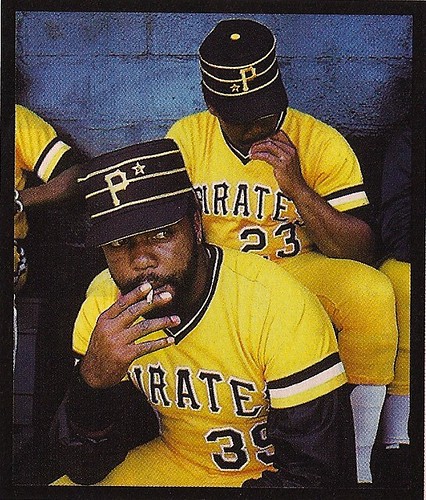
Is Dave Parker a Hall of Famer?

“Stooge for the Pirates” by Keith Fujimoto is licensed under CC BY-SA 2.0.

Does a power hitter who had 339 homers in his career deserve the ultimate owner that can be bestowed upon a player? On first glance, you might say no. But what if that former player, who happens to be 1978 National League Most Valuable Player Dave Parker, was also a seven time All-Star, three time Gold Glove winner and a guy who won two batting titles?

True, 339 homers isn’t a ton for a guy like Parker, but that said, he wasn’t the most prodigious power hitter in his prime. He didn’t have as much power as a guy like Jim Rice, for example. But much like Rice, Parker was a feared hitter for over a decade. Parker got MVP votes in 1975 and in 1990 as well when he was an All-Star for the Milwaukee Brewers at 39 years old.

Parker is one of those rare hitters who could hit for average and power and had five straight seasons hitting at least .308 and during this period (1975-79), he also led the National League in slugging twice, so he wasn’t just hitting singles. Also in that five year peak, his 345 extra base hits trailed only Rice and Mike Schmidt. His 942 hits ranked sixth in all of baseball and his .321 average was second only to Rod Carew. He also had 72 outfield assists during these five years which was the most of anyone.

He had nearly 3,000 hits (2,712) and is 35th all time in intentional walks which shows how feared he was as a hitter. There are 26 right fielders in the Hall of Fame. Parker would rank 15th out of that group in hits — ahead of, for example, Vladimir Guerrero (2,590). He’d rank 10th in extra-base hits, 11th in homers and 13th in RBIs. Among all Hall of Famers, Parker would rank just outside the top 50 in hits (right behind Lou Gehrig), 44th in RBIs (right behind Guerrero) and 38th in extra-base hits (just ahead of Eddie Mathews and Ivan Rodriguez).

Parker struggled after that excellent five year run in the late 1970s. In his early 1980s years, he struggled with weight gain, injuries and off field issues. But he rebounded after he signed with his hometown Cincinnati Reds in 1983. At ages 34 and 35, he had back to back top five MVP finishes, and was the runner-up for the NL MVP in 1985 when he hit .312 with 34 homers, 198 hits, 42 doubles and a .365 OBP. He also led the NL in total bases that year.

The rub is that WAR does mean a lot, and Parker comes up short here. His career WAR of 40.1 and for Hall of Fame right fielders, the average is 71.5 and that is a big difference. For comparison, recent right-field inductees like Guerrero (59.4 WAR) and Tony Gwynn (69.2) easily exceed Parker. So do Parker’s outfield contemporaries who were elected, like Andre Dawson (64.8), Winfield (64.2) and Reggie Jackson (74.0). Then again, he’s higher than Harold Baines (38.7).

Parker had four seasons with a .900 OPS or higher, but only one of these seasons came after the 1970s. He had six seasons hitting .300 or better, and five seasons slugging .500 or better; only one of each came after the ’70s. Four of his five highest extra-base hit totals were in the ’70s, as were each of his four highest stolen base totals. So while Parker’s eventual Hall of Fame candidacy at the end of the 1970s was likely certain, for the rest of his career, he does not compare well to Jim Rice and compares a bit better to non-Hall of Famers like Dwight Evans and Dale Murphy who have had their struggles with getting Hall of Fame votes. Both Evans and Murphy had longer primes and post 1980, Evans actually had better numbers than Parker, especially with OBP (From 1980-1991, Evans .383, Parker .322). 

Ultimately, while I am completely biased because Dave Parker is one of my favorite players, I can’t possibly see how The Cobra belongs in the Hall of Fame. Because outside of those fantastic 1970s numbers, he was below average in the early 1980s and then anywhere from average to occasionally excellent in the late 1980s and early 1990s, but nothing that exhibited Hall of Fame numbers.

Posted by JD

Don Sutton Deserves the Hall

posted by JD

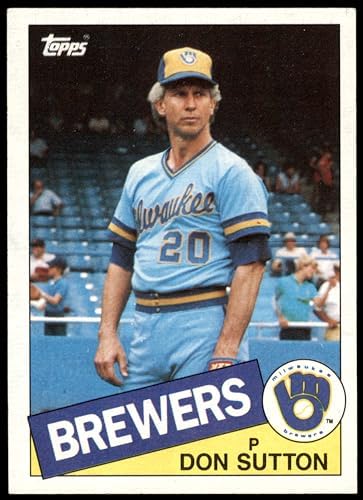
Don Sutton 1985 Topps

I gotta be honest, I’ve never given a ton of credit to Don Sutton and his career previously. Sure, the guy is a Hall of Famer and his 324 career wins rank 14th all time in baseball history. But was he ever great? Did he have any seminal baseball moments? He never had the same mound presence as guys like Seaver, Bob Gibson, Clemens, etc. But looking closer at his career…he kind of was great in several ways.

I noticed that he pitched the seventh most innings in baseball history. That alone speaks volumes. The guy pitched 20 straight seasons of 200+ innings which is insanity to me. I skipped over the 1981 strike year, and the season which broke his streak? He merely pitched 191 innings as a 42 year old! Eight straight seasons in his prime, he also pitched more than 250 innings per year.

But think about how important pitching a ton of innings is to, not just a pitching staff, but to the entire team. Sutton repeatedly going deep into games saves the bullpen, sure. But it also changes the entire roster construction of the team. Being able to depend on Sutton meant that he could take the place of three or four other pitchers and then the team he was on could use those resources in other places. Maybe have a leaner pitching staff to have an extra pinch hitter or something like that. Sutton’s durability helped the entire team, and not only that, innings pitched goes a long way to WAR…mainly because it helps the entire team.

In addition, Sutton may not have been dominant, but he was often the best pitcher on very very good teams. Sure, he made four World Series appearances and didn’t get a ring to show for it, but he was arguably the best pitcher on all four of those teams (three for the Dodgers, one for the Brewers in 1982).

On top of the very valuable innings pitched, he also led his league in WHIP four times and was in the top five for Cy Young voting for five straight seasons. Don Sutton may not be on the pantheon of the greatest pitchers ever, but he deserves his plaque in the Hall of Fame.