MLB’s First Hit in Canada, Eh?

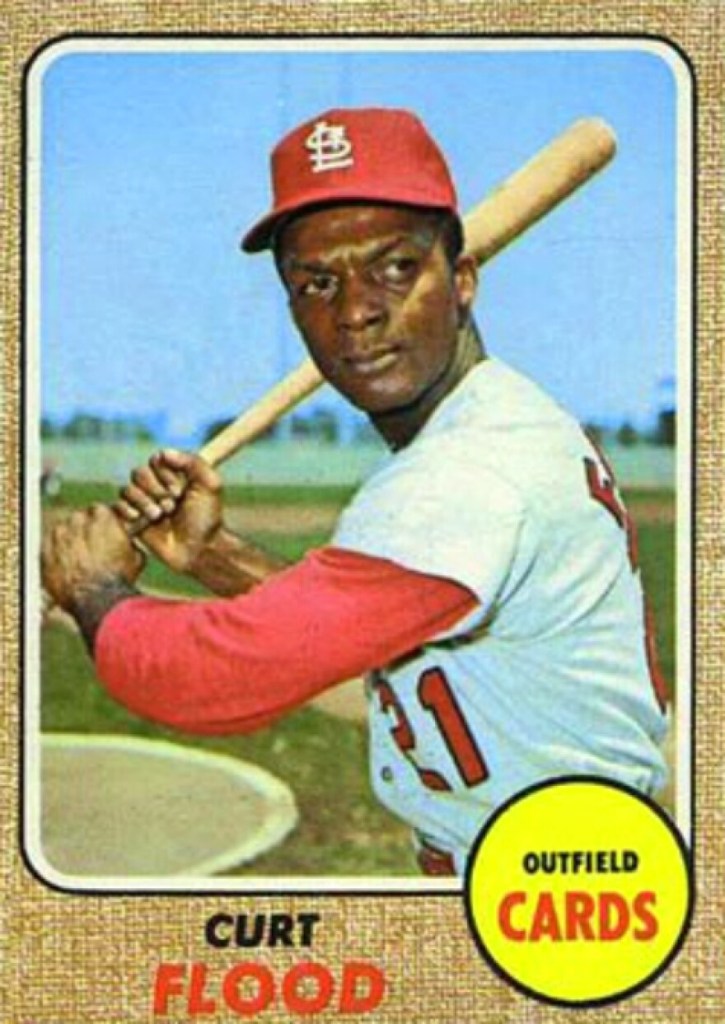
Curt Flood 1968 Topps

I started rewatching Ken Burns “Baseball” documentary the other night. To me it is the ultimate in baseball documentaries. I remember looking forward to watching it each September night in 1994 when it came out. I would have my Doritos and Mountain Dew at the ready, or Easy Cheese and Ritz, and watch it on my little 13’ TV in my basement bedroom while sorting my baseball card collection. I was just a teenager but always enjoyed documentaries, and PBS in general. I watched Doctor Who when I was younger and all the Nature shows; my mom was partial to Are You Being Served?. As I rewatched the documentary from an adult perspective, I couldn’t help but see that baseball is filled with little known people who, due to the synchronicities in their lives, suddenly impact the game in a big way, and through that American history. Many people will say, “It’s just a game”, and while this sentiment is true, sports have and will likely always play a major role in our society. Like everything else in this world, baseball is comprised of people, people with stories, with interesting lives and those unique experiences fascinate me to no end.

There are some larger-than-life figures in baseball who have become household names. Everyone knows about Babe Ruth, right? Or amazing inspirational players like the great Jackie Robinson, who not only impacted the game, but society as a whole. These players have movies and books about them. There are players who have reached amazing statistical achievements, like Cal Ripken’s 2,632 consecutive games played or Cy Youngs 511 career wins. Their stories are legendary.

But for all those legendary stories out there, there are so many other players whose names are slowly fading from the memory of all but the die-hard fans. Until recently many of the players I write about here, I had never heard of or only knew of because of their cards. Take Curt Flood.

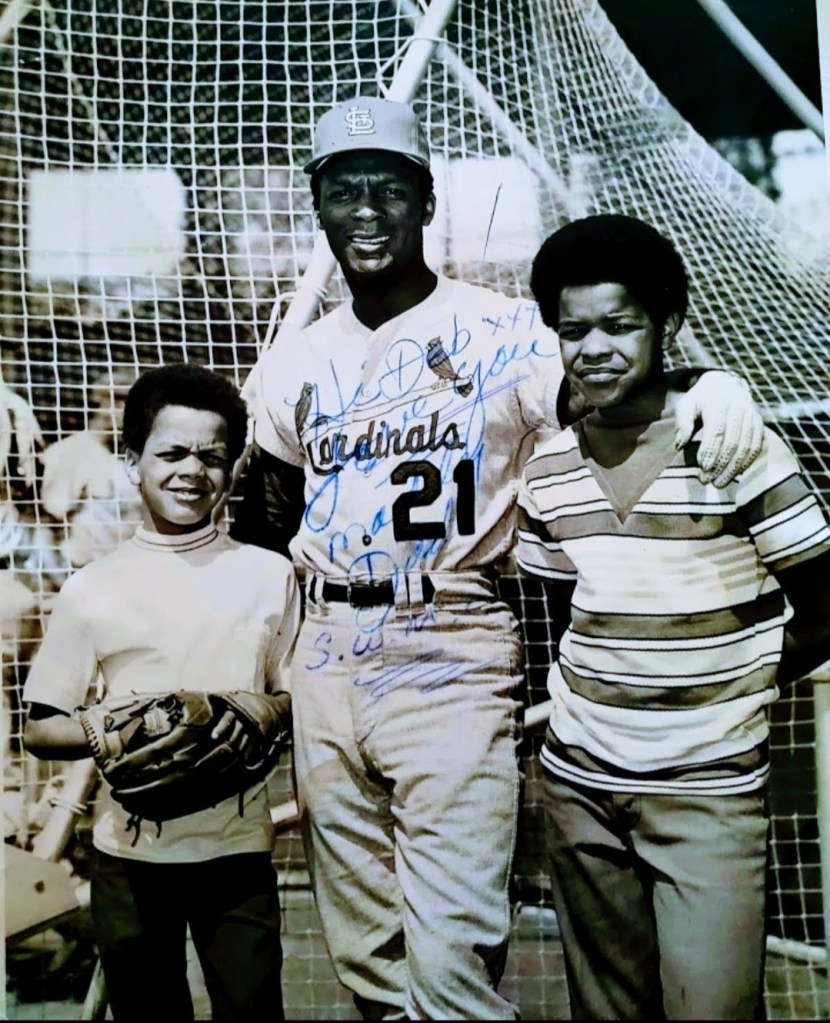
Curt Flood and Sons. By Curt Flood, Jr. – Personal collection., CC BY-SA 4.0, https://commons.wikimedia.org/w/index.php?curid=138517653

The name was familiar, I’m sure I’d seen his cards now and again, but he didn’t play in my lifetime and died while I was still a teen. But man is he cool! Not only was he one of the best defensive outfielders in baseball history, but he played a pivotal role in ending the players reserve clause and allowing for free agency to take shape. The clause, “kept players on their teams for life – or could trade them without the player’s wishes – while denying players the ability to test the market or sign with other teams.” Collier, The Madison Times, March 2024

Curt Flood was born in Texas in 1938. His family later moved to Oakland California, and it was there that Flood got his first taste of baseball. At 9 years old, Flood joined a local little league team and was coached by George Powles, who became an inspiration and mentor to him. Powells was a bird-dog scout for the Cincinnati Redlegs, and Flood continued to play for Powells through High School. Aside from being a great ball player, Flood was also known as a wonderful artist and according to Terry Sloop, “teammates and other players around the league also commissioned family portraits from Flood and called him “Rembrandt.”” SABR, retrieved May 2025

In 1956 Flood was signed by the Cincinnati Redleg’s, where he would learn some harsh truths about racial hatred during his first spring training in Florida. He had to be housed in a different hotel than his teammates due to being black. While in the minor leagues he was not allowed to eat with his white teammates, could not stay with them, and could not use restrooms while they traveled. He had to endure abuse from fans and teammates alike. It was so bad Flood found himself crying at night and considered quitting. Still, he faced the adversity head on and took inspiration from players like Jackie Robinson.

In a 1962 interview with Clifford Evens, Flood spoke of his respect for his idol. “Of course, the one real idol that I had was Jackie Robinson. He set a real wonderful example for most of the young fellas coming along during his time. Everyone had the desire in the back of their mind to follow in his footsteps. And I was no different. I respected him as a man and as a ballplayer as well.” (Retrieved May 24 from Classic Baseball Broadcasts)

 Flood tour up the minor leagues. He was named Player of the Year after leading the league in average (.340) and runs scored (133), and coming in second in RBI’s (128). He also showed off his defensive mastery, leading the league with 388 putouts. He hit 29 home runs, setting a team record. He would be called up to the Majors in September of 1956, only seeing one at bat, and striking out. 

In 1957 he would again find himself in the minors. He once again showed off his hitting skills but had 42 errors after a move to third base. He was called up and played in 3 games, getting his first Major league hit, a home run, but was traded to the Cardinals in the off season. He would spend the next 12 years with St. Louis.

1958, 1959 and 1960 were not great seasons offensively for Flood. His rookie season saw him hit .261 with 10 home runs and 41 RBI. He was caught stealing 12 out of 14 attempts. His slugging was .382. In ’59 he hit .255 in 208 at bats. This could be due to the racism of Cardinals Manager Solly Hemus who, despite Flood’s obvious talent, especially on defense, sat him often. In 1960, it was more of the same. Flood had 398 at-bats and hit only .237.

By 1961, the Cardinals replaced Hemus with Johnny Keane, and Flood began to put things together. By the end of the summer, Keane named him the starter in Centerfield and he finished the season hitting .322. He would continue to play well for the Cardinals the rest of his time with them.

In 1964 he was named to his first Major League All Star game as he co-led the league with 211 hits, tied with Roberto Clemente. He received his second Gold Glove and first World Series ring as the Cardinals defeated the Yankees in seven games.

He would be named an All Star two more times (’66 and ’68) and would win another 5 straight Gold Gloves. Flood was a key member of the Cardinals World Series win in 1967 against the Boston Red Sox. He had a great season in ’67 batting .335.

While Flood had another great year in ’68 and the Cardinals once again found themselves in the World Series, he made a key error in game 7 that led to his slipping and falling on the wet grass. The batter, Jim Northrup, ended up with a triple, knocking in two runs for the Tigers. The Tigers would go on to win 4-1. This error along with some personal issues led to a souring of the relationship between Flood and the Cardinals.

Throughout the ’69 season Flood dealt with off field issues and continued stress between himself and the front office. This culminated in his being traded to the Phillies. He was upset with this trade, and had no intention of going to Philadelphia, but due to the reserve clause, his only other choice was to retire. This led to Flood fighting the league and an eventual lawsuit against then commissioner Bowie Kunh and the MLB. The case made it to the Supreme Court, but Flood eventually lost. “Despite the loss in the Supreme Court, Flood’s litigation motivated the player’s union to continue to fight against the reserve clause, and it was finally removed in 1975 by an arbitrator who ruled that two other players were eligible to negotiate contracts with any team.  A year later, in 1976, the players’ union and the owners agreed to a contract that included provisions permitting free agency.” Collier, The Madison Times, March 2024 To read more about this case please check out the links in my sources and this link to the full case file (Flood v. Kuhn, 407 U.S. 258 (1972).

Flood would miss the entirety of the 1970 season and would play in only 13 more games in 1971 before leaving baseball for good. For many years after this Flood’s life was difficult. He drank too much, was in debt, and was even homeless for a time. In 1978 he would try his hand at broadcasting with the Oakland Athletics, but failed miserably.

He would eventually fight his way back. He married a former flame, actress Judy Pace, and was able to maintain his sobriety. He created the Curt Flood Youth Foundation and was named President of the Senior Professional Baseball Association for a couple of years. He also got back into painting. In 1994 he was featured in the aforementioned Ken Burns’ documentary Baseball.

He would pass away in 1997 at the age of 59 from complications of throat cancer.

“In 1998 Congress passed the Curt Flood Act, which eliminated baseball’s antitrust exemption in regard to labor issues. Flood received one final posthumous accolade in 1999, when Time magazine named him one of the ten most influential athletes of the past century. Sloop, SABR, Retrieved May 26th, 2025

Curt Flood played a pivotal role in baseball as we know it today. Although the end of his career was difficult, I’d like to end with one of those interesting facts I’m always talking about. One of those synchronicities.

In 1969 the Montreal Expos would become the newest expansion team in Major League Baseball and the first team located outside of the United States. They would play their first home game on April 14th, 1969. This was the first Major League baseball game played outside of the United States. They would face the St. Louis Cardinals at Jarry Park Stadium.

In the first inning of that game, Curt Flood would smack a double off pitcher Larry Jaster thus recording the first-ever hit in a Major League Baseball regular-season game played in Canada. The Expos would go on to win the game 8-7, but Flood would accomplish a feat that will never happen again.Flood might not be in the Hall of Fame, but he is definitely a player worth remembering.

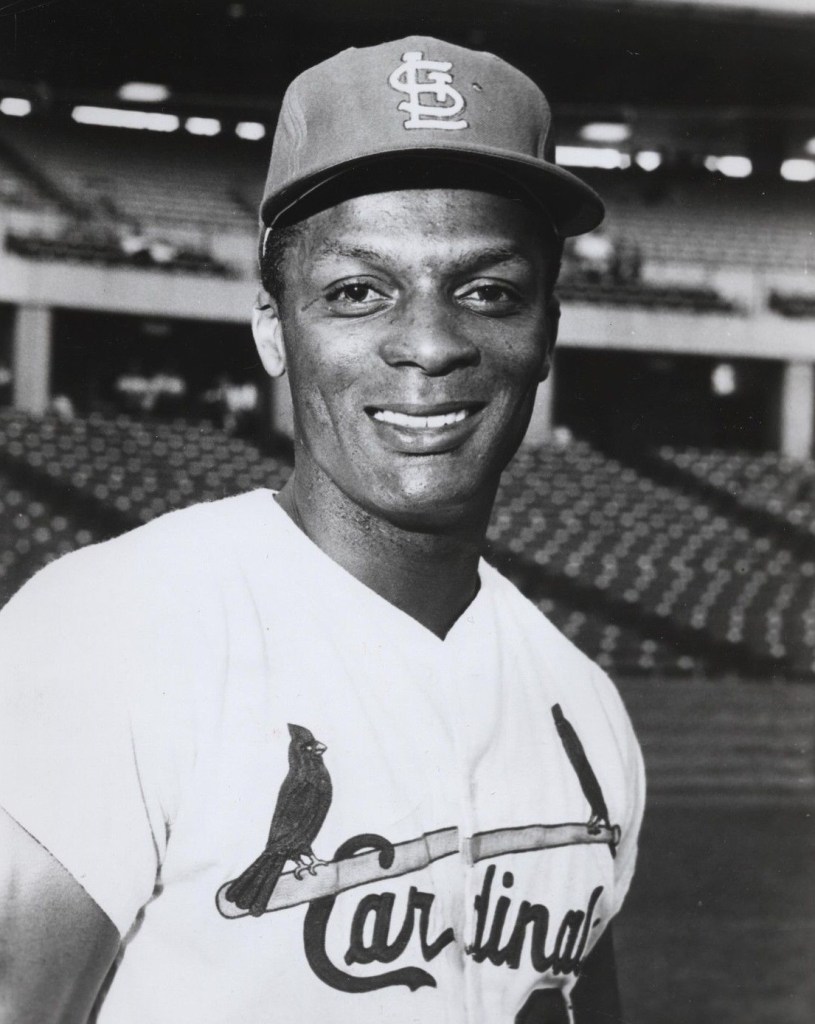
Curt Flood Public Domain

Sources:

Acocella, Nick “Flood of Free Agency”, Special to ESPN.com retrieved May 22nd, 2025

Collier, Charles “Curt Flood Had the Courage to do the Right Thing”, The Madison Times, March 2nd 2024

Evens, Clifford “1962 interview with Curt Flood” retrieved from Classic Baseball Broadcasts

Sloop, Terry “Curt Flood” SABR, retrieved May 23rd, 2025

Spatz, Lyle “The Best and Worst St. Louis Cardinals Trades” The National Pastime, Volume 25, 2005

Swinton, Elizabeth, “This Day in Sports History: First MLB Game Played Outside U.S. in Montreal” SI.com, April 14th, 2020

 “Curt Flood, Baseball Player, and Union Activist born”. African American Registry. Retrieved May 25th, 2025

“Players hope Flood returns”. Free Lance-Star. (Fredericksburg, Virginia). Associated Press. April 28, 1971. p. 8.

“Maverick Flood dies of cancer”. Spokesman-Review. (Spokane, Washington). wire services. January 21, 1997. p. C1.

Flood v Kunh https://supreme.justia.com/cases/federal/us/407/258/

Baseball Reference

Wikipedia

Smoky in a Pinch

posted May 6th, 2025 by jake

Smoky Burgess,1963 Fleer #55

I believe that everyone has an interesting story, and I love reading about people. People in history, music, Hollywood, writers, inventors, but I also love the randomness of finding someone I have never heard of before and learning their stories. In baseball, for every Mickey Mantle, there is a Don Demeter. Which is an awesome name if I’m honest. Aside from interesting stories, I also get pulled in by names, especially when I’m researching players for…yep you guessed it, my Immaculate Grids! So, imagine the level of my interest meter when I saw the name Smoky Burgess. Then I saw this picture and I was hooked. He did not look like a prototypical baseball All Star.

Smoky Burgess, 1967 Topps #506

Like many of the players with cool names, Smoky was not his given name. Forrest “Smoky” Burgess was born in 1927 in North Carolina. His father was a semi-professional player, and Smoky followed in his father’s footsteps. Smoky was a solid left-handed hitting catcher (he threw righty), and played well in high school. He was noticed by scouts and in 1943 the St. Louis Cardinals tried to sign him at the age of 16, but he was considered too young and had to wait until a year later before he was grabbed by the Chicago Cubs.

1944 was a great year for Smoky. After signing with the Cubs, he bought himself a shiny new Mercury and would meet the woman of his dreams, Margaret, who would eventually become his wife.

At 17, he had a great season for the Lockport Cubs, hitting .325 in 1944. He would only play 12 games in 1945 before joining the Army. He would remain enlisted through the rest of the 1945 season and almost all of 1946. Smoky would return with a bit of extra weight and a serious injury to his throwing arm, the result of a jeep accident while in the Army in Germany.

Upon his return, Smoky would continue his hard-hitting ways, though he had to be moved from catcher to outfield due to the injury. He would win the batting title in 1947 for the Fayetteville Cubs, batting .387 with a 1.008 OPS including 11 home runs and 28 doubles. In 1948 it was more of the same for the Nashville Volunteers as he would once again win the batting title, this time hitting .386 was an OPS of 1.082 and 22 home runs, 102 RBIs and 38 doubles. He was promptly promoted. He was also moved back to catcher as his arm began to improve.

Smoky was 22 years old when he made his major league debut on April 19, 1949, for the Chicago Cubs. He would only play in 46 games and didn’t play well. He was sent back to the minors where he would stay for all of 1950. After hitting .325 for the Springfield Cubs he found himself back in Wrigley for the 1951 season.

It wasn’t a great start for Smoky as he hit only .251 in 94 games with 2 home runs and .632 OPS. After the season, he was traded to Cincinnati, where he played exactly 0 games before being traded again, this time to the Philadelphia Phillies.

With the Phillies, Smoky started to blossom. His aggressive approach at the plate lead to his first (1954) of 9 All Star selections and he routinely hit for average. His All Star season was his best to date. He hit .368 with 127 hits and only 11 strikeouts with an OBP of .432. Unfortunately, he only had 392 plate appearances, disqualifying him for the 1954 batting title.

In 1955 after only 7 games, he was traded to the Cincinnati Redlegs (as they were called from ’53 to ‘58). He was once again an All Star, hitting .306 in 421 at bats, with 20 home runs. On July 29th he went 4-6 with 3 home runs and 9 RBI’s helping the Redlegs beat the Pirates. His best game in the majors! In 1956, he was the catcher for a 10-inning no-hitter against the Milwaukee Braves. Three pitchers combined to hold the Braves hitless through 10 innings, but the Redlegs lost in the 11th inning.

He was a good teammate in the locker room and had a solid reputation off the field as well. He was known to be a good family man, attended church regularly and avoided vices like tobacco and alcohol. If there was one weakness, it was probably his defense.

He struggled defensively since his Army injury. His defensive contribution was rated -96 by Total Baseball, he was an easy catcher to steal against and “he routinely ranked among the league leaders in passed balls, stolen bases allowed, and errors by a catcher.” Sturgill, Andy. “Sweet ’60: The 1960 Pittsburgh Pirates” (SABR, 2013. pg 45)

Still, he was known to be a real pain to batters at the plate. According to Bill James, “Some catchers like to chatter at the hitters to see if they can mess them up while they’re trying to hit. Smoky was the world’s champion. He used to drive Richie Ashburn nuts. He’d say, ‘Get ready, Rich; it’s a fastball.’ Ashburn would pop up or something, so Burgess would say ‘You didn’t do too well on the fastball, Richie; let’s try a curve.’ Of course, Ashburn never could believe him and couldn’t ignore him. One time he asked the umpire, ‘Isn’t there some rule that will make that guy shut up?'” (The New Bill James Historical Baseball Abstract. Free Press Publishing. 13 June 2003. Pg 392)

He would remain with the Redlegs through the 1958 season before being traded to the Pirates where he would become an All Star in his first three seasons with Pittsburgh. In ’59 he hit .297 and once again found himself on the receiving end of a no hitter.

On May 26th 1959, pitcher Harvey Haddox, who happened to be traded with Smoky from the Redlegs earlier in the year, pitched a perfect game through 13 innings against the Milwaukee Braves. The same team as the last no-hitter Burgess was a part of in 1956. Like that game, this one also ended in a loss. After 13 perfect innings, in which Haddox would retire 36 straight batters, a throwing error by the Pirate’s third baseman landed a player on first. The Braves Eddie Mathews would then hit a sacrifice, moving the runner to second. With his perfect game tanked, Haddix still had a no hitter going, so when “Hammerin’ Hank” Aaron came up to bat the obvious move was an intentional walk to face Joe Adcock, who was sitting at 0-4 for the day. Adcock would nail the ball to deep right center for a game winning double. This made Burgess the catcher for two no hitters that both ended in losses in extra innings to the Milwaukee Braves. That’s crazy right!?

1960 was an awesome year for the Pirates and for Smoky. He played solid defense, posting the top fielding percentage among NL catchers. He also hit well, with a .294 average in 337 at-bats, and he was a key contributor to the Pirates World Series run making the All Star game for the 2nd year in a row.

For Smoky, it was his first time in the playoffs, and he went 6-18 for a .333 average and had a key hit in the seventh game of the World Series against the Yankees. The Pirates would eventually win the title on a ninth inning home run in game seven by Bill Mazeroski. This was the only time a World Series was won on a game winning home run in the 9th inning of game seven and is one of the most iconic World Series wins in history. It was the Pirates first title in 35 years and their third overall. It was also the one and only World Series ring for Smoky Burgess.

Smoky would remain with the Pirates through most of the 1964 season. During ’64, he would play 68 games, but only fielded in 44, the rest of the time pinch hitting. In September of ’64 he was released and picked up on waivers by the Chicago White Sox. He would spend the rest of his career with Chicago and would become one of the premier pinch hitters in baseball. This was prior to the DH position which may have been great for Burgess. Smoky currently ranks fourth all time with 145 pinch hits with 16 pinch home runs.

Smoky would retire at the age of 40 on October 1st, 1967.

For his career, he was selected to the All-Star game nine times and was the first catcher in baseball history to be selected from three different teams (the Phillies 1954, Redlegs 1955, Pirates in 1959, 1960, 1961, and 1964). Later joined by two other outstanding catchers; Lance Parrish (a personal favorite of mine) and Paul La Duca.  He also won that World Series ring in 1960. He had a career batting average of .295 (nice for a catcher/pinch hitter), 126 home runs, 673 RBI’s and a .362 OBP along with 230 doubles.

He would go on to run a car dealership in North Carolina and spend time with his family. Smoky eventually became a scout and minor league batting coach with the Braves, helping players like Dale Murphy hone their skills.

Smoky Burgess passed away at the age of 64 in 1991.

“Everything went well, I have no regrets. I don’t know a thing I would have changed. If I hadn’t played baseball, I would have probably had to work in the cotton mills. That’s real hard work. I’m certainly glad I had baseball.”-Smoky Burgess (Sturgill, Andy pg 50)

Smoky Burgess, 1953, Public Domain

Sources

https://www.baseball-almanac.com

https://www.baseball-reference.com

Grosshandler, Stanley, “Unsung Heroes: No-Hit Catchers”, 1979 Baseball Research Journal

Hurte, Bob “Sweet ’60: The 1960 Pittsburgh Pirates” (SABR, 2013), e-book pg 340-352

James, Bill. “The New Bill James Historical Baseball Abstract “Free Press Publishing. 13 June 2003. E-book Page 392

https://sabr.org

Schatz, Michael ballparksavvy.com February 2025

Sturgill, Andy “Sweet ’60: The 1960 Pittsburgh Pirates” (SABR, 2013), e-book pg 41-50

https://en.wikipedia.org/wiki/Smoky_Burgess

“Moyer” Age is Just a Number

Posted April 26th, 2025 by Jake

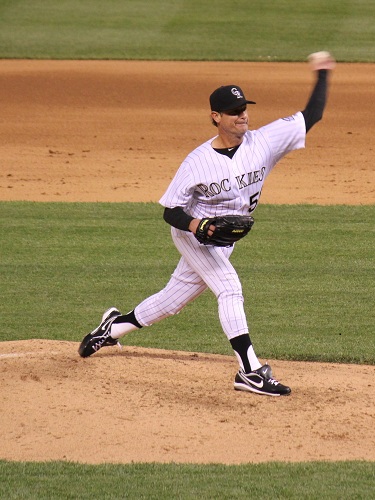
Jamie Moyer pitching for the Colorado Rockies during a game against the Atlanta Braves on May 5, 2012.
By MrMcPhoto – Own work, CC BY-SA 3.0

This is my second entry in the Age is Just a Number series featuring a pitcher who defied the critics and his own struggles to break a number of records and have a pretty awesome career.

Jamie Moyer played Major League baseball for 25 years, on eight different teams, including a stint with my Red Sox in 1996. I remember opening packs of cards, looking for players like Griffey Jr, Frank Thomas, of course Cal Ripken, who I just loved, and always Red Sox players. In fact, that might be the only time I would have given Moyer a second look. Sure, I remember his cards, in fact I probably have a bunch in my common’s boxes from my junk wax openings. He’s got plenty of cards out there, hell he played in four decades!

Moyer was no superstar. He was the opposite of Nolan Ryan, throwing an assortment of pitches, relying on control and mixing things up, rather than speed. Moyer was never the first name that came to mind when thinking of the greatest pitchers in baseball. He was an All Star only once in 2003 with the Seattle Mariners and, in 2018, he failed to meet the 5% threshold to remain on the Hall of Fame ballot, receiving only 10 votes. Still, there’s something to be said for longevity, especially for a pitcher, and that Moyer had in spades. He was also an honorable family man and cared deeply for his community.

Moyer was born in 1962. He was a natural sports star, playing baseball, basketball and golf in High school, where he pitched 3 consecutive no-hitters, going 10-0 in his junior year. He was a record breaker in college for the Saint Joseph’s Hawks. He holds the season records for most wins (16) for ERA (1.99) and for strikeouts (90). He is a member of his Alma Mata’s Hall of Fame and had his number retired at Saint Joseph’s in 2018.

He started his Major League career with the Cubs in 1986 and won his first game against Steve Carlton and the Phillies, which was of huge significance because Moyer grew up in Pennsylvania as a Phillies fan and Carlton was a boyhood hero. He didn’t have a great rookie season though, with a horrible 5.05 ERA and a 7-4 record.

Moyer didn’t fare much better in his sophomore season finishing with a 5.10 ERA and a losing record of 12-15 in 33 starts. He pitched 201 innings with 147 strikeouts and led the league in earned runs with 114.

By 1988, Moyer started to put things together…a little. Although his record would be 9-15, he had a much-improved ERA at 3.48. Still, he had done little to gain the Cubs confidence and in December he was traded along with Rafael Palmeiro and Drew Hall to the Texas Rangers for 6 players.

In 1989 Moyer had only 15 starts due to a lat strain and was a terrible 4-9 with a 4.70 ERA. In 1990 he mostly played out of the bull pen and again had a pretty poor performance at 2-6 with a 4.66 ERA and a measly 58 strikeouts in 102 innings. After the season he was unceremoniously released by Texas and this was the start of a few poor showings for Moyer who joined the Cardinals in 1991 for one season, but was sent to the minors after a poor start to the season and subsequently released. He was picked back up by the Cubs in 1992, now 29 years old, but didn’t make the team out of spring training. He was released again and played in Detroit’s minor league system.

By 1993, Moyer had been released by four teams and was 30 years old when the Baltimore Orioles signed him. According to The Sporting News, “Jamie Moyer, 30, has had significant major league experience with the Cubs, Rangers, and Cardinals, but he is fighting to keep his career alive.” He did just that, finishing the season for Baltimore with a winning record (12-9) and a 3.43 ERA in 25 games. He also pitched three complete games, including his first shutout in three years.

1994 was shortened by the strike and Moyer had a 5-7 record and 4.77 ERA in 23 starts. By 1995 he was back in the bullpen and working to earn another role in the starting rotation. He would go 8-6 with a 5.21 ERA and was again released. Now over 30, Moyer was struggling to find a home after 9 tumultuous seasons in the Majors.

1996 would see Moyer join the Boston Red Sox, but they struggled to find a place for him, shifting the embattled pitcher between the bullpen and rotation. He was not happy in Boston, and they traded him to the Seattle Mariners. He started 11 games and went 6–2 with a 3.31 ERA. Moyer’s record of 13–3 between Boston and Seattle led the majors in winning percentage at .813. It seemed that Moyer was finally figuring things out, and he would continue to have his best years with Seattle, where he played for the next 11 seasons.

From 1996 to 2006, he would be one of the better pitchers in the league. Over his 11 seasons with the Mariners, he would compile a franchise leading 2,093 innings pitched, 323 starts, and 188 quality starts, and his 1,239 strikeouts are the third most for the Seattle franchise. He would have 145 wins, second most in Seattle history. Moyer was the Mariners Opening Day starting pitcher in 2000, 2004-2006. He also got his one and only All-Star selection in 2003 when he went 21-7 with a 3.27 ERA. By 2006 he was the oldest active Major League player at 43 years old.

During the 2006 season, Moyer was on the decline and considered retirement, but Seattle offered to trade Moyer to his childhood team, the Phillies, and he was off to the City of Brotherly Love. He would become the oldest pitcher in Philadelphia franchise history to win a game and would finish 5–2 with a 4.03 ERA. This earned him a 2-year contract at 44 years old.

In August of 2007 Moyer struck out his 2,000th batter. He had a winning record that year at 14-12 but had a 5.01 ERA. He is said to have had the slowest fastball of all NL starters, averaging 81.1 miles per hour. The Phillies were good in 2007, they won the division, but failed to win a playoff game.

2008 was a great year for Moyer, who at 45, was the oldest active player in the MLB. He also set a couple of other oldest player records. He would get a hit in a game against the Padres in April, becoming the oldest Phillie ever to get a hit. After beating the Rockies in May, he secured his 235th career win, and for his career, a win against every Major League team. 2008 continued to provide Moyer was some amazing moments.

He earned his 16th win of the year and became the second-oldest pitcher to win 16. Moyer also became the second-oldest pitcher to ever start a postseason game at the age of 45 years 321 days. Jack Quinn started for the Philadelphia Athletics in 1929 at 46 years 103 days.

Moyer became the oldest pitcher at 45 years 329 days to pitch in a National League Championship Series game, starting in Game 3. With all he had accomplished, I think most importantly for Moyer was winning his first World Series ring when the Phillies defeated the Rays. After 23 Major League seasons, he finally had a ring, and the best part; it was with his childhood team. The last time the Phillies had won the World Series was 1980 when Moyer was still in High School.  It was only the second time Philly had won, and Moyer was overjoyed.

Aside from the World Series win and all the oldest pitcher records, Moyer had a decent season. He would finish 16-7 with a 3.71 ERA. Good enough for Philly to give him another 2-year contract.

In 2009 Moyer struggled out of the gate, and the Phillies sent him to the bull pen. Manager Charlie Manuel said, “Jamie was a total professional and team player when we let him know of the decision to move him to the bullpen. He has been, and will continue to be, a very important part of this team.” (Miller, 2009). This showed just how important Moyer was to the team and the type of player and person he was. By the end of 2009, Moyer pulled three muscles, the wear and tear becoming apparent, and would miss the rest of the season and playoffs. He would finish 2009 with a 12-10 record and a 4.94 ERA.

Moyer was entering his age 47 season in 2010, and he would again break the age barrier, becoming the sixth-oldest pitcher to appear in a game and the eighth major league pitcher to start a game in four different decades. He was also, along with Omar Vizquel, the only other player left who played in the 1980’s. Moyer became the oldest player in Major League Baseball history (47 years, 170 days) to pitch a shutout on May 7, 2010, against the Braves. This was a momentous moment for Moyer as he was the only MLB pitcher to throw a shutout in four different decades (1980s, 1990s, 2000s, and 2010s). Sadly, his season was cut short due to a sprain in his ulnar collateral ligament, ending his season.

At the end of 2010 Moyer had Tommy John Surgery, causing him to miss all of 2011. His contract with Philly would end, and there was speculation that he would retire. He was, after all, 48 years old and coming off major surgery and an entire missed season. Still, in 2012 at 49 years old, the Rockies would give the old veteran a chance.

In 2012, Moyer would become the oldest pitcher to record a win as well as the oldest player to record RBI (remember there was a time when pitchers still hit). By 2012, Moyer had pitched in 50 Major League stadiums, the most of any pitcher since 1900. Unfortunately, he was released in June after going 2-5 with a 5.70 ERA.

He would sign a couple of minor league contracts with the Orioles and then the Blue Jays but was released by both.

In 2013 Jamie Moyer would retire from Major League Baseball at the age of 50.

Moyer didn’t have a Hall of Fame career, but he was a determined pitcher who never gave up on his dreams. His longevity earned him several interesting records and a World Series ring with his childhood team. He would finish his career with a 49.8 WAR, 269 wins to 209 losses, 2,441 strikeouts in 4,074 innings and a 4.25 ERA.

He was a great member of his communities, wherever he played. Moyer won both the Branch Rickey and Roberto Clemente awards for community service and is also an advocate for children, starting The Moyer Foundation to help children deal with their grief over the loss of a loved one. Moyer was always considered a strong teammate and a resilient person who loves baseball and his community. He’s also an inspiration to those who agree that age is just a number.

Sources:

Baseball-Reference.com

Bush, Federick SABR.org

Miller, Doug (August 11, 2009).”Pedro to make ’09 debut Wednesday”. Major League Baseball. Retrieved April 23rd, 2025.

Peebles, Laura “April 17, 2012: Jamie Moyer sets record as oldest winning pitcher as Rockies beat Padres, 5-3.” SABR.org

“Moyer proves that some things get better with age,” The Sporting News, October 1, 2001, vol :58.

Wikipedia Page

Age is Just a Number

Posted April 17th, 2025 by jake

Minnie Miñoso 1953 Bowman

I was playing pickleball the other day, and this older man came over to be my partner. He explained that he was probably going to need a bit of help as he was not too quick on his feet. He was 85, and while he struggled a little to get to some balls, his reaction time at the kitchen was insane, he had a great serve and could dink with the best of them. We didn’t win, but man he was funny, and we had a blast. His friend who brought him was very grateful that I played with him, and I said “anytime”. I’m no pro, I’m out there to have fun, and he made it fun. He was full of energy and humor. I realized, this is someone I would like to emulate as I get older. I hope I’m able to get out, meet new people and play a sport when I’m that age. This got me to research some of the oldest to players in the Major Leagues and it was quite the list of interesting feats.

From Satchel Paige striking out a batter at nearly 60 for the Kansas City As in 1965 to Julio Franco smacking a home run for the New York Mets at almost 49 years old in 2006, there are many age defying stories to be told. In life age is just a number, and one player who proved this in seven different decades was Minnie Miñoso.

Minnie Miñoso was inducted into the Baseball Hall of Fame in 2022. Minoso passed away in 2015 at the age of 90-92 years old depending on the birthday you use. I want to add a disclaimer here. I’ve noticed some discrepancies with Miñoso’s age and date-of-birth in a few different articles. It would seem there was some confusion as to his actual age and birth year. I’ve been going on November 29th, 1923, a date that you find almost everywhere. So, if sometimes his age seems off, you may be right.

At the induction, his family were on hand to receive the honors and his wife, Sharon Rice- Miñoso, spoke on his behalf. He was elected through the Golden Days Era Committee along with Jim Kaat, Tony Oliva and Gil Hodges. It was a beautiful summer day. I remember it well. I was there, along with my uncle and cousins. As lifelong Red Sox fans, we made the trip to Cooperstown for David Ortiz, and it was an all-around awesome experience.

One of the facts that struck me about Miñoso was that he played in seven different decades, though some of the at-bats were for promotional purposes, I still thought it was pretty cool. He made plate appearances in the 1940’s in his home country of Cuba and eventually for the New York Cubans of the Negro National League, winning a World Series with them in 1947 and becoming a two-time Negro League’s All Star.

The next year, 1948, he signed on with the Cleveland Indians. He would only play in 9 games before being sent to the minors in San Diego for additional conditioning. He played well in San Diego, hitting for a .297 average with 22 homers, 19 doubles and 13 stolen bases in 137 games in 1949, then in 167 games in 1950, he had 203 hits and batted .339 with 130 runs, 40 doubles, 10 triples, 20 home runs and 115 RBIs, plus he also stole 30 bases. Miñoso showed all the skills of a future All Star and in 1951 he was promoted to the Majors.

 Unfortunately, he would only play in 8 games for Cleveland. This had nothing to do with his skill or potential, but was due to a lack of open spots in which to play him. I said unfortunately, but not for Miñoso…for Cleveland. They would trade him to the Chicago White Sox where he would play for the next 6 seasons, becoming an instant All Star.   

Miñoso was the first black player for the White Sox and the fans loved him, even giving the rookie his own day and the nickname “Mr. White Sox”. He would play 138 games for Chicago in 1951, batting an outstanding .324 with 32 doubles, 14 triples (most in the MLB), 10 home runs and 31 stolen bases. He was known to crowd the plate, and he was plunked a league-leading 16 times, frustrating opposing pitchers. He would make the first of his 7 All Star team appearances (as one of the first Latin Americans to be named All Star) and he would finish 2nd in AL Rookie of the Year voting and 4th for MVP.

Miñoso was just getting started. After his spectacular rookie season “Mr. White Sox” would continue to wow the Comiskey Park fans. He was an All Star again in 1952, 1953 and 1954. Having had arguably his best season with the White Sox in 1954 batting .320 with 182 hits, 29 doubles, a league leading 18 triples and 19 home runs with 116 RBI’s, he also stole 18 bases.

Miñoso was a character both off and on the field. Driving around Chicago in his green Cadillac, flashy cloths and jewelry, and big hats, he continued to live up to his nickname, “Mr. White Sox”.

In 1957, Miñoso had another All-Star season. He ended up with 21 home runs (the most he had hit up until that point) and led the league in doubles with 36 while also hitting .310. But the White Sox were desperate to win, having continuously been bested by the Yankees, and were offered a trade that they just couldn’t pass up. In the off season, Cleveland offered up Al Smith, who was a quality player with youth on his side, and pitcher Early Wynn, who would go on to have a Hall of Fame career, for Miñoso, and “Mr. White Sox” left the windy city.

Miñoso was back with Cleveland in 1958, and had a solid season with 168 hits, 94 runs, and 14 stolen bases (though he was also caught stealing 14 times). He also hit the most home runs of his career with 24, to go along with 80 RBIs, 25 doubles and a .302 batting average. I mentioned earlier researching those who defied the age barrier, well by 1958 Miñoso was 34 years old, and he had the most home runs of his career!

In 1959, he was once again an All Star, hammering 21 home runs and finishing the season with a .302 batting average. Cleveland finished five games back behind Miñoso’s former White Sox, who made a trade in the off season to bring Miñoso back to Chicago.

In 1960, he entered his 3rd decade playing ball. He was now 36 years old and started the decade off with a bang. Once again with the White Sox, he played in 154 games and made the All-Star team again. He led the league in hits with 184, and had 34 doubles, 20 home runs and 105 RBIs to go along with a .311 batting average. “Mr. White Sox” was back, and the fans were ecstatic!

In 1961, the White Sox struggled to a fourth-place finish. Miñoso had another productive season. He played in 152 games and had a .280 batting average with 151 hits, 28 doubles and 14 home runs. Unfortunately, it would be his last productive season in the Majors.  He was traded to the Cardinals but only played 39 games in 1962 due to injuries. He was then sent off to the Washington Senators in 1963 and played 109 games as the fourth outfielder. In 1964, he found his way back to the White Sox but only played 30 games.

Though he was slowing down, at 40 he decided to play in Mexico, and had a resurgence. He batted .360 and led the league with 106 runs and 35 doubles for Charros de Jalisco in 1965. He would continue to play baseball for 8 more years in Mexico, bringing him into his fourth decade. He would finally leave the game in 1973 at 49 years old…or so it seemed.

He would become a coach for the White Sox in 1976 and appeared as a DH in 3 games with Chicago. In 8 at bats, he would only get one hit, but was still a favorite of the White Sox fans. He continued to coach through 1978.

In 1980, he would amazingly get two more at bats with the White Sox. He was around 56 by this point, depending on which date of birth you use, and became one of only two players to have played a game in five decades! The other being Nick Altrock, who remains the oldest player ever to hit a triple at age 48 in 1924. Altrock played his last game in 1933 at 57 years old, but Miñoso would top that.

Miñoso didn’t suit up again for 13 years. In 1993, at 69 (I know this is getting ridiculous now!), he signed with the Saint Paul Saints. This would seem to be more of a promotional stunt, but according to Michael Clair of MLB.com, “Mike Veeck, the owner of Saint Paul, made it clear that this wasn’t just a promotion to get fans into the gates and that a baseball player, especially one like Miñoso, would not do anything to embarrass himself. “I don’t think of it as a promotion, I think that’s an appearance of talent,” Veeck told MLB.com. “That’s how I view it — it’s an opportunity for these younger fans, and for fans who enjoy them to see this remarkable human who all these years later could still swing the bat, who still hustled out to first base.” (Clair, Micheal, MLB.com, 2021)

Miñoso got one live at bat, and made contact, grounding out. This would be his sixth decade, and the bat and ball are now enshrined at Cooperstown. Six decades, and he made contact with the ball, at 70! I wish.

His seventh decade was also with the Saints. This time in 2003 at the young age of 79. He signed a one-day contract and walked in his only at-bat. This made him the only player to have played in seven decades.

Miñoso had a career WAR of 53.2 with 2113 hits, 195 home runs, 365 doubles, 95 triples, 1089 RBIs, 216 stolen bases and a career .299 batting average. He was a 9x All Star and was inducted into the Hall of Fame in 2022, 7 years after his death in 2015 at 90 something depending on the date of birth. I’m going with 91. His number 9 was retired by the White Sox in 1983.

“Once you get (baseball) in your blood, you can never quit,” “I love the game.” Minnie Miñoso, via the Daily Sentinel, 1976

by John Rice is licensed under CC BY 2.0

Sources:

https://www.baseball-reference.com/players/m/minosmi01.shtml retrived April 2025

Clair, Michael. “Miñoso’s amazing seven-decade career.” MLB.com, February 2021

Livacari, Gary. “Minnie Minoso’s “Grand” Return to the White Sox, 1960!,” baseballhistorycomesalive.com, February 2022

Muder, Craig. “Miñoso defies time as White Sox’s DH,” baseballhall.org, retrieved April 2025

Stewart, Mark. “Minnie Miñoso,” SABR bio, December 2021

https://en.wikipedia.org/wiki/Minnie_Mi%C3%B1oso retrieved April 2025

Flick Finds Fame

Posted March 27, 2025 by jake

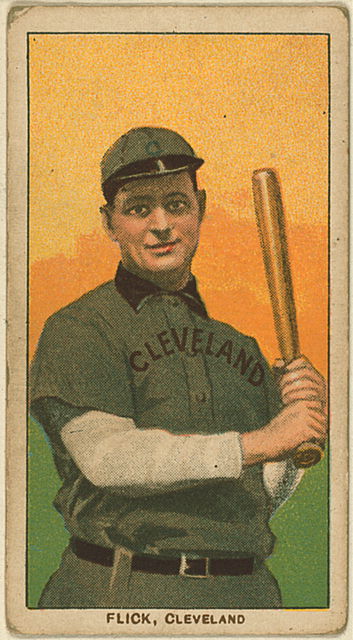
Elmer Flick, outfielder with the Cleveland Bronchos/Naps, image from the 1910 American Tobacco Company baseball card.

When I saw the name Elmer Flick the other day, I had to learn more, especially when I found out he was a Hall of Famer (Class of 1963). I personally could not remember hearing the name Flick in the past, but I quickly discovered an underrated and often forgotten old school star.

Flick was born in Bedford, Ohio in 1876, the son of a farmer and Civil War Veteran. In true 1800’s style, he joined a semi-pro team when he was 15 years old because the team was short a player and Flick happened to be hanging around the train station when they were leaving for a game. He played catcher in high school and was waving the local team on when they realized they needed the help. For a youngster, he did well, and not long after, Flick began to play minor league ball with the Youngstown Puddlers in 1896.

Using a baseball bat that he handmade (that is old school baseball gold), Flick hit over .400 but struggled in the outfield. Flick had always played catcher, so his .826 fielding percentage was no surprise; there would be an adjustment to the outfield. Luckily, he was a quick study, and his defense improved.

His hitting skills were never a question, and with the improved defense, he found himself playing left-field for the Dayton Old Soldiers. (I Love these team names!!) His fielding percentage increased to .921, and his offense was legendary. Flick batted .386 with 183 hits. This included 42 doubles, 10 home runs, an impressive 135 runs and even 25 stolen bases. He also led the league in triples with 20 and total bases with 295.

In 1898 he was signed to the Philadelphia Phillies as a reserve outfielder, but due to injuries, he quickly became a starter. It was a great rookie season for the young slugger as he finished with a .302 average including 16 doubles, 13 triples, 8 homeruns, and 81 RBI’s. He also stole 23 bases and only struck out 36 times in 453 at bats.

In 1900, still with the Phillies, he had an amazing season. In 545 at-bats, he had only 30 strikeouts, batting .367 (a career high) which included additional career highs in hits (200) home runs (11), slugging (.545), OPS (.986) and a league leading 110 RBIs. He also had 32 doubles, 16 triples and 35 stolen bases. His high batting average put him in a tense race for the batting title against super star Honus Wagner, who would end up winning the title at the end of the season. Wagner spoke of the race, “I’ve had a lot of thrills, but don’t think I was ever happier than in 1900 when I won after battling Elmer Flick to the last day of the season for the title.”  Lieb, Fred (January 27, 1971)

 Not only was he great at the plate, but he was becoming a solid outfielder with a .914 fielding percentage and 232 put-outs’ and 23 assists, often throwing out hitters at first. He was also a feisty player, one time getting into a fist fight with teammate and future Hall of Famer, Nap Lajoie, over a bat! Lajoie would end up breaking his thumb in the altercation, missing 5 weeks.

Apparently Flick and Lajoie buried the hatchet, and both left the Phillies in 1902 joining the American League Philadelphia Athletics. They only played 11 games with the Athletics before moving to the Cleveland Bronchos. This was due to a legal injunction obtained by the Philadelphia Phillies which prevented players under contract with their team from moving to other teams. This injunction was found to only be valid in Pennsylvania and couldn’t be enforced in Ohio. To avoid legal ramifications, Flick and Lajoie would travel together, ensuring never to step foot in Pennsylvania until 1903 when the two leagues made peace.

Born and raised in Ohio, Flick would stay with Cleveland, now called the Naps, for the remainder of his Major League career. He would continue to play well for Cleveland, leading the league in batting average (.308) , triples(18),  SLG (.432) and OPS (.845)  in 1905, leading in games (157), plate appearances (707) at bats (624), runs (98), triples (22) and stolen bases (39) in 1906 and again in triples (18) in 1907, his last full season.

By 1907, Flick had second thoughts about his baseball career. He was stressed from the constant playing and felt physically run down. He considered retiring but stayed on for the season. Flick was so highly regarded by the Naps that in spring training of 1907 they turned down a trade from the Detroit Tigers, who offered a straight up deal, Flick for future AL MVP and Hall of Famer Ty Cobb! Based on the rest of these two players’ careers, I’d guess that the Naps regretted turning that deal down.  

Although Flick had another productive year in 1907, even leading the league in triples again with 18, by 1908 his health had severely deteriorated. He was plagued with an unexplained gastrointestinal illness which caused him to miss almost the whole season, playing in only 9 games. He continued with the Naps in 1909 and 1910, but played in only 66 and 24 games respectively. He was replaced by a pre–Black Sox Scandal Shoeless Joe Jackson, and eventually sold to the Kansas City Blues, however the deal was canceled when Flick refused to go to Kansas City and, without a team, he would return to the minor leagues.

He played two more seasons for the Minor League Toledo Mud Hens in 1911 and 1912 before being released and retiring from baseball.

He would move back to his hometown of Bedford, Ohio and take up raising horses and real estate. He got married and had five children. He also did some scouting for Cleveland as well.

Flick seemed to live in relative obscurity until 1961 when Ty Cobb passed away. A few stories about Cobb mentioned the failed trade of Cobb for Flick in the 1907 season, and with some influence from Branch Rickey, Flick was inducted into the Hall of Fame by the Veteran’s Committee. Flick was 87 years old, and didn’t believe that he had been elected. He had to be convinced that it was real. Flick was the oldest living inductee, and at the ceremony he said, “This is a bigger day than I’ve ever had before. I’m not going to find the words to explain how I feel.” Corcoran, Dennis (2010)

Flick passed away at the age of 94 in 1971, one of only 4 19th century players who were still alive. Flick played 13 years in the Majors accumulating a 52.7 WAR with 1752 hits, 48 home runs, 756 rbis, 950 runs, 268 doubles, 164 triples and 330 stolen bases. His career batting average was .313 with a .389 career OBP.

Flick’s Hall of Fame induction was met with much criticism, but  anyone who can hit .400 with a homemade bat, get in a fist fight during a season and still almost beat Honus Wagner for the batting title, have his team refuse to trade him for Ty “freaking” Cobb, and then live to be 94 years old, is one tough ball player, and I, for one, am glad he was inducted and got to be around to not believe it. I’m glad Flick found fame.

Elmer Flick, outfielder with the Cleveland Naps (AL), before a game, circa 1910


Sources:

https://www.baseball-reference.com/players/f/flickel01.shtml

Corcoran, Dennis (2010). Induction Day at Cooperstown: A History of the Baseball Hall of Fame Ceremony. McFarland. pp. 78–80.

Lieb, Fred (January 27, 1971). “Rickey, Honus Remembered Flick”. St. Petersburg Times. Retrieved March 26, 2025.

Louisa, Angelo “Elmer Flick” via https://sabr.org/ Retrieved on March 26th, 2027

https://en.wikipedia.org/wiki/Elmer_Flick

Photos:

1: This media file is in the public domain in the United States.

2: This work is from the George Grantham Bain collection at the Library of Congress. According to the library, there are no known copyright restrictions on the use of this work.

The Priceless “Junk Wax”

March 18th, 2025 by jake

It’s funny the things that different people can find relaxing. Two years ago, I was scrolling around on social media and saw a video of this guy opening packs of baseball cards. These weren’t modern packs, with all their flashy, shiny parallels, in-card relics and on-card autographs…they were cards from the late 1980’s and early 1990’s, affectionately called “The Junk Wax” era. I loved every second of those videos, and down the rabbit hole I went, scrolling through video after video. I watched as someone’s disembodied fingers opened packs of mostly baseball cards with the occasional pack of basketball, football, movie cards and even Garbage Pail Kids, thrown in. Sometimes the crazier folks would even eat the 30 plus year old gum that is found in most old packs of Topps. I’ve tried it, it’s horrible!

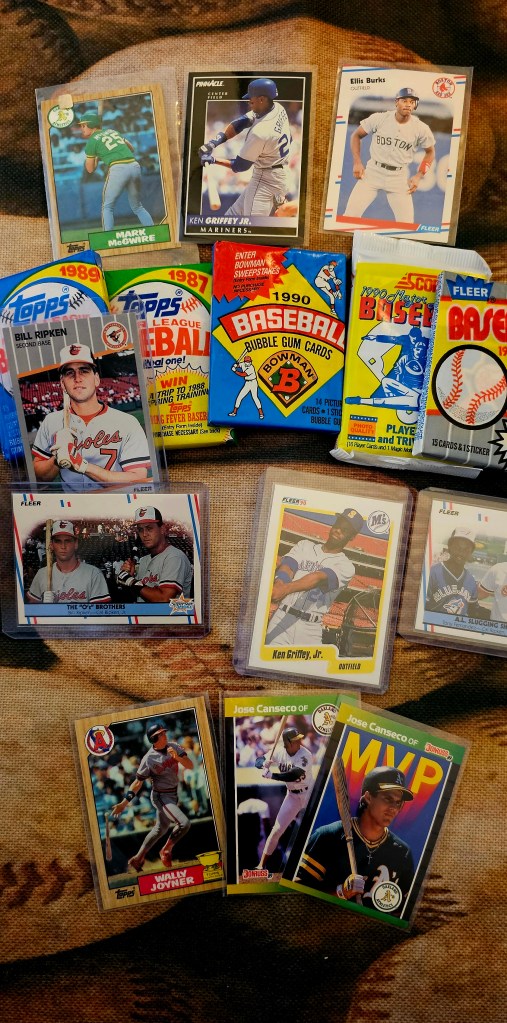
There was something so soothing about watching a pack of instantly recognizable 1987 Topps being opened for the first time in 38 years. With its wood grain borders, team logos at the top and player names in the color filled box at the bottom, the memories came flooding in. Watching as players like Terry Pendleton, Doug Drabek, Ken Oberkfell, Candy Maldonado, and Storm Davis flashed by the screen. Then suddenly, a Future Stars card! “Could it be? Will Bo know 2025? Nope!” …It’s Tim Pyznarski, next card Atlee Hammaker. Then I catch a glimpse of the Red Sox logo peeking out and it’s… Wade Boggs! Sweet! I was hooked. Next thing I knew I was scouring EBAY for old packs of cards from the Junk Wax era to open myself.

The Junk Wax Era of baseball cards spans roughly from 1986 to 1994. It was a time of overproduction, inflated expectations, and eventual market collapse. The industry was booming, fueled by speculative investors hoping to cash in on future rarities and rookies. Though the average collector was unaware of this at that time, card manufacturers like Topps, Fleer, Donruss, Score, and Upper Deck flooded the market with millions (sometimes billion)of cards. The sheer volume meant that even rookie cards of legendary players like Ken Griffey Jr., Frank Thomas, and Chipper Jones were so overproduced that they never became the scarce, high-value collectibles investors had hoped for.

In the mid-’90s the bubble burst. As the supply outstripped the demand, card values plummeted, card stores closed, and investors lost small fortunes. Warehouses and garages filled with unopened packs and collectors found themselves sitting on mountains of once-hyped cards that were now worth little more than sentimental value. But, to me, sentimental value is where it’s at!

None of this mattered to an elementary and middle school kid who would readily take out the trash every night for a chance at making a buck, then excitedly ride his bike to the local convenience store with some friends to buy a couple of packs of the newest Topps. Yes, most packs were 50 cents back then, and yes you could find them in almost any convenience store.

Made with Dall-e by Jake

My friends and I would open these packs up with gusto while listening to DJ Jazzy Jeff and the Fresh Prince singing about Elm Street from the cassette player. After guzzling a Mountain Dew and finishing off some Doritos, it was time for talking trades. Mark McGwire for Cal Ripken Jr., Tony Gwynn for Darryl Strawberry. We were wheeling and dealing like Sandy Alderson and Dallas Green (GMs for the Oakland Athletics and Chicago Cubs respectively), at the 1987 Winter Meetings. We were not thinking about investments or rarity, about future returns. We were just kids having fun while we searched for our favorite players and teams. Though I was a Red Sox fan, I loved Cal Ripken, and collected around 500 of his cards. I still have them, my wife calls it stalkery.

As I got older, somewhere in High School, my attention shifted from cards to…other things. I still loved baseball, but things changed, and I stopped collecting. Most of my cards ended up being sold for gas money or traded for a joint, while my favorites, the ones I just couldn’t part with(like those Cal’s I mentioned earlier), sat in boxes and binders collecting dust in my mom’s basement as they faded into my subconscious. They found a home in that place where GI Joe is pitching curveballs to Ken Griffey Jr. while Harry meets The Hendersons and The Bangles Walk like Egyptians through my cerebral cortex.

It’s that place, the cerebral cortex, the long-term memory center, where the streetlights came on as I sat scrolling through those videos. Each pack elicited a new memory of days gone by. The sound of the wrappers being torn open, that sweet scent of paper and ink, the images of those silly, wood-grained borders, of those worthless pieces of cardboard with the pictures of childhood heroes looking up from the front as their yearly achievements lined the back. It was the nostalgia that made those videos so relaxing for me and led me to create my own videos and social media pages, and ultimately this blog.

A lot of people watch and comment, mostly having fun, some to remind me of how worthless each pack I open is. Those latter people don’t understand that value is in the cerebral cortex of the beholder. I know these cards are worthless, but there is no value I can place on that time I opened a pack of 1989 Fleer, and there it was, the infamous Bill Ripken F%$# Face card in all its glory. It was awesome! As a kid I remembered drooling as I looked at that card in the display cases of long closed card shops, with no chance of buying it. I remember hoping that I would someday be so lucky as to open a pack and find it. I never did, but I also never imagined that Thirty-Five years later I would pull one! Here’s a link to the original post. Billy Ripken FF Pull.

After that I was hooked and rediscovered the fun of opening packs of cards from my youth. I know it’s not going to make me a millionaire, but that’s not the point. It’s the memories, the nostalgia. It’s finding that child-like joy once again, and that to me is why “Junk Wax” is priceless.

*If you’d like to take a walk down memory lane with me, I post videos to Facebook, Instagram, Tik-Tok and YouTube. All links are on the Home page menu of the blog. Thanks for reading!!!*

A “Pitch” Hitter

March 14, 2025 by jake

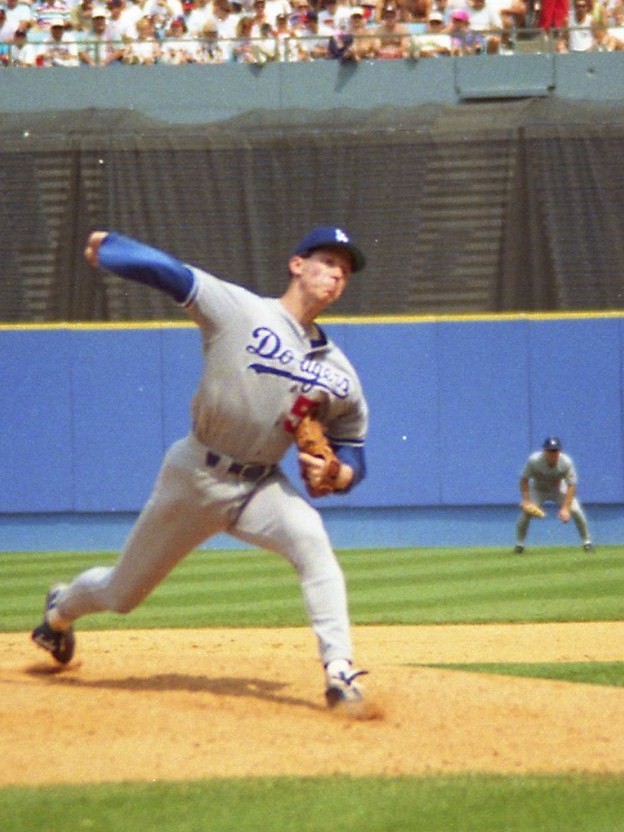
“Orel Hershiser 1993” by jimmyack205 is licensed under CC BY 2.0.

The designated hitter has been a staple of the American League since 1973. Pitchers in the National League were still required to bat, and usually in the ninth spot, until 2022. Since 1986, the World Series has followed the rules of the designated home team’s league. It’s no surprise the designated hitter rule had finally become the standard. Most pitchers were easy outs. Sure, there were occasional big hit moments, but by and large, the pitcher coming up to bat was a joke. In 1993 one pitcher defied the standard.

Orel Leonard Hershiser IV was born September 16, 1958 and played 18 seasons in the Major Leagues from 1983 to 2000. He is currently 66 years old. He was a 3 time All Star, a World Series winner (1988), a NL Cy Young winner (1988), a 2 time LCS MVP (1988, 1995), a World Series MVP (1988), he won the Gold Glove in 1988 and even won the Silver Slugger in 1993.

Of his 18 seasons, 1988 was Hershiser’s best season by far. He started 34 games, completing 15 of them, 8 of which were shutouts. In his 267 innings pitched, Hershiser had 178 strikeouts and an ERA of 2.26.

While not a flamethrower, Hershiser was a strategic pitcher, which gained him 23 wins that season. This style of pitching also led to Hershiser obtaining the record for consecutive scoreless innings pitched with 59. He also won the Gold Glove. The Dodgers made the playoffs, and Hershiser won his first NL Championship MVP Award (the second was 1995) after pitching starting in three games against the New York Mets, shutting them out in Game 7. Oh, and for good measure, he got a save in Game 4.

The Dodgers won the World Series ring 1988 after beating the Athletics 4 games to 1. Most people remember that timeless pinch-hit walk-off homerun by a hobbled Kirk Gibson in Game One of that series, but it was World Series MVP Oral Hershiser who really secured the ring. In Game two he allowed only three singles, all by Dave Parker, shutting out the A’s. He also was the first pitcher to get three hits in a World Series game since 1924, and the first pitcher to record a World Series RBI since 1983. So, the dude could hit!

He capped off the World Series in Game Five, by pitching a complete game, allowing only four hits, two runs, and striking out nine.

1988 was a great year for Hershiser and led to him becoming the only player to receive the Cy Young Award, the Championship Series MVP Award, and the World Series MVP Award in the same season.

Enough about his great 1988 season, I’m here to talk about 1993, and not because of his pitching. In fact, 1993 was a mediocre year for Hershiser. He started 33 games, completed 5 of those with one shutout. He pitched 215 innings with 141 strikeouts and a pretty pedestrian 3.59 ERA. He went 12-14. But what really caught my attention was his hitting stats. Remember I mentioned that 3 hit game in the 1988 World Series? It was important because in 1993 he won a Silver Slugger Award. In 73 AB he had 26 hits for a .356 avg. He had 11 runs, 4 doubles and 6 RBI’s. He really had a great hitting season for someone who only appeared in 34 games. Sure, he was no Shohei, no one is, but in a time when the 9th batter was almost always a pitcher, and the likelihood of an out, or possibly a bunt was very high, Hershiser defined the odds-at least in 1993. For his career his batting average is .201.

Hershiser retired in 2000 but continued to be involved in baseball in many ways. He’s been a consultant, a special assistant, a pitching coach, and executive and a television analyst. He finished his career with a 204-150 win-loss record, 3.48 career ERA and 2,014 career strikeouts.

“Go after the hitter, I said. Quit being so careful. Get ahead of the count. Even the good hitters are going to fail 70 percent of the time. You got what it takes to get anybody out. What I saw in Orel over the next twelve years was a baseball player with a tenacious will to learn, to grow, and to improve. I saw an outstanding young man who was a hard worker – aggressive, even daring, on the mound. Not only did I get what I asked for, I got more. Without a doubt, Orel Hershiser is one of the smartest baseball players I’ve ever managed.”- Hall of Fame Manager Tommy Lasorda in Between the Lines: Nine Things Baseball Taught Me About Life (Orel Hershiser, Faithwords, 07/01/2002, Foreword)

A Series of Firsts

March 13th, 2025 by Jake

Wheeler “Doc” Johnston

Welcome to another post directly inspired by the most recent Immaculate Grid. Today’s research was for players who played for both Cleveland and Cincinnati. This player only played 3 games with the Reds in 1909, but I love players with the name Doc, which reminds me of the Old West, sort of like baseball in the late 1800’s and early 1900’s, only with balls and gloves instead of pistols, though I’m sure I’ll find a story about some pistol carrying pitcher at some point. I digress, let’s get to the player, and why, even though he only has a career 3.2 WAR, I still felt there was a cool story to tell.

Doc Johnston was born September 9th, 1887, in Cleveland…Tennessee! (See already a twist!) His first name wasn’t really Doc. (Did you really think it would be?) But rather, his full name was Wheeler Roger Johnston. Doc to his teammates.

Doc started his career as a first baseman on the Reds in 1909, but played in only 3 games. He then spent most of his career with the Cleveland Naps (1912,1913,1914) and Cleveland Indians (1918,1919,1920). In the middle he was with the Pittsburgh Pirates (1915 and 16), where he had possibly his best season in 1915, with a 2.1 WAR. That season, he committed only 13 errors at first base in 1,514 chances for a fielding percentage of .991. He also hit 5 HR, had 12 triples, 19 Doubles and 26 Stolen Bases, though he was also caught stealing 17 times! But what I really want to look at is 1920, a historic season for Cleveland, ending with an interesting trip to the World Series for Doc.

The 1920 Cleveland Indians had a 98-56 record which brought them to the World Series and, ultimately, their first World Series Title after beating the Brooklyn Robins 5 games to 2. The fifth game of this series was historical in many ways. First, it featured an unassisted triple play by Second Baseman Bill Wambsganss, who leapt to catch a line drive, landed on second forcing the out there, then tagged the runner coming from first. Game 5 also featured the first ever grand slam in World Series history, a smoking shot in the first inning by Elmer Smith, giving the Indians a quick 4-0 lead. Finally, Jim Bagby, Cleveland’s starting pitcher and the winner of the game, helped himself with a 3-run home run in the fourth inning, the first by a pitcher in World Series history. Winning the World Series was bittersweet for the 1920 Cleveland Indians who had lost a teammate and a friend in Short Stop Ray Champman, who, on August 17, was hit by a pitch, becoming the only Major League player to die on the field.

Though not the best player on the team, Doc Johnston had a great season in 1920. His stellar defensive play was on display again as he committed only 12 errors in 1530 chances with a .992 fielding percentage. He batted .292 in 535 AB, with 2 HR, 71 RBI, 24 doubles, 10 Triples and 13 Stolen Bases, though he didn’t do much during the World Series with only 3 singles in 11 AB.

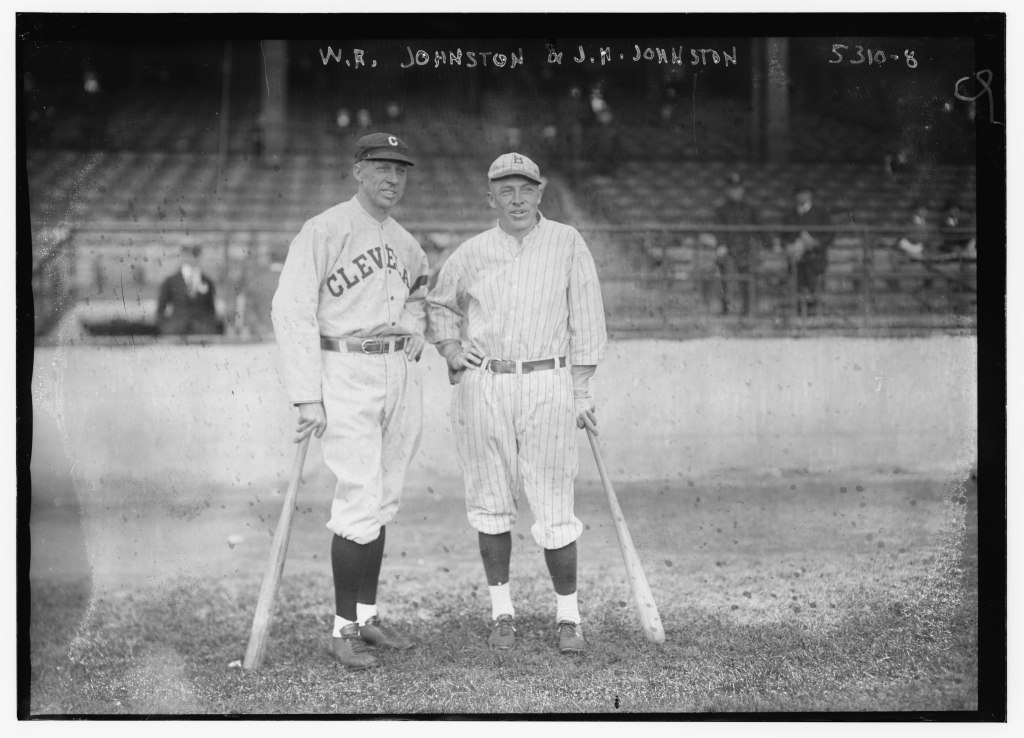
Still, the 1920 World Series was a notable one for Doc Johnston. Aside from getting a ring, there was a familiar face on the Brooklyn Robins, his younger brother Jimmy Johnston, who played third base. This was another first for the World Series; the first time two brothers would face each other in the big game. Jimmy was in the World Series twice, both with Brooklyn (1916 and 1920), and both losses, while older brother Doc got his ring.

Doc Johnston would go on to play two more seasons. In 1921, he would remain in Cleveland and play 118 games. In 1922, he would move on to the Philadelphia Athletics where he would play 71 more games before leaving the Majors. He finished his career with a 3.2 WAR hitting .263 in 3774 AB with 992 hits, 14 home runs, and 381 RBI’s. He was considered a terrific defensive player and would end his career with a .989 fielding percentage at first base. After leaving the Major Leagues, he would go on to manage a few years in the minors.

On February 17th, 1961, Wheeler “Doc” Johnston would pass away at the age of 73.

Below are brothers Wheeler “Doc” Roger Johnston and James “Jimmy” Harle Johnston 1920 World Series.

Photos:

1st: Library of Congress, Prints and Photographs Division, Washington, D.C. 20540 USA, hdl.loc.gov/loc.pnp/pp.print Public Domain

2nd: Bain News Service, publisher – Library of Congress Catalog: https://lccn.loc.gov/2014711589 Public Domain

A Phenomenal Nickname

Recently I started playing the Immaculate Grid (baseball only), a browser game in which you have 9 guesses to fill a 3×3 grid with MLB players from the start of baseball in the 1800’s to present.  Very rarely do I complete the whole grid successfully (although my baseball knowledge has increased a lot since playing), but it is so much fun. My friends and I share our results with each other and have great text conversations about our favorite guesses and failures, while also learning about our favorite sport. After I finish with my guesses, I love to research all the grid categories and in doing so I discover so many of the fun baseball stories and legends of old.  

Today’s grid had a category for a player who was on both the Dodgers and the Phillies. Keep in mind the grid goes back to the very beginnings of baseball, so Dodgers can be Los Angeles Dodgers (1958-present), Brooklyn Dodgers (1911-1957), Brooklyn Robins (1916-1931), Brooklyn Superbas (1899-1910), Brooklyn Grooms (1895-1898), Brooklyn (1884-1894), Brooklyn Bridegrooms (1889-1890) and Philly consists of Philadelphia Phillies (1886-present), Philadelphia Phils (1942) and Philadelphia (1883-1885). So, a freaking deep pool to say the least. When I did my research after playing, I found a player from the 1880’s whose name was so awesome I just had to learn more.

“Phenomenal” Smith was born in Philadelphia on December 12th, 1864. Unfortunately, Phenomenal wasn’t his given name. (That would have been so cool!)

He was born John Francis Gammon, which at some point became John Francis Smith and began his baseball career in 1883 at the young age of 18 as a pitcher in the minors. He didn’t play much in his first few seasons, with only 4 Major League games in 1884 and 4 more in 1885. He played quite a bit in the minors in 1885 and 1886, mostly with the Newark Little Giants.

Legend has it that Smith gained the nickname Phenomenal after pitching a no-hitter against Baltimore on October 3, 1885. The nickname clearly stuck as it is found on all the baseball cards and literature of the day. It is possible he loved the nickname because another legend tells of an arrogant young ball player who, in his very brief stint with the Major League Brooklyn Greys, claimed to be so good he didn’t need his teammates to win. (Talk about no team in I.)

On June 17th, 1885, this cocky comment led to his teammates reportedly committing 14 intentional errors to punish Smith and losing the game 18-5. This incident led to Phenomenal’s release after only one game with Brooklyn, and a trip back to the minor leagues. (This is why I love these old stories, as this is something that would never happen in today’s Major Leagues.)

In 1886 while with Newark, he was, well, phenomenal, pitching 292 innings with a .74 ERA and 317 strikeouts, while going 22-10. In 1887, he was back in the Major Leagues and started 55 games for Baltimore. In true old school fashion, he completed 54 of them for 491 innings but only had 209 strikeouts and a 3.79 ERA and was 25-30.

He would go on to play with Baltimore until 1888 when he was purchased by the Philadelphia Athletics for around $1000 dollars. He wouldn’t play much with them and was released in June 1889. In 1890 and 1891, he played a few games for the Philadelphia Phillies and the Pittsburgh Alleghenys, until his final game, June 15, 1891, with the Phillies. He was only 26. His final Major League statistics did not nearly justify his phenomenal nickname as he would finish his career 54-74, with a 3.89 ERA and 519 strikeouts in 1169.1 innings and a 7.7 War.

After he left major league baseball for good, Phenomenal would spend another 15 years as a player-manager in the minor leagues. He would play-manage over a dozen minor league teams, some of which were even named after him (The Norfolk Phenoms and The Portland Phenoms). While a player-manager with Norfolk, he has been credited with discovering and managing the future Hall of Famer, Christy Mathewson, then only 19. In 1890, after one season with Phenomenal as his manager, Mathewson would be sent to the major leagues and would go on to become one of the most dominant pitchers in baseball history.

Phenomenal Smith spent 5 more years in baseball as the player-manager of The Manchester New Hampshire Baseball Club. In 1901 at the age of 36 he would win the batting title in the New England league after hitting .363.

Phenomenal stayed in New Hampshire, becoming a police officer in 1904 and having many children. He retired from police work in 1932 and would live until the age of 87, passing away in Manchester in 1952.  

Posted by Jake

ARTICLE REFERENCES:

Cory Snyder: Swashbuckling Power Hitter

With the wispy blonde hair from his moustache in his outstanding 1989 Donruss card, Cory Snyder fit the bill as a swashbuckling power hitter in his early career with the Cleveland Indians. At that point in his career, Snyder had led a charmed early baseball career, from earning a full scholarship to Brigham Young University to being named to the first United States national baseball team which earned a silver medal in the 1984 Summer Olympics. Not only that, he was drafted in the first round of the 1984 Major League Baseball Draft after a successful college career when he was on the College Baseball All-America Team.

The 1989 Donruss set is one of the best that Donruss put out in the entire decade. Maybe in its history. The color gradients, the team logo and the inclusion of the player’s position are all welcomed. The player font is futuristic…at least for 1989. And when you would put several cards of this set side by side, with the same color gradients, they would run together and be almost seamless, like they were connected. With this Snyder card specifically, I like the photography, and how they capture his eye black and blazing red batting gloves as well as the belt in front. And please let’s not forget Snyder’s wispy moustache and his hair spilling out from the back of the batting helmet. Overall a great looking card, like many of the 1989 Donruss set.

1989 Donruss Cory Snyder

Justifiably, expectations were pretty high for Snyder as he started his pro career and he only spent a season at Double-A in 1985 and then 49 games at Triple-A in 1986 hitting .302 before getting called up to the major leagues. After hitting 28 homers in his first full pro season at Double-A, Snyder took to the big leagues immediately, smashing 24 homers in just 103 games for Cleveland. Not only that, Snyder played mostly in right field, but also spent time at shortstop and third base. For this, he finished fourth in the 1986 American League Rookie of the Year voting.

The 1985 Cleveland Indians were a lousy 60-102 but with Snyder and a bunch of young, talented players like Joe Carter and Brett Butler, in 1986 Cleveland surged to 84-78. In 1987, the baseball world was expecting big things from Snyder and Cleveland, so one of the more infamous Sports Illustrated covers was made featuring Snyder and Carter.

Although Cleveland went back to being lousy in 1987 with a 61-101 record, Snyder hit 33 homers to lead the team, one of three players to hit 30 homers along with Carter and third baseman Brook Jacoby who both had 32. The only thing is, 1987 featured the “rabbit ball” where something funky happened to the baseball which led to a spike in home runs throughout baseball. Largely because of this, Snyder’s WAR for 1987 is a paltry -0.4.

Which takes us to 1988, and the season that is featured most recently on the back of Snyder’s 1989 Donruss card, his third. This was likely Snyder’s best season, where he hit 26 homers and struck out the least he’d had in his three years with 101. He had the highest OBP so far, and what would ultimately be his second highest in his career at .326. All of this contributed to the highest WAR he’d put up for a season in his career at 2.7. He tied for his best batting average at .272 and scored 71 runs while playing virtually all of his games in right field where he led the American League with 14 outfield assists in right field and led all outfielders with 16 assists total.

That 1988 season would prove to be Snyder’s height as a player. Unfortunately, he’d get injured in 1989 and his batting average tanked to .215 and then in 1990 it wasn’t much better at .233. He was a league average player for WAR in 1989 and -0.6 WAR in 1990, though he still had a bit of pop, hitting at least 14 homers in each season. But Cleveland would trade Snyder to the White Sox in 1991 where he only lasted half a season before being traded again to Toronto. He hit a whopping .175 between the two teams. In 1992 he signed with the San Francisco Giants and had a nice comeback year, hitting .269 with 14 homers and a 1.2 WAR playing in 124 games. He was a free agent again in 1993 and signed a two year deal with the Los Angeles Dodgers and had a productive year. In 1994, however, the strike hit, and Snyder decided to just go home. He concluded his career with a 0.7 WAR and 149 home runs with a .249 batting average and this beauty of a 1989 Donruss card!

Posted by JD

ARTICLE REFERENCES: