
Checklist
16
Welcome back to Baseball by the Numbers. Today we are looking at uniform number 16. Over 800 players have worn the number 16 at some point in their careers. Thirty-three of those players finished their career with a WAR of 40 plus. It was also a number that many players held onto, with 112 having worn it for five years or more. Two legends wore number 16, but only for 1 season each. Featured in the uniform number 4 post, Rogers Hornsby, whose 127.3 career WAR is 12th all-time, wore uniform number 16 briefly in 1933 when he was claimed off waivers midseason to become a player/manager for the St. Louis Browns. And the great Braves pitcher Warren Spahn wore number 16 in 1942 with the Boston Braves, his first season in the Majors. Spahn is ranked 32nd all-time with a 100.1 career WAR.
Number 16 was a favorite among pitchers and out of the seven players featured for this post all but one was a hurler. Let’s Go!
Number 1:
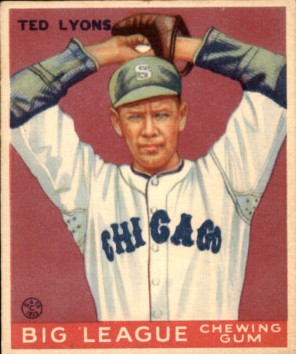
The Chicago White Sox franchise leader in wins, Ted Lyons played exclusively for the White Sox for twenty-one seasons from 1923-1946. (He missed 1943-45 for military service.) He was a crafty right-handed pitcher who could throw a knuckleball, cutter, changeup and a nasty curve. He wore uniform number 16 his entire career save for 1931 and had a career WAR of 70.7.
I love when I get to feature an old Goudey card. This is Lyon’s 1933 card. I love this picture, with Lyons staring down the batter, winding up for a pitch, the Chicago name across his chest and the signature “S” on the White Sox cap. Such a cool card.
Lyons was an All-Star in 1939, but his best years were played prior to the inception of the All-Star game. He had a W/L% over .500 in twelve seasons. He led the league in wins, complete games, innings and shutouts twice each and in ERA once. Although he topped 200 innings in 10 seasons, hitting 307 in 1927, he never had more than 74 strikeouts in any season. He won his games with finesse and crafty pitches, like his signature knuckleball. Lyons pitched a no hitter in 1926 against the Red Sox at Fenway Park.
From 1943 to 1945 Lyons was in the military. He returned in 1946 and pitched in 5 complete games with a 2.32 ERA before hanging up the cleats for good.
He would finish his career with a .531 W/L % amassing 260 wins (good for 42nd all-time). He had a career ERA of 3.67 with an ERA+ of 118. He had more walks 1,121 than strikeouts 1,073. His 4,161 innings are 37th all-time and he had 356 complete games (24th all-time) and 27 shutouts.
Lyons uniform number 16 was retired by the Chicago White Sox in 1987, and he was inducted into the National Baseball Hall of Fame in 1955.
Ted Lyons passed away in 1986 at 85 years old.
Number 2:
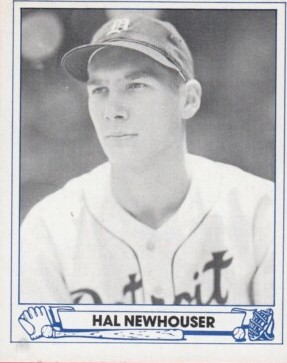
“Hurricane Hal “was a temperamental left-handed pitcher who played in the Majors for seventeen years from 1939 to 1955. He played for the Detroit Tigers (1939-1953) and the Cleveland Indians (1954 and 1955). He had a career WAR of 62.8 and wore uniform number 16 his entire career.
There were no cards produced in 1944 due to the war, but in 1983 TCMA produced a commemorative set. That is the card I used for this post. From 1939 to 1944, Newhouser was not doing well as a pitcher. While he had shining moments, his temper and emotions got the better of him (hence the nickname “hurricane”). He was able to turn things around in the ’44 season with help from catcher Paul Richards (Stewart 2014, p. 215)
Newhouser was a seven-time All-Star. He was the American League MVP in 1944 and 1945. In 1944, he pitched 312 innings with 25 complete games and 6 shutouts while leading the league in wins, going 29-9, and strikeouts with 187. 1945 saw Newhouser win the pitching triple crown. He had a great season leading the league in season WAR (11.3), innings (313.1) wins (25), ERA (1.81), complete games (29), shutouts (8) and strikeouts (212). The Tigers also won the 1945 World Series, where Newhouser pitched a complete game to win game 7.
Newhouser was released by the Tigers in 1953 and planned to retire but was convinced to join Cleveland by his former World Series teammate Hank Greenberg. He would play in 28 games over the next two seasons before retiring in 1955.
Newhouser finished his career with a 207-150 record for a W/L% of .580. He had a career ERA of 3.06, ERA+ of 130 and 1,796 strikeouts. He would complete 212 games with 33 shutouts.
Newhouser’s uniform number 16 was retired by the Detroit Tigers in 1997, and he was inducted into the National Baseball Hall of Fame in 1992.
Hal Newhouser passed away at the age of 77 in 1998.
Number 3:
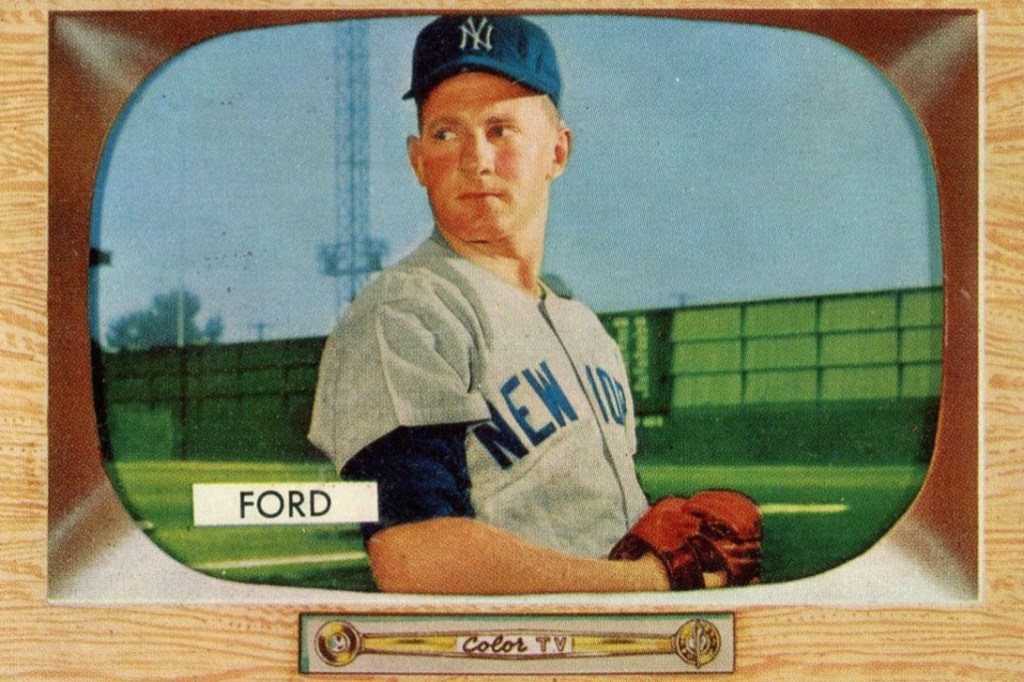
The most World Series victories by a pitcher is 10, and is held by our next player, Whitey Ford. Known as “the Chairman of the Board”, Ford played for sixteen years, all in the Bronx with the New York Yankees. From 1950-1967 (he missed ’51 and ’52 for military service), Ford stood tall on the Yankees’ pitching mound. He wore uniform number 16 his entire career, aside from his rookie season (19), and had a career WAR of 57.
I absolutely love the 1955 Bowman design. There is just something about the iconic television-shaped border and the simplicity of the cards that just catches my eye. I had to use this one for Ford.
Whitey Ford was a ten-time All-Star (twice in ’60-’61). He won the Cy Young Award in 1961 when he went 25-4 over a league leading 283 innings with a 3.21 ERA, 3 shutouts and 209 strikeouts. Ford led the league in wins three times, ERA twice, complete games once and shutouts twice. He was a member of six Yankees World Series Championships, earning the World Series MVP award in 1961.
Ford retired in 1967 after playing only seven games that season. He pitched in 3,170 innings with a 236-106 record good for 7th all-time in W/L% at .690. He had a career 2.70 ERA, 133 ERA+ (34th all-time), 1.215 WHIP and 1,956 strikeouts. He holds several World Series records including wins (10), starts (22) and strikeouts (94). He also has the record of 33 consecutive scoreless innings in the World Series.
Ford’s uniform number 16 was retired by the Yankees in 1974, and he was inducted into the Baseball Hall of Fame that same year.
Whitey Ford passed away at age 91 in 2020.
Number 4:
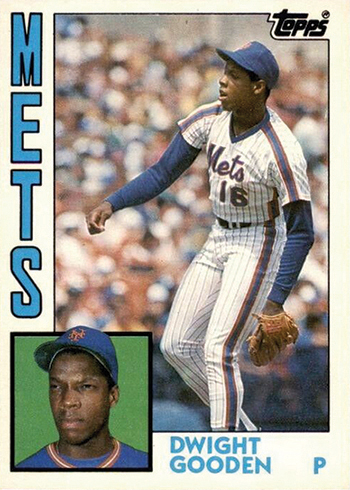
Growing up I was very familiar with Dwight “Doc” Gooden. My best friend loved the Mets and was always looking for his cards. Gooden was a righty who pitched for sixteen seasons from 1984 to 2000. He played for the New York Mets from 1984-1994. He was suspended for the 1995 season due to cocaine use, something that would become a lifelong struggle for the talented pitcher. He came back and played for the Yankees (1996-1997). Cleveland (1998-1999) and in 2000 he played some games with the Astros, Tampa Bay and finally the Yankees again. Gooden wore uniform number 16 for fourteen seasons, including his entire Mets career. He had a career WAR of 53.
I love the 1984 Topps design. Although I hadn’t started collecting until around 1986, I remember trading for and when I could, buying cards from the early ‘80s. This card is fantastic, I love the small portrait in the bottom square, the team and player names along the white border, and best of all, Gooden’s number 16 is visible in the main photo. Bonus: This is his Topps Traded card, his first in set card with 1985.
Gooden was a four-time All-Star. He was the National League ROY in 1984 when he led the league in strikeouts with 276. The next season, 1985, he won the Cy Young award on the back of a pitching triple crown. In 35 games (276.2 innings), he was 24-4 with a 1.53 ERA and 268 strikeouts. Gooden pitched a no-hitter on May 14th, 1996. He was a member of two World Series Championships; with the Mets in 1986 when they beat the Red Sox (boooo) and in 2000 as a member of the Yankees.
Gooden’s career started off strong, but sadly due in part to his substance use issues, his career took a dive quickly and he retired in 2000.
“Doc” Gooden had a career record of 194-112 a W/L% of .634. He had a career ERA of 3.51, ERA+ of 111, WHIP 1.256 and 2,293 strikeouts in 2,800.2 innings for a 7.4 S09.
Gooden is a member of the New York Mets Hall of Fame, and his uniform number 16 was retired by the Mets in 2024.
Gooden is 61 years old and he has been outspoken about his struggles with addiction and mental illness and is currently an advocate for those with similar struggles.
Number 5:
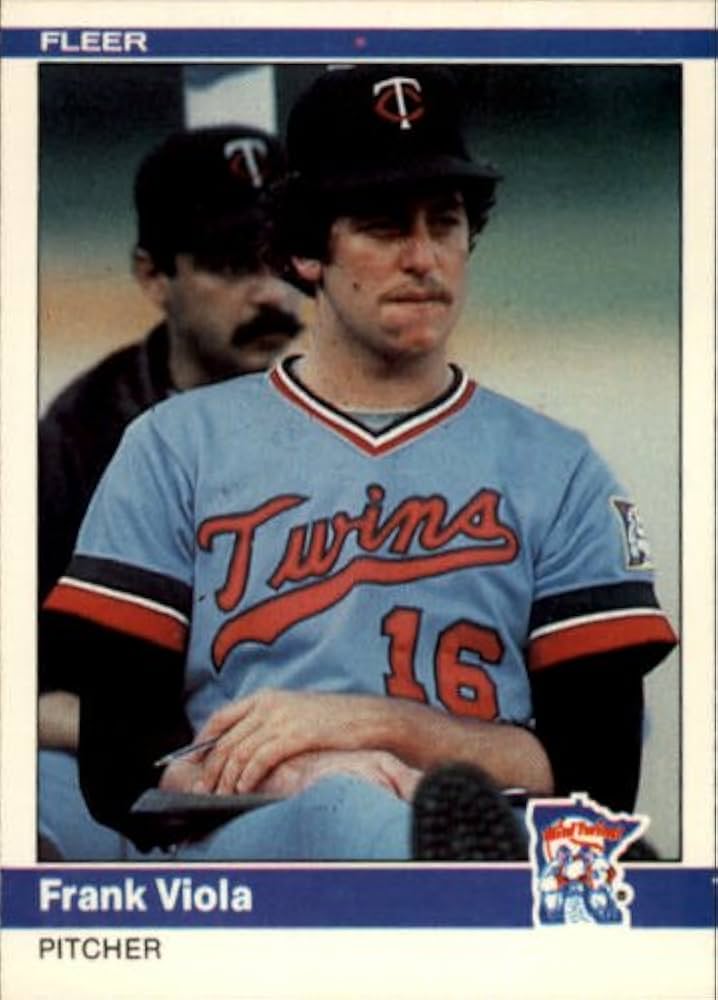
Left-hander Frank Viola pitched for fifteen seasons from 1982-1996. He was with the Minnesota Twins from 1982 to 1989 when he was traded to the Mets. He stayed with the Mets until 1991, then bounced around a little playing for the Red Sox (1992-1994). (I remember the excitement when the Sox signed him!) The Cincinnati Reds (1995) and finally the Toronto Blue Jays (1996). He had a career WAR of 47 and wore uniform number 16 for eleven seasons.
I choose this 1984 Fleer card to represent Viola due to his uniform number being visible on the front. It is an interesting card. I like the 1984 Fleer design, it’s simple but pleasant. The photo of Viola just sort of chilling works well as it has a very ‘80s baseball feel with that old school Twins uniform and his signature mustache. Overall, a great card for the post.
Viola was a three-time All-Star who won the Cy Young Award in 1988 after winning a league leading 24 games to 7 losses while pitching 255 innings with a 2.64 ERA, 1.136 WHIP and 193 strikeouts. He was a member of the 1987 World Series Championship Twins with Kent Hrbek, Kirby Puckett and fellow pitchers Jeff Reardon and Bert Blyleven. He was named the World Series MVP after starting three games for 19 innings and going 2–1 with a 3.72 ERA and striking out 16. He was the winning pitcher of the decisive game 7.
He finished his career in 1996 with a career 176-150 record, 3.73 ERA, 112 ERA+, 1.301 WHIP and 1,844 strikeouts.
Viola is a member of the Minnesota Twins Hall of Fame.
He is currently 65 years old and has been coaching in an independent baseball league.
Number 6:
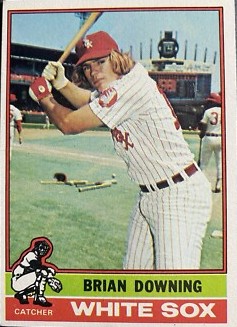
Brian Downing played outfield and catcher for twenty seasons from 1973-1992. He played for three teams, the Chicago White Sox (1973-1977), the California Angels (1978-1990) and the Texas Rangers (1991-1992). He had a career WAR of 51.5 and only wore uniform number 16 for five seasons with the White Sox. Still, I remember Downing well from my youth and wanted to make sure he made the list. He is also the only non-pitcher to make the uniform number 16 list.
I choose this 1976 Topps card because Downing is with the White Sox, the team he played for while wearing number 16. I love all the Topps cards form the ‘70s and this one is great. I like the border and the little catcher in the corner designating his position. I was also thrown off by these White Sox uniform colors. Last post I mentioned the White Sox crazy uniform designs of the ’70s when I featured Dick Allen.
Downing had his lone All-Star season in 1979 with the Angels when he hit .326 with 12 home runs and 75 RBIs. This would start a career shift that saw Downing improve dramatically while with California, where he would stay for thirteen seasons. He would finish his career in 1992.
Downing had a career batting average of .267 with 2,099 hits, 1,188 runs, 360 doubles, 275 home runs and 1,073 RBIs.
Downing is a member of the Angels Hall of Fame.
Downing is currently retired and 75 years old.
Number 7:
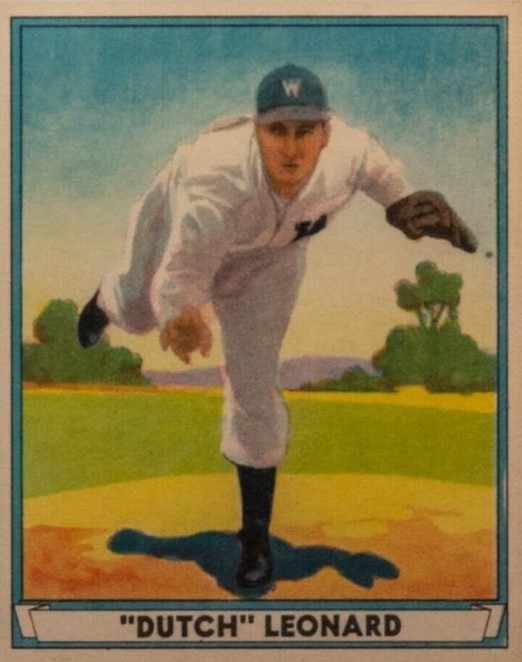
Emil John “Dutch” Leonard was a right-handed pitcher who played for twenty years from 1933-1953. He started his career with the Brooklyn Dodgers (1933-1936) then played for the Washington Senators (1938-1946), Philadelphia Phillies (1947-1948) and the Chicago Cubs (1949-1953). He had a career WAR of 49 and wore uniform number 16 for nine seasons.
I really liked this 1941 Play Ball card. Unlike the Hal Newhouser above, this was a real set. The photo is a great action shot of Leonard as he throws a pitch for the Washington Senators. It was with the Senators that he wore uniform number 16, so I found it a fitting inclusion. I like to imagine he is throwing his famous knuckleball, a pitch that even the amazing Jackie Robinson struggled to hit.
“Dutch” was a five-time All-Star. He had arguably his best season in 1945 when he went 17-7 with a 2.13 ERA in 216 innings and had 96 strikeouts.
He retired with a career 191-181 record. In 3,218.1 innings he had an ERA of 3.25, ERA+ 119, 30 shutouts in 192 complete games, 1.256 WHIP and 1,170 strikeouts. He also had 45 career saves.
Leonard passed away at the age of 74 in 1983
Final Score:
This was a tough one for me. While working on this post I got a new job, moved to a new apartment and dealt with two huge snowstorms. It’s nice to be over this hump. I’ll give a couple of shout-outs. A couple of players with over 40 WAR who didn’t make the cut were featured previously. Bobby Bonds (57.9 WAR, 00 Post), Bobby Grich (71.1 WAR, 4 Post) and Bobo Newsom (47.8 WAR, 00 Post) all wore it for a few years. A handful of greats wore uniform number 16 once including Chipper Jones, Jimmie Foxx, Scott Rolen, Joe Medwick and Reggie Smith.
I always like to give a quick mention to those who wore the number for a long time. Aramis Ramirez wore number 16 for eighteen seasons, Reggie Sanders for sixteen, Garret Anderson for fifteen and Ray Lankford for thirteen. I can’t wait to snake this thing around and talk about some of these guys.
As always thank you for reading. If you enjoy this post shoot a comment, give it a like or clap or whatever, or even better subscribe…I promise you won’t get spammed. Either way, I’m going to keep this train rolling, so check my out soon for uniform number 17.
Sources:
https://www.baseball-almanac.com/
https://www.baseball-reference.com/
“Contrary Guy Alternative Baseball Thoughts”. Contrary Guy. March 25, 2012. Retrieved July 29, 2012.
Stewart, Mark (2014). “Hal Newhouser”. In Wancho, Joseph; Huhn, Rick; Levin, Leonard; Nowlin, Bill; Johnson, Steve (eds.). Pitching to the Pennant: The 1954 Cleveland Indians. University of Nebraska Press.
Shout out to all the cool cards and creative commons for my pictures! Thanks Topps and Fleer and Donruss and Upper Deck and all the rest.
 Weekly Windup