Baseball by the Numbers: 18

Read about the Project
Checklist

18

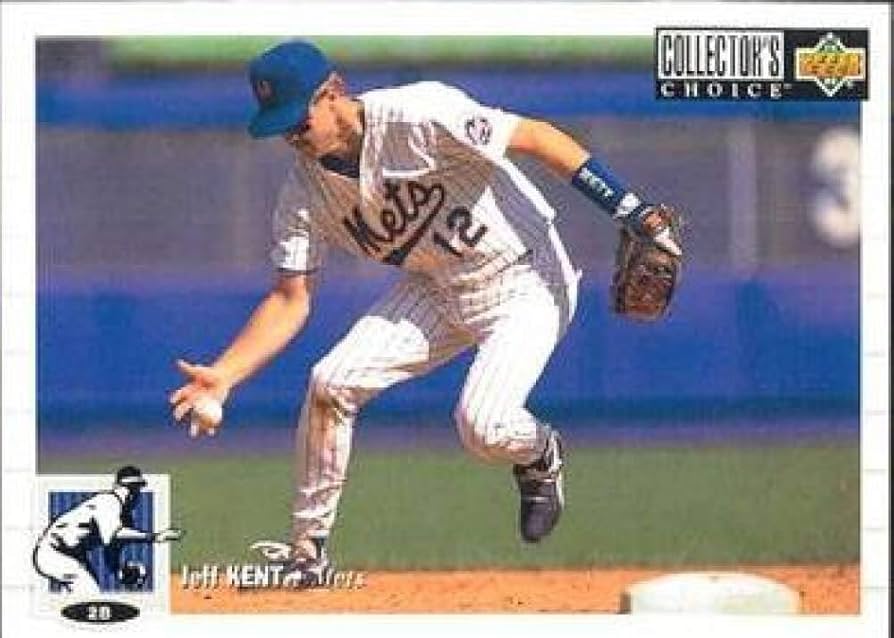
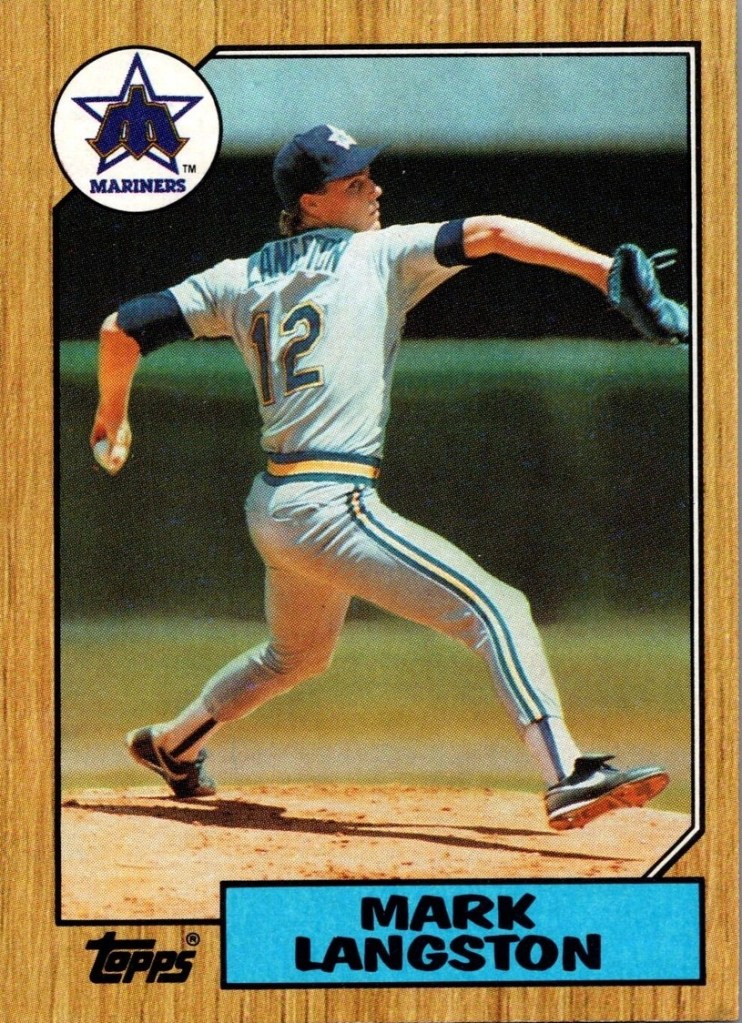
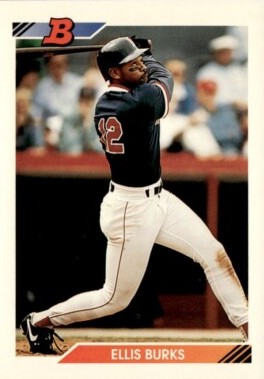
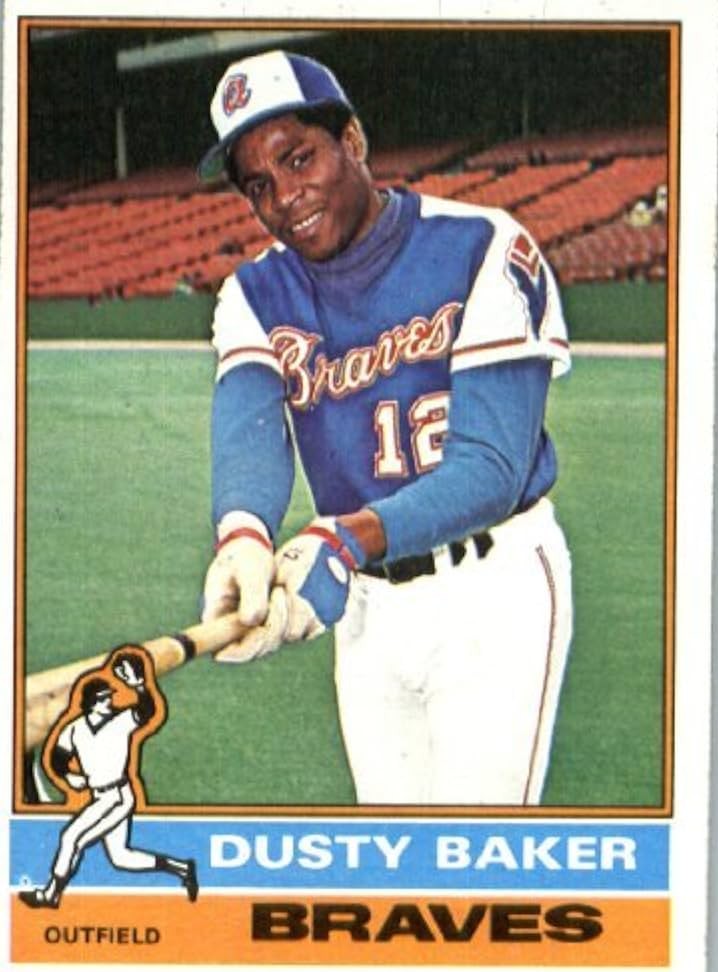
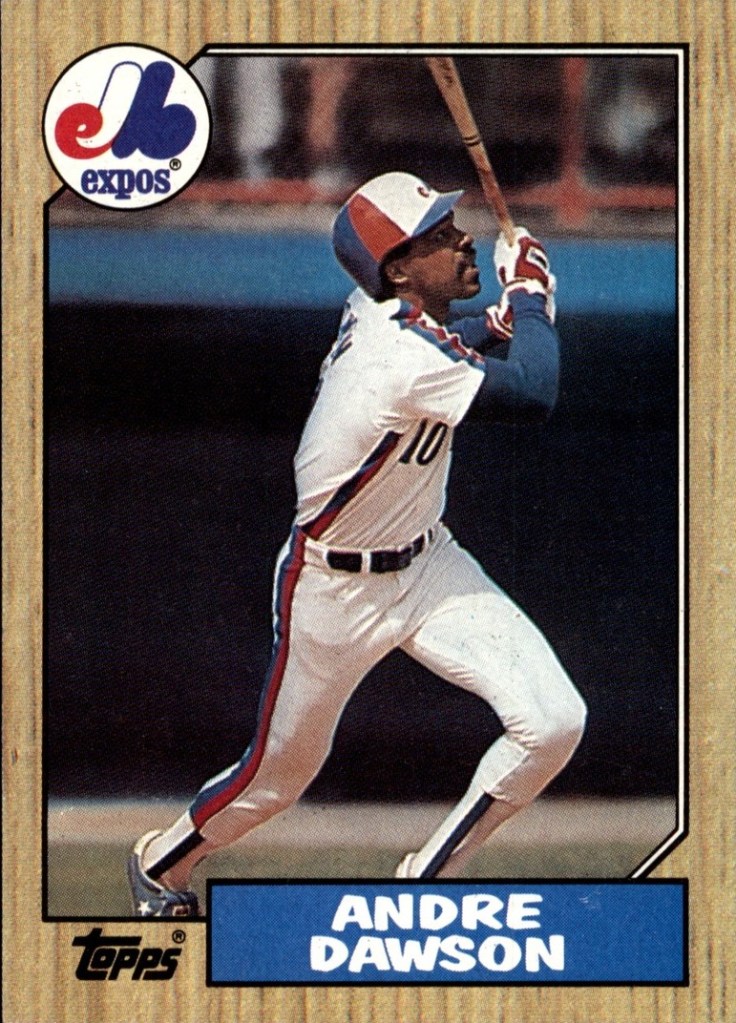
Welcome back to Baseball by the Numbers. Today we are looking at uniform number 18. 863 players have worn uniform number 18 at some point in their career, but only about 11% (97 players) kept the number 18 for five years or more. There was one Legend (100+ WAR) who wore 18 for seven seasons. Joe Morgan was already featured in the uniform number 8 post, but he’s well deserving of another featured spot. Aside from Morgan, twenty-seven other players who wore 18 also had a career WAR of 40 plus, and as always here are my top picks.

The Legend

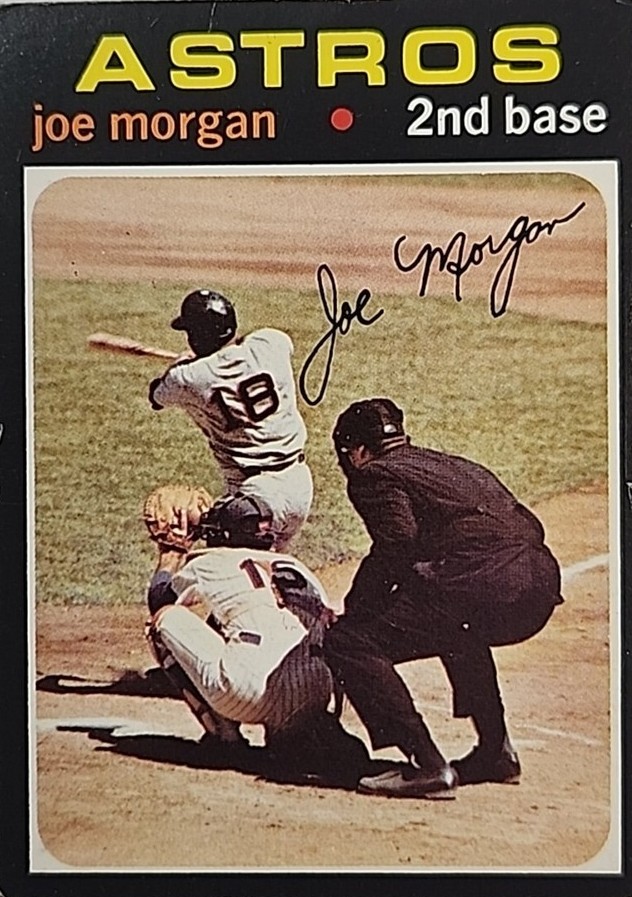
Joe Morgan, 1971 Topps, #264

For twenty-two seasons, Joe Morgan played perhaps some of the best baseball ever seen at second base. From 1963 to 1984, Morgan played on five teams. Morgan started his career with the Houston Colt .45s. He wore uniform number 12 for eight games in 1963. The next season he played 10 games and wore number 35. By 1965, the Colt .45s became the Houston Astros and Morgan, now wearing number 18, broke out, placing second in ROY voting. He would keep the number 18 for the rest of his tenure with Houston (1965-1971), before switching to uniform number 8 after his trade to the Reds. After seven seasons with the Reds, he was back with the Astros for one season in 1980, then went to the San Francisco Giants (2 yrs), Philadelphia Phillies (1 yrs) and finished his career with one final season on the Oakland Athletics. He wore uniform number 18 for seven seasons and had a career WAR of 100.6 good for thirty-first all-time.

Morgan was a ten-time All-Star who won the National League MVP award twice (75, 76), both times with the Reds. In 1975, he led the league in season WAR (11), walks (132), OBP (.466), and OPS (.974) while hitting .327 with 67 stolen bases and winning the Gold Glove Award. In 1976, Morgan led the league in WAR (9.6) OBP (.444), SLG (.576), OPS (1.020) and sacrifice flies with 12.

He won five Gold Glove Awards and was a Silver Slugger in 1982. Morgan was known for his speed, stealing over 40 bases in nine different seasons (with 60 or more three times). He was a tough player to strike out too, with 77 strikeouts being the most in any season. He also led the league in walks four separate times.

As a member of the “Big Red Machine”, Morgan was a two-time World Series Champion in 1975 and 1976 (his two MVP seasons) while playing alongside Pete RoseJohnny Bench and Tony Perez with Sparky Anderson as the manager.

He retired after the 1984 season with a .271 career batting average, 2,517 hits, 449 doubles, 268 home runs, 1,133 RBIs, 689 stolen bases (11th all-time), and 1,865 walks (5th all-time). For second basemen, he is 4th all-time with 5,742 putouts, 3rd in assists with 6,967 and 6th in double plays with 1,505.

Morgan is a member of both the Houston Astros and the Cincinnati Reds Hall of fame with the Reds retiring his uniform number 8 in 1998.

He was inducted into the Baseball Hall of Fame in 1990.

Joe Morgan passed away at the age of 77 in 2020.

Number 1:

Bret Saberhagen, 1988 Fleer, #268

As a kid I followed several players, most of them with the Red Sox, but others were based on card collecting, watching baseball highlights on This Week in Baseball and reading The Sporting News. Bret Saberhagen was one player that I loved collecting. He was a right-handed pitcher who played for sixteen years (1984-2001) for four teams. He started out on the Royals (1984-1991) until he was traded in 1991 to the Mets for a couple of players including Gregg Jefferies (a legend from my youth). He stayed with the Mets until 1995. He then played one season (1995) with the Colorado Rockies, before finishing his career with my team, the Boston Red Sox (1997-1999, 2001). He wore uniform number 18 for seven seasons and had a career WAR of 58.9.

Saberhagen was only 19 when he started his Major League career with the Royals. Despite his youth, he had a good first season going 10-11 with a 3.48 ERA and 73 strikeouts. In 1985, only his second season, he would win the first of two Cy Young Awards going 20-6 with a 2.87 ERA, and he led the Kansas City Royals to their first World Series title. He would win the World Series MVP Award in 1985, going 2-0 with a 0.50 ERA, with two complete games in Games 3 and 7. He allowed just one run, 11 hits, and one walk over 18 innings, and pitched a shutout in the deciding Game 7.  Saberhagen won his second Cy Young in 1989 when he led the league in wins (23), ERA (2.16), season WAR (9.7), innings (262.1), complete games (12) and ERA plus (180) while also winning a Gold Glove. He was a three-time All-Star and pitched a no-hitter in August of 1991.

Bret Saberhagen retired in 2001 after pitching only 3 games for the Red Sox that season. He had a career record of 167-117 (.588 W/L%) 3.34 ERA, 1.14 WHIP, 1,715 strikeouts in 2,562 innings with 76 complete games and 16 shutouts.

He is a member of the Kansas City Royals Hall of Fame.

Number 2:

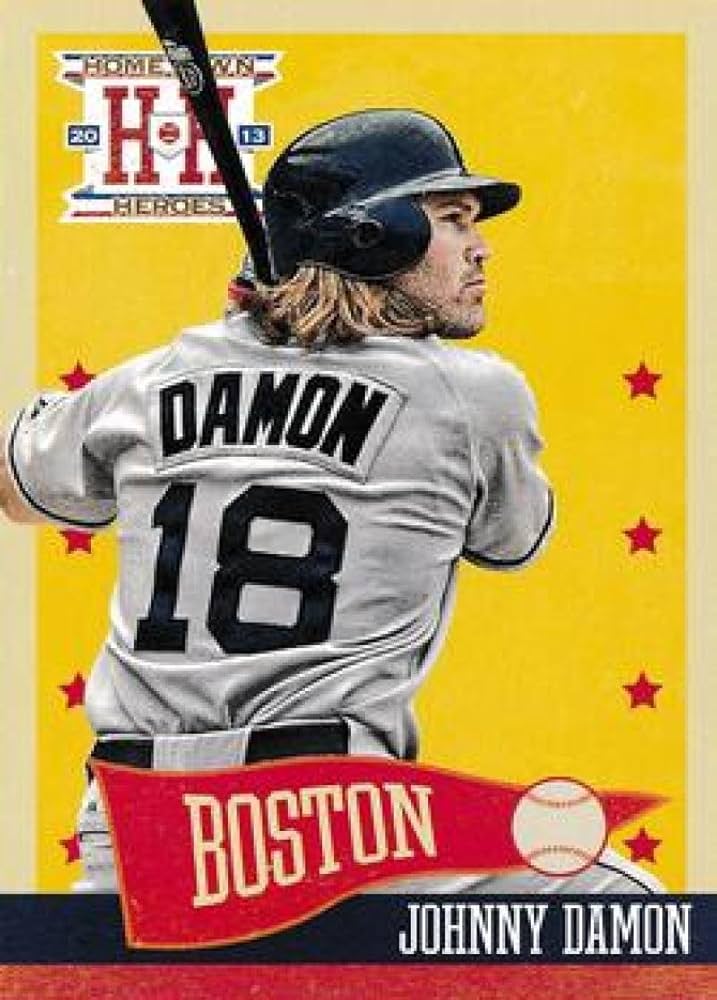
Johnny Damon, 2013 Panini Hometown Heroes, #25

Johnny Damon played outfield for eighteen seasons from 1995-2012 for seven different teams. Damon was known for his speed and found himself primarily batting in the leadoff spot. He started his career with the Kansas City Royals (1995-2000). He spent 2001 with Oakland Athletics, then joined the Boston Red Sox where his scrappy play and personality fit in well with the “The Idiots” (2002-2005). He defected to the rival New York Yankees (2006-2009), then jumped around a bit to finish his career with the Detroit Tigers (2010), Tampa Bay Rays (2011) and the Cleveland Indians (2012). He wore uniform number 18 for fourteen seasons and had a career WAR of 56.3.

Damon was a two-time All-Star. He had over 25 stolen bases in ten seasons, leading the league in 2000 with 46. He also had over 100 runs in ten seasons. Damon had one of his best seasons in 2004 with the Red Sox, batting .304 with 123 runs, 35 doubles, 20 home runs, 94 RBI and 19 stolen bases. That season he played a role in breaking “the Curse” with the Red Sox winning their first World Series in 86 years. Damon was also a member of the 2009 World Series Champion Yankees.

After 2012, Damon never played another game. He tried unsuccessfully to get signed up until 2015. Damon finished his career with a .284 batting average, .352 OBP, 2769 hits, 1668 runs (32nd all-time), 522 doubles (50th all-time), 47 triples, 235 home runs, 1139 RBIs and 408 stolen bases.

He is a member of the Boston Red Sox Hall of Fame.

Number 3:

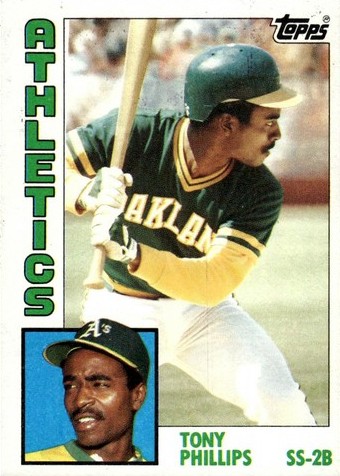
Tony Phillips, 1984 Topps, #309

Tony Phillips played for eighteen seasons from 1982 through 1999. He was a utility player who bounced around the league, playing for six teams in his career. Phillips started his career with the Oakland Athletics (1982-1989), then signed with the Detroit Tigers (1990-1994) who traded him to the Angels (1995). He would bounce around after that playing for the White Sox (1996-1997), Angels again (1997), Blue Jays and Mets (1998), and ending where it all started, with Oakland again (1999). Phillips wore uniform number 18 for five seasons while with Oakland from 1982 to 1986 and had a career WAR of 50.9.

I remember Phillips most with Oakland and the Tigers. I loved the 1984 Topps and even though it does not show his number, he wore 18 during the 1984 season, so it fit well for the post.

Phillips was a utility player extraordinaire. He never made an All-Star team, but he did lead the league in runs once and walks twice. In 1986, he became the first member of the Oakland Athletics to hit for the cycle. He was a member of the 1989 Oakland Athletics World Series Championship team during the “Earthquake Series” which I remember watching. Oakland was stacked with players and featured the GOAT Rickey Henderson, the Bash Brothers (Jose Canseco and Mark McGwire), pitchers Dave Stewart and Bob Welch and closer Dennis Eckersley.

Phillips played his last game in 1999. He finished his career with 1,319 walks (48th all-time). He had a .266 batting average with 2023 hits, 1300 runs, 360 doubles, 160 home runs, 177 stolen bases and 819 RBIs. He also had a .374 OBP.

Phillips passed away in 2016 at the young age of 56 years old.

Number 4:

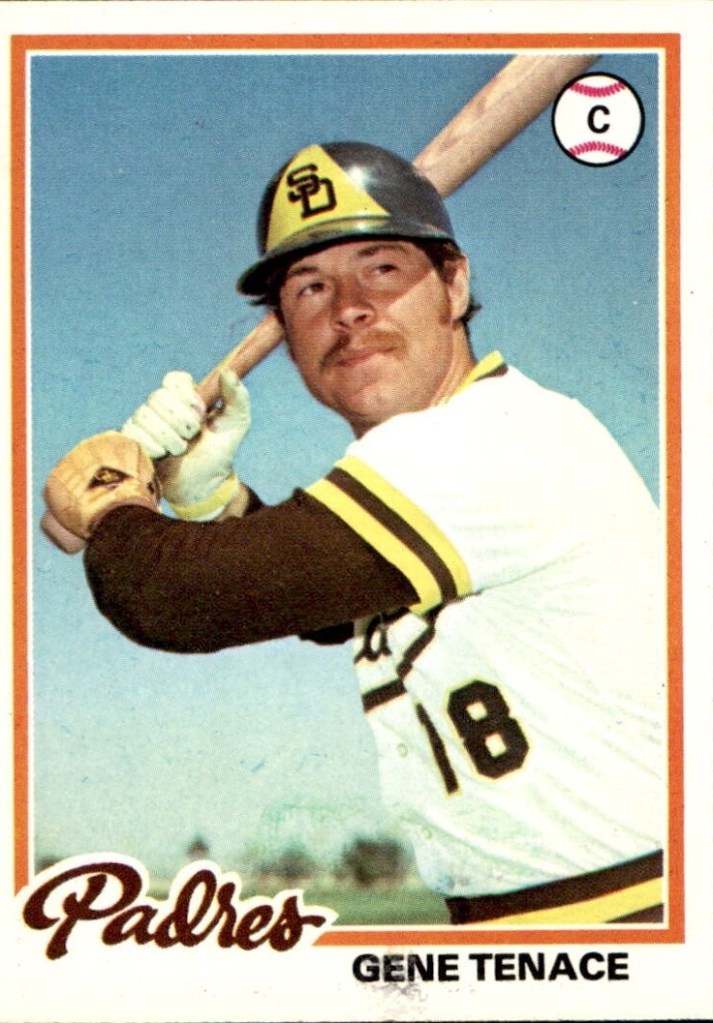
Gene Tenace, 1978 Topps, #240

One of the top catchers of his era, Gene Tenace played for fifteen seasons from 1969-1983. Tenace started his career with the Oakland Athletics (1969-1976) moved on to the San Diego Padres (1977-1980), then played two seasons with the St. Louis Cardinals (1981-1982) and finished his career with the Pirates (1983). Tenace had a career WAR of 46.8 and wore uniform number 18 for eleven seasons.

Tenace was an All-Star in 1975 and has a whopping 6 World Series rings. He was a member of the Oakland Athletics World Series Championship dynasty that won three straight rings (1972-1974) along with Reggie Jackson, Catfish Hunter and Rollie Fingers. Tenace was the World Series MVP in 1972 when he batted .348 with 4 runs, 4 home runs, 9 RBI, .400 OBP, .913 SLG and an OPS of 1.313. He was also a member of the 1982 Cardinals win with Jim Kaat, Bruce Sutter and Ozzie Smith. In 1992 and 1993, Tenace was a coach for the Blue Jays Championships.

He retired after the 1983 season with a career batting average of .241 with 1,060 hits, 201 home runs, 674 RBIs and a .388 OBP.

Tenace is a member of the Athletics Hall Of Fame.

Number 5:

Ben Zobrist, 2010 Bowman Chrome, #71

Switch-hitting, super utility player Ben Zobrist spent fourteen seasons in the Majors playing for four teams. He started his career with the Tampa Bay Rays (2006-2014). He was traded to the Oakland A’s in 2015 and stayed with them for only 67 games before being traded to the Kansas City Royals. He then moved on to the Chicago Cubs (2016-2019). He has a career WAR of 44.7 and wore uniform number 18 for his entire fourteen seasons.

During his career, Zobrist played second base, shortstop, all three outfield positions and even spent a little time at first and third. He was known as a versatile defender who could also get on base. A three-time All-Star, Zobrist had his best season in 2009 when he led the league in season WAR (8.6) and batted .297 with 27 home runs, 91 RBIs, 17 stolen bases, and a .405 OBP. He had 20 home runs or more in 3 seasons, had over 30 doubles 6 times, and walked over 90 times in four seasons. In 2011, he had 8 RBIs in one game, a Tampa Bay record. Zobrist is a two-time World Series Champion, winning a ring with the Kansas City Royals in 2015 and with the Chicago Cubs in 2016. The Cubs won for the first time in 108 years and Zobrist, who batted .357 with 10 hits, two doubles, a triple, 5 runs, 2 RBI, 4 walks and a .419 OBP, was named the World Series MVP.

Zobrist retired after the 2019 seasons. He had a career batting average of .266 with 1,566 hits, 884 runs, 349 doubles, 44 triples, 167 homeruns, 768 RBIs and a .357 OBP.

Number 6:

Mel Harder, 1934 Goudey, #66

Known as Chief, Mel Harder was a right-handed pitcher who played for 20 years exclusively with the Cleveland Indians from 1928 to 1947. Red Farber, Walter Johnson, Ted Lyons and Mel Harder are the only pitchers to have played for twenty seasons with one team.  He was also a pitching coach (1948-1963) and managed a few games in 1961 and 1962 for Cleveland, spending 36 years total with the franchise. He would spend an additional six years coaching various teams before leaving baseball after 42 years. Harder had a career WAR of 44.3 and wore uniform number 18 for eighteen seasons.

Harder was a four-time All-Star who was considered one of the most difficult pitchers to face in his day. He led the league in ERA in 1933. He was a member of the 1948 Cleveland World Series Championship team that included six Hall of Famers; Lou Boudreau, Bob Feller, Joe Gordon, Bob Lemon, Satchel Paige and Larry Doby.

Harder’s last season was 1947. He finished his career with 223 wins to 186 losses, good for a .545 W/L%. He had a 3.80 ERA, 1.408 WHIP and 1,161 strikeouts in 3,426 innings to go along with 181 complete games and 24 shutouts. He also had 24 saves.

Chief is a member of the Cleveland Guardians Hall of Fame, and his number 18 was retired by Cleveland in 1990.

Mel Harder passed away in 2002 at the age of 93 years old.

Number 7:

Darryl Strawberry, 1984 Topps, #182

One of the things I love about writing these posts is nostalgia, and nothing brings it out more than writing about players from my youth. Strawberry is one of those players I will always remember. The “Straw Man” was a favorite player to my best friend growing up, and an enemy to Red Sox fans. He played right field for seventeen seasons from 1983-1999. Mostly known for his eight seasons on the New York Mets (1983-1990), who selected him with the first pick in the 1980 draft, Strawberry also played for the Dodgers (1991-1993), San Francisco Giants (1994) and the New York Yankees (1995-1999). Strawberry had a career WAR of 42.1 and wore uniform number 18 for all eight seasons he played with the Mets.

Strawberry made an immediate impact his rookie season with 26 home runs, 74 RBI and 19 stolen bases and winning the 1983 ROY Award. The next season he would become an All-Star for the first time. Strawberry would make 8 consecutive All-Star appearances and win two Silver Slugger awards. He had over 25 home runs in his first nine seasons, leading the league with 39 in 1988. He also had over 100 RBIs twice, over 100 runs twice and stole over 25 bases in five seasons. He joined the 30-30 club in 1987 with 39 home runs and 36 stolen bases. He was a member of 3 World Series Championships; in 1986, when the Mets beat the Red Sox (booo!), then in 1996 and 1999 with the Yankees.

Sadly, Strawberry’s career was shortened due to personal issues, injuries and addiction. From 1992 to 1999 he only played 100 games once. He was missing practices and games and was suspended for cocaine use while also dealing with colon cancer. By 2000, he was once again suspended for drug use and never played again.

Strawberry finished his career with a .259 batting average with 1,401 hits, 898 runs, 256 doubles, 335 home runs, 1000 RBIs and 221 stolen bases.

For years Strawberry struggled with addiction issues and legal problems. He went to rehab and found solace in his Christian faith, becoming an ordained minister. Strawberry has been sober for over 20 years and has dedicated his life to helping others through the sharing of his story.

He was entered into the New York Mets Hall of Fame, and his uniform number 18 was retired by the Mets in 2024.

Final Score:

Uniform number 18 had several players with an over 40 WAR wear it for 1 season. Red Ruffing, Keith Hernandez and Minnie Minoso are all players who I have featured in prior posts, and each wore uniform number 18 for 1 season. Red Faber (White Sox 31, 33), Willie Randolph (Pirates 75),  Andrew Jones (Yankees 2011) and Dazzy Vance (Cardinals 33) all wore number 18 as well.

Thank you for reading and if you’re enjoying this content hit a like, subscribe or shoot me a comment. Next up is uniform number 19!

Sources:

https://www.baseball-almanac.com

https://www.baseball-reference.com

“Oakland Athletics 8, Baltimore Orioles 4”Retrosheet. May 16, 1986.

Markoe, Lauren “Darryl Strawberry goes from ballfield to pulpit”The State Journal-Register. (July 27, 2013)

https://www.sabr.org

Shout out to all the cool cards and creative commons for my pictures! Thanks Topps and Fleer and Donruss and Upper Deck and all the rest.
Baseball by the Numbers: 17

Read about the Project
Checklist

17

Welcome back to Baseball by the Numbers. Today we are looking at uniform number 17. I like this number in general, probably because it has a 7 in it. I will often go out of my way to grab a locker or a parking spot with 7 in it, so 17 is often the spot I will pick. Apparently, baseball players also like the number, as nearly 900 players have worn 17 in history. 105 of those players kept 17 for over 5 seasons. No player who wore 17 had a WAR over 100 and only thirty-seven had a 40 plus WAR. Although no Legends had number 17, the amazing Ken Griffey Jr. wore 17 for 1 season in 2008 while with the Chicago White Sox.

Number 1:

Scott Rolen, 2000 Upper Deck Ionix, #38

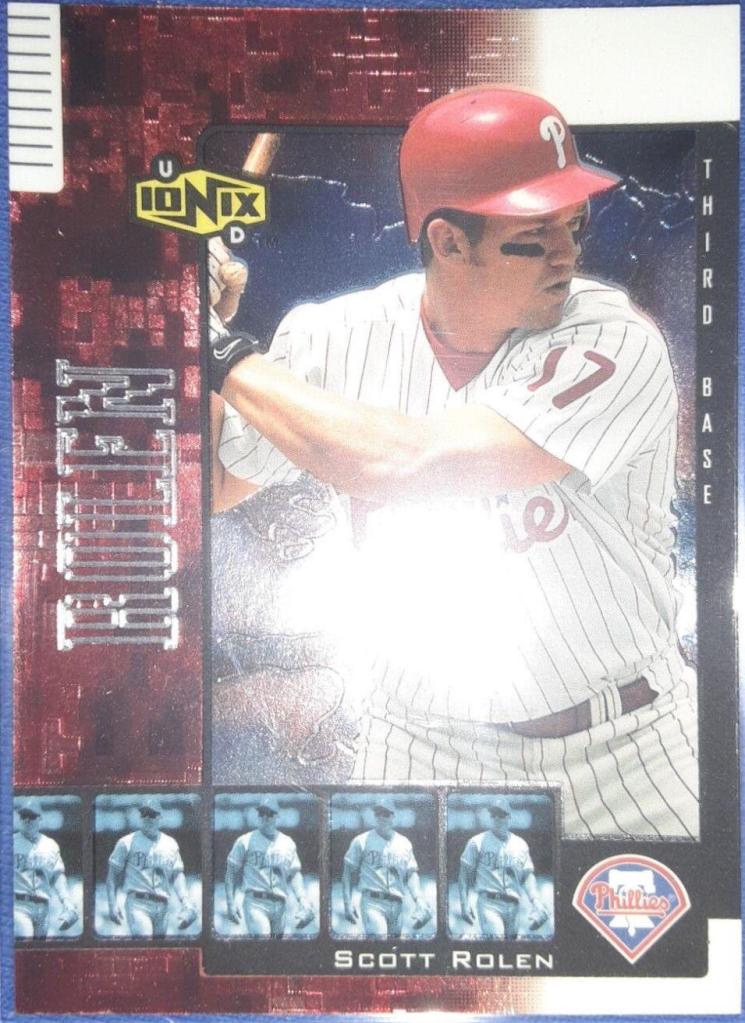
In 1997, rookie third baseman Scott Rolen played 153 games for the Phillies. He batted .283 with 159 hits, 35 doubles, 21 home runs, 92 RBIs and 16 stolen bases. He also led all National League third basemen with 144 putouts. He won the NL Rookie of the Year. Rolen would remain in the Majors for seventeen seasons from 1996 to 2012. After his amazing debut with Philadelphia (1996-2002) he was traded in 2002 to the Cardinals where he stayed for six seasons until 2007. He was traded to the Blue Jays (2008-2009) for Troy Glaus and eventually finished his career with the Cincinnati Reds (2009-2012). He had a career WAR of 70.1 and wore uniform number 17 for six seasons, all with Philly.

Aside from winning the Rookie of the Year, Rolen was a seven-time All-Star. He has the fourth most Gold Gloves of any third basemen with eight, trailing only Brooks Robinson, Mike Schmidt and Nolan Arenado. He hit 20 or more home runs in ten seasons, had over 100 RBIs five times and won a Silver Slugger award in 2002. He was a key contributor to the Phillies 2006 World Series Championship team.

Rolen’s final game was in 2012. He finished his career with .281 batting average, 1211 runs, 2077 hits, 517 doubles, 316 home runs, 1287 RBI and 118 stolen bases.

He is a member of both the Philadelphia Phillies and St. Louis Cardinals Hall of Fames. He was inducted into the National Baseball Hall of Fame in 2023.

Number 2:

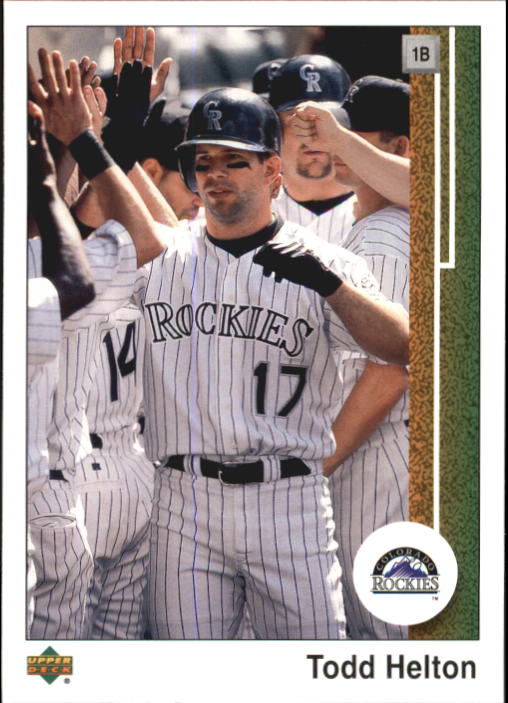
Todd Helton, 2002 Upper Deck Authentics, #166

Todd Helton wins the uniform number 17 triple crown. He played first base for 17 seasons (1997-2013) and wore uniform number 17 for all 17 seasons played. He played exclusively for the Colorado Rockies and had a career WAR of 61.8.

Helton was a five-time All-Star. He batted over .300 in twelve seasons and won four Silver Sluggers. He was 5th in MVP voting in 2000 when he led the league in season WAR (8.9), batting average (.372), hits (216), doubles (59), RBIs (147), OBP (.463), SLG (.698) and OPS (1.162) while also hitting 42 home runs. (It’s crazy he was 5th : Jim Edmonds, Mike Piazza, Barry Bonds and Jeff Kent (winner) were ahead of him.) Helton had over 30 home runs and 100 RBIs in five seasons each and won three Gold Glove Awards. He won the Hank Aaron award in 2000.

Helton retired after the 2013 season. He ended his career with a .316 batting average, 2519 hits, 1401 runs, 369 home runs and 1406 RBIs. He was in the top 50 all-time in several categories. He had 592 doubles (20th), 1335 walks (38th), OBP .414 (29th), SLG .539 (38th) and OPS .953 (24th).

In 2014, his uniform number 17 was the first number retired by Colorado. Helton’s is one of only three retired numbers, including fellow player Larry Walker (33) and of course Jackie Robinson (42). Team president Keli McGregor (KSM) was also honored.

Todd Helton was inducted into the National Baseball Hall of Fame in 2024.

Number 3:

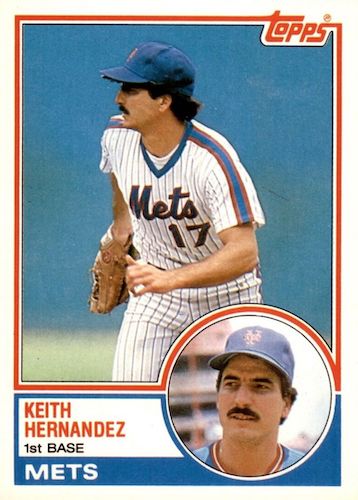
Keith Hernandez, 1983 Topps Traded, #43

Whenever Keith Hernandez comes up I must ask myself, “Was it really Roger McDowell, or did Keith Hernandez spit on Kramer and Newman?” Aside from his infamous appearance on Seinfeld, Hernandez is also well known for his dry humor as the Mets color commentator on SNY.

Hernandez played first base for seventeen seasons from 1974 to 1990. He started his career with the St. Louis Cardinals (1974-1983), then was traded to the Mets (1983-1989) and played his final games with the Cleveland Indians (1990), He had a career WAR of 60.4 and wore uniform number 17 for eight seasons while with the Mets and Cleveland.

Hernandez was a five-time All-Star with two Silver Slugger Awards. He was the National League MVP in 1979 when he batted a league leading .344 with 210 hits, 11 home runs and 105 RBIs. He also led the league in doubles (48) and runs (116) while winning a Gold Glove. He won 11 Gold Gloves in his career. Hernandez was a member of two World Series Champions. In 1982 he was a member of the Cardinals Championship team managed by Whitey Herzog and featuring Jim Kaat, Ozzie Smith and Bruce Sutter and in 1986 he won a ring with the New York Mets along with future Hall of Famer Gary Carter. (Yes the one against the Red Sox!)

Hernandez retired in 1990 after having played only 43 games with Cleveland. He ended his career with a .296 batting average, 2182 hits, 1124 runs, 426 doubles, 162 home runs and 1071 RBIs.

Hernandez is a member of both the Cardinals and the Mets Hall of Fame. His number 17 was retired by the New York Mets in 2022.

Aside from Seinfeld, Hernandez appeared in Sesame Street, Law and Order and a couple of movies. He’s also written and contributed to multiple books and, as mentioned above, is a well-liked color commentator.

Number 4:

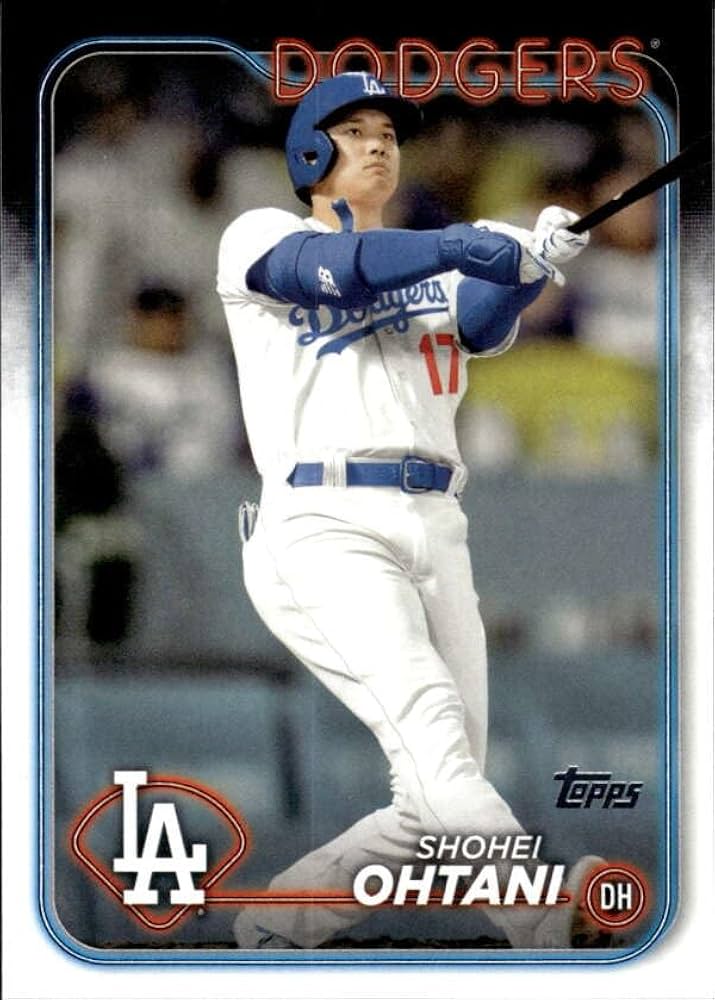
Shohei Ohtani, 2024 Topps, #500

“Shotime” is currently 15th in career WAR for active players at 51.8. The two-way Japanese star has made a huge impact since entering the league in 2018. In only 9 seasons (2018-present), he has been an All-Star both at the plate and on the mound. He started his career with the Los Angeles Angels (2018-2023) then signed the largest contract in sports history, 10 years/$700 million to play with the Los Angeles Dodgers.

Ohtani was the American League Rookie of the Year in 2018 when he batted .285 with 93 hits, 21 doubles 22 home runs, 61 RBI and 10 stolen bases to go with a 4-2 record 3.31 ERA and 63 strikeouts in 51 innings. Ohtani is a five-time All-Star. He’s won 4 MVP awards and has been voted for the All-MLB First Team 6 times. He has 4 Silver Sluggers and 3 Hank Aaron Awards. Ohtani has led the league in runs twice, home runs twice (hitting over 50 twice), RBIs once, triples once, OBP twice, SLG, OPS, OPS+ and Total Bases three times each. He was a member of two World Series Championships with the Dodgers (2024 and 2025). He is the only member of the 50-50 club (2024). He also hit for the cycle in 2019.

He is currently playing for the Dodgers and continues to play at an All-Star level. He currently has a career batting average of .281 with 1069 hits, 720 runs, 194 doubles, 45 triples, 285 home runs, 679 RBIs and 165 stolen bases. He has a 41-20 record (.672 W/L%) with a 2.91 ERA, 1.066 WHIP, 146 ERA+ and 688 strikeouts in 546.2 innings. With his dominate two-way play, Ohtani is a generational talent often compared to the great Babe Ruth.

Number 5:

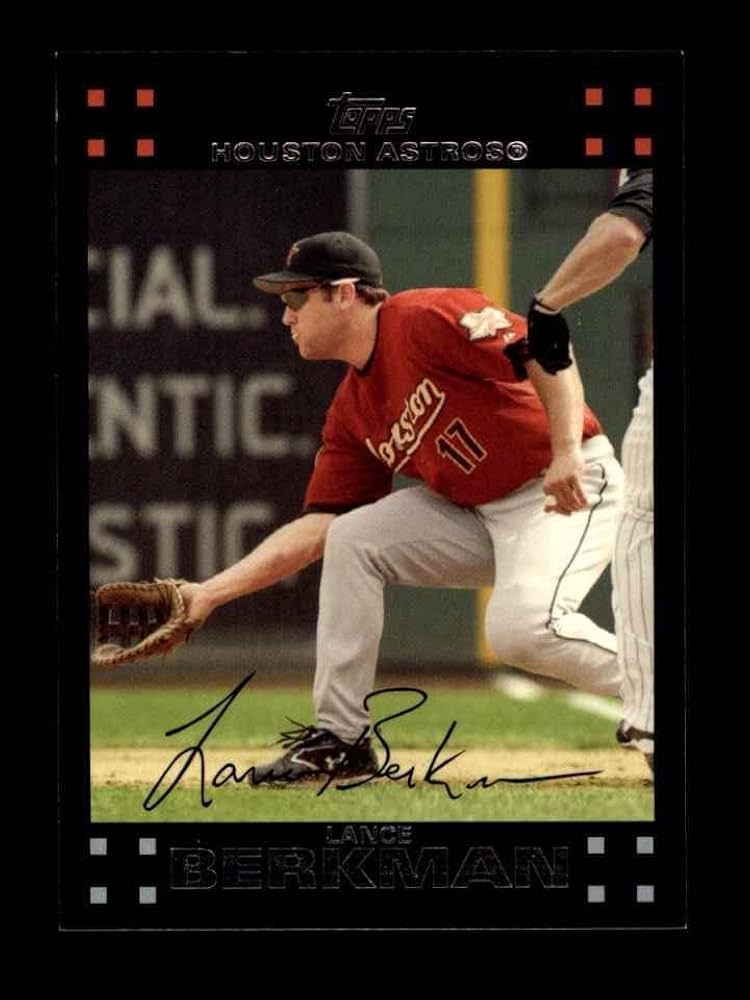
Lance Berkman, 2007 Topps, #590

When I was a young fan, Lance Berkman was a personal favorite. I loved collecting the “Killer Bees” of the Houston Astros: Lance Berkman, Jeff Bagwell, and Craig Biggio. Berkman played outfield and first base for fifteen seasons from 1999-2013 primarily with the Astros (1999-2010), then with the Yankees (37 games in 2010), the Cardinals (2011-2012) and finally with the Texas Rangers (2013). He had a career WAR of 51.9 and wore uniform number 17 for eleven seasons.

Berkman was a six-time All-Star and was voted the comeback player of the year in 2011 as a key member of the St. Louis Cardinals World Series Championship team.

Berkman retired after the 2013 season with a .293 career batting average, 1905 hits, 1146 runs, 422 doubles, 366 home runs and 1234 RBIS.

Berkman is a member of the Houston Astros Hall of Fame. Since his retirement Berkman has been coaching college baseball.

Number 6:

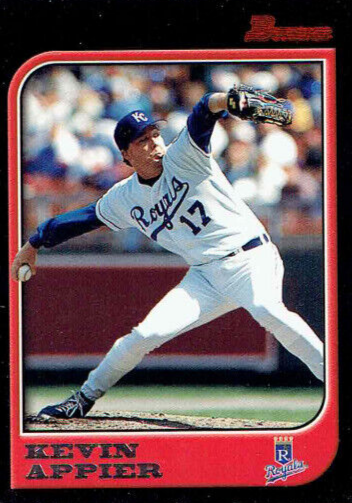
Kevin Appier, 2007 Bowman, #26

Kevin Appier was a right-handed pitcher for sixteen seasons from 1989 to 2004. He played for the Kansas City Royals from 1989-1999 and 2003-2004. In 1999, he was traded to the Oakland Athletics and played with them until 2000. He then played for the Mets (2001), and the Anaheim Angels (2002-2003). He had a career WAR of 54.5. Appier wore uniform number 17 for five seasons with the Royals.

While he only had one All-Star appearance (1995), he was a solid pitcher, especially in the beginning of his career. He had 3 seasons with under 3.00 ERA, leading the league in 1993. He won two Roberto Clemente Awards (1996 and 1998). At the end of the 2001 season, he was traded from the Mets to the Angles for Mo Vaughn and was a member of their 2002 World Series Championship team.

He ended his career after the 2004 season with a .552 W/L% (169-137), 3.74 ERA, 1.29 WHIP, 1994 strikeouts and a 121+.

Appier is a member of the Kansas City Royals Hall of Fame.

Number 7:

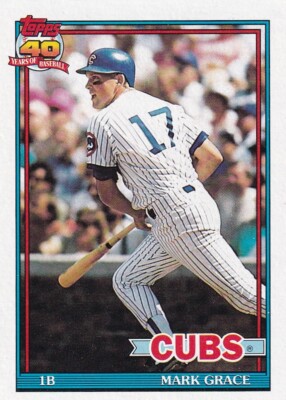
Mark Grace, 1991 Topps, #520

Left-handed first baseman Mark Grace played for sixteen seasons from 1988 to 2003 with the Chicago Cubs (1988-2000) and the Arizona Diamondbacks (2001-2003). Grace wore number 17 his entire career save for the first half of his rookie season and had a career WAR of 46.5.

In 1988, he was second in ROY voting, losing to the Reds Chris Sabo in a close vote. A three-time All-Star, Grace had the most hits and the most doubles of any player in the 90’s. I remember how popular he was during the decade, we all predicted a Hall of Fame career. Grace was also a strong defender winning four Gold Gloves. He won a World Series Championship in 2001 with the Diamondbacks.

Grace retired in 2003. He had a career batting average of .303, 2244 hits, 1179 runs, 511 doubles, 173 home runs and 1146 RBIs.

Grace is a member of the Chicago Cubs Hall of Fame. He never did get into the National Baseball Hall of Fame.

Since retiring, Grace has been a color commentator and analyst for several networks.

Final Score:

Aside from Griffey Jr. mentioned in the introduction, several other standout players wore 17 for short periods. Pitcher David Cone (WAR 62.3, 3 years), Dazzy Vance (60.4, 1yr), Jim Bunning (59.5, 1yr) and Sammy Sosa (58.6, 1 Yr). One of my favorite pitchers, Bret Saberhagen wore number 17 six seasons with my Boston Red Sox and with the Mets. I almost wrote him in this post, but (spoiler alert), he will be in the next post, so I skipped him this time.

From a longevity standpoint; right fielder Shin-Sho Choo (15 seasons), Brewer’s infielder Jim Gantner (15 seasons) and seven-time All-Star pitcher Camilo Pascual (14 seasons).

As always, thank you for reading and please leave a comment, suggestion or give it a like…and subscribe to receive an email update for number 18.

Sources:

https://www.baseball-almanac.com/

https://www.baseball-reference.com/

https://www.sabr.org/

Shout out to all the cool cards and creative commons for my pictures! Thanks Topps and Fleer and Donruss and Upper Deck and all the rest.
Baseball by the Numbers: 16

Read about the Project
Checklist

16

Welcome back to Baseball by the Numbers. Today we are looking at uniform number 16. Over 800 players have worn the number 16 at some point in their careers. Thirty-three of those players finished their career with a WAR of 40 plus. It was also a number that many players held onto, with 112 having worn it for five years or more. Two legends wore number 16, but only for 1 season each. Featured in the uniform number 4 post, Rogers Hornsby, whose 127.3 career WAR is 12th all-time, wore uniform number 16 briefly in 1933 when he was claimed off waivers midseason to become a player/manager for the St. Louis Browns. And the great Braves pitcher Warren Spahn wore number 16 in 1942 with the Boston Braves, his first season in the Majors. Spahn is ranked 32nd all-time with a 100.1 career WAR.

Number 16 was a favorite among pitchers and out of the seven players featured for this post all but one was a hurler. Let’s Go!

Number 1:

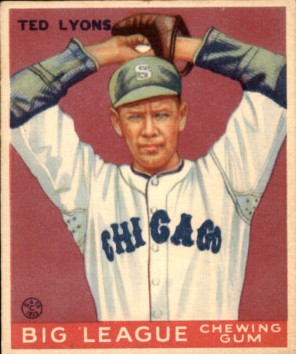
Ted Lyons, 1933 Goudey, #7

The Chicago White Sox franchise leader in wins, Ted Lyons played exclusively for the White Sox for twenty-one seasons from 1923-1946. (He missed 1943-45 for military service.) He was a crafty right-handed pitcher who could throw a knuckleball, cutter, changeup and a nasty curve. He wore uniform number 16 his entire career save for 1931 and had a career WAR of 70.7.

I love when I get to feature an old Goudey card. This is Lyon’s 1933 card. I love this picture, with Lyons staring down the batter, winding up for a pitch, the Chicago name across his chest and the signature “S” on the White Sox cap. Such a cool card.

Lyons was an All-Star in 1939, but his best years were played prior to the inception of the All-Star game. He had a W/L% over .500 in twelve seasons. He led the league in wins, complete games, innings and shutouts twice each and in ERA once. Although he topped 200 innings in 10 seasons, hitting 307 in 1927, he never had more than 74 strikeouts in any season. He won his games with finesse and crafty pitches, like his signature knuckleball. Lyons pitched a no hitter in 1926 against the Red Sox at Fenway Park.

From 1943 to 1945 Lyons was in the military. He returned in 1946 and pitched in 5 complete games with a 2.32 ERA before hanging up the cleats for good.

He would finish his career with a .531 W/L % amassing 260 wins (good for 42nd all-time). He had a career ERA of 3.67 with an ERA+ of 118. He had more walks 1,121 than strikeouts 1,073. His 4,161 innings are 37th all-time and he had 356 complete games (24th all-time) and 27 shutouts.

Lyons uniform number 16 was retired by the Chicago White Sox in 1987, and he was inducted into the National Baseball Hall of Fame in 1955.

Ted Lyons passed away in 1986 at 85 years old.

Number 2:

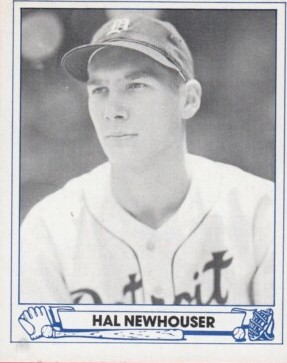
Hal Newhouser, 1983 TCMA “Play Ball”, #6

“Hurricane Hal “was a temperamental left-handed pitcher who played in the Majors for seventeen years from 1939 to 1955. He played for the Detroit Tigers (1939-1953) and the Cleveland Indians (1954 and 1955). He had a career WAR of 62.8 and wore uniform number 16 his entire career.

There were no cards produced in 1944 due to the war, but in 1983 TCMA produced a commemorative set. That is the card I used for this post. From 1939 to 1944, Newhouser was not doing well as a pitcher. While he had shining moments, his temper and emotions got the better of him (hence the nickname “hurricane”). He was able to turn things around in the ’44 season with help from catcher Paul Richards (Stewart 2014, p. 215)

Newhouser was a seven-time All-Star. He was the American League MVP in 1944 and 1945. In 1944, he pitched 312 innings with 25 complete games and 6 shutouts while leading the league in wins, going 29-9, and strikeouts with 187. 1945 saw Newhouser win the pitching triple crown. He had a great season leading the league in season WAR (11.3), innings (313.1) wins (25), ERA (1.81), complete games (29), shutouts (8) and strikeouts (212). The Tigers also won the 1945 World Series, where Newhouser pitched a complete game to win game 7.

Newhouser was released by the Tigers in 1953 and planned to retire but was convinced to join Cleveland by his former World Series teammate Hank Greenberg. He would play in 28 games over the next two seasons before retiring in 1955.

Newhouser finished his career with a 207-150 record for a W/L% of .580. He had a career ERA of 3.06, ERA+ of 130 and 1,796 strikeouts. He would complete 212 games with 33 shutouts.

Newhouser’s uniform number 16 was retired by the Detroit Tigers in 1997, and he was inducted into the National Baseball Hall of Fame in 1992.

Hal Newhouser passed away at the age of 77 in 1998.

Number 3:

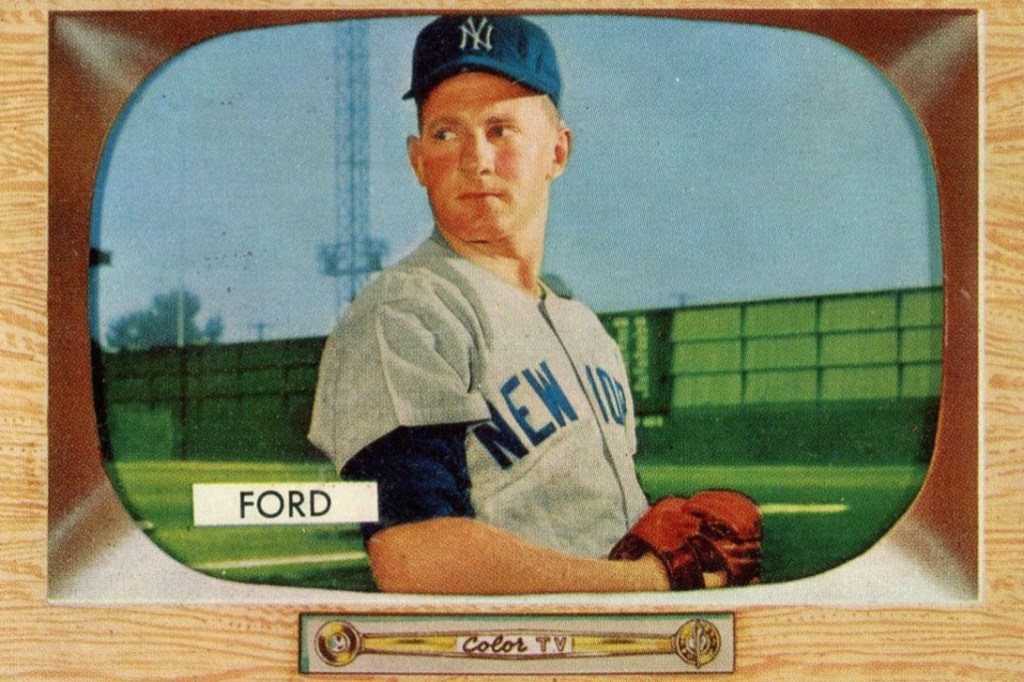
Whitey Ford, 1955 Bowman, #59

The most World Series victories by a pitcher is 10, and is held by our next player, Whitey Ford. Known as “the Chairman of the Board”, Ford played for sixteen years, all in the Bronx with the New York Yankees. From 1950-1967 (he missed ’51 and ’52 for military service), Ford stood tall on the Yankees’ pitching mound. He wore uniform number 16 his entire career, aside from his rookie season (19), and had a career WAR of 57.

I absolutely love the 1955 Bowman design. There is just something about the iconic television-shaped border and the simplicity of the cards that just catches my eye. I had to use this one for Ford.

Whitey Ford was a ten-time All-Star (twice in ’60-’61). He won the Cy Young Award in 1961 when he went 25-4 over a league leading 283 innings with a 3.21 ERA, 3 shutouts and 209 strikeouts. Ford led the league in wins three times, ERA twice, complete games once and shutouts twice. He was a member of six Yankees World Series Championships, earning the World Series MVP award in 1961.

Ford retired in 1967 after playing only seven games that season. He pitched in 3,170 innings with a 236-106 record good for 7th all-time in W/L% at .690. He had a career 2.70 ERA, 133 ERA+ (34th all-time), 1.215 WHIP and 1,956 strikeouts. He holds several World Series records including wins (10), starts (22) and strikeouts (94). He also has the record of 33 consecutive scoreless innings in the World Series.

Ford’s uniform number 16 was retired by the Yankees in 1974, and he was inducted into the Baseball Hall of Fame that same year.

Whitey Ford passed away at age 91 in 2020.

Number 4:

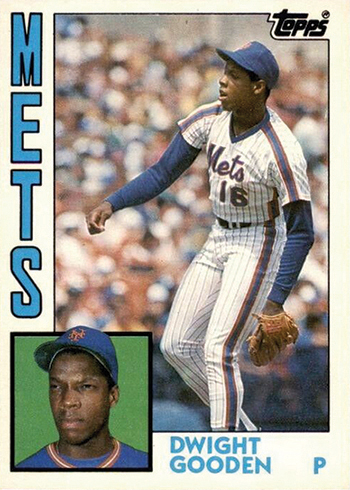
Dwight Gooden, 1984 Topps Traded, #42T

Growing up I was very familiar with Dwight “Doc” Gooden. My best friend loved the Mets and was always looking for his cards. Gooden was a righty who pitched for sixteen seasons from 1984 to 2000. He played for the New York Mets from 1984-1994. He was suspended for the 1995 season due to cocaine use, something that would become a lifelong struggle for the talented pitcher. He came back and played for the Yankees (1996-1997). Cleveland (1998-1999) and in 2000 he played some games with the Astros, Tampa Bay and finally the Yankees again. Gooden wore uniform number 16 for fourteen seasons, including his entire Mets career. He had a career WAR of 53.

I love the 1984 Topps design.  Although I hadn’t started collecting until around 1986, I remember trading for and when I could, buying cards from the early ‘80s. This card is fantastic, I love the small portrait in the bottom square, the team and player names along the white border, and best of all, Gooden’s number 16 is visible in the main photo. Bonus: This is his Topps Traded card, his first in set card with 1985.

Gooden was a four-time All-Star. He was the National League ROY in 1984 when he led the league in strikeouts with 276. The next season, 1985, he won the Cy Young award on the back of a pitching triple crown. In 35 games (276.2 innings), he was 24-4 with a 1.53 ERA and 268 strikeouts. Gooden pitched a no-hitter on May 14th, 1996.  He was a member of two World Series Championships; with the Mets in 1986 when they beat the Red Sox (boooo) and in 2000 as a member of the Yankees.

Gooden’s career started off strong, but sadly due in part to his substance use issues, his career took a dive quickly and he retired in 2000.

“Doc” Gooden had a career record of 194-112 a W/L% of .634. He had a career ERA of 3.51, ERA+ of 111, WHIP 1.256 and 2,293 strikeouts in 2,800.2 innings for a 7.4 S09.

Gooden is a member of the New York Mets Hall of Fame, and his uniform number 16 was retired by the Mets in 2024.

Gooden is 61 years old and he has been outspoken about his struggles with addiction and mental illness and is currently an advocate for those with similar struggles.

Number 5:

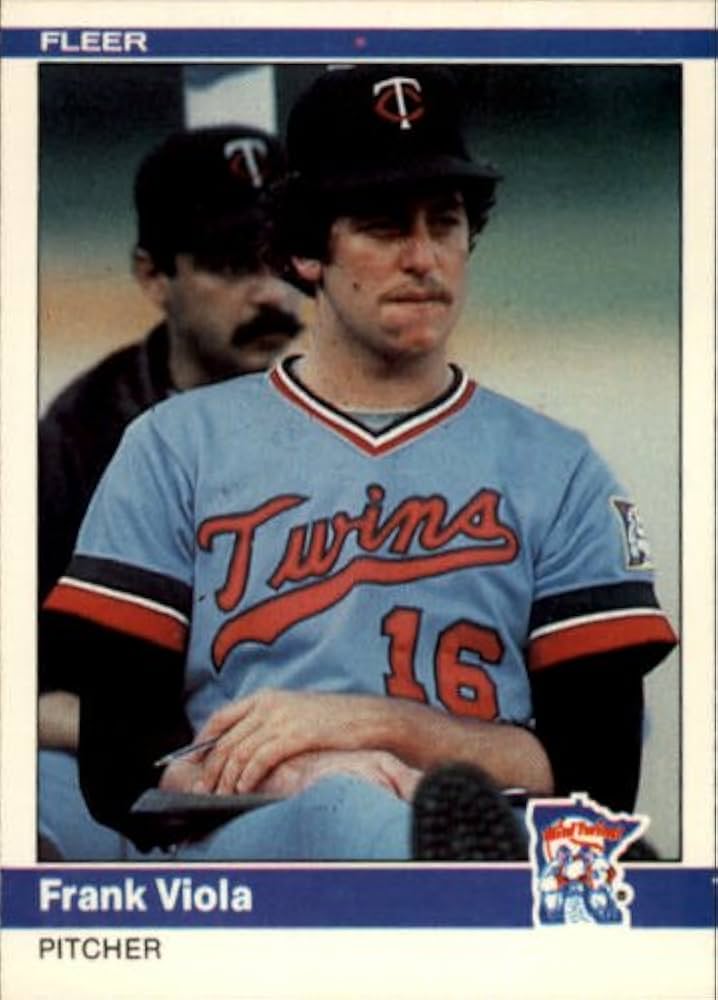
Frank Viola, 1984 Fleer, #575

Left-hander Frank Viola pitched for fifteen seasons from 1982-1996. He was with the Minnesota Twins from 1982 to 1989 when he was traded to the Mets. He stayed with the Mets until 1991, then bounced around a little playing for the Red Sox (1992-1994). (I remember the excitement when the Sox signed him!) The Cincinnati Reds (1995) and finally the Toronto Blue Jays (1996). He had a career WAR of 47 and wore uniform number 16 for eleven seasons.

I choose this 1984 Fleer card to represent Viola due to his uniform number being visible on the front. It is an interesting card. I like the 1984 Fleer design, it’s simple but pleasant. The photo of Viola just sort of chilling works well as it has a very ‘80s baseball feel with that old school Twins uniform and his signature mustache. Overall, a great card for the post.

Viola was a three-time All-Star who won the Cy Young Award in 1988 after winning a league leading 24 games to 7 losses while pitching 255 innings with a 2.64 ERA, 1.136 WHIP and 193 strikeouts. He was a member of the 1987 World Series Championship Twins with Kent Hrbek, Kirby Puckett and fellow pitchers Jeff Reardon and Bert Blyleven. He was named the World Series MVP after starting three games for 19 innings and going 2–1 with a 3.72 ERA and striking out 16. He was the winning pitcher of the decisive game 7.

He finished his career in 1996 with a career 176-150 record, 3.73 ERA, 112 ERA+, 1.301 WHIP and 1,844 strikeouts.

Viola is a member of the Minnesota Twins Hall of Fame.

He is currently 65 years old and has been coaching in an independent baseball league.

Number 6:

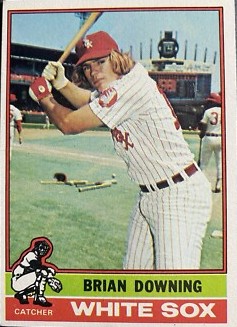
Brian Downing, 1976 Topps, #23

Brian Downing played outfield and catcher for twenty seasons from 1973-1992. He played for three teams, the Chicago White Sox (1973-1977), the California Angels (1978-1990) and the Texas Rangers (1991-1992). He had a career WAR of 51.5 and only wore uniform number 16 for five seasons with the White Sox. Still, I remember Downing well from my youth and wanted to make sure he made the list. He is also the only non-pitcher to make the uniform number 16 list.

I choose this 1976 Topps card because Downing is with the White Sox, the team he played for while wearing number 16. I love all the Topps cards form the ‘70s and this one is great. I like the border and the little catcher in the corner designating his position. I was also thrown off by these White Sox uniform colors. Last post I mentioned the White Sox crazy uniform designs of the ’70s when I featured Dick Allen.

Downing had his lone All-Star season in 1979 with the Angels when he hit .326 with 12 home runs and 75 RBIs. This would start a career shift that saw Downing improve dramatically while with California, where he would stay for thirteen seasons. He would finish his career in 1992.

Downing had a career batting average of .267 with 2,099 hits, 1,188 runs, 360 doubles, 275 home runs and 1,073 RBIs.

Downing is a member of the Angels Hall of Fame. 

Downing is currently retired and 75 years old.

Number 7:

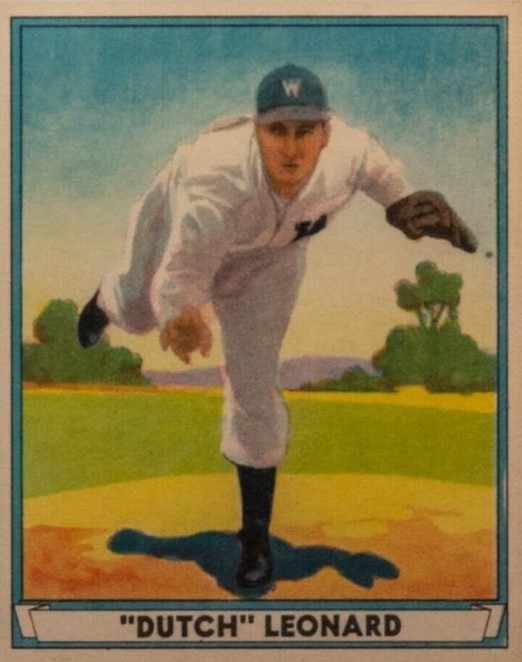
Dutch Leonard, 1941 Play Ball, #24

Emil John “Dutch” Leonard was a right-handed pitcher who played for twenty years from 1933-1953. He started his career with the Brooklyn Dodgers (1933-1936) then played for the Washington Senators (1938-1946), Philadelphia Phillies (1947-1948) and the Chicago Cubs (1949-1953). He had a career WAR of 49 and wore uniform number 16 for nine seasons. 

I really liked this 1941 Play Ball card. Unlike the Hal Newhouser above, this was a real set. The photo is a great action shot of Leonard as he throws a pitch for the Washington Senators. It was with the Senators that he wore uniform number 16, so I found it a fitting inclusion. I like to imagine he is throwing his famous knuckleball, a pitch that even the amazing Jackie Robinson struggled to hit.

“Dutch” was a five-time All-Star. He had arguably his best season in 1945 when he went 17-7 with a 2.13 ERA in 216 innings and had 96 strikeouts.

He retired with a career 191-181 record. In 3,218.1 innings he had an ERA of 3.25, ERA+ 119, 30 shutouts in 192 complete games, 1.256 WHIP and 1,170 strikeouts. He also had 45 career saves.

Leonard passed away at the age of 74 in 1983

Final Score:

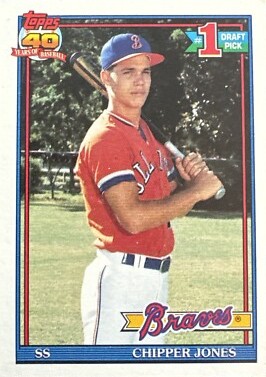
This was a tough one for me. While working on this post I got a new job, moved to a new apartment and dealt with two huge snowstorms. It’s nice to be over this hump. I’ll give a couple of shout-outs. A couple of players with over 40 WAR who didn’t make the cut were featured previously. Bobby Bonds (57.9 WAR, 00 Post), Bobby Grich (71.1 WAR, 4 Post) and Bobo Newsom (47.8 WAR, 00 Post) all wore it for a few years. A handful of greats wore uniform number 16 once including Chipper Jones, Jimmie Foxx, Scott Rolen, Joe Medwick and Reggie Smith.

I always like to give a quick mention to those who wore the number for a long time. Aramis Ramirez wore number 16 for eighteen seasons, Reggie Sanders for sixteen, Garret Anderson for fifteen and Ray Lankford for thirteen. I can’t wait to snake this thing around and talk about some of these guys.

As always thank you for reading. If you enjoy this post shoot a comment, give it a like or clap or whatever, or even better subscribe…I promise you won’t get spammed. Either way, I’m going to keep this train rolling, so check my out soon for uniform number 17.   

Sources:

https://www.baseball-almanac.com/

https://www.baseball-reference.com/

“Contrary Guy Alternative Baseball Thoughts”. Contrary Guy. March 25, 2012. Retrieved July 29, 2012.

https://www.sabr.org/

Stewart, Mark (2014). “Hal Newhouser”. In Wancho, Joseph; Huhn, Rick; Levin, Leonard; Nowlin, Bill; Johnson, Steve (eds.). Pitching to the Pennant: The 1954 Cleveland IndiansUniversity of Nebraska Press.

Shout out to all the cool cards and creative commons for my pictures! Thanks Topps and Fleer and Donruss and Upper Deck and all the rest.
 

Baseball by the Numbers: 15

Read about the Project
Checklist

15

Welcome back to Baseball by the Numbers. Today we are looking at uniform number 15 and man a lot of players have worn this number.  It looks like at least 825 players have worn number 15 at some point in their career.  Thirty-two players who wore number 15 had a career WAR over 40 and 111 players had the number for 5 years or more. It does not seem that any player with over 100 WAR has ever worn the number 15, however there is a story, possibly a myth, that I thought was cool.

Randy Johnson, “the Big Unit”, is 30th all-time in career WAR at 101.1. The myth goes that he wore uniform number 15 in 1992 while playing with the Mariners for just one game. It was July and he was having a down season, so in a weird attempt to turn things around he reversed his number 51. In researching this, I continuously got responses that said he never wore number 15, or that this was a myth, or even that he did wear it once, but at a different time for a different reason. After some research I finally found a reference to this myth in a September 1993 article in the Seattle Times. The article states, “In an effort to reverse his luck last July, the 6-foot-10 left-hander wore 15 instead of his usual 51 and lost 7-6 at Yankee Stadium after a flock of unearned runs.” (Finnigan, Bob, 1993). So maybe this did happen, and this is the reason I have so much fun researching these uniform numbers.

Before starting I wanted to mention that another player with a “big” nickname wore the number 15 for a short time. Frank Thomas, “the Big Hurt” wore number 15 for a short time in 1990, his rookie year, before switching to 35.

Fun stuff!

Number 1:

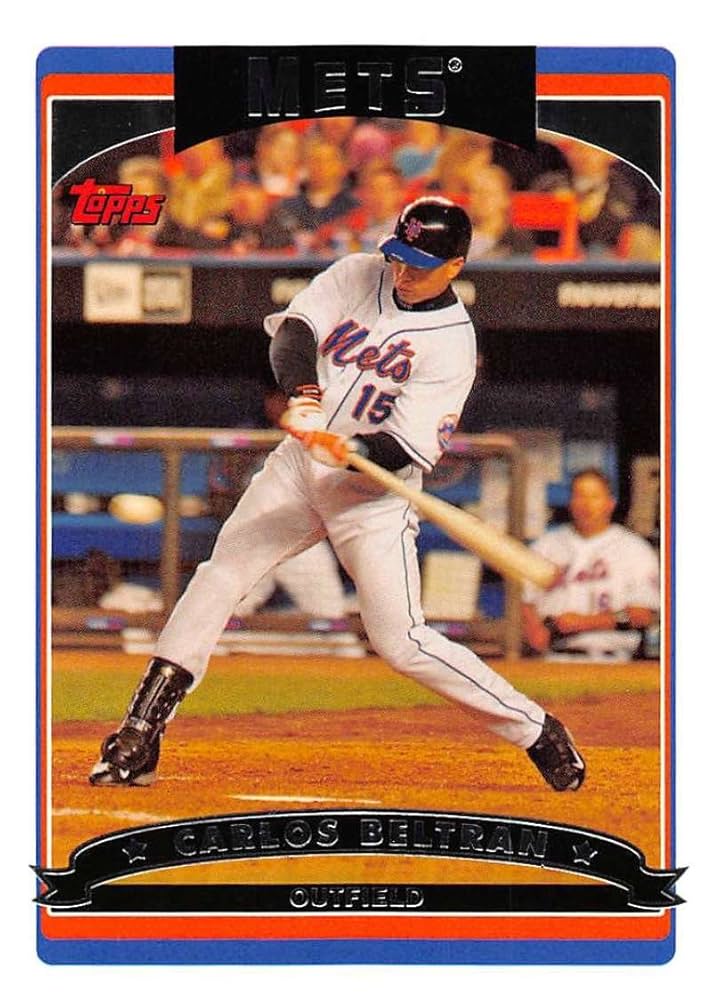
Carlos Beltran, 2006 Topps, #520

It is likely that by the time you read this, Carlos Beltran is one of the newest members of the National Baseball Hall of Fame. He is entering his 4th year on the ballot and in 2025 he received 70.3% of the vote, very close to making it in. Expectations are high for the outfielder who played for 20 years from 1998 to 2017. Beltran played for seven teams: the Kansas City Royals (1998-2004), Houston Astros (2004 and 2017), New York Mets (2005-2011), San Francisco Giants (2011), St. Louis Cardinals (2012-2013), New York Yankees (2014-2016), and the Texas Rangers (2016). He wore uniform number 15 for thirteen seasons and had a career WAR of 70.0.

Beltran blasted onto the scene in 1999 winning the American League Rookie of the Year after hitting .293 with 194 hits, 112 runs, 27 doubles, 22 home runs, 108 RBIs and stealing 27 bases. He also got it done on defense leading centerfields in putouts and assists. After his rookie breakout, Beltran continued his stellar play. He was a nine-time All-Star who hit over .290 seven times, has 100 or more runs seven times, over 100 RBIs eight times and has 25 or more home runs in eight seasons and 25 or more stolen bases in six. He was a member of the 30-30 club in 2004, won two Silver Slugger Awards and was the Roberto Clemente Recipient in 2013. Beltran was also a strong defender and won three Gold Glove Awards. He was a member of the 2017 World Series Champion Houston Astros.

Beltran played his last game in 2017. Upon retirement he had the highest stolen base percentage of any player with 300 or more attempts (312-361 at 86.4%). Beltran was the 5th player with 400 home runs, 500 doubles and 300 steals joining Willie Mays, Andre Dawson, Barry Bonds and Alex Rodriguez. He had a career .279 batting average with 2,725 hits, 1,582 runs, 565 doubles (29th all-time), 78 triples, 435 home runs (48th all-time), 1,587 RBIs (41st all-time) and 312 stolen bases. He finished his career with a .986 fielding percentage playing primarily in center and right field. He won the Roberto Clemente Award in 2013.

In 65 postseason games, Beltrán batted .307 with 45 runs, 15 doubles, 16 home runs, 42 RBI and 11 stolen bases with a 100% stolen base percentage.

**Beltran was elected to the Hall of Fame January 20th, 2026.**

Number 2:

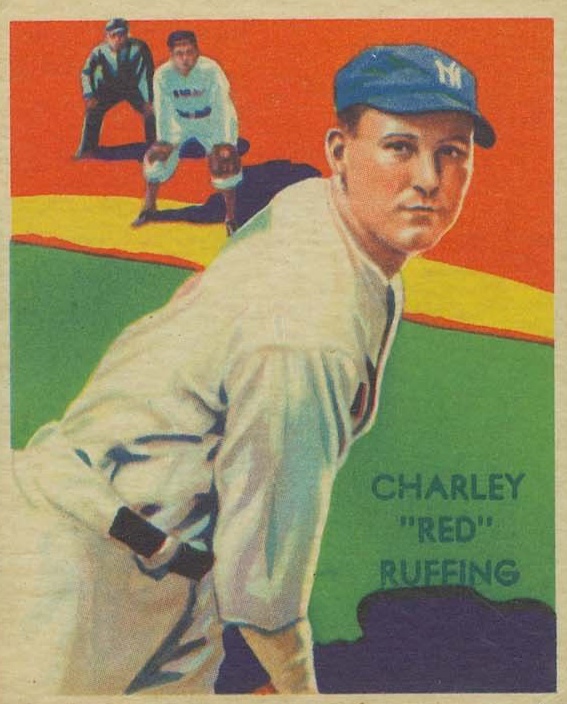
Red Ruffing, 1935 Diamond Stars, #60

Red Ruffing is a right-handed pitcher who played for twenty-two seasons from 1924 to 1947 (missing 1943-1944 for military service). He played for the Boston Red Sox (1924-1930), New York Yankees (1930-1946) and Chicago White Sox (1947). He wore uniform number 15 for eleven seasons while with the Yankees. He had a career WAR of 68.6.

Another beautiful Diamond Stars card, Ruffing’s 1935 entry features an umpire and a second baseman (most likely Tony Lazzeri who wore number 6 on the 1935 Yankees) standing behind the pitcher. These cards don’t usually have other players in the background, so I found this to be a cool feature.

Ruffing was a six-time All-Star who led the league in wins in 1938 and strikeouts in 1932. He had over 20 wins in four seasons. He was a member of the six World Series Championship teams (1932, 1936-1939, 1941) all with the Yankees playing alongside legends Babe Ruth, Lou Gehrig, Lefty Gomez, Bill Dickey, Tony Lazzeri and Joe DiMaggio.

Toward the end of his career, Ruffing started to suffer from a series of injuries and was released by the Yankees. He signed with Chicago and played 9 games with the White Sox before retiring in 1947.

He had a career W/L% of .548 going 273-225. He is 32nd all-time in wins. He has a career ERA of 3.80, WHIP of 1.341 and ERA+ 109. His 4,344 innings pitched is also 32nd all-time and he has 1,987 strikeouts, 335 complete games (29th all-time) and 45 shutouts (tied for 29th).

Ruffing is a member of the Boston Red Sox Hall of Fame.

Ruffing was inducted into the National Baseball Hall of Fame in 1967.

Red Ruffing passed away at age 80 in 1986. 

Number 3:

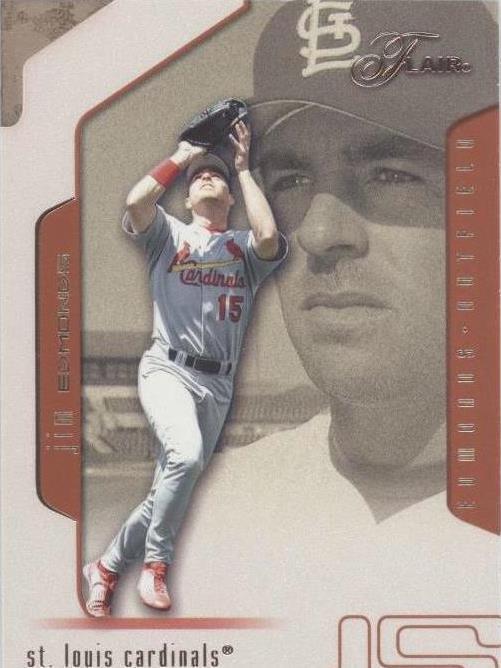
Jim Edmonds, 2002 Flair, #15

One of the top defensive center fielders of his time, Jim Edmonds played seventeen seasons from 1993-2010. He was a member of the Anaheim/California Angels (1993-1999) before being traded to the St. Louis Cardinals, where he played from 2000-2007. He spent the next couple of years jumping around, playing for the San Diego Padres and the Chicago Cubs in 2008, missing 2009, and finishing with stints on the Milwaukee Brewers and Cincinnati Reds in 2010. He had a career WAR of 60.4 and wore uniform number 15 for ten seasons, from 2000-2010.

This 2002 Flair card is perfect. I wanted a card that showcased Edmonds number and his defense, this had both. Flair is an interesting set. It was a “premium” set produced by fleer with glossy photos and thicker cards. They were first produced in 1993 and lasted until 1999, with a brief redo from 2002-2006 (which is when this card is from). I do appreciate the design and innovation at the time.

Edmonds was a four-time All-Star who won a Silver Slugger in 2004. He batted over .300 and had 30 or more home runs five times each. He also had over 100 RBIs in four seasons. He was a great defender and won eight Gold Glove Awards. He was a pivotal member of the 2006 World Series Champion Cardinals managed by Tony La Russa and featuring Hall of Fame third baseman Scott Rolan.

Edmonds retired after the 2010 season. He has a career batting average of .284 with 1,949 hits, 1,251 runs, 437 doubles, 393 home runs and 1,199 RBIs.

Currently 55, he is a member of the St. Louis Cardinals Hall of Fame.

Number 4:

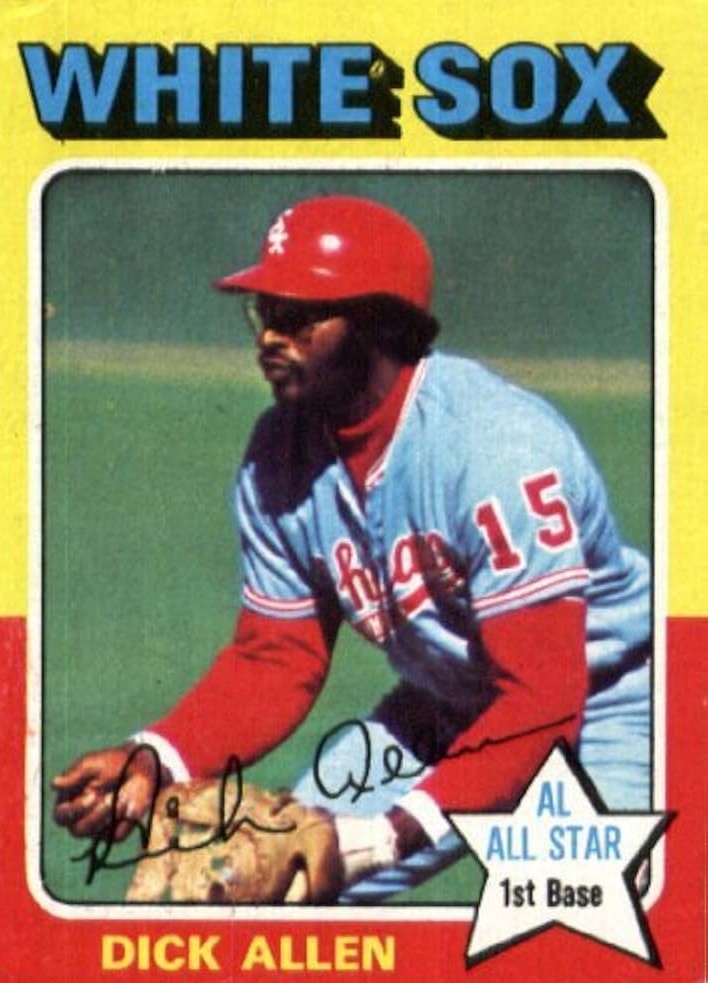
Dick Allen, 1975 Topps, #400

Dick Allen earned his nickname “Crash” when he “crashed” onto the Major League scene winning the Rookie of the Year Award in 1964. He played third and first for fifteen seasons from 1963 to 1977 as a member of the Philadelphia Phillies (1963-1969 and 1975-1976), St. Louis Cardinals (1970), Los Angeles Dodgers (1971), Chicago White Sox (1972-1974) and the Oakland Athletics (1977). He had a career WAR of 58.8 and wore uniform number 15 for thirteen seasons.

This 1975 card of “Crash” is pure nostalgia. I love the card design and the perfect 70’s color scheme. This is an All-Star card, and the uniform threw me off. Here Allen is on the White Sox, but the uniform looks so different than what normally comes to mind with the White Sox. In the 70’s the team tried several different uniform experiments including this color scheme and even shorts!

Dick Allen was a seven-time All-Star, he was the ROY in 1964 and was the American League MVP in 1972 when he led the league in home runs (37), RBIs (113), walks (99), OBP (.420), SLG (.603) and OPS 1.023. He had over 30 home runs in six seasons, leading the league twice and he batted over .300 seven times. Allen ended his career in 1977 after only 54 games with Oakland.

“Crash” has a career .292 batting average with 1,848 hits, 1,099 runs, 320 doubles, 79 triples, 351 home runs, 1,119 RBI’s and he is ranked 45th all-time in career SLG at .534. 

He is a member of the Philadelphia Phillies Wall of Fame, and his uniform number 15 was retired by the Phillies in 2020.

In 2025, the Classic Baseball Era Committee voted Allen into the National Baseball Hall of Fame.

Dick Allen passed away in 2020 at age 78.

Number 5:

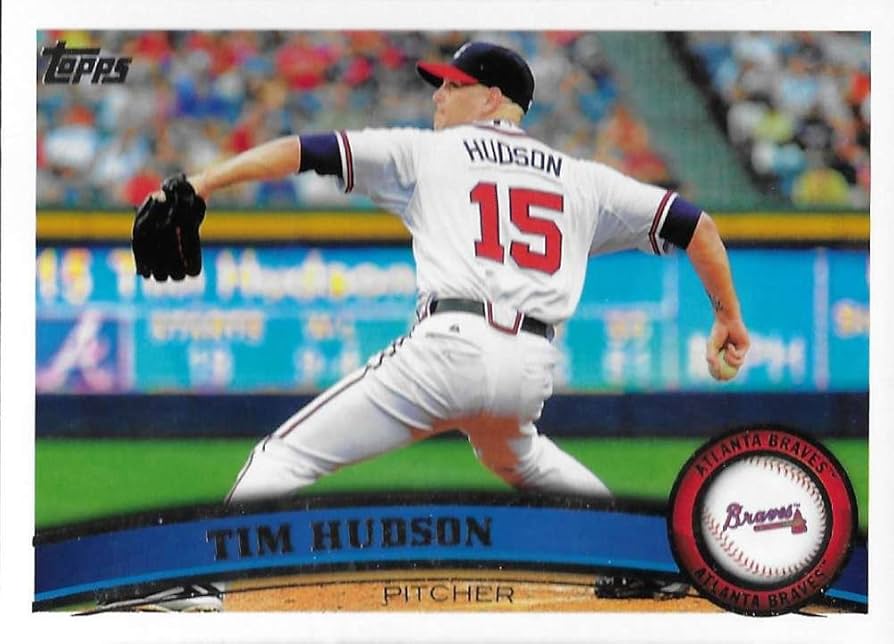
Tim Hudson, 2011 Topps, #77

Right-handed sinkerballer Tim Hudson pitched for seventeen years from 1999 to 2015 for the Oakland Athletics (1999-2004), Atlanta Braves (2005-2013) and the San Francisco Giants (2014-2015). He had a career WAR of 57.9 and wore uniform number 15 for fourteen seasons.

I love the landscape photo of Hudson on this 2011 Topps. He is with the Braves and it’s a perfect shot of his number. These are the cards I get excited about for this post and this is one of them. I love to have the uniform number fully visible.

Tim Hudson was an All-Star in four seasons. He led the league with 20 wins in 2000, and in 2010 he won the comeback player of the year after undergoing Tommy John surgery. During his comeback, he was 17-9 with a 2.83 ERA in 228 innings and had 139 strikeouts. Hudson was a member of the 2014 World Series Champion Giants along with fellow all-star pitcher Madison Bumgarner, all-star outfielder Hunter Pence and catcher Buster Posey.

Hudson played his final game in October of 2015 and left to a standing ovation. He had a career W/L% of .625 and is 222-133. He has a career ERA of 3.49, WHIP 1.239, ERA+ 120 with 2,080 strikeouts in 3,126 innings and 26 complete games and 13 shutouts.

Hudson is a member of the Athletics and the Braves Hall of Fames.

Since retiring he has coached college baseball and done some broadcasting while also being involved in philanthropy for children through his Hudson Family Foundation.

Number 6:

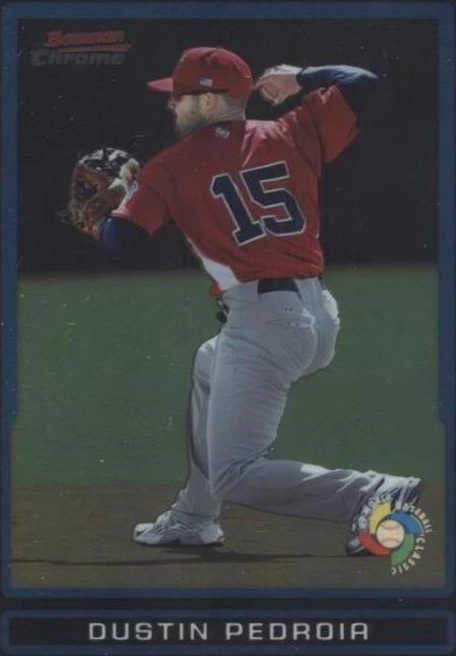
Dustin Pedroia, 2009 Bowman Chrome, #BDPW5

Aw Yeah! Always going to be wicked pumped when I get to feature a favorite. Dustin Pedroia played second base exclusively for the Red Sox from 2006-2019. He wore uniform number 15 for thirteen of his fourteen seasons, wearing 64 in 2006, and had a career WAR of 51.8.

Pedroia became an instant fan favorite in Fenway for his gritty play, hustle and stellar defense at second. He won the American League ROY in 2007 and was a four-time All-Star. He had 213 hits in 2008, leading the league. He had over 100 runs in four seasons, leading the league twice. He won the Silver Slugger in 2008. He also won 4 Gold Gloves, the first Red Sox infielder to do so.

He was a member of the 2007 and 2013 Red Sox World Series Championship teams. The 2007 team featured Hall of Famer David Ortiz and All-Stars Mike Lowell, Manny Ramirez, Josh Beckett, Jonathan Papelbon and rookie pitcher Hideki Okajima. The 2013 Red Sox team was filled with scrappy players and known for the “Fear the Beards” motto.

Sadly, Pedroia’s career wasn’t long. By 2018, he was suffering from significant knee issues and in 2018 and 2019 he only played 9 games combined. In 2020, he would miss the entire season and retired in 2021.

Pedroia had a career batting average of .299 with 1,805 hits, 922 runs, 394 doubles, 140 home runs and 725 RBIs.

He is a member of the Boston Red Sox Hall of Fame.

Number 7:

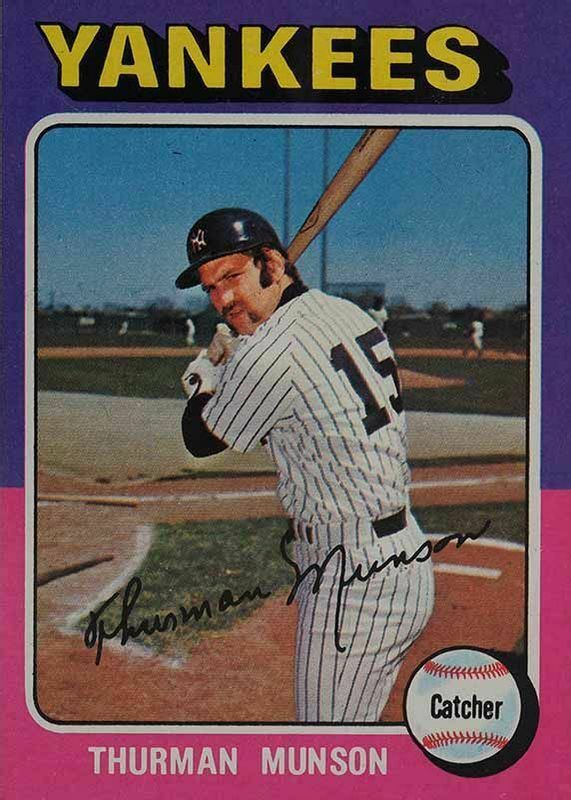
Thurman Munson, 1975 Topps, #20

From 1969 to 1979, Thurman Munson was an All-Star catcher for the New York Yankees. He played for eleven seasons before being killed in a tragic accident. Munson wore uniform number 15 for his entire eleven-year career and had a career WAR of 46.

I love the design of the 1975 Topps cards, and this one of Munson is perfect. The colors are awesome, the little baseball with his position is a nice touch, and the photo is great; Munson staring down the pitcher with his signature handlebar mustache under that intimidating glare, his number 15 visible on the back of his uniform. Perfection!

Munson was a seven-time All-Star who won the American League Rookie of the Year Award in 1970. He hit over .300 in five seasons and had over 100 RBIs three times. He was the American League MVP in 1976 beating out George Brett. That season he batted .302 with 186 hits, 17 home runs and 105 RBIs. He also won three Gold Glove awards and led the league in assists three times and fielding percentage once. Munson was named captain of the Yankees in 1976, the first captain since Gehrig in 1939. He was a member of the 1977 and 1978 World Series Champion New York Yankees along with pitcher Catfish Hunter and outfielder Reggie Jackson and pitcher Goose Gossage (1978).

Munson’s career ended in 1979 after he was tragically killed in a plane crash at 32 years old. He had a career batting average of .292 with 1,558 hits, 229 doubles, 32 triples, 113 home runs and 701 RBIs.

His uniform number 15 was retired by the New York Yankees in 1979 upon his death.

Final Score:

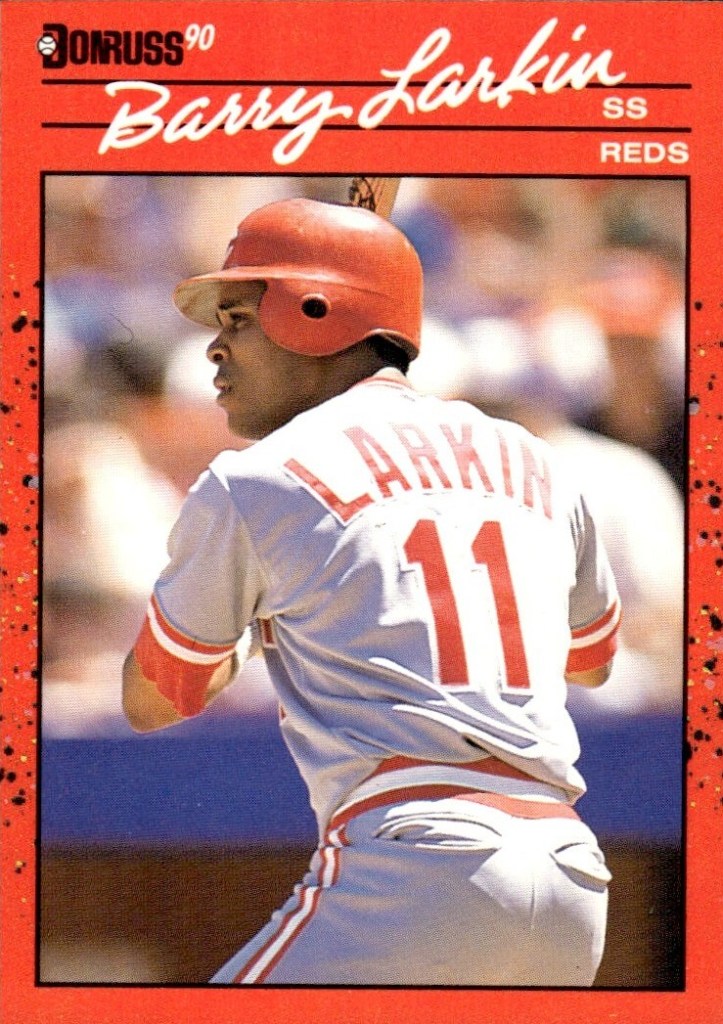
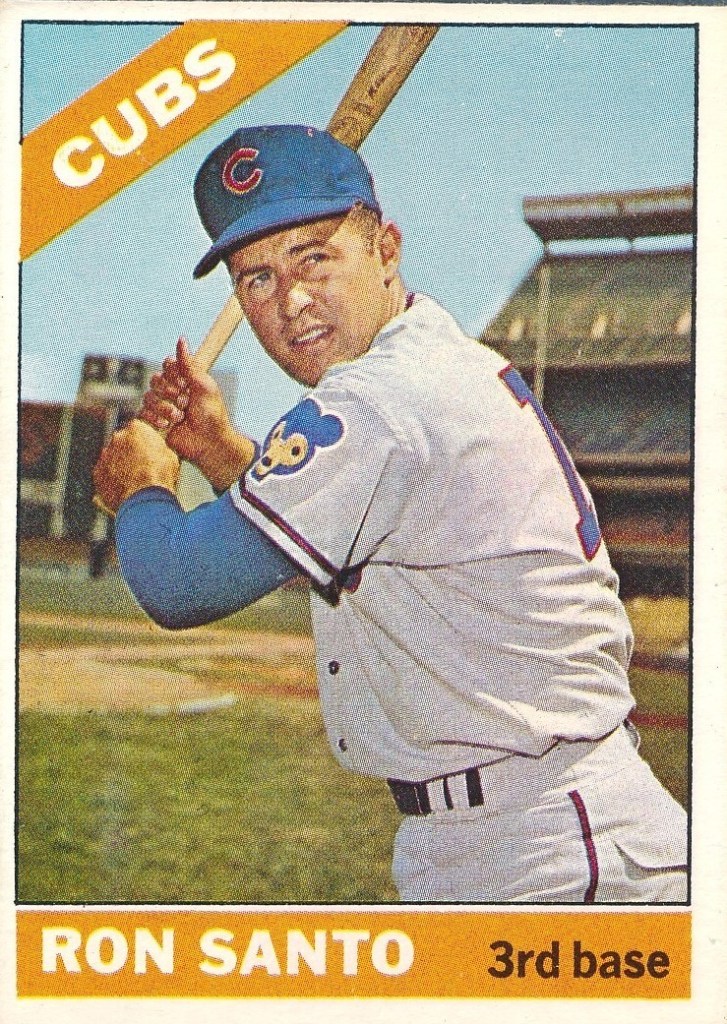
Number 15 was great! Let’s finish things off with a couple of quick shout outs. Joe Torre (WAR 57.7) who was featured under the uniform number 9 post also wore uniform number 15 for nine years with the Milwaukee/Atlanta Braves. Johnny Mize (WAR 70.6) wore it for 3 years with the New York Giants (1947-1949). Hall of Famers Ron Santo (70.5, Cubs 1960), Barry Larkin (70.5, Reds 1986-87), Dazzy Vance (60.4, Brooklyn Dodgers 1932) and Waite Hoyt (52.4, Brooklyn Dodgers 1938) all had uniform number 15 at some point. Of course, I always want to give props for longevity as well. George Foster, Davey Lopes, and Sandy Alomar Jr all wore uniform number 15 for sixteen years each.

Thank you so much for reading, it truly means so much to me. I hope you enjoy these posts. Please subscribe and share, like and comment, I’d love to hear from you! And stay tuned because uniform number 16 will be coming up soon!

Sources:

Austin, John (October 16th, 2012). “Carlos Beltran is Señor Octubre”. HighHeatStas.com

https://www.baseball-almanac.com/

https://www.baseball-reference.com/

Finnigan, Bob (September 24th, 1993). “Fitting Tribute? Johnson May Don Ryan’s No. 34 — Numbers Game Includes Records Within M’s Reach.” The Seattle Times

Pini, Jeff (November 4th, 2014). “Dustin Pedroia Makes Team History With Fourth Gold Glove Award.” Boston.com

https://sabr.org/

Shout out to all the cool cards and creative commons for my pictures! Thanks Topps and Fleer and Donruss and Upper Deck and all the rest.
Baseball by the Numbers: 14

Read about the Project
Checklist

14

Welcome back to Baseball by the Numbers. Today we are looking at uniform number 14. 755 players have worn number 14 at some point in their career. Two all-time greats wore this number for one season each. The amazing Willie Mays, who is 5th all-time for career WAR (156.2), had uniform number 14 his rookie season with the New York Giants in 1951. It was the only season he didn’t wear number 24. One of my all-time favorite players, the GOAT Rickey Henderson had uniform number 14 in 1993 while with the Toronto Blue Jays. Rickey is 19th all-time in career WAR at 111.2 and wore 6 different numbers throughout his career. Aside from those two legends, an additional thirty-two players who wore number 14 also had a career WAR of 40 or better and eighty-two players wore the number 14 for five years or more. Since Mays and Henderson only had this number 1 season each, there will be no “official” legend in this post, though the number 1 player is still a legend in my book. 

Number 1:

Pete Rose, 1965 Topps, #207

Mostly known as one of the best hitters in baseball history, Pete Rose was also a great defender. He is the only player with over 500 games played at five different positions (first base, second base, third base, right field and left field) and has also played games in center as well. There’s a helpful fact for your Immaculate Grid.

From 1963 to 1986, “Charlie Hustle” spent twenty-four seasons wowing fans with his defensive prowess and hitting and base running skills. Rose played for the Cincinnati Reds (1963-1978, 1984-1986), Philadelphia Phillies (1979-1983), and the Montreal Expos (1984). He wore uniform number 14 his entire career and had a career WAR of 79.6.

I love this 1965 Topps card of Pete Rose. It’s a great photo of him with the Reds, and his number is visible on the front of the uniform. I really like the design of 1965 Topps, especially the banner at the bottom with the team’s name and logo displayed. Love that old school Reds logo!

Rose has the 9th most All-Star appearances in history with seventeen. He is the only player to have had All-Star appearances at five different positions. Rose was the National League Rookie of the Year in 1963 and was the NL MVP in 1973. He has two Gold Glove awards, a Silver Slugger, and won the Roberto Clemente award in 1976. He hit .300 or better in fifteen seasons, leading the league three times. He led the league in hits seven times and had 200 or more hits in ten seasons, tied for the most with Ichiro Suzuki. He also led the league in doubles five times, runs four times and OBP twice.

Rose was a member of three World Series Championship teams. He won two (1975 and 1976) with the “Big Red Machine” Cincinnati Reds team which also featured manager Sparky Anderson, and Johnny Bench, Joe Morgan and Tony Perez. Rose was the MVP in the 1975 Series when he batted .370 with 10 hits, 3 runs, a double, a triple and 5 walks. He was won a ring as a member of the 1980 Phillies along with pitcher Steve Carlton and third baseman Mike Schmidt.

Rose played 95 games for the Expos in 1984 when he was traded back to the Reds. He would play his last few seasons with the Reds as a player/manager. He would retire as a player in 1986 but stay on as Reds manager through 1989.

Rose holds several MLB records. He is first in games played, at-bats, plate appearances and singles. His 4,256 hits is 1st all-time, and he had 100 or more hits in a record 23 straight seasons. He is also tied for first with ten seasons of 200 hits or more. He has a .303 career batting average and is 2nd all-time in doubles with 746 and 6th all-time in runs with 2,165. He has 135 triples, 160 home runs, 1,314 RBIs and 198 stolen bases. He ranks 14th in all-time walks (1,566) and 9th in Total Bases (5,752).

Rose is a member of the Cincinnati Reds Hall of Fame, and his uniform number 14 was retired by the Reds in 2016.

Despite all his achievements, Rose was banned from the National Baseball Hall of Fame in 1991 due to his inclusion on the permanently ineligible list in the aftermath of a gambling investigation in 1989.

Pete Rose passed away at the age of 83 in 2024.

In May of 2025, Rose became eligible for the Hall of Fame due to a change regarding permanent ineligibility after death. He will be eligible for Veterans Committee selection in 2027 and I hope he gets in.

Number 2:

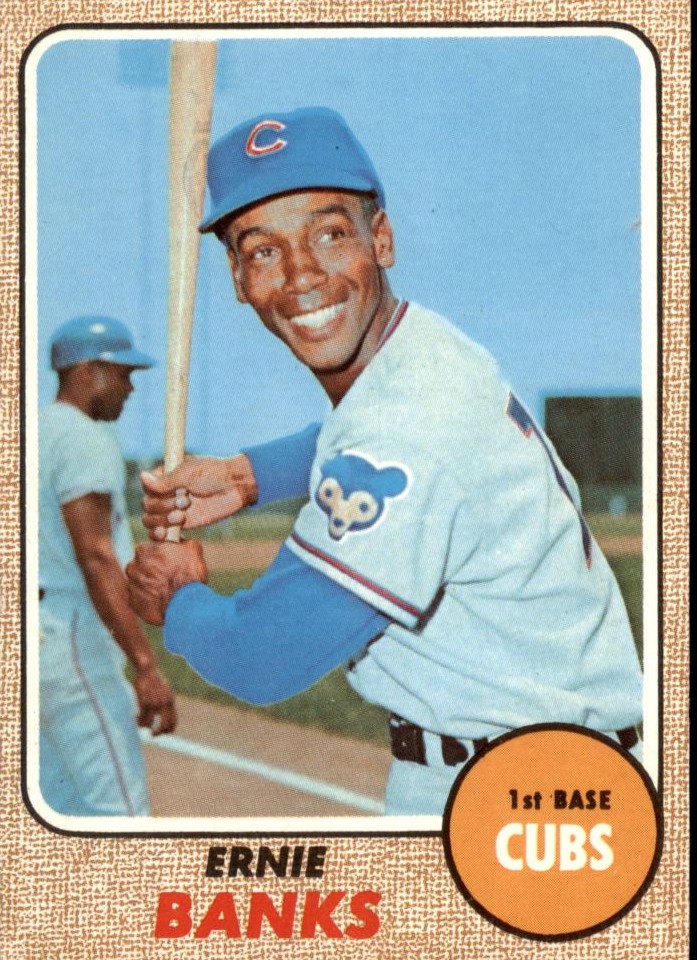
Ernie Banks, 1968 Topps, #355

Known as “Mr. Cub” for playing his entire nineteen-year career with the Chicago Cubs, Ernie Banks was a shortstop and first baseman from 1953 to 1971. Banks started his career in the Negro Leagues in 1950 and in 1953, became the first black player for the Chicago Cubs franchise. Banks wore uniform number 14 his entire career and had a career WAR of 67.8.

Look at that smile. This 1968 Topps card of Ernie Banks showcases his other nickname “Mr. Sunshine” given to him for his infectious smile and ever-present optimism and love of baseball. Aside from that smile, I really love the old Cubs uniforms and logo, and the design of these 1968 Topps is classic.

Banks was a phenomenal player. He placed 2nd in ROY voting in 1954 losing to Wally Moon. He was an All-Star fourteen times and won a Gold Glove in 1960. He was the National League MVP in 1958 and 1959. In 1958, he led the league in home runs (47), RBIs (129), SLG (.614) and TB (379) and in 1959 he had a league leading season WAR of 10.2 with 45 home runs and again led the league in RBIs with 143. Banks had over 40 home runs in five seasons and over 100 RBIs in eight. Banks was also a strong defensive player, and he led the National League in putouts five times and in fielding percentage four times.  

Banks won the Lou Gehrig Memorial Award in 1968 and retired in 1971. He was named to the MLB All-Century Team. He finished his career with a .274 batting average, 2,583 hits, 407 doubles, 512 home runs (23rd all-time), and 1,636 RBIs (33rd).

“Mr. Cub” is a member of the Chicago Cubs Hall of Fame and the Cubs retired his uniform number 14 in 1982.

Banks was inducted into the National Baseball Hall of Fame in 1977.

Ernie Banks passed away in 2015 at the age of 83.

Number 3:

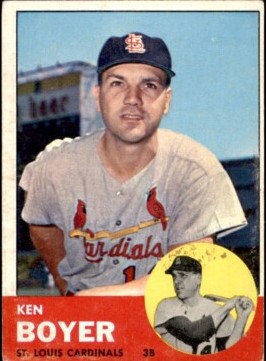
Ken Boyer, 1963 Topps, #375

Ken Boyer spent fifteen years in the Majors from 1955 to 1969. He was a third baseman whose best years were with the St. Louis Cardinals (1955-1965). He was traded to the Mets in 1965 and stayed with them until mid 1967 when he was traded to the Chicago White Sox for Sandy Alomar. He would eventually be released and spent the rest of his career with the Los Angeles Dodgers, playing his last game in August of 1969. Boyer had a career WAR of 62.8 and wore uniform number 14 for fourteen seasons, wearing 45 only with the Dodgers.

I like the 1963 Topps design with the little photo in the corner. I chose this card of Boyer because he is with the team he spent most of his career with and you can just about make out the uniform number 14 on the front of his jersey…just use your imagination and squint.

Boyer was a strong defensive third baseman. He earned 5 Gold Glove Awards and led the league in fielding percentage once and double-plays five times. He was an eleven-time All-Star who batted over .300 in five seasons and, in 1964, was voted National League MVP after hitting .295 with 185 hits, 30 doubles, 24 home runs and a league leading 119 RBIs. Playing alongside Lou Brock and pitcher Bob Gibson, Boyer’s MVP play in 1964 propelled the Cardinals to a World Series win.

Boyer ended his career with a .287 batting average, 2,143 hits, 318 doubles, 68 triples, 282 home runs and 1,141 RBIs. Defensively at third base he is ranked 32nd in putouts, 21st in assists and 14th in double plays turned all-time.

Boyer is a member of the St. Louis Cardinals Hall of Fame, and his uniform number 14 was retired by the Cardinals in 1984.

He was only 51 when he passed away from cancer in 1982.

Number 4:

Jim Bunning, 1963 Topps, #365

There have been over 238,000 games played in baseball over the course of roughly 154 years…and only 24 times has a pitcher pitched a perfect game. Jim Bunning accomplished that feat on June 21st, 1964.

Jim Bunning was a pitcher in the Majors for seventeen years from 1955 to 1971. He played for the Detroit Tigers (1955-1963), Philadelphia Phillies (1964-1967), Pittsburgh Pirates (1968-1969), Los Angeles Dodgers (1969) and finished back with the Phillies (1970-1971). He had a career WAR of 59.4 and wore uniform number 14 for sixteen seasons.

Like Boyer above, I used another 1963 Topps for Bunning since I had trouble finding a card with his number visible. In this card he is with the Tigers where he played for nine seasons.

Bunning was a nine-time All-Star. He had over 200 strikeouts in six seasons, leading the league three times and pitched over 200 innings in twelve (300+ twice). He led the league in season WAR twice, wins once and shutouts twice. Aside from his perfect game in 1964, mentioned above, he pitched a no-hitter on July 20th, 1958. He is one of only seven pitchers in history (along with Sandy Koufax, Addie Joss, Cy Young, Randy Johnson, Roy Halladay and Mark Buehrle) to pitch both a no-hitter and a perfect game in their career.

Bunning retired in 1971 with a career winning % of .549 with a 224-187 record. He has a career ERA of 3.27, WHIP 1.179 and ERA+ of 115. In 3,760.1 innings he is ranked 22nd in strikeouts with 2,855. He also has 151 complete games with 40 shutouts (44th all-time tied with 6 others) and he has 16 saves.

He is on the Phillies Wall of Fame, and his uniform number 14 was retired by Philly in 2001.

Bunning was elected to the National Baseball Hall of Fame in 1996.

After retirement Bunning was a politician and is the only baseball player in history to be elected to both the United States Senate and the National Baseball Hall of Fame.

Jim Bunning passed away in 2017 at the age of 85.

Number 5:

Larry Doby, 1949 Bowman, #233

Eleven weeks after Jackie Robinson broke the color barrier in Major League Baseball, centerfielder Larry Doby made his debut on July 5th, 1947. He was the first black player in the American League. Doby started with the Newark Eagles of the Negro Leagues and played four and a half years before joining the Majors. He played thirteen seasons in the Majors from 1947 to 1959 with Cleveland (1947-1955, 1958), Chicago White Sox (1956-1957, 1959) and the Detroit Tigers (1959). He had a career WAR of 56.7 and wore uniform number 14 for eleven seasons.

Doby was a Negro Leagues All-Star in 1946 and won the World Series with teammates Leon Day and Monte Irvin of the Newark Eagles that same year. In the Majors, Doby was a seven time All-Star. He led the league in runs once, home runs twice and RBIs once. He had over 100 RBIs in four seasons and hit over 20 home runs eight times. Doby was a part of the 1948 World Series Champion Cleveland Indians, a team that featured feature Hall of Famers Lou Boudreau, Bob Feller, Joe Gordon, Bob Lemon and Satchel Paige. “In Game 4 of the World Series against the Boston Braves, Doby became the first African-American player to homer in a World Series.” (Monagan, 2017)

Doby suffered from bone deterioration in his ankle and retired in 1959. He finished his career with a .283 batting average, 1,515 hits, 253 home runs and 970 RBIs.

Doby is a member of the Cleveland Guardians Hall of Fame. His uniform number 14 was retired by Cleveland in 1994, and he was elected to the National Baseball Hall of Fame in 1998.

Larry Doby passed away at age 79 in 2003.

Number 6:

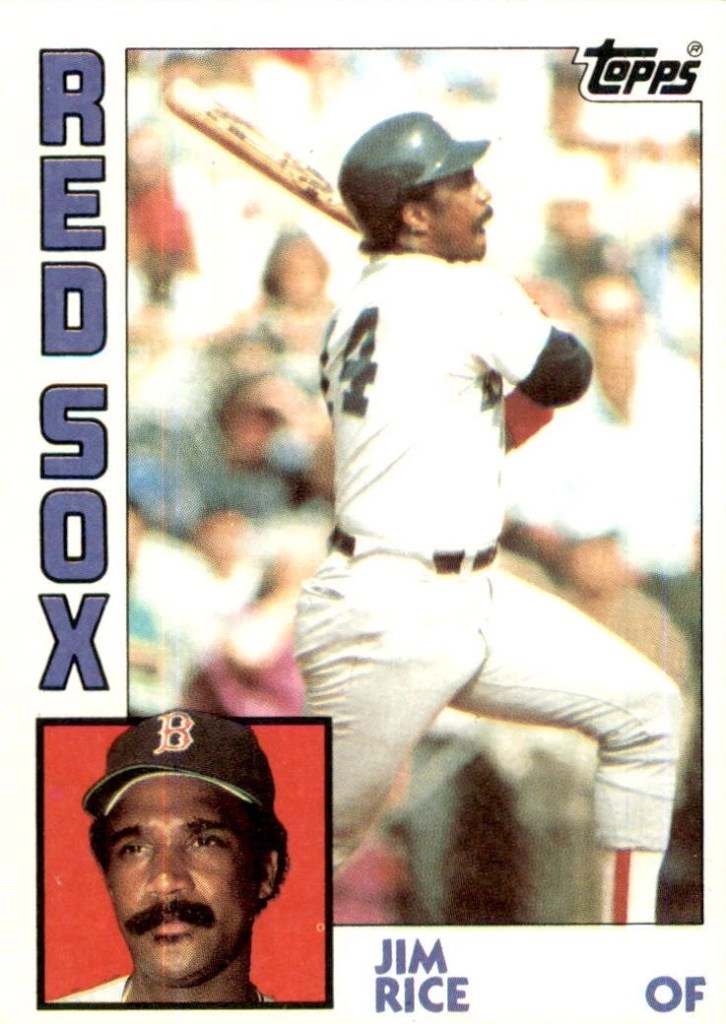
Jim Rice, 1984 Topps, #550

I’m always excited when I get to write about a Boston player, and Jim Rice is the quintessential Red Sox hero. Rice played from 1974 to 1989 and spent his entire sixteen-year career as a left fielder and later designated hitter for the Boston Red Sox. He wore uniform number 14 his entire career and had a career 47.7 WAR.

I’ve always been partial to the 1984 Topps design. I really like this card of Jim Rice. It’s a great example of the set, with the team’s name along the side and the portrait of Rice (and his great mustache) in the corner box. The main photo also works great for this post as you can see Rice’s number 14 on the back of his jersey as he completes his swing.

In 1975, Rice was second in Rookie of the Year voting, losing to teammate Fred Lynn. He won the American League MVP award in 1978 when he led the league in 14 categories including WAR (7.6), hits (213), triples (15), home runs (46) RBIs (139) and OPS (970). Rice is the only player in history to lead the league in home runs, RBIs, and triples in the same year. Blevins, David (2012)

He batted over .300 seven times with four 200+ hit seasons, hit over 30 home runs four-times and had over 100 RBIs eight times. He was an eight-time All-Star and won two Silver Sluggers. He was a member of two Red Sox World Series appearances (1975 and 1986). The Sox lost both 4 games to 3.  (ugg!)

Rice played his last game in August of 1989. He finished his career with a .298 batting average, 2,452 hits, 373 doubles, 79 triples, 382 home runs, 1,451 RBIs, 1,249 runs scored and 4,129 total bases.

Rice is a member of the Boston Red Sox Hall of Fame, and his uniform number 14 was retired by Boston in 2009.

He was inducted into the National Baseball Hall of Fame in 2009.

Rice is 72 years old and works as an analyst during Boston Red Sox pre and post-game shows for NESN (New England Sports Network).

Number 7:

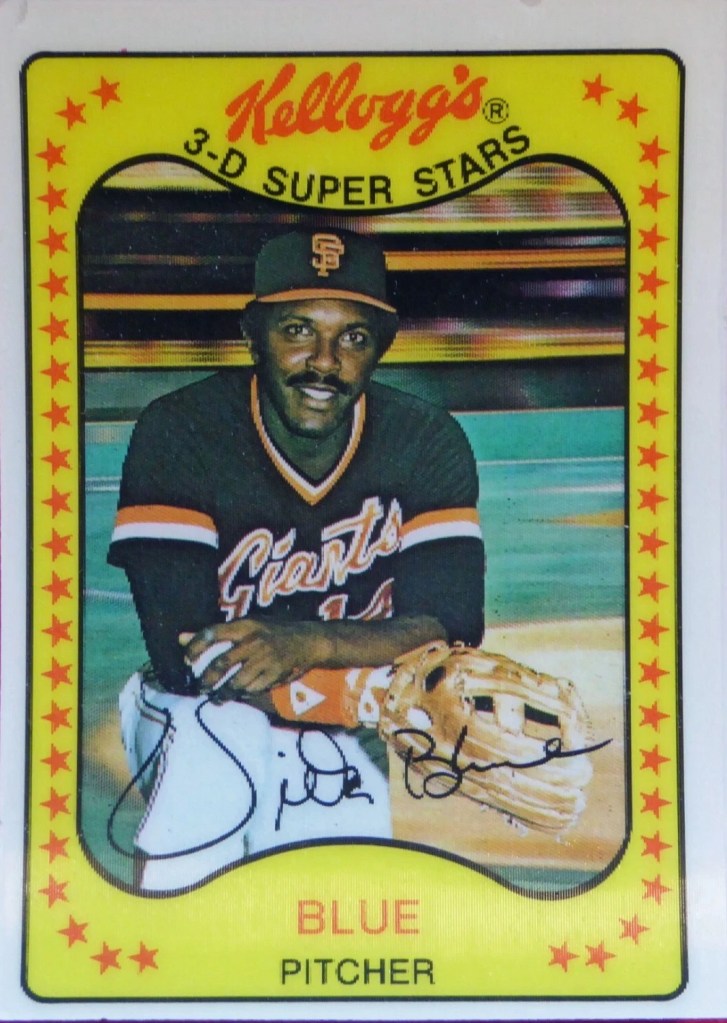
Vida Blue, 1981 Kellogg’s, #23

A left-handed fireballer, Vida Blue played for seventeen seasons from 1969 to 1986. Blue pitched for the Oakland Athletics (1969-1977), San Francisco Giants (1978-1981, 1985-1986) and Kansas City Royals (1982-1983). Originally wearing four different numbers while with the A’s (21,28,17,35), he switched to uniform number 14 in 1973 and wore it for most of the next twelve seasons (he also wore 33 while with Kansas City). Blue had a career WAR of 45.1.

I really wanted to pick a card with Vida Blue on the Oakland A’s, but the only cards I could find that had the number visible showed uniform number 35. Then I saw this beauty. I love Kellogg’s Brand 3-D baseball cards. This is from 1981 and you can see Blue’s number 14 right on the front of his Giants uniform.

Vida Blue won the Cy Young Award and was the American League MVP in 1971. In 39 starts, he went 24-8 with 24 complete games and led the league with 8 shutouts. He had 301 strikeouts in 312 innings for a league leading 8.7 SO9. He also led the league with a 1.82 ERA. He was also an All-Star, one of 6 seasons as an All-Star.

In his seventeen seasons, Blue had 20 or more wins three times and pitched for an under 3 ERA seven times. On September 21st, 1970, he pitched a no-hitter. Blue was a member of the Athletics three consecutive World Series Championships from 1972-1974 along with fellow pitchers Catfish Hunter and Rollie Fingers, and “Mr. October” Reggie Jackson.  

Blue played his last game in 1986. He would finish his career with a .565 W-L % on a 209-161 career record. He had a 3.27 ERA, 1.233 WHIP and an ERA+ of 108. In 3,343.1 innings he had 2,175 strikeouts with a SO9 of 5.9. He pitched 143 complete games and 37 shutouts.

He is a member of the Oakland Athletics Hall of Fame and the San Francisco Giants Wall of Fame.

Vida Blue passed away at the age of 73 in 2023.

Final Score:

It seemed that a lot of players like to keep number 14, so I wanted to highlight a few players who missed the cut but wore uniform number 14 for a long time. Hall of Famer Gil Hodges wore it for seventeen seasons, 3-time All-Star Julio Franco for 16 years, 6-time All-Star Paul Konerko wore it sixteen years while with he White Sox, the “Big Cat” Andrés Galarraga wore 14 for fifteen seasons, Minnesota Twins Legend Kent Hrbek wore it thirteen seasons, and 8-time All-Star Bill “Moose” Skowron wore uniform number 14 for twelve seasons. There are so many more, but they will have to wait for the next go through.

Thank you so much for reading. I hope you enjoy these posts. Please subscribe and share, like and comment, I’d love to hear from you! And stay tuned because uniform number 15 will be coming up soon!

Sources:

https://www.baseball-almanac.com/

https://www.baseball-reference.com/

Blevins, David (2012). The Sports Hall of Fame Encyclopedia: Baseball, Basketball, Football, Hockey, Soccer. Lanham, Maryland: The Scarecrow Press. p. 800. 

Coffey, Michael (2004). 27 Men Out: Baseball’s Perfect Games. New York: Atria Books. pp. 79–95

Monagan, Matt (2017). Nearly 70 years ago, Larry Doby became the first African-American player to hit a World Series HR, mlb.com

https://www.sabr.org

Shout out to all the cool cards and creative commons for my pictures! Thanks Topps and Fleer and Donruss and Upper Deck and all the rest.
 

Baseball by the Numbers: 13

Read about the Project
Checklist

13

Welcome back to Baseball by the Numbers. Today we are looking at lucky uniform number 13. Only 367 players in history wore this number, which makes me think that superstitions may be at play. And it might be justified because only eight players with uniform number 13 have a career WAR over 40, and one of them, the legend, is filled with controversy. Due to this, I will be using a couple of players with under 40 career WAR for this post. Sixty-four players who wore number 13, wore it for five years or more. The legend is a player who is 16th in career WAR yet has never been voted into the Hall of Fame. The reason involved his positive test and subsequent admission to and suspension for the use of performance enhancing drugs (PEDs). I’m sure most of you can guess who it is.

The Legend

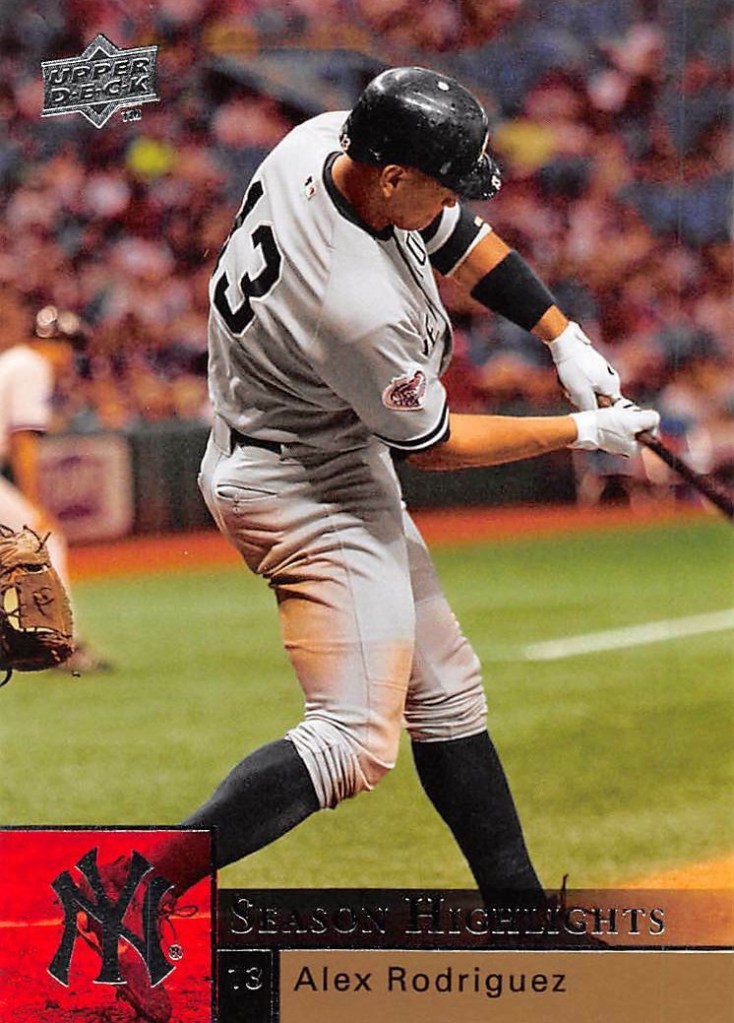
Alex Rodriguez, 2009 Upper Deck, #469

One of the greatest players of all time, Alex Rodriguez played shortstop and third base for twenty-two years. From 1994 to 2016, “A-Rod” played for the Seattle Mariners (1994 -2000), Texas Rangers (2001-2003) and the New York Yankees (2004-2013, 2015-2016). He missed 2014 due to a suspension from baseball. He is 16th all-time in career WAR with a 117.4 and he wore uniform number 13 for twelve seasons while with the Yankees. Rodriguez also wore number 3 the rest of his career and I mentioned him in that post, but left the legend spot to The Babe.

On September 3rd, 2008, Alex Rodriguez smashed his 549th home run. The two-run bomb came in the 9th inning off Tampa pitcher Troy Percival. Tampa manager Joe Maddon thought the ball went foul and contested it. For the first time in MLB history the umpires used instant replay, the home run was ruled fair, and the Yankees won the game 8-4. This 2009 Upper Deck Highlights card commemorates that event, and it has his number 13 showing so a win-win!

A-Rod was a 14-time All-Star with ten Silver Slugger Awards, two Gold Gloves and he won the American League Hank Aaron Award four times. He batted over .300 in nine seasons, leading the league in 1996 with a .358 average. He led the league in home runs 5 times, with over 40 home runs in five seasons and over 50 in three seasons. He was the American League MVP in 2003, 2005 and 2007. He is also a member of the 40-40 club when in 1998 he had 42 home runs and 46 stolen bases.  A-Rod was a member of the World Series Champion New York Yankees in 2009 along with star shortstop Derek Jeter, pitcher CC Sabathia and closer Mariano Rivera.  

A-Rod was suspended for the entire 2014 season due to his involvement in the Biogenesis scandal related to performance enhancing drugs. He would come back in 2015 as a DH for the Yankees, but in 2016 he would be regulated to pinch hitting and after 65 games, Rodriguez retired as a player.

Rodriguez’s overall stats are amazing, placing in the top 50 in many categories. He has a career batting average of .295 with 3,115 hits (24th all-time), 548 doubles (33rd) and is 5th all-time in home runs with 696. A-Rod is 8th in runs (2,021), 4th in RBIs (2,086), 29th in SLG (.550), 43rd in OPS (.930) and 7th in Total Bases (5,813). He also has a career OBP of .380 and 329 stolen bases.

Due to the controversies surrounding his suspension and use of PEDs, Rodriguez has not been voted for the Baseball Hall of Fame. His number is not retired either. He is currently 50, ans is a businessman and has been a baseball analyst and host for a number of networks.

 Number 1:

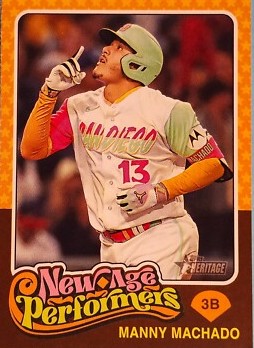
Manny Machado, 2024 Topps Heritage New Age Performers, #NAP-13

Another active player to make the list, Manny Machado is entering his 15th season in the Majors. He has played shortstop and third base since 2012. Machado started his career with the Baltimore Orioles until he was traded to the Dodgers during the 2018 season. Machado only stayed with the Dodgers for 66 games. He signed a 10-year, $300 million contract (the largest at the time) with the San Diego Padres in 2019 which would run through the 2028 season. He currently has a career WAR of 61.7 (9th best of all active players) and aside from that half season with the Dodgers (number 8), he has worn number 13 for fourteen years.

I thought this 2024 Topps Heritage card was a great one to use for the post. Machado is in the Padres cool City Connect uniform, with his number visible on the front. I think this is a nice-looking card with a vintage feel, cool photo and of course the number showing.

Machado has been selected for the All-Star team seven times in his career. He has 2 Gold Glove Awards, 1 Platinum Glove, and is a 3-time Silver Slugger. He has seven seasons with 30 or more home runs and nine with 30 or more doubles, leading the league once in doubles with 51. He is also a 2-time All-MLB First Team member.

Machado is currently 33 years old. He plays for the Padres and should remain with them through 2028. In 2025, he was an All-Star and batted .275 with 169 hits, 33 doubles, 27 home runs, 95 RBIs and 14 stolen bases.

Number 2:

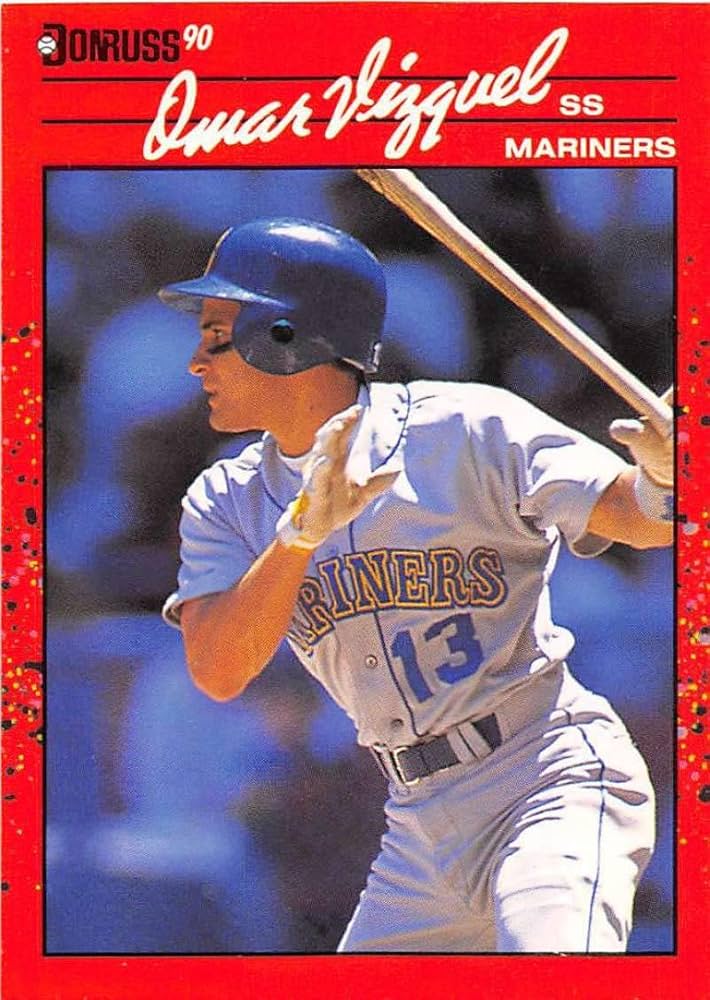
Omar Vizquel, 1990 Donruss, #483

Omar Vizquel played 24 seasons as a shortstop and third baseman from 1989-2012. He played for the Seattle Mariners (1989-1993), Cleveland (1994-2004), San Francisco Giants (2005-2008), Texas Rangers (2009), Chicago White Sox (2010-2011) and Toronto Blue Jays (2012). He had a career WAR of 45.6 and wore uniform number 13 for twenty-two seasons.

I’m always happy to use a card from my collecting days. 1990 Donruss never disappoints. It was such a popular set when I was a kid, mainly due to the poor quality control and the dozens of error cards that we all thought were going to be worth a fortune (spoiler: they weren’t). This card of Vizquel works perfectly. It’s a nice photo that shows his uniform number on the front.

Vizquel was a 3-time All-Star known more for his outstanding defense than his hitting. He was an 11-time Gold Glove Award winner and led the league’s shortstops in putouts once and fielding percentage six times. He went 95 games without an error between September 1999 to July of 2000, a record at the time. In 2000, he tied the record for lowest number of errors in a season at shortstop with 3.

Vizquel retired after the 2012 season. His career 2,877 hits are 44th all-time. He has a career .272 batting average with 456 doubles, 77 triples, 80 home runs, 1,445 runs, 951 RBIs and 404 stolen bases. He has the highest career fielding percentage of all shortstops in history at .9847. He also has the most double plays made at short and is fifth all-time in assists at all positions.

Vizquel is a member of the Cleveland Guardians Hall of Fame.  

Number 3:

Claude Passeau” by RebelNation1947 is licensed under cc by-sa 2.0.

In the history of the World Series there have only been a handful of low hit games. One of those came in 1945 between the Chicago Cubs and the Detroit Tigers. In game three, Claude Passeau of the Cubs threw a complete game, one-hit gem against the Tigers. He got a nice win, but the Tigers eventually won the series 4 games to 3.

Claude Passeau had a short but productive thirteen-year career from 1935-1947. He was a right-handed pitcher who played for the Pittsburgh Pirates (1935), Philadelphia Phillies (1936-1939) and the Chicago Cubs (1939-1947). He wore uniform number 13 for ten seasons and had a career WAR of 45.1.

I couldn’t find many cards of Passeau, so I grabbed this photo off creative commons. It’s a nice action shot from 1936. In 1936, Passeau was with the Phillies and wore uniform number 48. He went 11-15 that season with a 3.48 ERA in 217 innings. He also had 8 complete games.

Passeau was a five-time All-Star who led the league in strikeouts in 1939 with 137. Like many pitchers at the time, he pitched a lot of innings, over 200 eleven times, leading the league with 292 in 1937. He also had 10 or more complete games ten times.

He would finish his career with a .519 w/l% going 162-150. He had a career ERA of 3.32 with 1,104 strikeouts in 2,719.2 innings.

Claude Passeau passed away in 2003 at the age of 94.

Number 4:

Dave Concepción, 1979 Topps, #450

A career Cincinnati Red, Dave Concepción played shortstop for nineteen seasons from 1970-1988. He and fellow shortstop Barry Larkin are tied for most seasons with the Reds. He wore uniform number 13 his entire career and has a career WAR of 40.1.

I love this 1979 Topps card. I like the set, and the design is great with the little Topps logo in the corner, and the team’s name in the banner under the photo. This is a beautiful photo of Concepción, and I love when the uniform number is on the front of the jersey.

Concepción was an All-Star in nine seasons winning the All-Star game MVP in 1982. He won five Gold Glove awards and two Silver Sluggers. He was a strong defender and led the league in assists twice, putouts once and fielding percentage once. He was a member of The Big Red Machine, a Reds team that won the World Series in 1975 and 1976. The team was managed by the great Sparky Anderson and featured Pete Rose, Joe Morgan, Tony Perez, George Foster, Ken Griffey Sr. and Johnny Bench.   

He retired at age 40 after the 1988 season with a .267 career batting average, 993 runs, 2,323 hits, 389 doubles, 48 triples, 101 home runs, 950 RBIs and 321 stolen bases.

Concepción is a member of the Reds Hall of Fame, and his uniform number 13 was retired by Cincinnati in 2007. He is also a member of the Venezuelan Hall of Fame.

Number 5:

Lance Parrish, 1987 Topps, #791

One of my favorite players growing up, Lance Parrish played catcher for nineteen seasons from 1977-1995. He played for the Detroit Tigers from 1977-1986, which is when I started collecting his cards. I loved the Tigers in the mid 80’s and Parrish, along with “Sweet Lou” Whitaker, were my favorites on the team. Parrish also played for the Philadelphia Phillies (1987-1988), he was traded to the California Angels in 1988 and stayed with them until 1992. He then bounced around a lot playing for the Seattle Mariners (1992), Cleveland Indians (1993), Pittsburgh Pirates (1994) and Toronto Blue Jays (1995). He wore uniform number 13 eighteen seasons and had a career WAR of 39.5.

I just loved this 1987 Topps photo of Parrish. As you all know I’m a huge 1987 Topps fan, it was my first full set of cards as a kid and holds such a strong place in my nostalgic filled heart. This card is so awesome. Parrish is decked out in his full catcher’s gear, the cool Tigers logo is in the top corner (I love the team logo on the front of the cards!), and his name is in the blue box at the bottom of that familiar wood border. 

Parrish was nicknamed “Big Wheel”. Fantastic Nickname! He was a strong defensive catcher who could also hit the ball. He made the All-Star team eight times, won six Silver Slugger awards and was a three-time Gold Glove winner. He led the league’s catchers in double plays three times, assists once, caught stealing twice and caught stealing percentage twice. On the offensive end, he had six seasons of 20 plus home runs and had 114 RBIs in 1983. He was a member of the Detroit Tigers 1984 World Series Championship. The team was managed by Sparky Anderson (who I mentioned earlier with Dave Concepción) and included Kirk Gibson, Alan Trammell, Chet Lemon, Lou Whitaker, Darrell Evans and pitcher Jack Morris.

After bouncing around a bit his last few seasons, Parrish played his final game in 1995. He had a career .252 batting average with 1,782 hits, 305 doubles, 324 home runs, 1,070 RBIs and a .991 lifetime fielding percentage.

Now 69 years old, Parrish has been involved in coaching and managing and is a special assistant in the Tigers organization.

Number 6:

Carl Crawford, 2008 Upper Deck, #784

“The Perfect Storm”, Carl Crawford played leftfield for fifteen years from 2002 to 2016, most notably with the Tampa Bay Rays (2002-2010). He also played with the Boston Red Sox (2011-2012) and the Los Angeles Dodgers (2013-2016). He had a career WAR of 39.2 and wore uniform number 13 for ten seasons.

Crawford was a speedy player. The four-time All-Star led the league in stolen bases and triples four times each. He had over 40 stolen bases in seven seasons, eclipsing 50 four times and had 60 stolen bases in 2009. He batted over .300 in six seasons and won both a Gold Glove and a Silver Slugger award in 2010.

He finished his career with a lifetime .290 batting average, 1,931 hits, 989 runs, 309 doubles, 123 tiples, 136 home runs, 766 RBIs and is 43rd all-time with 480 stolen bases.

Crawford is a member of the Tampa Bay Rays Hall of Fame.

He is currently the CEO of record label 1501 Certified Entertainment who signed then newcomer Megan Thee Stallion in 2018. 

Number 7:

Billy Wagner, 2003 Donruss, #298

Although he has a lower career WAR then most of the players I’ve chosen in this series (27.7), “Billy the Kid” deserves a spot on this list. He is also the first relief pitcher I’ve featured. Billy Wagner was an elite closer who played sixteen seasons from 1995 to 2010. From 1995 to 2003 he played for the Houston Astros until he was traded to the Philadelphia Phillies (2004-2005). He then played for the New York Mets (2006-2009), the Reds Sox (2009) and the Atlanta Braves (2010). He wore uniform number 13 for his entire career.

The left-handed closer was an All-Star seven times. He won the Rolaids Relief Man Award in 1999.

Wagner is 8th all-time with 422 saves. He pitched for 903 innings and had 47 wins. His lifetime ERA is 2.31, with 1,198 strikeouts and .998 WHIP. Among pitchers with at least 800 innings, he has the highest k/9 (11.9) and strikeout rate (33.2 %) and only a .187 average against him.

Wagner is a member of the Houston Astros Hall of Fame, and they retired his uniform number 13 in 2025.

Wagner was inducted into the Baseball Hall of Fame in 2025.

Final Score:

This was the first time I’ve dipped below the 40 career WAR threshold since my first two posts (00 and 0), but it was well worth it, especially since I got to feature Parrish. There were a few players who I could have put on this list ahead of Wagner, but the Hall of Fame closer deserved a place.

A few great players wore uniform number 13 for short periods of time. Hall of Famer Roberto Clemente (95 WAR, 1955/Pirates), Pitcher Zack Greinke (77.4 WAR, 2011-2012/Brewers), pitcher David Cone (62.3 WAR, 1986/Royals) and current Atlanta Brave Matt Olsen (39.7 WAR, Athletics/2016).

Infielder Hanley Ramírez wore uniform number 13 for eight seasons. He was the ROY in 2006 and was a 3-time All-Star who played fifteen seasons with a career WAR of 38.3. Nine-time All-Star and current Kansas City Royals great Salvador Perez wore 13 for his entire fourteen-year career thus far. I’d be remiss if I didn’t mention John Valentin who wore uniform number 13 from 1992-2001 while with the Boston Red Sox and has a career WAR of 32.5.

As always, I could go on all day. If I missed someone that you like feel free to give them a shoutout in the comments. Thanks for reading and please hit the subscribe. Stay tuned for uniform number 14!

Sources:

https://www.baseball-almanac.com/

https://www.baseball-reference.com/

Jaffe, Jay (December 19, 2017). “Billy Wagner’s dominance gives him a surprisingly strong Hall of Fame case”Sports Illustrated.

Rodriguez makes history Ninth-inning home run becomes first replay 9/4/2008 The Spokesman Review

https://www.sabr.org

Shout out to all the cool cards and creative commons for my pictures! Thanks Topps and Fleer and Donruss and Upper Deck and all the rest.
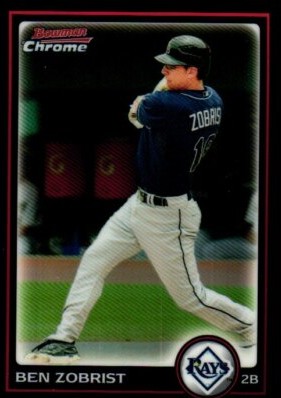
Baseball by the Numbers: 12

Read about the Project
Checklist

12

Welcome back to Baseball by the Numbers. Today we are looking at uniform number 12. I found nearly 900 players in history who wore uniform number 12. Two players had a 100 plus WAR but only wore the number 12 for one season each. In 1999, the “Rocket” Roger Clemens (WAR 139.2) wore the number 12 for half a season after being traded to the Damn Yankees from the Blue Jays. He would switch to 22 midway through the season. Joe Morgan (WAR 100.6), who was the featured legend for uniform number 8, wore number 12  in his rookie season with the  Houston Colt .45s. Aside from these two, thirty-four other players with a career WAR of 40 or more wore uniform number 12 and 101 different players had the number for five years or more. There was no legend for this uniform number. Picking the first player was heartbreaking. He was one of my favorites for a long time growing up, but he wore a different number when he was a Red Sox hero, then he turned heel, joined the Evil Empire and took on the number 12. Luckly, another of my favorite players wore the number 12 while with the Sox, so that balanced things out.

Number 1:

Wade Boggs, 2000 Topps Highlights, #458

The “Chicken Man” was one of my favorite players growing up. From 1982 to 1999, Wade Boggs played third base for three teams. He began his eighteen-year career with the Red Sox (1982-1992) where he was a Fenway hero. Then in a move out of the WWE playbook, he turned heel and signed with the Evil Empire, the New York Yankees (1993-1997). He would finish his career with the Tampa Bay Rays (1998-1999). He wore uniform number 12 while with the Yankees and the Rays and had a career WAR of 91.4.

When Wade Boggs smacked a home run off Cleveland pitcher Chris Haney in the 6th inning of a Rays home game on August 7th, 1999, he made history. It was the first time a player would obtain his 3,000th hit on a home run. What’s crazy to me is the fact that two more players actually accomplished the same feat, Derek Jeter in 2011 and Alex Rodriguez in 2015. It’s these types of facts that make baseball so fascinating to me. This 2000 Topps Highlights card commemorates Bogg’s historic hit, and since it featured him in the number 12 uniform number, it was perfect for the post…plus he’s with Tampa, so it takes away some of the sting.

Boggs was an All-Star in twelve straight seasons and won the Silver Slugger 8-times. He was a prolific hitter, batting .300 or more in fifteen of his eighteen seasons, winning the American League batting title 5-times. He had over 200 hits in seven seasons, leading the league with 240 in 1985. He also led the league in OBP 6 times. He has 2 Gold Gloves at the hot corner. Boggs was a member of the World Series Champion Yankees in 1996 (uggg). A great team managed by Joe Torre, and featuring Hall of Famers Derek Jeter, Tim Raines and closer Mariano Rivera.

In 1999, 20 days after his historic 3,000th hit, Boggs would sustain an injury and never play again. He finished his career 31st all-time with 3,010 hits. His .328 career batting average is ranked 39th all-time. He also had 578 doubles (24th all-time), 61 triples, 118 home runs, 1,014 RBIs and 1,513 runs. His .415 career OBP is ranked 27th all-time.

There are only a handful of players who have multiple retired numbers for different teams, and Boggs in one of them. Boggs is a member of the Red Sox Hall of Fame and his number 26 while with the Boston was retired in 2016.

He is a member of the Tampa Bay Rays Hall of Fame, and his uniform number 12 was retired by the Rays in 2000, the only player with a retired number for the franchise. The other two retired numbers are coach Don Zimmer (66) and Jackie Robinson’s number 42, which is retired throughout the entire MLB.

Boggs was inducted into the National Baseball Hall of Fame in 2005.

Number 2:

Francisco Lindor, 2023 Topps, #450

This is the second time that I have featured a currently active player. Francisco Lindor is a shortstop currently playing with the New York Mets. He will be entering his twelfth season in the league. Lindor has played since 2015 when he began his career with Cleveland. He was traded to the Mets in 2020 and signed a 10-year deal that runs through 2031. He has worn uniform number 12 for his entire career and currently has a 55.7 career WAR.

I used his 2023 Topps card because it features him with his current team and shows his uniform number on the front. Lindor had a great 2023 season with 31 home runs and 31 stolen bases.

Lindor was second in ROY voting in 2015 and has been selected to 5 All-Star games. He’s won 4 Silver Slugger awards and is a 2-time member of the 30-30 club (2023 and 2025). He also has 2 Gold Glove awards.

Lindor is currently 32 years old. In 2025, Lindor played 160 games, batting .267 with 31 home runs, 31 stolen bases, and 86 RBI for his 2nd career 30-30 season.  He had minor surgery in the off-season but is expected to be a key contributor for the Mets in 2026.

Number 3:

Jeff Kent, 1994 Upper Deck Collector’s Choice, #159

As I write this, Jeff Kent was just elected as the newest member of the National Baseball Hall of Fame. He played 17 seasons from 1992 to 2008. He started his career with the Blue Jays for one season, then played for the New York Mets, Cleveland Indians, San Francisco Giants, Houston Astros and Los Angeles Dodgers. He wore uniform number 12 for ten seasons and had a career WAR of 55.4.

This 1994 Upper Deck Collector’s Choice has a great photo of Kent in the field, his uniform number clearly visible in the photo. Kent played for the Mets for four and a half years.

Jeff Kent was an All-Star five times and won 4 Silver Slugger awards. Kent was the National League MVP in 2000 when he had 196 hits for a .334 batting average with 41 doubles, 33 home runs and 125 RBIs. A great clutch hitter, Kent had over 100 RBIs in eight seasons and had six seasons with over 25 home runs.

Jeff Kent retired in 2009. He had a career batting average of .290 with 2,461 hits, 560 doubles (30th all-time), 377 home runs (the most by any second baseman), 1,320 runs and 1,518 RBIs.

On December 7th, 2025, it was announced the Kent was elected to the National Baseball Hall of Fame through the Contemporary Era Committee. He will be inducted in 2026.

Number 4:

Mark Langston, 1987 Topps, #215

Left-handed pitcher Mark Langston played sixteen seasons in the Majors from 1984 to 1999. He started his career with the Seattle Mariners where he played until 1989. He was traded to the Expos in May of 1989 in a trade that brought future Hall of Famer Randy Johnson to the Mariners. Langston played only 24 games in Montreal when he signed with the California Angels on a five-year, $16 million contract starting the 1990 season, the highest contract of any player at the time. He stayed with the Angels until 1997. He then played two more seasons, with San Diego (1998) and Cleveland (1999), before hanging up the cleats. He wore uniform number 12 for his first fourteen seasons and had a career WAR of 50.1.

I love this 1987 Topps card of Langston. The 1987 Topps set holds a special place in my heart, and this card is near perfect; the action shot with Langston’s number 12 showing, the blue background color in the name box, and the Mariners logo at the top. It’s one of those cards that I just love.

Langston started off his career strong. He was runner up for American League Rookie of the Year in 1984 losing to teammate Alvin Davis. He had 204 strikeouts that season, the first of five seasons with 200 or more K’s. He was a 4-time All-Star, who led the league in strikeouts 3 times. He was also a terrific fielder on the mound, he led the league in assists 3 times and won seven Gold Gloves. He was a part of a combined no-hitter in 1990, pitching the first 7 innings before Mike Witt would complete the game. He was great at pickoffs and once had three in a game, one of only eight players known to have accomplished this feat.

When he retired from baseball, he had a career record of 179-158, a .531 w/l %. He is 44th all-time with 2,464 strikeouts in 2,962.2 innings, with a 7.9 career SO9. He had 81 complete games, 18 shutouts, a 3.97 ERA and 1.354 WHIP. He also had an ERA+ of 107.

Langston is 65 years old and serves as the radio color-commentator for the Los Angeles Angels.

Number 5:

Ellis Burks, 1992 Bowman, #570

Yes! One of my favorite players growing up, Ellis Burks, played outfield for eighteen seasons from 1987 to 2004. He started off with the Boston Red Sox for six seasons and wore number 12 during that time. He would go on to wear three other numbers while bouncing around a bit. After leaving Boston, he played with the Chicago White Sox (1993), Colorado Rockies (1994 -1998), the San Francisco Giants (1998-2000) and the Cleveland Indians (2001-2003). He would finish his career back with Boston for the 2004 season. He wore uniform number 12 his first six seasons with the Red Sox and had a career WAR of 49.8.

This 1992 Bowman is beautiful. I remember the 1992 Bowman as having nice photos and a clean design. They are missing the team logo on the front, which is a pet peeve of mine, but overall, the cards look great and this one of Burks in his Red Sox uniform, taking a big swing, his number 12 clear in the photo was a perfect pick for the post.

Burks was a two-time All-Star and won two Silver Slugger awards. He hit .290 or better in seven seasons, with two seasons hitting .344, He led the league once each in runs, SLG and total bases. Burks was honored with a World Series ring as a part of the 2004 Boston Red Sox team that won their first World Series in 86 years, breaking the “Curse of the Bambino”. Although he only played 11 games during the season, and was not on the roster for the playoffs, Burks was considered a mentor to the young players during the season and the playoffs.

Burks retired after 2004 with a career batting average of .291 with 2,107 hits, 402 doubles, 63 Triples, 352 home runs, 1,206 RBIs, 1,253 runs, and 181 stolen bases.

Ellis Burks is currently an analyst and commentator for the Boston Red Sox at NESN (New England Sports Network).

Number 6:

Steve Finley, 2000 Topps Stadium Club, #133

From 1989 to 2007, Steve Finley played centerfield for eight different teams during his nineteen-year career. He started his career in Baltimore (1989-1990). In 1991, he was traded to the Houston Astros, along with pitchers Curt Schilling and Pete Harnisch for Glenn Davis. He stayed in Houston for 4 seasons until he was traded to the Padres (1995-1998). He then signed with the Arizona Diamondbacks (1999-2004), was traded to the Dodgers (2004), signed with the Angels (2005), the Giants (2006) and finally the Colorado Rockies (2007). His 43 games in Colorado made him one of only two players to play for all five National League West teams. He wore uniform number 12 for seventeen seasons and had a career WAR of 44.2.

Finley was a two-time All-Star. Known for his speed and stellar defense, he had 20 or more stolen bases and 100 or more runs in five seasons and led the league in triples twice. He also won five Gold Gloves. He won a World Series ring with the Arizona Diamondbacks in 2001, which I why I featured this nice 2000 Topps Stadium Club card for Finley. Not only is he with Arizona, but he’s mid slide with his uniform number 12 facing the camera.

By 2006 Finley was the oldest player to play 100 or more games in center field at age 41, but his skills began to decline. His last game would come in June of 2007. He was released by Colorado after 43 games. Finley had a career batting average of .271 with 2,548 hits, 449 doubles, 124 triples, 304 home runs, 1,443 runs, 1,167 RBIs and 320 stolen bases.

Since 1945 only four players have had 300 home runs and 100 triples. Finley is in good company with the other three, George Brett, Willie Mays and Stan Musial. He also joins Mays and Ken Griffey Jr. as the only three center fielders to have 2,500 or more hits and 5 Gold Glove Awards.

Number 7:

Dusty Baker, 1976 Topps, #28

A highly respected coach and manager, Dusty Baker has been involved in the MLB for over 56 years. He played for nineteen seasons from 1968 to 1986 as an outfielder for the Atlanta Braves (1968-1975), Los Angeles Dodgers (1976-1983), San Francisco Giants (1984) and the Oakland Athletics (1986-1987). He wore uniform number 12 for his entire playing career and had a career WAR of 37.

I loved this 1976 Topps from the moment I saw it, the design is great and the photo is perfect for this post, with Dusty’s uniform number right on the front and his infectious smile toward the camera. I used the 1976 Topps in my last post for Darrell Evans who was also on the Braves. The pictures are very similar, and I realized that Dusty is in the background of Evan’s picture. My guess is that the team did the pictures on the same day and perhaps went by uniform number. Evan’s was 11 then Dusty was next. That’s just my theory, but either way it’s a cool coincidence.

Baker was a two-time All-Star who won a Gold Glove in 1981 and won two Silver Slugger awards. He was the MVP of the 1977 NLCS while with the Dodgers when he hit .357 with 2 home runs (one was a grand slam) and had 8 RBIs. The Dodgers would lose that World Series, but Baker was a member of two World Series Champion teams. As a player, he was a member of the 1981 World Series Champion Dodgers, who were managed by Tommy Lasorda and featured rookie pitcher Fernando Valenzuela along with All-Stars Steve Garvey, Davey Lopes, Ron Cey and Pedro Guerrero. His second ring would come as a manager.

Baker played his final game in 1986. He finished his career with a .278 batting average, 1,981 hits, 320 doubles, 242 home runs, 1,013 RBIs and 137 stolen bases.

A year after retiring, Baker became a coach for the San Francisco Giants, this led to the next step as a manager. Baker has managed five different teams, all of which won division titles. He was the first manager in major league history to lead five different teams to division titles. He did so with the Giants 1993-2002, Cubs 2003-2006, Reds 2008-2013, Nationals 2016-2017, and Astros 2020-2023. His 2,183 wins put him at 8th all-time, and his .540 winning percentage is 14th. Baker was a three-time National League manager of the year and won the World Series in 2022 with the Houston Astros.

He is currently a Special Advisor for the San Francisco Giants front office.  

Final Score:

Quite a few good players wore uniform number 12 for short periods of time. In the beginning of this post, I mentioned Clemens and Morgan. Others include, Pudge Rodriguez (2 years), Kenny Lofton (1) Graig Nettles (3), Harmon Killebrew (2) Joe Medwick (1) Will Clark (1), and Lance Berkman (2). Bobo Newsome, who I featured in the very first Baseball by the Numbers post, wore 12 for eight seasons (He wore twelve different numbers in his career!).

Choosing the last pick was difficult. I originally had Roberto Alomar (67 WAR, 17 years worn), but due to his number being unretired, I skipped him. There were also a couple of other good players Eddie Stanky (WAR 41.6) and Gil McDougald (WAR 40.9) who could have taken the spot, but I just felt that Dusty Baker was the best choice. I’m sure that I will have plenty of time to include others in the future.

Thank you for reading. If you’re enjoying these posts, hit the like, subscribe to the email list, or send me a comment, I’d love to hear from you. And get ready for lucky number 13, coming soon!

Sources:

https://www.baseball-almanac.com/

https://www.baseball-reference.com/

https://www.sabr.org

 Shout out to all the cool cards and creative commons for my pictures! Thanks Topps and Fleer and Donruss and Upper Deck and all the rest.
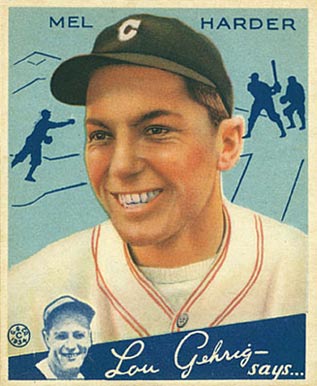
 

Baseball by the Numbers: 11

Read about the Project
Checklist

11

Welcome back to Baseball by the Numbers. Today we are looking at uniform number 11. I found 708 players in history who wore uniform number 11. Rogers Hornsby wore it for 2 seasons with the St. Louis Browns in 1934 and 1935. He was already featured with his uniform number 4 here. Aside from Hornsby (WAR 127.3), no other player who wore number 11 had a WAR of 100 or more. Eddie Mathews, who wore the number in 1967 with the Astros, had a career WAR of 96, but only wore it for one season. After Mathews, the next highest career WAR is 74.7. Not counting Hornsby and Mathews, thirty-six players who wore uniform number 11 had career WAR over 40 and ninety-one players wore the number for 5 years or more. Gary Sheffield wore number 11 for seven seasons but he was already featured in the last post (uniform number 10), so this is his shout out. This list has one pitcher and is the first list that will feature a currently active player. Here are my top seven players for uniform number 11!

Number 1:

Paul Waner, 1936 Diamond Stars, #83

Paul Waner played in the Majors for twenty years from 1926 to 1945. He was a rightfielder for the Pittsburgh Pirates until 1940, then he jumped around a bit, playing for the Brooklyn Dodgers, Boston Braves, Brooklyn Dodgers again and finally the New York Yankees. Waner has one of my favorite nicknames, “Big Poison” and wore uniform number 11 for his first eight seasons. He had a career WAR of 74.7

This is one of the busiest Diamond Stars cards I’ve seen. The 1936 Paul Waner features “Big Poison” (I’m going to be using that a lot!), in the front with another player in the background. It looks like that player has uniform number 26 which would make it Pep Young who played second for the Pirates in the 1930s. The card also shows a catcher and umpire, so it seems Waner is about to be at bat maybe. Just an interesting addition to the Diamond Stars collection.

Paul Waner was a 4-time All-Star, having also played seven great seasons before the All-Star game was formed. He was the National League MVP in 1927 when he batted a league leading .380 and led the league in hits (237), triples (18), RBIs (131) and total bases (342). “Big Poison” batted over .300 fourteen times, leading the league in batting average 3-times. He had 200 or more hits in eight seasons and led the league in doubles twice (including 62 in 1932) and triples twice.

By 1941 he started to jump around from team to team and retired in 1945 with only one at bat. Waner ended his career with only 113 home runs but was 30th all-time with a .333 batting average. His 3,152 hits ranked him 20th all-time. He had 605 doubles (16th), 191 Triples (10th), 1,627 runs (41st) and 1,309 RBIs. “Big Poison” is ranked the 9th greatest right fielder in history in “The New Bill James Historical Baseball Abstract.” (2003).

Waner is a member of the Pittsburgh Pirates Hall of Fame, and his uniform number 11 was retired in 2007.

Waner was inducted into the National Baseball Hall of Fame in 1952.

Paul Waner passed away in 1965 at the age of 62.  

Number 2:

Barry Larkin, 1990 Donruss, #71

Barry Larkin played from 1986 to 2004 and spent his entire nineteen-year career exclusively with the Cincinnati Reds. He was one of the premier shortstops in the league during my youth and a player who I remember well. I have quite a few of his cards. He started his career with uniform number 15 but quickly switched to 11 and wore it for seventeen seasons. He had a career WAR of 70.5.

1990 Donruss is such an important set from my young collector days. Anyone who collected during the junk wax error will remember this set. It wasn’t beautiful, but at the time, the 1990 Donruss was highly sought after for its poor-quality control. There were dozens of errors to search for. Opening a pack was like looking for that 1 of 1 card today. Some errors were as simple as a missing trademark or period, others were lines through the All-Star symbol, or a reverse negative photo of the Juan Gonzales rated rookie card, or a photo of John Smoltz on a Tom Glavine card, it was endless. They are all pretty worthless now,m but the chase was fun. I chose this Larkin mainly due to his uniform number being prominently visible in the photo, but this set will always be a classic to me.

Larkin was a 12-time All Star who won nine Silver Slugger awards and 3 Gold Gloves. He was the National League MVP in 1995 with a .319 batting average, 15 home runs, 66 RBIs and 51 Stolen Bases. He hit .300 or better nine times and had 25 or more stolen bases in seven seasons. In 1990, he was a member of the World Series Champion Reds whose bullpen, known as “the Nasty Boys” (very 90s nickname), consisted of Norm Charlton, Rob Dibble and Randy Myers.

By 1997, Larkin began to suffer several injuries. While still productive during the next few years, he would eventually retire after a strong All-Star season in 2004.

Larkin had a career batting average of .295 with 2,340 hits, 441 doubles, 76 triples, 198 home runs, 1,329 runs, 960 RBIs and 379 stolen bases. He also won the Roberto Clemente Award in 1993.

Larkin is a member of the Cincinnati Reds Hall of Fame with the Reds retiring his uniform number 11 in 2012.

He was inducted into the Baseball Hall of Fame in 2012.

Number 3:

Carl Hubbell, 1935 Diamond Stars, #39

From 1928 to 1943, batters were plagued by lefthanded screwball specialist Carl Hubbell. Hubbell played his entire sixteen-year career for the New York Giants. He wore uniform number 11 for eleven seasons and had a career WAR of 68.5.

“King Carl” as he was often called, is just chilling in this 1935 Diamond Stars card. The relaxed pose, confident smirk and tilted hat bring his personality to life. And the Giants uniform is fantastic. Love these Diamond Stars!

Aside from “King Carl”, Hubbell was also known as “the Meal Ticket” for his ability to nearly guarantee a win. He was a 9-time All-Star who led the league in wins and ERA three times each. He had five straight seasons of 20 or more wins and set the Major League record for consecutive wins with 24 in a row between 1936 and 1937. He had an under 3 ERA in seven seasons, his best being a 1.66 ERA over 308 innings (amazing!). He pitched over 200 innings ten times with four of those being 300 or more. He was also the National League MVP in 1933 and 1936.

In 1933, Hubbell pitched for the World Series winning New York Giants, a team that included Hall of Famers, Mel Ott, Travis Jackson, Bill Terry and Lefty O’Doul. He pitched a no-hitter on May 8, 1929, and is known for his amazing All-Star appearance in 1934 when he struck out Babe Ruth, Lou Gehrig, Jimmie Foxx, Al Simmons and Joe Cronin in order.

Hubbell’s last game came in 1943. He had a .622 win/loss percentage with 253 wins good for 46th all-time. His career ERA is 2.98, WHIP is 1.166 and he has 1,677 strikeouts. He’s tied for 48th in adjusted ERA plus with a 130.

His uniform number 11 was retired in 1944 by the Giants, and Hubbell was inducted into the Baseball Hall of Fame in 1947.

After his release in 1943, Hubbell continued with the Giants organization in player development for the rest of his life.

Carl Hubbell passed away at the age of 85 in 1988.

Number 4:

Edgar Martinez, 1990 Topps, #148

Edgar Martínez was a third baseman and designated hitter for eighteen seasons from 1987 to 2004. He played exclusively for the Seattle Mariners and wore uniform number 11 for his entire career. He had a career WAR of 68.4.

I think this might be the first time I’ve used a card in which the player in the photo is not wearing his uniform. In this 1990 Topps, Martínez is wearing his warmup jacket, but his number 11 is on the front which made this a perfect choice. I also fondly remember the 1990 Topps set, and this card brings back that nostalgic feeling. 1990 was his first season as a full-time player.

Martínez was a 7-time All-Star who won five Silver Slugger awards. A prolific hitter, Martínez batted .300 or better in ten seasons, leading the league twice. He also had an OBP of .400 or better in eleven seasons (leading three times) and led the league in doubles twice. He received the Roberto Clemente award in 2004.

Martínez retired after the 2004 season. He finished his career with a .312 batting average. He had 2,247 hits, 1,219 runs, 514 doubles, 309 home runs and 1,261 RBIs. He is 22nd all-time in OBP with a .418 and 37th in OPS with a career .933 percentage.

Martínez is a member of the Seattle Mariners Hall of Fame, and his uniform number 11 was retired by them in 2017.

He was inducted into the National Baseball Hall of Fame in 2019.

Edgar Martínez continues to be a successful hitting coach and advisor with the Seattle Mariners.

Number 5:

Darrell Evans, 1976 Topps, #81

Darrell Evans was a third and first baseman for twenty-one seasons from 1969 to 1989 who played with the Atlanta Braves, San Francisco Giants, Detroit Tigers and finished his career with one more year in Atlanta. He wore uniform number 11 for nine seasons, all while on the Braves, and had a career WAR of 58.7.

I chose this 1976 Topps because Evans is on the Braves, the team he played for while wearing the number 11 and if you look closely you can see the uniform number peeking out from under his arms on the front of his jersey. 1976 Topps has a nice design; I love the color bands on the bottom that match his uniform. 1976 was his last with Atlanta (until 1989) as he was traded to the Giants in June of that season.

Evans was an All-Star twice. He had over 30 home runs in four seasons, leading the league in 1985 with 40. I remember Darrell Evans well for his time with the Detroit Tigers (1984 to 1988). I was just a nine-year-old, newly minted baseball fan, and chose the Tigers as my team because their logo was a cool animal, but they also won the 1984 World Series, so they may have been highly televised at the time. Evans was a pivotal part of that team, a team managed by the great Sparky Anderson, anchored by pitcher Jack Morris and powered by hitters Kirk Gibson, Alan Trammell, Lou Whitaker, Chet Lemon and one of my personal favorite players at the time, Lance Parrish.

Evans would retire after the 1989 season after signing a 1-year contract and playing in 109 games with the Atlanta Braves.

He finished his career with 2,223 hits and a .248 batting average, with 1,344 runs, 329 doubles, 1,354 RBIs, and 414 home runs.

Darrell Evans would go on to become a manager and coach in the minors leagues and the Golden Baseball League.

Number 6:

Jose Ramirez, 2019 Bowman, #66

José Ramírez is the first currently active player to make any of these lists. He began his career in 2013 with the Cleveland Guardians as an infielder, primarily playing third base. 2025 was his thirteenth season in the Majors and he has remained in Cleveland his entire career so far. Ramírez has worn uniform number 11 for twelve years and currently has a career WAR of 57.6.

 I used this 2019 Bowman because his number is partially visible on his back. I am not a fan of the more recent card sets, and this Bowman is rather plain. The photo is cool, but in my opinion the design is poor.

Ramírez is a 7-time All-Star who has won six Silver Slugger awards. The switch hitter is a 3-time member of the 30-30 club, having accomplished the feat in 2018, 2024, and 2025. He currently has a .283 batting average with 1,668 hits, 398 doubles (he’s led the league twice), 285 home runs, 949 RBI’s (he’s had over 100 in four seasons), 1,001 runs (over 100 in five seasons), and 287 stolen bases. He’s been named the Bob Feller Man of the Year 3-times.

Ramírez is currently 33 years old, his last two seasons have been great (both 30-30 seasons) and he has 3 years left on a seven-year fully guaranteed contract with Cleveland.

Number 7:

Luis Aparicio, 1973 Topps, #165

From 1956 to 1973, Luis Aparicio played exceptional defense at shortstop for the Chicago White Sox (1956-1962, 1968-1970), Baltimore Orioles (1963-1967) and the Boston Red Sox (1971-1973). He wore uniform number 11 his entire eighteen-year career. He had a career WAR of 55.9.

I found it hard to find a card that showed Aparicio’s uniform number, so I went with this 1973 Topps. Not only do I love the design of this card, but it features Aparicio while on my Red Sox!

In 1956, Aparicio made an immediate impact in the Majors winning the Rookie of the Year award, the first Latin American to do so. Aparicio was a 13-time All-Star whose stellar defense garnered him 9 Gold Gloves. He led the leagues shortstops in putouts four times, assists seven times, and fielding percentage eight times. He was also fast and led the league in stolen bases a record nine straight seasons, stealing over 50 bases four times. He was a member of the 1966 World Series Champion Baltimore Orioles team that featured Jim Palmer, Brooks Robinson and Frank Robinson.  

Aparicio retired at the end of 1973. He finished his career with a .262 batting average, 2,677 hits, 394 doubles, 92 triples, 83 home runs, 791 RBI’s and 1,335 runs. His 506 career stolen bases are 38th all-time.

He is a member of the Baltimore Orioles Hall of Fame.

In 1984 the Chicago White Sox retired his uniform number 11, and he was inducted into the Baseball Hall of Fame that same year.

As of this post, Aparicio is the oldest living Baseball Hall of Famer at age 91.

Final Score:

Uniform number 11 was interesting. We had our first currently active player. We also had another pitcher. A few shout outs are in order. Ron Cey, who was featured in the last post, wore uniform number 11 for five seasons from 1983 to 1987. 3-time All-Star Hal McRae (WAR 27.9) wore uniform number 11 his entire nineteen-year career from 1968 to 1987 with the Reds and Royals, 1991 Rookie of the Year Chuck Knoblauch (WAR 44.6) wore it his entire twelve season career, Toby Harrah (WAR 51.6) had the number 11 for sixteen seasons and 2007 MVP Jimmy Rollins (WAR 47.9) wore it for fourteen years.

There are many more players to write about on the next go around, but for now, it’s time to check out uniform number 12. Number 12 had close to 900 players wear it in their careers, so read on to see who will make the list!

Sources:

https://www.baseball-almanac.com/

https://www.baseball-reference.com/

Haft, Chris (19 June 2024). “Willie Mays, a baseball giant, dies at 93”MLB.com.

Newhan, Ross (November 22, 1988). “Carl Hubbell, 85, Dies of Injuries Suffered in an Auto Accident”Los Angeles Times.

https://www.sabr.org

 Shout out to all the cool cards and creative commons for my pictures! Thanks Topps and Fleer and Donruss and Upper Deck and all the rest.
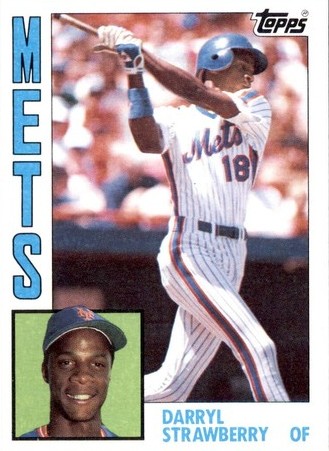
Baseball by the Numbers: 10

Read about the Project

Checklist

10

Welcome back to Baseball by the Numbers. Today we are looking at uniform number 10. I found that around 689 players in history wore the number 10 at some point in their career. Out of that group, one player had a career WAR of over 100. This player is a pitcher, which is important because so far I’ve posted uniform number 00 to uniform number 9 and have featured a total of 89 players with only 4 being pitchers (two in 00 post and 2 in the 0 post). This is mainly due to the way in which numbers have had been distributed historically, with the numbers being assigned based on batting order.

Twenty-six additional players who wore number 10 had a career WAR of 40+ and 109 players wore the number for 5 years or more. There was one player who is on this list who was already featured for wearing a different number at one point in his career, but deserves to make both lists. I’m sure this will happen on occasion in the future too. So let’s get to it!

The Legend:

Lefty Grove, 1934 Diamond Stars, #1

Robert Moses Grove, better known as Lefty, was a left-handed (bet that was hard to guess) pitcher who played for 17 seasons from 1925 to 1941. He was a member of the Philadelphia Athletics until 1933 and then played on the Boston Red Sox from 1934 to 1941. Grove wore uniform number 10 for eleven years and had a career WAR of 106.8 good for 26th all-time. This is only the 5th time out of all these post that features a pitcher.

I had to use this 1934 Diamond Stars card because Lefty is in his Red Sox uniform, and I love Diamond Stars. Luckily, he did wear number 10 while on the Sox, so it works. 1934 was his first year in Boston and due to an injury, he only pitched 109 innings. He usually averaged over 250 innings a season. He went 8-8 with 43 strikeouts.

Grove was a 6-time All-Star. Lefty won his first Triple Crown in 1930 when he had 28 wins with a 2.54 ERA and 209 strikeouts in 291 innings. He also led the league in WAR (10.4), W-L % (.848), games (50), Whip (1.14) and saves with 9. He was the American League MVP in 1931 when he won his second pitching Triple Crown with 31 wins, a 2.06 ERA and 175 strikeouts. Although he only had 200 strikeouts once, he led the league in strikeouts on seven occasions. He also led the league in ERA a record 9-times and wins 4-times.

Grove was a member of the 1929 and 1930 Philadelphia Athletics World Series Champions. Managed by Connie Mack, the teams featured Mickey Cochrane, Eddie Collins, Jimmie Foxx and Al Simmons.

Grove retired in 1941. He had a career record of 300-141 for a .680 w/l % (13th all-time). His 300 wins are good for 23rd all-time. Grove pitched in 3,940.2 innings, the 44th most in history.  He had a career ERA of 3.06 with an ERA+ of 148 (9th all-time), 2,266 strikeouts (SO/9 of 5.2) and a 1.278 WHIP. He also saved 54 games.

Grove is a member of the Athletics and the Boston Red Sox Hall of Fame and was voted into the MLB All-Century Team.

He was inducted into the National Baseball Hall of Fame in 1947.

Lefty Grove passed away in 1975 at the age of 75.

Number 1:

Chipper Jones, 1991 Topps, #333

From 1993 to 2012, Chipper Jones played third base and left field with the Atlanta Braves for his entire nineteen-year career. He wore uniform number 16 in 1993, then wore uniform number 10 for the rest of his career, eighteen seasons. He had a career WAR of 85.3.

Jones was the first overall pick in the 1990 draft. The Braves originally wanted a pitcher and intended to draft Todd Van Poppel, a coveted prospect at the time. Van Poppel was not interested in playing in Atlanta and made it known early on. This turned out to be the best possible turn of events as the Braves opted for Jones, and the rest is history. Rogers, Phil (June 4, 1990). 

This 1991 Topps card represents Jones being the first pick in the draft. I love this card! It brings back so many memories. When I was a kid, the 1991 Chipper Jones Topps card was always on our wish lists. I remember also wanting Todd Van Poppel cards, but he turned out to be a dud, while Chipper was a stud. Chipper didn’t make it to the Majors until 1993 when he had only 3 at-bats, then missed all of 1994 with an injury. By 1995, he would start to show the world why he was the number 1 draft pick, placing second in ROY voting that season. He lost to Hideo Nomo (One of my favorites!).

Jones was an 8-time All-Star. He won the National League MVP in 1999 when he batted .319 with 181 hits, 41 doubles, 45 home runs, 110 RBIs and 25 stolen bases, while walking 126 times with .441 OBP, .633 SLG and 1.074 OPS. Oddly enough, Jones was not an All-Star selection in 1999. I had to look this up, and found that the MVP has not made the All-Star game at least twelve other times. This article by Jason Foster at MLB.com, highlights those instances.

Jones won two Silver Slugger awards. He batted over .300 in 10 different seasons with 30 or more home runs in 6 seasons, 100 or more RBIs in nine and an OBP of over .400 in ten seasons. He was a member of the 1995 World Series Champion Braves, a team managed by Bobby Cox, and featuring pitching greats Greg Maddux, John Smoltz and Tom Glavine, and the “Crime Dog”, first baseman Fred McGriff.

Chipper would retire in 2012 finishing in the top 50 all-time in many offensive categories. He had a career batting average of .303 with 2,726 hits, 549 doubles (32nd), 468 home runs (35th), 1,623 RBIs (35th), and 1,619 runs (46th). He added 150 stolen bases and 1,512 walks (16th all-time) to go with a .401 OBP, .529 SLG and a .930 OPS (41st all-time).

Jones is a member of the Braves Hall of Fame, and his uniform number 10 was retired by Atlanta in 2013.

He was inducted into the National Baseball Hall of Fame in 2018. He is one of only four number one draft picks in the Hall, the others being Ken Griffey Jr., Joe Mauer and Harold Baines.

Chipper has since been a coach and consultant for the Braves and has done some work in the broadcast booth.

Number 2:

Johnny Mize, 1936 R312, #39

Known as “Big Jawn”, Johnny Mize played for fifteen seasons in the MLB from 1936 to 1953 (he missed 1943-1945 for military service). Mize played first base for the St. Louis Cardinals, New York Giants and New York Yankees. He wore uniform number 10 for six seasons while with the Cardinals, and had a career WAR of 70.6.

This is the 1936 R312 baseball card. I chose it due to Mize being on the Cardinals at the time this card was released, which was when he wore the number 10. These cards were produced by National Chicle, a gum company. I found some interesting information about these cards at oldcardboard.com.

Johnny Mize was a ten-time All-Star. He batted over .300 in nine seasons, leading the league in 1939 with a .349 average. He also led the league in home runs 4 times smashing 51 in 1947. In eight seasons he drove in over 100 RBIs, leading the league in that category on 3 occasions. 

From 1949 to 1953, Mize was a member of the New York Yankees that won the World Series Championship a record five straight years. Members of that team included, Manager Casey Stengel and Hall of Famers Yogi Berra, Phil Rizzuto, Joe DiMaggio, Whitey Ford and Mickey Mantle

Mize retired in 1953. He had a career batting average of .312 with 2,011 hits, 359 home runs, 1,337 RBIs with a .397 OBP, and is ranked 19th all-time in SLG (.562) and 20th in OPS (.959).

Mize is a member of the St. Louis Cardinals Hall of Fame and was inducted into the National Baseball Hall of Fame in 1981.

Johnny Mize passed away at the age of 80 in 1993.

Number 3:

Ron Santo, 1966 Topps, #290

Ron Santo spent fifteen seasons in the Majors, all of them in the Windy City from 1960 to 1974. Santo was the third baseman for the Chicago Cubs until 1973 and spent his final season on the South Side with the White Sox in 1974. Santo wore uniform number 10 his entire career, save for a few games in 1960, and had a career WAR of 70.5.

I haven’t used too many 1966 Topps cards. I like this one, you can see Santo’s number just a little on his back, the design is nice, and the old 1966 Cubs uniform is sweet, especially the logo on the sleeve.

Santo was a 9-time All-Star who batted over .300 four times. He led the league in season WAR once, walks four times and on base percentage twice. He also hit over 30 home runs in four seasons and is the only third baseman to have over 90 RBIs in eight straight seasons.

Santo was an excellent defender. He had 5 straight Gold Glove winning seasons while leading the league’s third basemen in assists and putouts seven times and double plays six times.

Santo retired in 1974 after being traded to the White Sox and having an awful season. He would finish his career with a .277 career batting average, 2,254 hits, 1,138 runs, 365 doubles, 342 home runs and 1,331 RBIs.

He is a member of the Chicago Cubs Hall of Fame, and his uniform number 10 was retired by the Cubs in 2003.

He was inducted into the National Baseball Hall of Fame in 2012.

He went on to become a broadcaster for the Cubs. Santo suffered from Type 1 Diabetes his entire life and had both of his lower legs amputated in 2001 and 2002, he would eventually pass away from complications of the disease in 2010 at the age of 70.

Number 4:

Andre Dawson, 1987 Topps, #345

“the Hawk” is another player whose cards I have a lot of. He played for twenty-one seasons from 1976 to 1996 as an outfielder. Andre Dawson started his career with the Montreal Expos where he played for eleven seasons. In 1987, he joined the Cubs where he stayed until 1992. He finished his career with two-year stints on the Boston Red Sox and the Florida Marlins. He wore uniform number 10 for twelve seasons (with the Expos and Red Sox) and had a career WAR of 64.8.

Dawson is the first player that I have featured twice. He wore uniform number 8 while with the Chicago Cubs for 8 seasons.

1987 Topps, oh how I love thee. While not the most aesthetically pleasing set of Topps, 1987 holds a special place in my heart. It is the first set that I received as a kid from my grandmother for Christmas. She would go on to buy me the full Topps sets for the next five years. I always looked forward to getting those sets. This Dawson card is cool because he’s with the Expos, whose cards I always liked, and his number is front and center. He was the MVP in 1987, when he led the league in home runs (49), RBIs (137) and Total Bases (353).

 Dawson was an eight-time All-Star. He was the National League ROY in 1977 and as mentioned earlier, was the MVP in 1987. He was a great defender, having won eight Gold Glove Awards in his career. He was a four-time Silver Slugger who batted over .300 on five occasions. He was also fast on the bases and stole 25 or more bases in six seasons. By 1994, injuries began to reduce his playing time and he played less than 80 games in each of his last few seasons before retiring in 1996.

Dawson finished his career with a .279 career batting average. He had 2,774 hits with 503 doubles. His 438 home runs are 47th all-time and his 1,591 RBIs are 40th. He also had 314 stolen bases and is 31st in Total Bases with 4,787.

Dawson is a member of the Montreal Expos and Chicago Cubs Hall of Fame.

He was inducted into the National Baseball Hall of Fame in 2010.

Number 5:

Gary Sheffield, 1994 Fleer Ultra, #199

I feel like Sheffield is a controversial pick due to his implication in the PED scandals, but I’ve decided to let that go and just highlight the players, no place for negativity in these posts. So you will see other controversial players as we move along. These posts are for the nostalgia and Sheffield was a fun player to watch when I was a kid.

Gary Sheffield played outfield and third for twenty-two seasons from 1988 to 2009 on eight different teams. He started on the Brewers (we all wanted those Sheffield Future Stars cards), and went on to play for the San Diego Padres, Florida Marlins, Los Angeles Dodgers, Atlanta Braves, New York Yankees, Detroit Tigers and finally the New York Mets. He wore uniform number 10 for eleven seasons with the Padres, Marlins (6 years) and the Mets. He had a career WAR of 60.5.

The Marlins are the primary team that I remember Sheffield playing for, and the team in which he wore uniform number 10 the longest, so I chose this 1994 Fleer Ultra. I loved the Ultra; they were glossy and colorful and had these great card backs. This one is awesome and shows his uniform number twice! It’s only the second time I’ve used the photo from the back of a card, the first being Jeff Bagwell.

Sheffield was a 9-time All-Star. He batted .290 or more fourteen times, while winning 5 Silver Slugger awards. He was a member of the 1997 World Series Champion Marlins team, the first in franchise history. The team was managed by Jim Leyland and included slugger Bobby Bonilla, speedster Édgar Rentería, the clutch Moisés Alou, pitchers Kevin Brown and Alex Fernandez and closer Robb Nenn.

Sheffield never played after 2009. He finished his career with a .292 batting average, 2,689 hits and 467 doubles and 253 stolen bases. He is 27th in home runs with 509, 39th in runs scored (1,636), 30th in RBIs (1,676), 21st in walks (1,475), and 35th in Total Bases (4,737). Sheffield holds the record for most MLB ballparks played in (51) and he and Fred McGriff, who was mentioned earlier in the Chipper section, are the only players to have 30 or more home runs in one season for 5 different teams.

Sheffield was eligible for the Hall of Fame in 2015, but due to his implications with steroids, fell off the ballot in 2024, having never received enough votes to be inducted.

His uncle is New York Mets legend Dwight “Doc” Gooden.

Number 6:

Ron Cey, 1981 Fleer, #126

Ron Cey played for seventeen seasons from 1971 to 1987. He was a third baseman who played for the Los Angeles Dodgers, Chicago Cubs and spent one season on the Oakland Athletics. Cey wore uniform number 10 for the twelve seasons he was with the Dodgers. He had a career WAR of 53.7. He was also one of Batman’s biggest enemies. I jest, but with his nickname, “the Penguin” , what was I supposed to think? The nickname was based on his unusual running style.

I wasn’t collecting when this 1981 Fleer came out, but I somehow had a lot of early 80s cards in my collection once I got going. The 1981 Fleer I remember well. The design is cool, and I’m a fan of the color borders and the little baseballs on the front with the team’s name is a nice touch. This Ron Cey also shows his uniform number, which works for my posts.

Cey was a 6-time All-Star. He was never much of a power hitter, having only hit 30 home runs once, but he did have 20 or more in ten seasons. He also never batted .300. He was consistent at driving in runs, having over 100 RBIs twice and over 90 five times. “the Penguin” wasn’t fast and only stole 24 bases in his entire career. He was, however, a hustler, who played hard and came in clutch when needed.

He was a member of the 1981 Dodgers World Series winning team, managed by Tommy Lasorda and featuring Pedro Guerrero and Steve Yeager. Cey, along with those two, were the co-MVPs of the 1981 Series.

He retired from baseball in 1987 with a .261 batting average, 1,868 hits, 316 home runs, 1,139 RBIs and a .961 fielding percentage.

Cey tried his hand at acting when he appeared in an episode of Columbo in 1990. He continues to work in an administrative role with the Los Angeles Dodgers.

Number 7:

Tommy Bridges, 1934 Diamond Stars, #5

Tommy Bridges pitched for sixteen seasons from 1930 to 1946 exclusively with the Detroit Tigers. He was a right-handed pitcher known for his curveball. Bridges wore uniform number 10 for thirteen seasons, wearing number 16 his first three. He had a career WAR of 50.4.

Any chance I get to feature a Diamond Stars card, I’m taking it, and in this post I got two. This Tommy Bridges 1934 Diamond Stars features another wonderful art-deco style photo. I love the colors and style of these pre-World War 2 cards.

Bridges was a 6-time All-Star who led the American League in wins once and strikeouts twice. He had 20+ wins three seasons in a row from 1934-1936.

Bridges was a member of Detroit’s World Series Championship teams in 1935 and ten years later in 1945. In 1935, he was on a Tigers team that also featured Hank Greenberg, Mickey Cochrane, Charlie Gehringer and Goose Goslin. The 1945 team featured Greenberg again and fellow pitcher Hal Newhouser.

Bridges didn’t play in 1944 due to military service and only played 13 games between 1945 and 1946, when he would retire. He had a final record of 194-136 with a career ERA of 3.57. He had 1,674 strikeouts in 2,826.1 innings (5.3 SO/9). His career WHIP was 1.368 and his ERA+ was 126. He also had 10 career saves.

Tommy Bridges passed away in 1968 at the age of 61.

Final Score:

There were a few players who wore uniform number 10 for one season and whose career WAR was over 40. These include, Carl Hubbell (68.5, New York Giants, 1932), Al Simmons (68.5, Red Sox, 1943), Wes Ferrell (60.1, Washington Nationals, 1938), and Dave Stieb (56.4, Chicago White Sox, 1993). Evan Longoria who was already featured in the uniform number 3 post, wore it for 5 seasons with the San Francisco Giants.

Three others I’d like to mention here are 6-time All-Star Rusty Staub (WAR 45.8) who wore uniform number 10 for nineteen seasons, Yankees Hall of Famer Phil Rizzuto (WAR 42.1) wore it his entire thirteen season career, and Rangers great Jim Sundberg wore it for twelve seasons with Texas (1974 to 1983, and in 1988-89).

Thank you for joining me. If you’re enjoying these posts, feel free to share, follow, like and comment, and of course check out the next post as well explore uniform number 11!

Sources:

https://www.baseball-almanac.com/

https://www.baseball-reference.com/

Bolton, Barry (March 24, 2010). “Ron Cey sets record straight on ‘The Penguin'”. Coug Fan.  

Foster, Jason (July 2025). MVP Award Winners Who Did Not Make the All-Star Team. mlb.com

Rogers, Phil (June 4, 1990). “The Class of ’90: TO EARN OR TO LEARN”. Sports Illustrated. Archived from the original on September 24, 2015.

https://www.sabr.org

https://baseballhall.org/discover/yankees-five-year-title-stretch-still-unmatched

Shout out to all the cool cards and creative commons for my pictures! Thanks Topps and Fleer and Donruss and Upper Deck and all the rest.
Baseball by the Numbers: 9

Read about the Project

Checklist

9

Welcome back to Baseball by the Numbers. Today we are looking at uniform number 9. I found that around 715 players in history wore the number 9. Out of that group there were two who had a career WAR of over 100. Rogers Hornsby, who was featured in the uniform number 4 post, wore it with the Chicago Cubs in 1934. The other player will be our Legend in this post. After those two, twenty-one additional players who wore uniform number 9 had a career WAR of 40+ and 103 players wore the number for 5 years plus.

The Legend:

Ted Williams, 1954 Topps, #250

One of the greatest hitters in history, Ted Williams went by many names, “Teddy Ballgame”, “The Thumper”, “the Splendid Splinter, “the Kid”, but to Red Sox fans he was the hero of Boston. One of the greatest players to wear the Red Sox uniform, Williams patrolled the left field of Fenway Park for his entire 19-year career. Williams played from 1939 to 1960, missing 1943-1945 and parts of 1952 and 1953 for military service. He wore uniform number 9 all nineteen seasons and had a career WAR of 121.8, good for 14th all-time.

This 1954 Topps card of Williams is a favorite of mine. I love that old Red Sox logo and the dual pictures, the portrait and the action shot. In 1954, Williams was an All-Star. He batted .345 and led the league in walks (136), OBP (.513), SLG (.635), and OPS (1.148).

Williams was an All-Star nineteen times. He was the American League MVP in 1946 and 1949. He won the Triple Crown twice. In 1942, when he batted .356 with 36 home runs and 137 RBIs and in 1947 when he batted .343 with 32 home runs and 114 RBIs. Interestingly, he didn’t win the MVP in his Triple Crown seasons, he was the runner up for MVP in both, losing to Joe Gordon in 1942 and Joe DiMaggio in 1947. Williams batted over .300 in almost every season he played, hitting .406 in 1941, the last time any player has accomplished this feat. Williams also led the league in season WAR (6x), runs (6x), doubles twice, home runs (4x), RBIs (3x), he led the league in walks 8-times, OBP an insane 12-times, SLG 9-times and OPS 10-times. He was one of the best all-around hitters to ever play the game.

Williams retired in 1960 after batting .316 in his final season. He ended his career 11th all-time with a .344 batting average. His career .482 OBP is 1st all-time. He also finished with 2654 hits, 525 doubles, 521 home runs (22nd all-time), 1839 RBIs (16th all-time). He is 4th all-time in walks (2021), 2nd in SLG (.634) and 2nd in OPS (1.116).

He is a member of the Boston Red Sox Hall of Fame and although he never played for anyone other than Boston, he is a member of the San Diego Hall of Fame as he was from that city.

He was voted for the MLB All-Century team and the MLB All-Time Team and he was inducted into the National Baseball Hall of Fame in 1966.

His number 9 was retired by the Boston Red Sox in 1984.

Ted Williams passed away at the age of 83 in 2002.

Number 1:

Reggie Jackson, 1970 Topps, #459

Reggie Jackson played right field for twenty-one seasons from 1967 to 1987 for four teams. He started and ended his career with the Athletics for ten total seasons, and played one season in Baltimore, five with the Yankees and five with the California Angels. He was with the Angels when I was collecting. I have a lot of his cards from the 80s and a lot of memories of Jackson in that uniform. He wore uniform number 9 for nine different seasons and had a career WAR of 74.

I choose this 1970 Topps for two reasons, he was on the A’s his main team, and you can see his number on the front. These 1970 Topps All-Star cards have a great design, with the photo of the player ripping through the newspaper background. They need to bring these back.

Jackson was a 14-time All-Star. He won the American League MVP in 1973, led the league in home runs four times and RBIs once, and won two Silver Slugger Awards.

Known as “Mr. October” for his post season heroics, Jackson was a member of five World Series Championship teams, three with the Athletics (1972-1974) and two with the Yankees (1977 and 1978). He was the World Series MVP in both 1973 and 1977.

In 1987, Jackson signed with the Athletics for his final season. He wore number 44 that year, which Jackson was more known for by then.

Jackson finished his career with a .262 batting average with 2584 hits, 463 doubles, 563 home runs (14th all-time), 1702 RBIs (27th all-time) and 228 stolen bases. Jackson also struck out a lot and leads all batters in history with 2597, probably not the best stat to be 1st in, but it’s a testament to how good he was that even with all those strikeouts, he was so clutch.  

Jackson is a member of the Athletics Hall of Fame, and his uniform number 9 was retired by them in 2004.

He was inducted into the Baseball Hall of Fame in 1993

Number 2:

Graig Nettles, 1973 Topps, #498

Graig Nettles played third base for twenty-two seasons in the MLB from 1967 to 1988. During his career, “Puff” (yes that was his nickname) played for the Minnesota Twins, Cleveland Indians, New York Yankees (ten seasons), San Diego Padres, Atlanta Braves and the Montreal Expos. He wore uniform number 9 for fifteen seasons and had a career WAR of 68.

I picked this 1973 Topps card to represent Nettles because I love the design and the photo. I also wanted to choose a card with Nettles on the Yankees since that was the team where he spent his best years. In 1973, Nettles had 22 home runs and 81 RBIs.

Nettles was a 6-time All-Star who won 2 Gold Glove awards. He led the league in home runs with 32 in 1976, his best overall season. Nettles was on two World Series Championships with the Yankees, 1977 and 1978. His was teammates with the number 1 player on this post, Reggie Jackson, though at that time Jackson wore number 44 and Nettles 9.

Nettles retired after the 1988 season with a career batting average of .248, 390 home runs and 1,314 RBI. He also had a .964 fielding percentage at third.

The 81-year-old Nettles is not in the Hall of Fame though he has the highest career WAR of all third basemen who are not in the Hall.

Number 3:

John Olerud, 1994 Fleer, #340

Another player that I really enjoyed collecting as a kid was John Olerud. Olerud played for seventeen seasons from 1989 to 2005. He was a first baseman, known for his signature batting helmet, which he wore while batting and fielding. He wore the helmet due to brain surgery while in college and was recommended to always wear it. Olerud began his career with the Blue Jays for 8 seasons, then played for the Mets, Mariners, Yankees and finished with the Red Sox. He wore uniform number 9 for all eight seasons with the Blue Jays and finished his career with a 58.1 career WAR.

1994 Fleer is one of my least favorite sets. I’m not a fan of the design, especially the difficult to read name and position up top. Also, if you ever open 1994 Fleer packs now, 30 years later, the cards tend to stick together. Still, this card works because this is during one of his Blue Jays seasons and his number 9 is visible, as well as that helmet.

Olerud was an All-Star twice and won three Gold Gloves. His best season was 1993 when he led the league in doubles (54), batting average (.363), OBP (.473) and OPS (1.072). He was on two World Series Championship teams with the Blues Jays in 1992 and 1993.

Olerud retired in 2005 with a career batting average of .295, 2239 hits, 500 double, 225 home runs and 1230 RBIs.

Olerud was inducted into the Canadian Baseball Hall of Fame in 2020.

Number 4:

Joe Torre, 1972 Topps, #500

When I think of Joe Torre, I think of him as the manager of the “Damn” Yankees, but Torre has been a staple in Major League Baseball since 1960. For this post we are focusing on his playing career, which spanned eighteen years from 1960 to 1977. At different points, Torre was a catcher, first baseman and third baseman who played for three teams: the Milwaukee/Atlanta Braves till 1968, the St. Louis Cardinals from 1969 to 1974 and the New York Mets 1975 to 1977. He wore uniform number 9 for his nine seasons with the Cardinals and Mets.

This 1972 Topps is a perfect fit. He’s with the Cardinals, the uniform number is visible on the front, and those sideburns are epic! I love the 1972 Topps design too.

Torre was a 9-time All-Star. He won the National League MVP in 1971 leading the league in hits (230), RBIs (137) and batting average (.363). Torre had two seasons with 200+ hits. He also batted .290 or more seven times. He won the Gold Glove in 1971.

Torre finished his career with 2342 hits for a .297 career batting average. He had 344 doubles, 252 home runs, and 1185 RBIs.

After Torre retired as a player he went on to manage for twenty-nine seasons. He won 4 World Series Championships as the Yankees manager in 1996 and 1998-2000. He is 5th all-time in managerial wins with 2326 and was a 2-time Manager of the year. He has continued in baseball in several key roles including color commentator and special assistant to the Commissioner. 

He is a member of the Braves and the Cardinals Hall of Fame.

Torres was inducted into the National Baseball Hall of Fame in 2014.

Number 5:

Enos Slaughter, Red Heart Dog Food, #28

Enos Slaughter (don’t you love his last name), played right field in the Majors for nineteen seasons from 1938 to 1959 (military service 1943-1945). He played for the St. Louis Cardinals from 1938 -1950 and played for the New York Yankees twice and the Kansas City Athletics and Milwaukee Braves once each. He wore uniform number 9 for thirteen seasons with the Cardinals and had a career WAR of 57.5.

This is a 1954 Red Heart Dog Food card of Slaughter with the Cardinals. I feel like this is a sharp looking card. According to Cardboard Connection, these cards could be received from Red Heart Dog Food as a mail-in offer in which you would receive a group of 11 cards featuring either red, blue, or green backgrounds with the red being the rarest. The full set includes 33 cards.
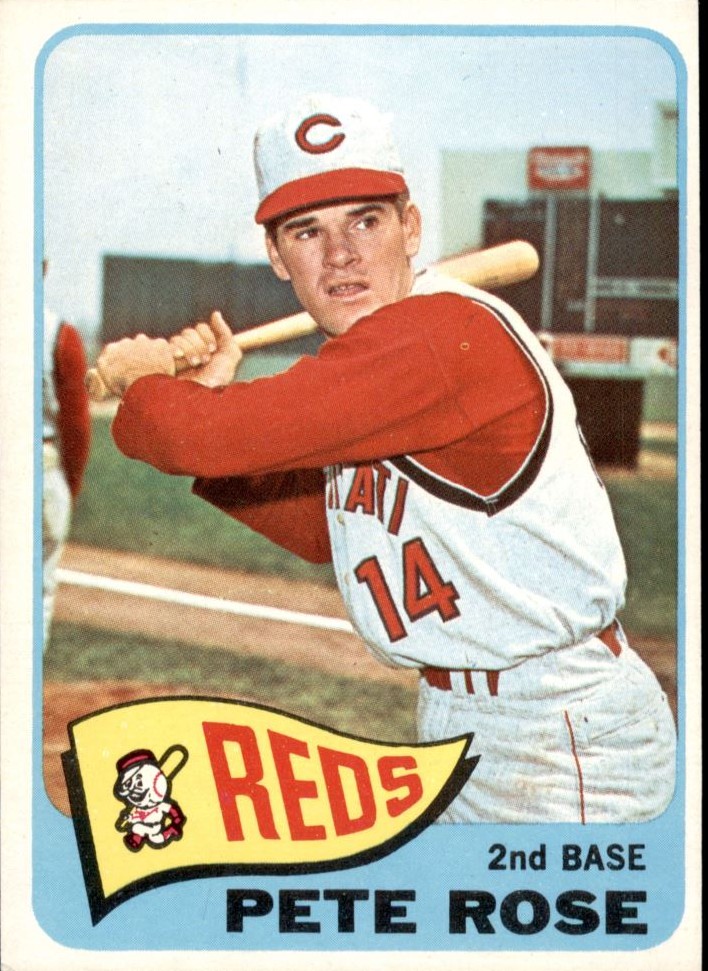
Born in North Carolina, Enos Slaughter was nicknamed “Country”. He was a 10-time All-Star who batted over .300 nine times. He was a member of four World Series Championship teams, 1942 and 1946 with teammate Stan Musial while on the Cardinals and in 1956 and 1958 with Mickey Mantle, Whitey Ford, and Yogi Berra on the Yankees.

After a progressive decline in playing time, Slaughter ended his career in 1959. He had a career .300 batting average with 2383 hits, 413 doubles, 148 triples, 169 home runs and 1304 RBI.

Slaughter is a member of the St. Louis Cardinals Hall of Fame, and his uniform number 9 was retired by them in 1996.
He was inducted into the Baseball Hall of Fame in 1985.

Enos Slaughter passed away in 2002 at the age of 86.

Number 6:

Gabby Hartnett, 1933 Goudey, #202

Okay, this may be my favorite nickname yet! Gabby Hartnett played catcher for twenty years in the Majors from 1922 to 1941. He played for the Chicago Cubs almost his entire career, finishing with one last year on the New York Giants. Hartnett wore uniform number 9 for six seasons and had a career WAR of 55.5. His nickname…” Old Tomato Face”!

1933 Goudey is such a classic card, and this one of Hartnett is perfect. I love that the photo has him in his catcher’s stance, but he just has a giant glove for protection. That’s how they rolled back then.

Hartnett was a 6-time All-Star and was the National League MVP in 1935 when he batted .344. He batted .290 or better in eight seasons. Not only was Hartnett a great hitting catcher, but he was also strong on the defensive end, leading the National League in putouts four times and in assists and fielding percentage six times. Hartnett also led the league seven times in double plays.

Harnett retired in 1941 with a .297 career batting average along with 1,912 hits, 867 runs, 396 doubles, 64 triples, 236 home runs, and 1,179 RBIs, with a .984 career fielding percentage. Hartnett  set the National League record at catcher with 163 career double plays, 4th all-time.

Hartnett is a member of the Chicago Cubs Hall of Fame.

“Old Tomato Face” was inducted into the National Baseball Hall of Fame in 1955.

Gabby Hartnett passed away at 72 years old in 1972.

Number 7:

Minnie Minoso, 1964 Topps, #538

Minnie Miñoso played baseball for twenty years from 1946 to 1964. He started in the Negro Leagues with the New York Cubans until 1949 when he played with Cleveland. He only stayed with Cleveland a short time, then played for the White Sox, back to Cleveland then back to the White Sox again, then St. Louis and Washington Senators for a season each and finally ending with the White Sox again. He wore uniform number 9 for sixteen seasons and had a career WAR of 53.2.

I love this 1964 Topps card of Miñoso. The card design is cool, and I love that uniform number on the sleeve. It’s perfect for the purposes of these posts!

Known as “the Cuban Comet”, Miñoso was a 2-time All-Star in the Negro League and a 9-time All-Star in the Majors. He won 3 Gold Glove Awards and, true to his nickname, led the league in stolen bases three times.

In 1947, he was a member of the Negro League World Series Champion New York Cubans along with future Major Leaguers Pat Scantlebury, Ray Noble and Lino Donoso.

Miñoso retired in 1964 but played in Mexico for eight more years until he was 47. He eventually became a coach for the White Sox and made three game appearances with the White Sox in 1976 when he was 52! Four years later, in 1980, he would again be activated and pinch hit twice at age 57. In 1993, at the age of 67, Miñoso appeared with the independent St. Paul Saints, he then returned to the Saints and drew a walk in 2003 at 77 years old. He is the only player in history to appear professionally in seven different decades.

Miñoso finished his career with a .299 batting average, 1228 runs, 2113 hits, 365 doubles, 195 home runs, 1089 RBIs and 216 stolen bases.

“Mr. White Sox” uniform number 9 was retired by Chicago in 1983.

Minnie Miñoso passed away in 2015 at the age of 90.

I had the opportunity to attend Minnie Miñoso’s Hall of Fame induction in 2022. I was there for David Ortiz but hearing Miñoso’s widow’s speech was so emotional. It inspired me to was inducted along with another player who I have feature in a prior post, Tony Oliva.

Bonus:

Roger Maris, 1961 Topps, #2

I just finished watching the movie “61” with Barry Pepper (Maris) and Thomas Jane (Mantle) and felt that despite his not meeting my WAR criteria (Maris had a 38.2), Maris deserved a little bonus mention.

Roger Maris played for only twelve years in the Majors from 1957 to 1968. He was a right fielder who played with the Cleveland Indians, Kansas City Athletics, New York Yankees and the St. Louis Cardinals. He wore uniform number 9 for nine seasons while with the Yankees and the Cardinals. His best years were with the Yankees where he would win the American League MVP 2-times (1960 and 1961) and broke Babe Ruth’s single season home run record in 1961 with 61 home runs. Maris is not in the Hall of Fame, but his uniform number 9 was retired by the Yankees in 1984.

Maris passed away at the young age of 51 in 1985 from non-Hodgkin lymphoma.

Final Score:

I had to add a quick spotlight on Roger Maris, but there were a few other notable players who wore uniform number 9. Matt Williams wore it for fifteen seasons and had a career WAR of 46.6, he played during my young collecting years and was a 5-time All-Star. A few other players of note; Bill Mazeroski (17 years, 36.5 WAR), Marquis Grissom (16 years, 29.6), Brady Anderson (14 years, 35 WAR), Terry Pendleton (14 years, 28.4 WAR) and Joe Adcock (10 years, 33.5 WAR). Of course there are many more, so once I finish with all the numbers, I may do a revisit to start spotlighting those I skipped.

I hope you’re enjoying the series, and I’m excited to now be working on uniform number 10! Double digits baby! Give me a follow or a like or leave a comment. I’m always happy to engage.

Sources:

https://www.baseball-almanac.com/

https://www.baseball-reference.com/

https://www.cardboardconnection.com/top-10-enos-slaughter-baseball-cards

https://sabr.org

 “White Sox legend Minnie Miñoso dies at age 90”. SBNation.com. Vox Media. March 2015.

 “Sarasota Herald-Tribune – Google News Archive Search”. Sarasota Herald-Tribune. Retrieved November 14, 2025 – via Google News Archive Search.

Shout out to all the cool cards and creative commons for my pictures! Thanks Topps and Upper Deck and Fleer and Donruss and all the rest!