
Checklist
11
Welcome back to Baseball by the Numbers. Today we are looking at uniform number 11. I found 708 players in history who wore uniform number 11. Rogers Hornsby wore it for 2 seasons with the St. Louis Browns in 1934 and 1935. He was already featured with his uniform number 4 here. Aside from Hornsby (WAR 127.3), no other player who wore number 11 had a WAR of 100 or more. Eddie Mathews, who wore the number in 1967 with the Astros, had a career WAR of 96, but only wore it for one season. After Mathews, the next highest career WAR is 74.7. Not counting Hornsby and Mathews, thirty-six players who wore uniform number 11 had career WAR over 40 and ninety-one players wore the number for 5 years or more. Gary Sheffield wore number 11 for seven seasons but he was already featured in the last post (uniform number 10), so this is his shout out. This list has one pitcher and is the first list that will feature a currently active player. Here are my top seven players for uniform number 11!
Number 1:

Paul Waner played in the Majors for twenty years from 1926 to 1945. He was a rightfielder for the Pittsburgh Pirates until 1940, then he jumped around a bit, playing for the Brooklyn Dodgers, Boston Braves, Brooklyn Dodgers again and finally the New York Yankees. Waner has one of my favorite nicknames, “Big Poison” and wore uniform number 11 for his first eight seasons. He had a career WAR of 74.7
This is one of the busiest Diamond Stars cards I’ve seen. The 1936 Paul Waner features “Big Poison” (I’m going to be using that a lot!), in the front with another player in the background. It looks like that player has uniform number 26 which would make it Pep Young who played second for the Pirates in the 1930s. The card also shows a catcher and umpire, so it seems Waner is about to be at bat maybe. Just an interesting addition to the Diamond Stars collection.
Paul Waner was a 4-time All-Star, having also played seven great seasons before the All-Star game was formed. He was the National League MVP in 1927 when he batted a league leading .380 and led the league in hits (237), triples (18), RBIs (131) and total bases (342). “Big Poison” batted over .300 fourteen times, leading the league in batting average 3-times. He had 200 or more hits in eight seasons and led the league in doubles twice (including 62 in 1932) and triples twice.
By 1941 he started to jump around from team to team and retired in 1945 with only one at bat. Waner ended his career with only 113 home runs but was 30th all-time with a .333 batting average. His 3,152 hits ranked him 20th all-time. He had 605 doubles (16th), 191 Triples (10th), 1,627 runs (41st) and 1,309 RBIs. “Big Poison” is ranked the 9th greatest right fielder in history in “The New Bill James Historical Baseball Abstract.” (2003).
Waner is a member of the Pittsburgh Pirates Hall of Fame, and his uniform number 11 was retired in 2007.
Waner was inducted into the National Baseball Hall of Fame in 1952.
Paul Waner passed away in 1965 at the age of 62.
Number 2:
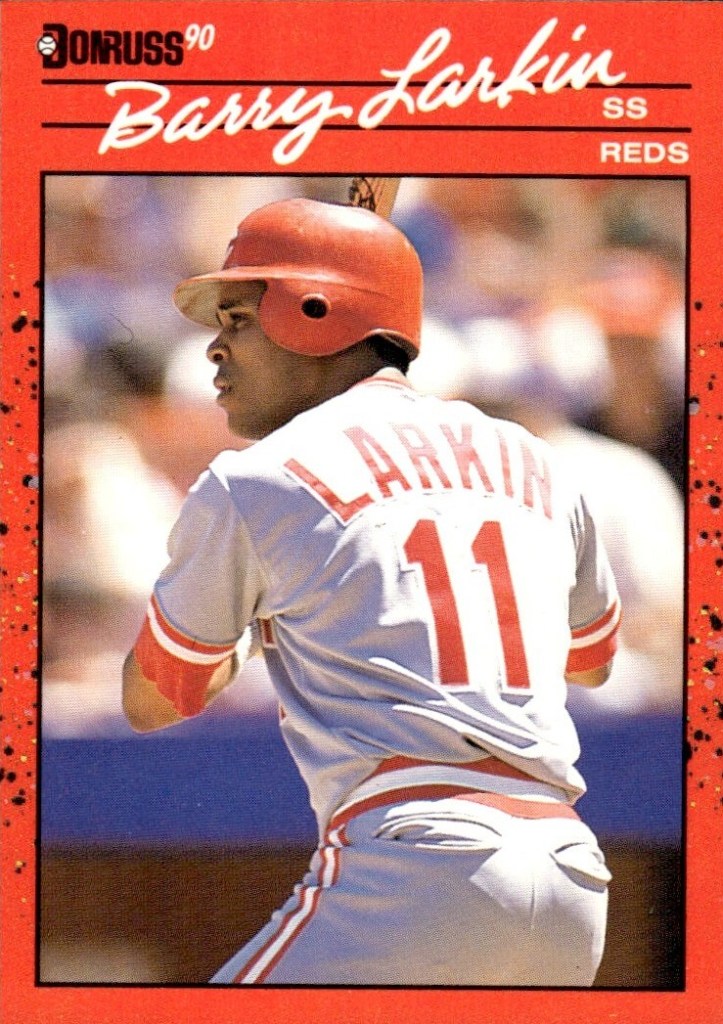
Barry Larkin played from 1986 to 2004 and spent his entire nineteen-year career exclusively with the Cincinnati Reds. He was one of the premier shortstops in the league during my youth and a player who I remember well. I have quite a few of his cards. He started his career with uniform number 15 but quickly switched to 11 and wore it for seventeen seasons. He had a career WAR of 70.5.
1990 Donruss is such an important set from my young collector days. Anyone who collected during the junk wax error will remember this set. It wasn’t beautiful, but at the time, the 1990 Donruss was highly sought after for its poor-quality control. There were dozens of errors to search for. Opening a pack was like looking for that 1 of 1 card today. Some errors were as simple as a missing trademark or period, others were lines through the All-Star symbol, or a reverse negative photo of the Juan Gonzales rated rookie card, or a photo of John Smoltz on a Tom Glavine card, it was endless. They are all pretty worthless now,m but the chase was fun. I chose this Larkin mainly due to his uniform number being prominently visible in the photo, but this set will always be a classic to me.
Larkin was a 12-time All Star who won nine Silver Slugger awards and 3 Gold Gloves. He was the National League MVP in 1995 with a .319 batting average, 15 home runs, 66 RBIs and 51 Stolen Bases. He hit .300 or better nine times and had 25 or more stolen bases in seven seasons. In 1990, he was a member of the World Series Champion Reds whose bullpen, known as “the Nasty Boys” (very 90s nickname), consisted of Norm Charlton, Rob Dibble and Randy Myers.
By 1997, Larkin began to suffer several injuries. While still productive during the next few years, he would eventually retire after a strong All-Star season in 2004.
Larkin had a career batting average of .295 with 2,340 hits, 441 doubles, 76 triples, 198 home runs, 1,329 runs, 960 RBIs and 379 stolen bases. He also won the Roberto Clemente Award in 1993.
Larkin is a member of the Cincinnati Reds Hall of Fame with the Reds retiring his uniform number 11 in 2012.
He was inducted into the Baseball Hall of Fame in 2012.
Number 3:
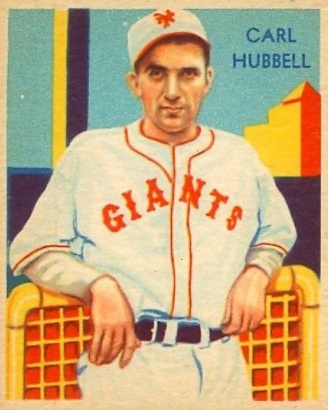
From 1928 to 1943, batters were plagued by lefthanded screwball specialist Carl Hubbell. Hubbell played his entire sixteen-year career for the New York Giants. He wore uniform number 11 for eleven seasons and had a career WAR of 68.5.
“King Carl” as he was often called, is just chilling in this 1935 Diamond Stars card. The relaxed pose, confident smirk and tilted hat bring his personality to life. And the Giants uniform is fantastic. Love these Diamond Stars!
Aside from “King Carl”, Hubbell was also known as “the Meal Ticket” for his ability to nearly guarantee a win. He was a 9-time All-Star who led the league in wins and ERA three times each. He had five straight seasons of 20 or more wins and set the Major League record for consecutive wins with 24 in a row between 1936 and 1937. He had an under 3 ERA in seven seasons, his best being a 1.66 ERA over 308 innings (amazing!). He pitched over 200 innings ten times with four of those being 300 or more. He was also the National League MVP in 1933 and 1936.
In 1933, Hubbell pitched for the World Series winning New York Giants, a team that included Hall of Famers, Mel Ott, Travis Jackson, Bill Terry and Lefty O’Doul. He pitched a no-hitter on May 8, 1929, and is known for his amazing All-Star appearance in 1934 when he struck out Babe Ruth, Lou Gehrig, Jimmie Foxx, Al Simmons and Joe Cronin in order.
Hubbell’s last game came in 1943. He had a .622 win/loss percentage with 253 wins good for 46th all-time. His career ERA is 2.98, WHIP is 1.166 and he has 1,677 strikeouts. He’s tied for 48th in adjusted ERA plus with a 130.
His uniform number 11 was retired in 1944 by the Giants, and Hubbell was inducted into the Baseball Hall of Fame in 1947.
After his release in 1943, Hubbell continued with the Giants organization in player development for the rest of his life.
Carl Hubbell passed away at the age of 85 in 1988.
Number 4:

Edgar Martínez was a third baseman and designated hitter for eighteen seasons from 1987 to 2004. He played exclusively for the Seattle Mariners and wore uniform number 11 for his entire career. He had a career WAR of 68.4.
I think this might be the first time I’ve used a card in which the player in the photo is not wearing his uniform. In this 1990 Topps, Martínez is wearing his warmup jacket, but his number 11 is on the front which made this a perfect choice. I also fondly remember the 1990 Topps set, and this card brings back that nostalgic feeling. 1990 was his first season as a full-time player.
Martínez was a 7-time All-Star who won five Silver Slugger awards. A prolific hitter, Martínez batted .300 or better in ten seasons, leading the league twice. He also had an OBP of .400 or better in eleven seasons (leading three times) and led the league in doubles twice. He received the Roberto Clemente award in 2004.
Martínez retired after the 2004 season. He finished his career with a .312 batting average. He had 2,247 hits, 1,219 runs, 514 doubles, 309 home runs and 1,261 RBIs. He is 22nd all-time in OBP with a .418 and 37th in OPS with a career .933 percentage.
Martínez is a member of the Seattle Mariners Hall of Fame, and his uniform number 11 was retired by them in 2017.
He was inducted into the National Baseball Hall of Fame in 2019.
Edgar Martínez continues to be a successful hitting coach and advisor with the Seattle Mariners.
Number 5:

Darrell Evans was a third and first baseman for twenty-one seasons from 1969 to 1989 who played with the Atlanta Braves, San Francisco Giants, Detroit Tigers and finished his career with one more year in Atlanta. He wore uniform number 11 for nine seasons, all while on the Braves, and had a career WAR of 58.7.
I chose this 1976 Topps because Evans is on the Braves, the team he played for while wearing the number 11 and if you look closely you can see the uniform number peeking out from under his arms on the front of his jersey. 1976 Topps has a nice design; I love the color bands on the bottom that match his uniform. 1976 was his last with Atlanta (until 1989) as he was traded to the Giants in June of that season.
Evans was an All-Star twice. He had over 30 home runs in four seasons, leading the league in 1985 with 40. I remember Darrell Evans well for his time with the Detroit Tigers (1984 to 1988). I was just a nine-year-old, newly minted baseball fan, and chose the Tigers as my team because their logo was a cool animal, but they also won the 1984 World Series, so they may have been highly televised at the time. Evans was a pivotal part of that team, a team managed by the great Sparky Anderson, anchored by pitcher Jack Morris and powered by hitters Kirk Gibson, Alan Trammell, Lou Whitaker, Chet Lemon and one of my personal favorite players at the time, Lance Parrish.
Evans would retire after the 1989 season after signing a 1-year contract and playing in 109 games with the Atlanta Braves.
He finished his career with 2,223 hits and a .248 batting average, with 1,344 runs, 329 doubles, 1,354 RBIs, and 414 home runs.
Darrell Evans would go on to become a manager and coach in the minors leagues and the Golden Baseball League.
Number 6:
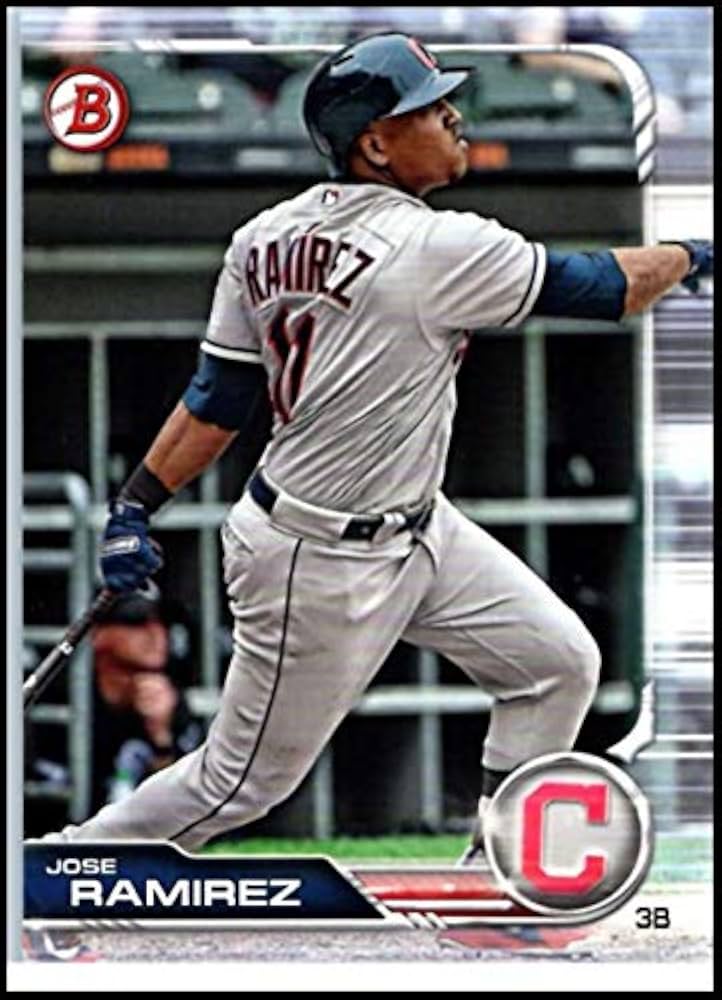
José Ramírez is the first currently active player to make any of these lists. He began his career in 2013 with the Cleveland Guardians as an infielder, primarily playing third base. 2025 was his thirteenth season in the Majors and he has remained in Cleveland his entire career so far. Ramírez has worn uniform number 11 for twelve years and currently has a career WAR of 57.6.
I used this 2019 Bowman because his number is partially visible on his back. I am not a fan of the more recent card sets, and this Bowman is rather plain. The photo is cool, but in my opinion the design is poor.
Ramírez is a 7-time All-Star who has won six Silver Slugger awards. The switch hitter is a 3-time member of the 30-30 club, having accomplished the feat in 2018, 2024, and 2025. He currently has a .283 batting average with 1,668 hits, 398 doubles (he’s led the league twice), 285 home runs, 949 RBI’s (he’s had over 100 in four seasons), 1,001 runs (over 100 in five seasons), and 287 stolen bases. He’s been named the Bob Feller Man of the Year 3-times.
Ramírez is currently 33 years old, his last two seasons have been great (both 30-30 seasons) and he has 3 years left on a seven-year fully guaranteed contract with Cleveland.
Number 7:

From 1956 to 1973, Luis Aparicio played exceptional defense at shortstop for the Chicago White Sox (1956-1962, 1968-1970), Baltimore Orioles (1963-1967) and the Boston Red Sox (1971-1973). He wore uniform number 11 his entire eighteen-year career. He had a career WAR of 55.9.
I found it hard to find a card that showed Aparicio’s uniform number, so I went with this 1973 Topps. Not only do I love the design of this card, but it features Aparicio while on my Red Sox!
In 1956, Aparicio made an immediate impact in the Majors winning the Rookie of the Year award, the first Latin American to do so. Aparicio was a 13-time All-Star whose stellar defense garnered him 9 Gold Gloves. He led the leagues shortstops in putouts four times, assists seven times, and fielding percentage eight times. He was also fast and led the league in stolen bases a record nine straight seasons, stealing over 50 bases four times. He was a member of the 1966 World Series Champion Baltimore Orioles team that featured Jim Palmer, Brooks Robinson and Frank Robinson.
Aparicio retired at the end of 1973. He finished his career with a .262 batting average, 2,677 hits, 394 doubles, 92 triples, 83 home runs, 791 RBI’s and 1,335 runs. His 506 career stolen bases are 38th all-time.
He is a member of the Baltimore Orioles Hall of Fame.
In 1984 the Chicago White Sox retired his uniform number 11, and he was inducted into the Baseball Hall of Fame that same year.
As of this post, Aparicio is the oldest living Baseball Hall of Famer at age 91.
Final Score:
Uniform number 11 was interesting. We had our first currently active player. We also had another pitcher. A few shout outs are in order. Ron Cey, who was featured in the last post, wore uniform number 11 for five seasons from 1983 to 1987. 3-time All-Star Hal McRae (WAR 27.9) wore uniform number 11 his entire nineteen-year career from 1968 to 1987 with the Reds and Royals, 1991 Rookie of the Year Chuck Knoblauch (WAR 44.6) wore it his entire twelve season career, Toby Harrah (WAR 51.6) had the number 11 for sixteen seasons and 2007 MVP Jimmy Rollins (WAR 47.9) wore it for fourteen years.
There are many more players to write about on the next go around, but for now, it’s time to check out uniform number 12. Number 12 had close to 900 players wear it in their careers, so read on to see who will make the list!
Sources:
https://www.baseball-almanac.com/
https://www.baseball-reference.com/
Haft, Chris (19 June 2024). “Willie Mays, a baseball giant, dies at 93”. MLB.com.
Newhan, Ross (November 22, 1988). “Carl Hubbell, 85, Dies of Injuries Suffered in an Auto Accident”. Los Angeles Times.
Shout out to all the cool cards and creative commons for my pictures! Thanks Topps and Fleer and Donruss and Upper Deck and all the rest.
 Weekly Windup
2 thoughts on “Baseball by the Numbers: 11”