

Checklist
9
Welcome back to Baseball by the Numbers. Today we are looking at uniform number 9. I found that around 715 players in history wore the number 9. Out of that group there were two who had a career WAR of over 100. Rogers Hornsby, who was featured in the uniform number 4 post, wore it with the Chicago Cubs in 1934. The other player will be our Legend in this post. After those two, twenty-one additional players who wore uniform number 9 had a career WAR of 40+ and 103 players wore the number for 5 years plus.
The Legend:
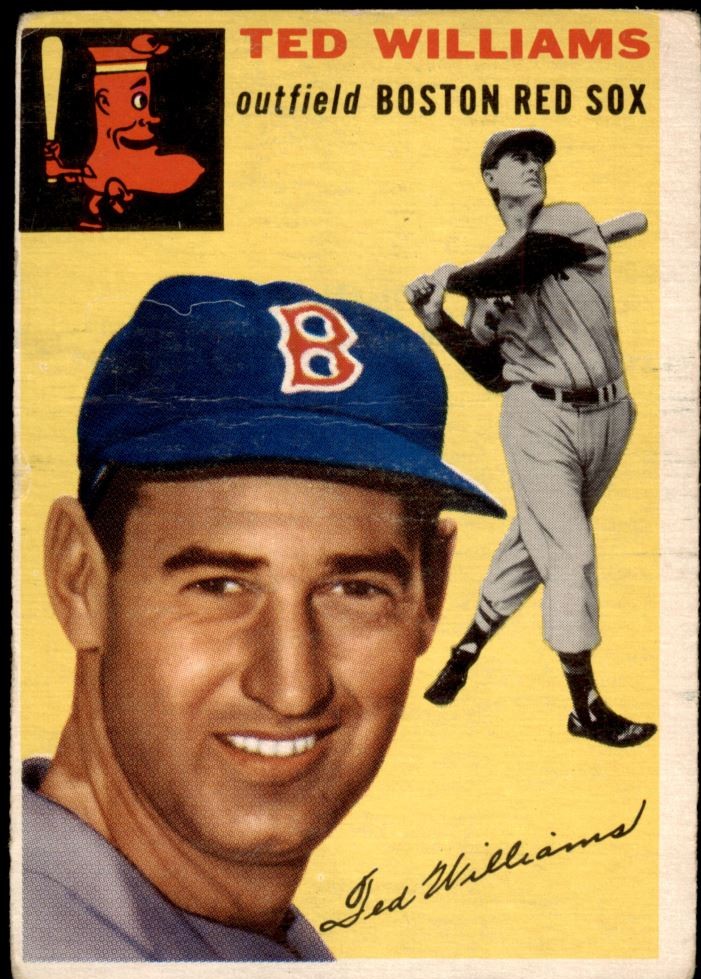
One of the greatest hitters in history, Ted Williams went by many names, “Teddy Ballgame”, “The Thumper”, “the Splendid Splinter, “the Kid”, but to Red Sox fans he was the hero of Boston. One of the greatest players to wear the Red Sox uniform, Williams patrolled the left field of Fenway Park for his entire 19-year career. Williams played from 1939 to 1960, missing 1943-1945 and parts of 1952 and 1953 for military service. He wore uniform number 9 all nineteen seasons and had a career WAR of 121.8, good for 14th all-time.
This 1954 Topps card of Williams is a favorite of mine. I love that old Red Sox logo and the dual pictures, the portrait and the action shot. In 1954, Williams was an All-Star. He batted .345 and led the league in walks (136), OBP (.513), SLG (.635), and OPS (1.148).
Williams was an All-Star nineteen times. He was the American League MVP in 1946 and 1949. He won the Triple Crown twice. In 1942, when he batted .356 with 36 home runs and 137 RBIs and in 1947 when he batted .343 with 32 home runs and 114 RBIs. Interestingly, he didn’t win the MVP in his Triple Crown seasons, he was the runner up for MVP in both, losing to Joe Gordon in 1942 and Joe DiMaggio in 1947. Williams batted over .300 in almost every season he played, hitting .406 in 1941, the last time any player has accomplished this feat. Williams also led the league in season WAR (6x), runs (6x), doubles twice, home runs (4x), RBIs (3x), he led the league in walks 8-times, OBP an insane 12-times, SLG 9-times and OPS 10-times. He was one of the best all-around hitters to ever play the game.
Williams retired in 1960 after batting .316 in his final season. He ended his career 11th all-time with a .344 batting average. His career .482 OBP is 1st all-time. He also finished with 2654 hits, 525 doubles, 521 home runs (22nd all-time), 1839 RBIs (16th all-time). He is 4th all-time in walks (2021), 2nd in SLG (.634) and 2nd in OPS (1.116).
He is a member of the Boston Red Sox Hall of Fame and although he never played for anyone other than Boston, he is a member of the San Diego Hall of Fame as he was from that city.
He was voted for the MLB All-Century team and the MLB All-Time Team and he was inducted into the National Baseball Hall of Fame in 1966.
His number 9 was retired by the Boston Red Sox in 1984.
Ted Williams passed away at the age of 83 in 2002.
Number 1:
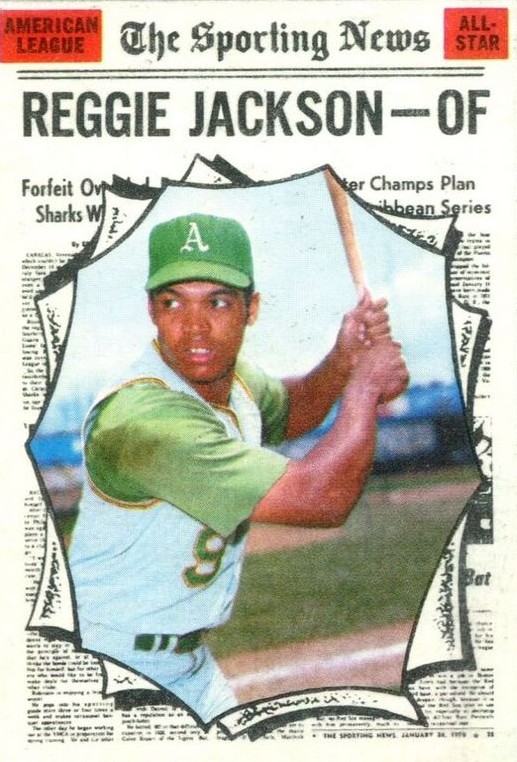
Reggie Jackson played right field for twenty-one seasons from 1967 to 1987 for four teams. He started and ended his career with the Athletics for ten total seasons, and played one season in Baltimore, five with the Yankees and five with the California Angels. He was with the Angels when I was collecting. I have a lot of his cards from the 80s and a lot of memories of Jackson in that uniform. He wore uniform number 9 for nine different seasons and had a career WAR of 74.
I choose this 1970 Topps for two reasons, he was on the A’s his main team, and you can see his number on the front. These 1970 Topps All-Star cards have a great design, with the photo of the player ripping through the newspaper background. They need to bring these back.
Jackson was a 14-time All-Star. He won the American League MVP in 1973, led the league in home runs four times and RBIs once, and won two Silver Slugger Awards.
Known as “Mr. October” for his post season heroics, Jackson was a member of five World Series Championship teams, three with the Athletics (1972-1974) and two with the Yankees (1977 and 1978). He was the World Series MVP in both 1973 and 1977.
In 1987, Jackson signed with the Athletics for his final season. He wore number 44 that year, which Jackson was more known for by then.
Jackson finished his career with a .262 batting average with 2584 hits, 463 doubles, 563 home runs (14th all-time), 1702 RBIs (27th all-time) and 228 stolen bases. Jackson also struck out a lot and leads all batters in history with 2597, probably not the best stat to be 1st in, but it’s a testament to how good he was that even with all those strikeouts, he was so clutch.
Jackson is a member of the Athletics Hall of Fame, and his uniform number 9 was retired by them in 2004.
He was inducted into the Baseball Hall of Fame in 1993
Number 2:
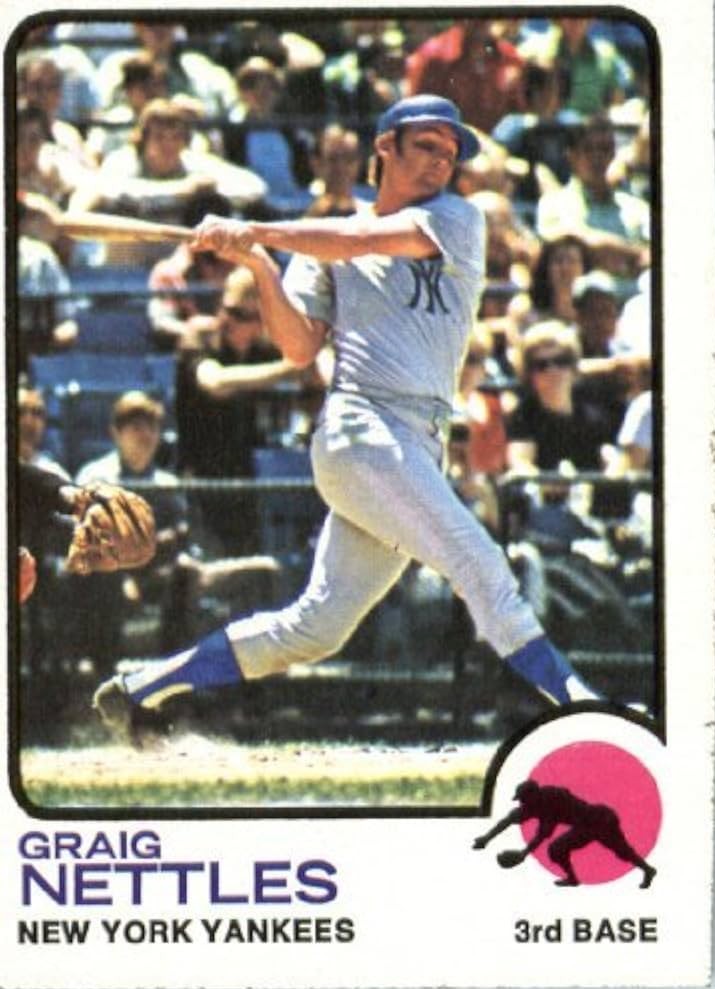
Graig Nettles played third base for twenty-two seasons in the MLB from 1967 to 1988. During his career, “Puff” (yes that was his nickname) played for the Minnesota Twins, Cleveland Indians, New York Yankees (ten seasons), San Diego Padres, Atlanta Braves and the Montreal Expos. He wore uniform number 9 for fifteen seasons and had a career WAR of 68.
I picked this 1973 Topps card to represent Nettles because I love the design and the photo. I also wanted to choose a card with Nettles on the Yankees since that was the team where he spent his best years. In 1973, Nettles had 22 home runs and 81 RBIs.
Nettles was a 6-time All-Star who won 2 Gold Glove awards. He led the league in home runs with 32 in 1976, his best overall season. Nettles was on two World Series Championships with the Yankees, 1977 and 1978. His was teammates with the number 1 player on this post, Reggie Jackson, though at that time Jackson wore number 44 and Nettles 9.
Nettles retired after the 1988 season with a career batting average of .248, 390 home runs and 1,314 RBI. He also had a .964 fielding percentage at third.
The 81-year-old Nettles is not in the Hall of Fame though he has the highest career WAR of all third basemen who are not in the Hall.
Number 3:

Another player that I really enjoyed collecting as a kid was John Olerud. Olerud played for seventeen seasons from 1989 to 2005. He was a first baseman, known for his signature batting helmet, which he wore while batting and fielding. He wore the helmet due to brain surgery while in college and was recommended to always wear it. Olerud began his career with the Blue Jays for 8 seasons, then played for the Mets, Mariners, Yankees and finished with the Red Sox. He wore uniform number 9 for all eight seasons with the Blue Jays and finished his career with a 58.1 career WAR.
1994 Fleer is one of my least favorite sets. I’m not a fan of the design, especially the difficult to read name and position up top. Also, if you ever open 1994 Fleer packs now, 30 years later, the cards tend to stick together. Still, this card works because this is during one of his Blue Jays seasons and his number 9 is visible, as well as that helmet.
Olerud was an All-Star twice and won three Gold Gloves. His best season was 1993 when he led the league in doubles (54), batting average (.363), OBP (.473) and OPS (1.072). He was on two World Series Championship teams with the Blues Jays in 1992 and 1993.
Olerud retired in 2005 with a career batting average of .295, 2239 hits, 500 double, 225 home runs and 1230 RBIs.
Olerud was inducted into the Canadian Baseball Hall of Fame in 2020.
Number 4:

When I think of Joe Torre, I think of him as the manager of the “Damn” Yankees, but Torre has been a staple in Major League Baseball since 1960. For this post we are focusing on his playing career, which spanned eighteen years from 1960 to 1977. At different points, Torre was a catcher, first baseman and third baseman who played for three teams: the Milwaukee/Atlanta Braves till 1968, the St. Louis Cardinals from 1969 to 1974 and the New York Mets 1975 to 1977. He wore uniform number 9 for his nine seasons with the Cardinals and Mets.
This 1972 Topps is a perfect fit. He’s with the Cardinals, the uniform number is visible on the front, and those sideburns are epic! I love the 1972 Topps design too.
Torre was a 9-time All-Star. He won the National League MVP in 1971 leading the league in hits (230), RBIs (137) and batting average (.363). Torre had two seasons with 200+ hits. He also batted .290 or more seven times. He won the Gold Glove in 1971.
Torre finished his career with 2342 hits for a .297 career batting average. He had 344 doubles, 252 home runs, and 1185 RBIs.
After Torre retired as a player he went on to manage for twenty-nine seasons. He won 4 World Series Championships as the Yankees manager in 1996 and 1998-2000. He is 5th all-time in managerial wins with 2326 and was a 2-time Manager of the year. He has continued in baseball in several key roles including color commentator and special assistant to the Commissioner.
He is a member of the Braves and the Cardinals Hall of Fame.
Torres was inducted into the National Baseball Hall of Fame in 2014.
Number 5:

Enos Slaughter (don’t you love his last name), played right field in the Majors for nineteen seasons from 1938 to 1959 (military service 1943-1945). He played for the St. Louis Cardinals from 1938 -1950 and played for the New York Yankees twice and the Kansas City Athletics and Milwaukee Braves once each. He wore uniform number 9 for thirteen seasons with the Cardinals and had a career WAR of 57.5.
This is a 1954 Red Heart Dog Food card of Slaughter with the Cardinals. I feel like this is a sharp looking card. According to Cardboard Connection, these cards could be received from Red Heart Dog Food as a mail-in offer in which you would receive a group of 11 cards featuring either red, blue, or green backgrounds with the red being the rarest. The full set includes 33 cards.
Born in North Carolina, Enos Slaughter was nicknamed “Country”. He was a 10-time All-Star who batted over .300 nine times. He was a member of four World Series Championship teams, 1942 and 1946 with teammate Stan Musial while on the Cardinals and in 1956 and 1958 with Mickey Mantle, Whitey Ford, and Yogi Berra on the Yankees.
After a progressive decline in playing time, Slaughter ended his career in 1959. He had a career .300 batting average with 2383 hits, 413 doubles, 148 triples, 169 home runs and 1304 RBI.
Slaughter is a member of the St. Louis Cardinals Hall of Fame, and his uniform number 9 was retired by them in 1996.
He was inducted into the Baseball Hall of Fame in 1985.
Enos Slaughter passed away in 2002 at the age of 86.
Number 6:
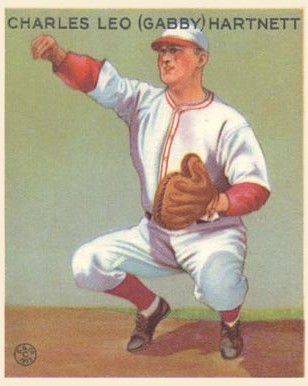
Okay, this may be my favorite nickname yet! Gabby Hartnett played catcher for twenty years in the Majors from 1922 to 1941. He played for the Chicago Cubs almost his entire career, finishing with one last year on the New York Giants. Hartnett wore uniform number 9 for six seasons and had a career WAR of 55.5. His nickname…” Old Tomato Face”!
1933 Goudey is such a classic card, and this one of Hartnett is perfect. I love that the photo has him in his catcher’s stance, but he just has a giant glove for protection. That’s how they rolled back then.
Hartnett was a 6-time All-Star and was the National League MVP in 1935 when he batted .344. He batted .290 or better in eight seasons. Not only was Hartnett a great hitting catcher, but he was also strong on the defensive end, leading the National League in putouts four times and in assists and fielding percentage six times. Hartnett also led the league seven times in double plays.
Harnett retired in 1941 with a .297 career batting average along with 1,912 hits, 867 runs, 396 doubles, 64 triples, 236 home runs, and 1,179 RBIs, with a .984 career fielding percentage. Hartnett set the National League record at catcher with 163 career double plays, 4th all-time.
Hartnett is a member of the Chicago Cubs Hall of Fame.
“Old Tomato Face” was inducted into the National Baseball Hall of Fame in 1955.
Gabby Hartnett passed away at 72 years old in 1972.
Number 7:

Minnie Miñoso played baseball for twenty years from 1946 to 1964. He started in the Negro Leagues with the New York Cubans until 1949 when he played with Cleveland. He only stayed with Cleveland a short time, then played for the White Sox, back to Cleveland then back to the White Sox again, then St. Louis and Washington Senators for a season each and finally ending with the White Sox again. He wore uniform number 9 for sixteen seasons and had a career WAR of 53.2.
I love this 1964 Topps card of Miñoso. The card design is cool, and I love that uniform number on the sleeve. It’s perfect for the purposes of these posts!
Known as “the Cuban Comet”, Miñoso was a 2-time All-Star in the Negro League and a 9-time All-Star in the Majors. He won 3 Gold Glove Awards and, true to his nickname, led the league in stolen bases three times.
In 1947, he was a member of the Negro League World Series Champion New York Cubans along with future Major Leaguers Pat Scantlebury, Ray Noble and Lino Donoso.
Miñoso retired in 1964 but played in Mexico for eight more years until he was 47. He eventually became a coach for the White Sox and made three game appearances with the White Sox in 1976 when he was 52! Four years later, in 1980, he would again be activated and pinch hit twice at age 57. In 1993, at the age of 67, Miñoso appeared with the independent St. Paul Saints, he then returned to the Saints and drew a walk in 2003 at 77 years old. He is the only player in history to appear professionally in seven different decades.
Miñoso finished his career with a .299 batting average, 1228 runs, 2113 hits, 365 doubles, 195 home runs, 1089 RBIs and 216 stolen bases.
“Mr. White Sox” uniform number 9 was retired by Chicago in 1983.
Minnie Miñoso passed away in 2015 at the age of 90.
I had the opportunity to attend Minnie Miñoso’s Hall of Fame induction in 2022. I was there for David Ortiz but hearing Miñoso’s widow’s speech was so emotional. It inspired me to was inducted along with another player who I have feature in a prior post, Tony Oliva.
Bonus:
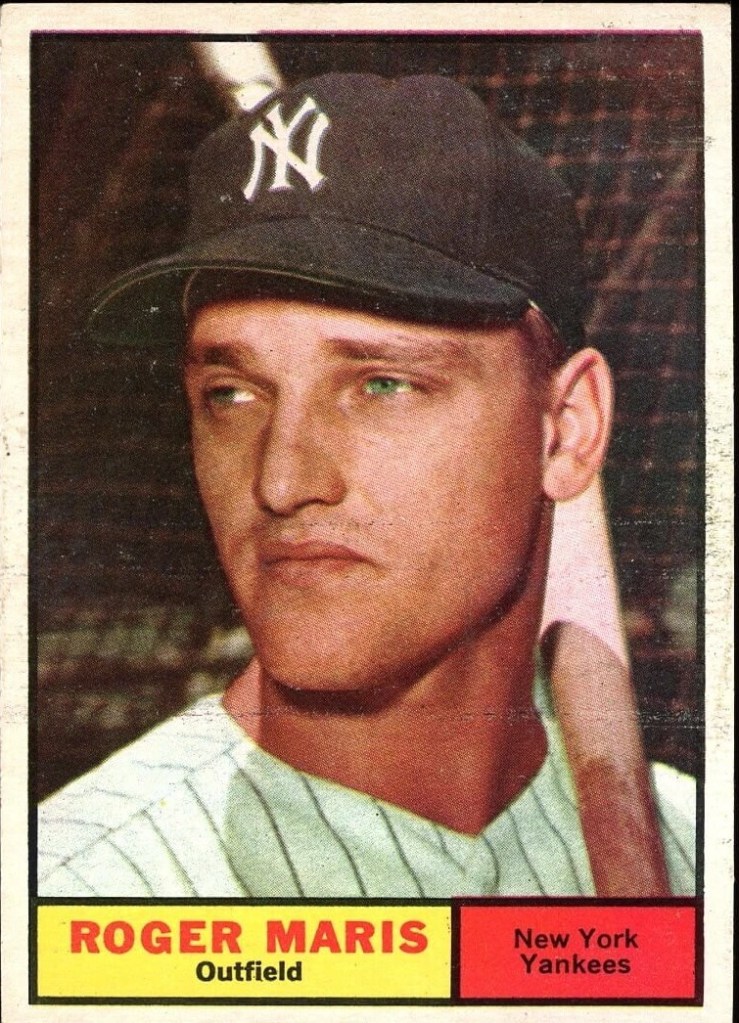
I just finished watching the movie “61” with Barry Pepper (Maris) and Thomas Jane (Mantle) and felt that despite his not meeting my WAR criteria (Maris had a 38.2), Maris deserved a little bonus mention.
Roger Maris played for only twelve years in the Majors from 1957 to 1968. He was a right fielder who played with the Cleveland Indians, Kansas City Athletics, New York Yankees and the St. Louis Cardinals. He wore uniform number 9 for nine seasons while with the Yankees and the Cardinals. His best years were with the Yankees where he would win the American League MVP 2-times (1960 and 1961) and broke Babe Ruth’s single season home run record in 1961 with 61 home runs. Maris is not in the Hall of Fame, but his uniform number 9 was retired by the Yankees in 1984.
Maris passed away at the young age of 51 in 1985 from non-Hodgkin lymphoma.
Final Score:
I had to add a quick spotlight on Roger Maris, but there were a few other notable players who wore uniform number 9. Matt Williams wore it for fifteen seasons and had a career WAR of 46.6, he played during my young collecting years and was a 5-time All-Star. A few other players of note; Bill Mazeroski (17 years, 36.5 WAR), Marquis Grissom (16 years, 29.6), Brady Anderson (14 years, 35 WAR), Terry Pendleton (14 years, 28.4 WAR) and Joe Adcock (10 years, 33.5 WAR). Of course there are many more, so once I finish with all the numbers, I may do a revisit to start spotlighting those I skipped.
I hope you’re enjoying the series, and I’m excited to now be working on uniform number 10! Double digits baby! Give me a follow or a like or leave a comment. I’m always happy to engage.
Sources:
https://www.baseball-almanac.com/
https://www.baseball-reference.com/
https://www.cardboardconnection.com/top-10-enos-slaughter-baseball-cards
“White Sox legend Minnie Miñoso dies at age 90”. SBNation.com. Vox Media. March 2015.
“Sarasota Herald-Tribune – Google News Archive Search”. Sarasota Herald-Tribune. Retrieved November 14, 2025 – via Google News Archive Search.
Shout out to all the cool cards and creative commons for my pictures! Thanks Topps and Upper Deck and Fleer and Donruss and all the rest!
 Weekly Windup
3 thoughts on “Baseball by the Numbers: 9”