

8
Welcome back to Baseball by the Numbers. Today we are looking at uniform number 8, and I am so excited and I just can’t hide it! As I’ve mentioned previously, probably more than a few times, uniform number 8 holds a very special place in my heart. My favorite player of all-time wore this number, and I still have 100s of his cards and other memorabilia. Most of you can probably guess who it is, but if not, you’ll find out below. Number 8 is also special to my family since another player who wore that number is a family legend (not related, just idolized). Is the suspense killing you? I hope so, because it will keep you reading, and this may be my longest post yet.
Uniform number 8 had 672 players who wore it in their career. There was one Legend (career WAR over 100) and thirty-nine players with a career WAR over 40. Ninety players wore uniform number 8 for five years or more.
There were a few players who wore number 8 for only one season. Three, Luke Appling, Al Simmons and Bobby Bonds, I have covered in past posts. Appling, featured in the 4 post, wore it for one season with the White Sox in 1932. Simmons, featured in the 7 post, wore it with the Red Sox in 1943. Go Sox! Bonds (featured in the 00 post and will be seen again) wore it in 1981 with the Chicago Cubs. Hall of Famer Paul Warner also wore number 8 for one seasons in 1942 with the Boston Braves.
Out of the 672 players who wore the number, only one player had a career WAR that exceeded 100 and will make the coveted Legends spot.
The Legend:
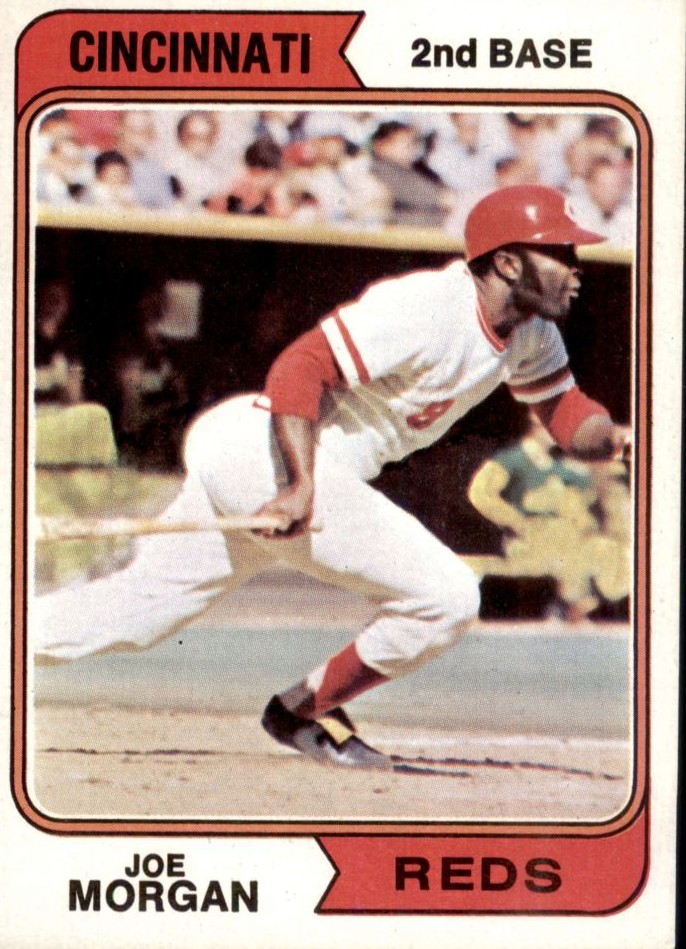
For twenty-two seasons, Joe Morgan played perhaps some of the best baseball ever seen at second base. From 1963 to 1984, Morgan played on five teams. He started his career with the Houston Colt .45s/Astros for nine seasons before being traded during the 1971 Winter Meetings to the Cincinnati Reds, where he would become a pivotal cog in the “Big Red Machine”. After seven seasons with the Reds, he was back with the Astros for one season in 1980, then went to the San Francisco Giants (2 yrs), Philadelphia Phillies (1 yrs) and finished his career with one final season on the Oakland Athletics. He wore uniform number 8 for thirteen seasons and had a career WAR of 100.6 good for thirty-first all-time.
I used the 1974 Topps for this post because the card is fantastic. Morgan started wearing number 8 with the Reds, and the number is visible on the front of his uniform in this card’s photo. The photo is a cool action shot of Morgan about to take off after a hit…and look at those epic sideburns! I like the style of these 1974 cards, with the team city and name in the banners around the border. Morgan was an All-Star in 1974. He batted .293, with 150 hits, 31 doubles, 22 home runs, 67 RBIs and 58 stolen bases. He had 120 walks to only 69 strikeouts and a league leading .427 OBP.
Morgan was a ten-time All-Star who won the National League MVP award twice (75, 76), both times with the Reds. In 1975, he led the league in season WAR (11), walks (132), OBP (.466), and OPS (.974) while hitting .327 with 67 stolen bases and winning the Gold Glove Award. In 1976, Morgan led the league in WAR (9.6) OBP (.444), SLG (.576), OPS (1.020) and sacrifice flies with 12.
He won five Gold Glove Awards and was a Silver Slugger in 1982. Morgan was known for his speed stealing over 40 bases in nine different seasons (with 60 or more three times). He was a tough player to strike out with 77 strikeouts being the most in any season. He also led the league in walks 4 separate times.
As a member of the “Big Red Machine”, Morgan was a two-time World Series Champion in 1975 and 1976 (his two MVP seasons) while playing alongside Pete Rose, Johnny Bench and Tony Perez with Sparky Anderson as the manager.
He retired after the 1984 season with a .271 career batting average, 2517 hits, 449 doubles, 268 home runs, 1133 RBIs, 689 stolen bases (11th all-time), and 1865 walks (5th all-time). For second basemen he is 4th all-time with 5742 putouts, 3rd in assists with 6967 and 6th in double plays with 1505.
Morgan is a member of both the Houston Astros and the Cincinnati Reds Hall of fame with the Reds retiring his uniform number 8 in 1998.
He was inducted into the Baseball Hall of Fame in 1990.
Joe Morgan passed away at the age of 77 in 2020.
Number 1:

I’ve been looking forward to this post since I came up with the idea for this series. In the number one spot! Cal Ripken Jr.! the “Iron Man”.
Although I’ve lived in Massachusetts most of my life and am a Red Sox fan, Cal was my hero. When I first started collecting cards I really hadn’t caught full-on Red Sox fever. As a kid, I would float from team to team based on the silliest of things (like rooting for the Tigers because I liked the animal). As I started collecting cards and watching This Week in Baseball or Sportscenter and reading Sports Illustrated or Beckett I just fell in love with Cal’s game. I started collecting every Ripken card I could find, had his poster on my wall, and his Starting Lineup on my desk. As my love for the Red Sox grew, I made sure the games I went to were against the Orioles. There were plenty of opportunities to see Cal play. He was the standard in hard work and dedication.
When I got older and stopped collecting, I regretfully sold most of my cards, but I kept one binder and a box. Both were filled with Cal Ripken cards, and I still have them all. Cal will always be my favorite player of all-time.
Cal Ripken Jr. played for twenty-one years in the Majors from 1981 to 2001. He was a shortstop and third baseman for the Baltimore Orioles, where he played his entire career and wore uniform number 8 for all twenty-one seasons. He had a career WAR of 95.9 and is considered by many, me included, to be the best shortstop in history.
Ripken was an All-Star nineteen times. He was Rookie of the Year in 1982. He was the American League MVP twice (1983 and 1991) and won two Gold Glove Awards. He was an eight-time Silver Slugger. Ripken was a member of the Orioles 1983 World Series Championship team along with Hall of Famers Eddie Murray and Jim Palmer. During his career he played with his brother Billy for six seasons and was managed by his father, Cal Sr., for three.
I choose this 1996 Topps Chrome Ripken card because it commemorates his greatest achievement, one that is unlikely to ever be duplicated. On September 6th, 1995 Cal Ripken played in his 2131st consecutive game, breaking the streak set by Lou Gehrig 56 years earlier. The game was one of the most watched baseball games in ESPN history. Unfortunately, I could not watch it as I was in military training having joined earlier that year, but I still have a couple of VHS recordings that friends and family taped for me. He would continue to play in every game until September of 1998 when he decided to end his streak at 2632 consecutive games.
The wear and tear of his streak eventually took its toll and Ripken played in less than 100 games in 1999 and 2000 before he retired at the end of the 2001 season.
Aside from his consecutive games streak, he would end his career with a .276 batting average, he is 16th in history with 3184 hits, 17th in doubles with 603, 51st in home runs with 431 (the most of any shortstop in history), 29th in RBIs (1695), and 18th in total bases (5168).
Ripken is a member of the Orioles Hall of Fame, and his uniform number 8 was retired in 2001.
He was inducted into the National Baseball Hall of Fame in 2007.
Currently, Ripken is a best-selling author and is deeply involved in charitable organizations.
Number 2:

“Carl Yastrzemski, Carl Yastrzemski, Carl Yastrzemski, the man we call Yaz (We love him)”, Jess Cain, The Yaz song (1967)
I remember my uncle singing this song when I was young. I believe he still has the record, and I would bet he still sings it when he’s making his lunch. Carl Yastrzemski was a hero to me growing up. I never saw him play live but heard so many stories. As I became increasingly interested in baseball, my uncle, who is the biggest Red Sox fan in history, was perplexed by my love for Cal Ripken, a rival of the Boston Red Sox. My uncle would tell me stories of the greatest Red Sox teams and taught me all about the Curse of the Bambino (which was finally broken in 2004). Those stories made sure that as I grew up and finally stopped rooting for teams based on their logos, I would land with the best fans for the best team. The Boston Red Sox! They have been my favorite team for over thirty years and will always be.
“Yaz” primarily played left field with the Boston Red Sox for his entire twenty-three-year career (he also played a couple of stints at first and third). He is tied with Brooks Robinson for longest tenure with one team. From 1961 to 1983, Yastrzemski was the hero of Fenway Park, wearing uniform number 8 his entire career, while finishing with a career WAR of 96.4.
I love this 1975 Topps design. The colors along the border, with the team’s name shadowed up top and the player’s name below, just pops. The position in the little baseball is a nice touch, and I love this photo of Yaz, especially with his uniform number visible. Though 1975 was a down year (.269 batting average, 14 home runs, 60 RBIs), he still made an All-Star appearance.
Yaz was an eighteen-time All-Star. He led the league in season WAR three times, runs and hits twice, doubles and batting average three times, walks twice, OBP five times, SLG three and OPS four times. In 1967 he was the American League MVP and led the league in home runs (44), RBIs (121) and batting average (.326), winning the elusive Triple Crown.
At the end of 1983 he retired from baseball at the age of 44. He finished his career with a .285 batting average. He is 9th all-time in hits (3419), 9th in doubles (646), 41st in home runs (452), and 15th all-time in RBIs (1844). Yaz is also 6th all-time in walks with 1845 and is 10th in Total Bases with 5539. He has a career OBP of .379, SLG of .462 and OPS of .841.
Yastrzemski was also an amazing defender, leading American League left fielders in assists seven times and winning seven Gold Glove Awards. Sabermetrics determines his placement as second all-time defensive left fielder, specifically Total Zone Runs, or as they abbreviate it on their site, “rtot.” Yastrzemski accumulated an rtot of 135 over his 23-year MLB career (Bonds finished with a 184 rtot). Perry, Jeff bosoxinjection.com
He is a member of the Red Sox Hall of Fame, and his uniform number 8 was retired in 1989.
He was inducted into the Baseball Hall of Fame in 1989.
Carl Yastrzemski is still loved by the Fenway Faithful and at 85 years old, threw out the first pitch at Fenway to start the 2025 season.
Number 3:
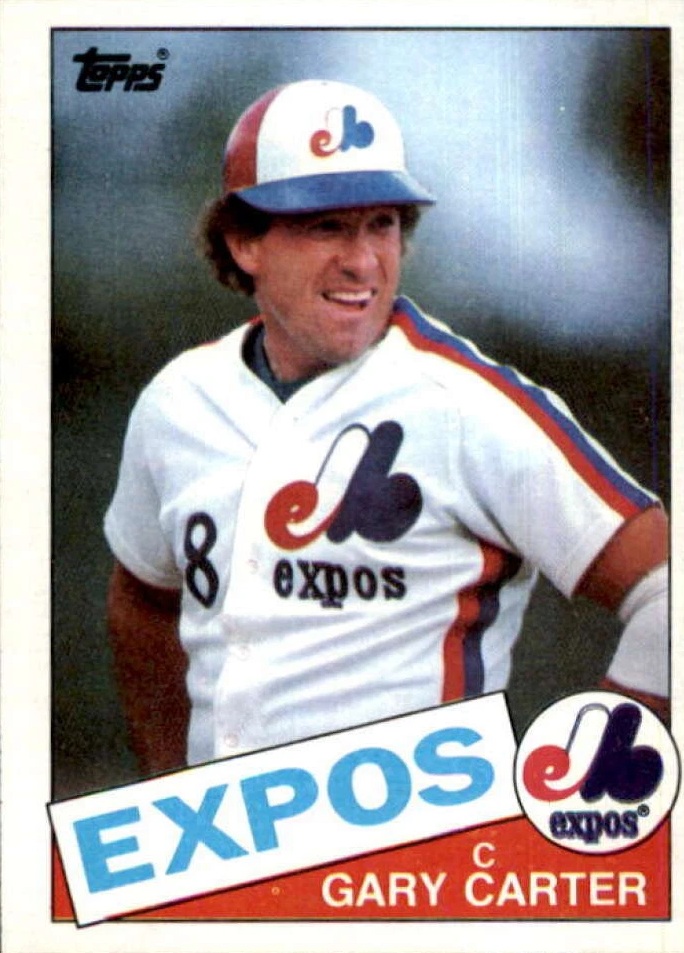
The original “Kid”, Gary Carter was known as an excellent defensive catcher who could hit well and motivate his teammates with his excitement for the game. Carter played nineteen seasons in the Majors from 1974 to 1992 as a catcher with the Montreal Expos for 10 seasons, then the New York Mets, San Francisco Giants, LA Dodgers and his last season back in Montreal. Carter wore uniform number 8 for eighteen seasons, having worn 57 his rookie year. He had a career WAR of 70.1.
I choose this awesome 1985 Topps for Carter. I love the 1985 Topps set, and this card is great. The colors blend perfectly with the Red, White and Blue Expos uniform, Carter’s uniform number visible on the front., and the team logo on the front. A perfect card for the post. Carter was an All-Star in 1985, having hit the most home runs of his career (32) to go along with a .281 batting average and 100 RBIs. He was a member of the 1986 World Series Champion Mets when they beat the Red Sox. The curse had struck again!
Carter was an All-Star in eleven seasons. He won five Silver Slugger awards and hit 100 or more RBIs in four seasons. He also won 3 Gold Gloves while leading the league’s catchers in putouts seven times, assists five times and double plays four times.
Carter finished his career in 1992 with a career batting average .262 and 2092 hits, 371 doubles, 324 home runs, and 1225 RBIs. For his career as a catcher he caught 127 shutouts, had 11785 putouts and 149 double plays.
He is a member of the Montreal Expos and New York Mets Hall of Fame, and his number 8 was retired by the Expos in 1993.
Carter was inducted into the National Baseball Hall of Fame in 2003.
Gary Carter passed away in 2012 at the age of 57 after a courageous battle with brain cancer.
Number 4:
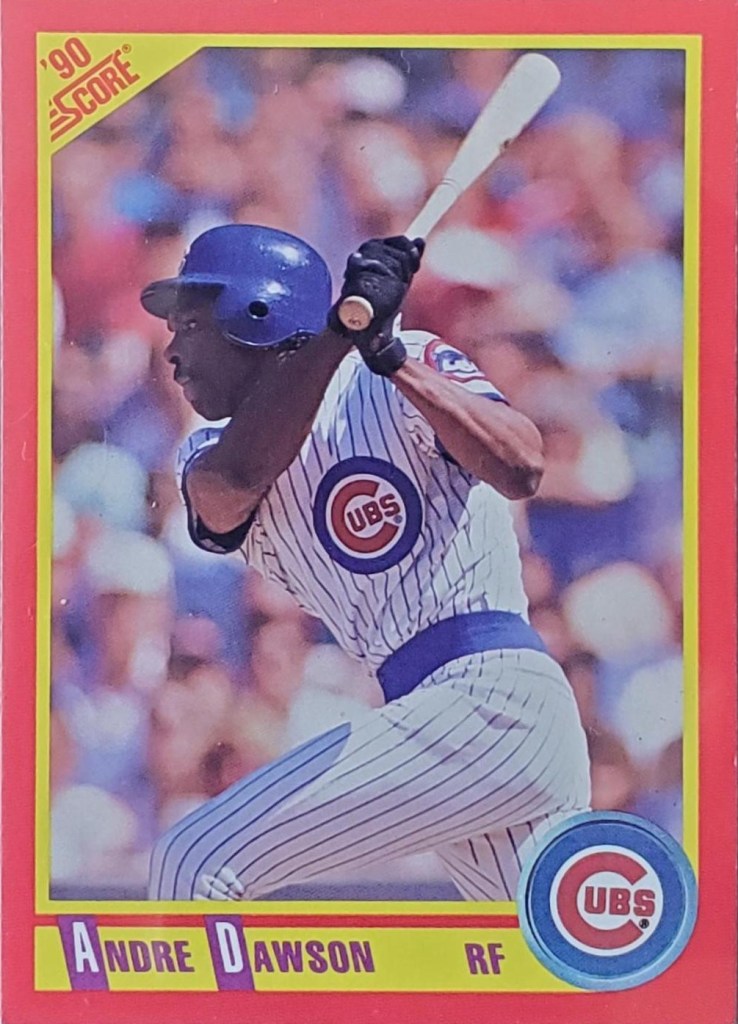
“the Hawk” is another player whose cards have a big place in my binder. He played for twenty-one seasons from 1976 to 1996 as an outfielder. Like Gary Carter above, Andre Dawson started his career with the Montreal Expos where he played for eleven seasons. In 1987, he joined the Cubs where he stayed until 1992. He finished his career with two-year stints on the Boston Red Sox and the Florida Marlins. He wore uniform number 8 for eight seasons and had a career WAR of 64.8.
I had trouble finding cards with Dawson’s number 8 showing. He wore the number while with the Cubs, and my memories of “the Hawk” are mostly during his Cubs tenure so I picked this 1990 Score. I liked collecting the Score cards and have a few of this card. I think it’s a nice action shot of Dawson. In 1990, he was an All-Star with a batting average of .310, 27 home runs, 100 RBIs, 16 stolen bases and led the league with 21 intentional walks.
Dawson was an eight-time All-Star. He was the National League ROY in 1977 and the MVP in 1987. He was also a great defender having won eight Gold Glove Awards. He was a four-time Silver Slugger who batted over .300 on five occasions. He was also fast on the bases and stole 25 or more in six seasons. By 1994 injuries began to reduce his playing time and he played less than 80 games in each of his last few seasons before retiring in 1996.
Dawson finished his career with a .279 career batting average. He had 2774 hits with 503 doubles. His 438 home runs are 47th all-time and his 1591 RBIs are 40th. He had 314 stolen bases and is 31st in Total Bases with 4787.
Dawson is a member of the Montreal Expos and Chicago Cubs Hall of Fames.
He was inducted into the National Baseball Hall of Fame in 2010.
Number 5:
“Ninety percent of the game is half mental.” ~ Yogi Berra
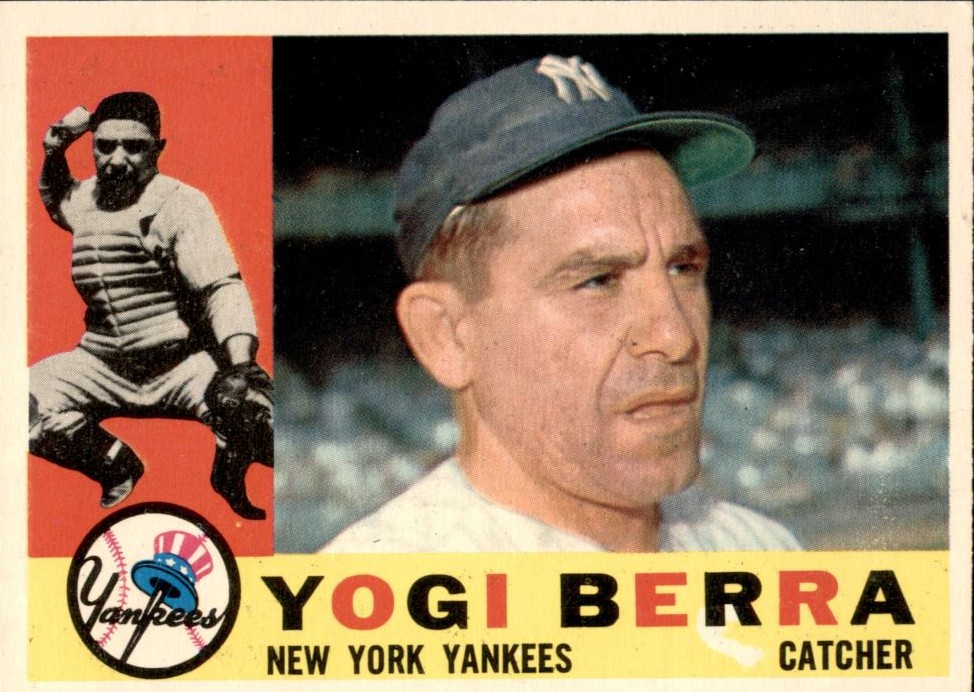
Yogi Berra was a catcher for nineteen seasons in the Major Leagues. He was well known for his sense of humor and his “yogisms”. Berra played from 1946 to 1965 for the New York Yankees, with his last season for the crosstown New York Mets. He wore uniform number 8 for sixteen seasons and had a career WAR of 59.5.
I used this 1960 Topps card because I like the design and the photo of Berra in his catcher’s gear is great. In 1960 Berra was an All-Star…twice!
For his career, Berra was an All-Star eighteen times (twice from 59-61). He was the American League MVP three times (51, 54, 55). He batted .290 or better seven times, hit 25 or more home runs six times and had over 100 RBIs five times. On the defensive end, he led catchers in putouts eight times, assists three times, and double plays six times. He played with many Yankee greats throughout his career, including Joe DiMaggio, Phil Rizzuto, Johnny Mize, Whitey Ford, and Mickey Mantle. Berra was a World Series Champion 10 times, the most of any player, and holds many series records.
He has a career .285 batting average with 2150 hits, 358 home runs, 1175 runs, 1430 RBIs and a career .989 fielding percentage at catcher. He holds the World Series records for the most games (75), hits (71), doubles (10), singles (49), games caught (63), and catcher putouts (457). Marcius, Chelsia Rose; McShane, Larry; Madden, Bill (September 2015)
His uniform number 8 was retired by the New York Yankees in 1972 along with his idol Bill Dickey (who will also be on this list). Aside from Jackie Robinson’s 42, I think this is the only instance where a number has been retired twice by one team. If anyone knows otherwise, drop a comment.
Berra was inducted into the Baseball Hall of Fame in 1972.
Yogi passed away at age 90 in 2015.
Number 6:

For twenty-one seasons, Wilver “Willie” Stargell, could be seen warming up with a sledgehammer during the Pirates batting practice. From 1962 to 1982, Stargell played left field and first base exclusively for Pittsburgh. He wore uniform number 8 his entire career and had a career 57.6 WAR.
I love this 1968 Topps card! It’s got a great photo of Stargell with his uniform number right on the front of the card. The only thing missing is the sledgehammer. 1968 wasn’t his best year, he batted only .237 with 24 home runs and 67 RBIs.
Stargell was a seven-time All-Star. He shared the 1979 National League MVP award with Keith Hernandez. Stargell batted .281 with 32 home runs and 82 RBIs that season. During his career, he led the league in home runs and OPS twice and in doubles, RBIs, WAR, and SLG once. Stargell had eight seasons with a .290 or better batting average. He was a member of two Pirates World Series Championships, 1971 with teammates Roberto Clemente and Bill Mazeroski and 1979 with teammates Bert Blyleven and Dave Parker. He was the MVP of the 1979 World Series after batting .400 with a .375 OBP, 12 hits, 4 doubles, 3 home runs and 7 RBIs.
Stargell earned the nickname “Pops” later in his career and was a mentor to young players in the Pirates organization until his last game in 1982. He ended his career with a .282 batting average accumulating 2232 hits, 423 doubles, 475 home runs (tied with Stan Musial for 32nd all-time), and 1540 RBIs (49th all-time).
Stargell is a member if the Pirates Hall of Fame and his uniform number 8 was retired by the Pirates in 1982.
He entered Cooperstown in 1988.
Wilver “Willie” Stargell passed away at 61 in 2001.
Number 7:
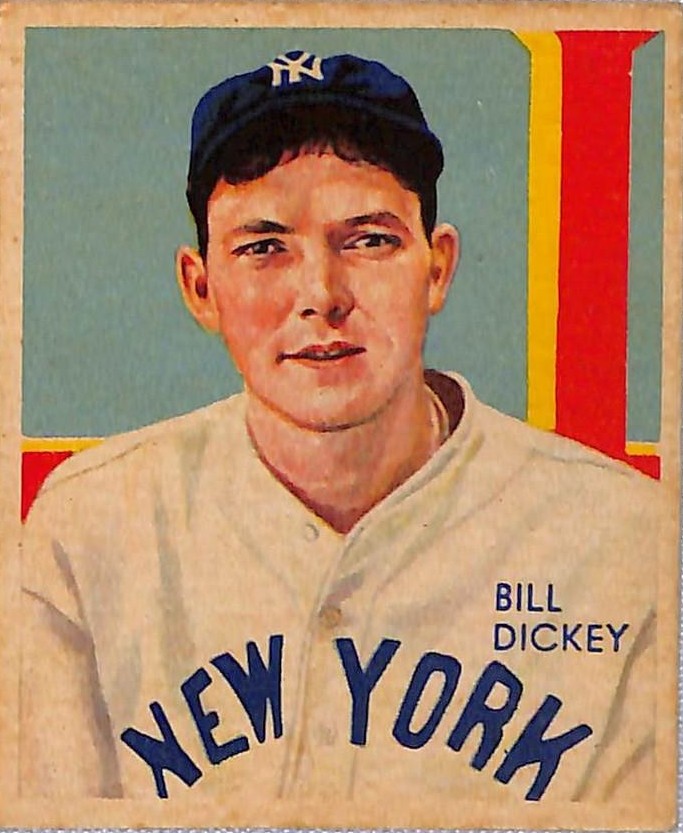
Bill Dickey played catcher exclusively with the New York Yankees for seventeen seasons from 1928 to 1946 (missing the 44 and 45 seasons for military service). He would go on to become a coach and a mentor to the Yankees young catcher, Yogi Berra, who also made it on this list. Dickey wore uniform number 8 every season aside from his first, and had a career WAR of 56.4.
I’m always happy to include a Diamond Stars card! This 1934 Bill Dickey is a beautiful card. The portrait is one of the best I’ve seen, and the background colors are awesome. In 1934 Dickey batted .322 with 12 home runs and 72 RBIs making the All-Star team.
Dickey was an All-Star in eleven seasons. He batted over .300 eleven times and hit over 20 home runs and 100 RBIs in 4 straight seasons from 1936 to 1939, amazing accomplishments for a catcher, especially during the ‘30s. In 1936 he batted .362 which is tied with Mike Piazza for 2nd highest season average by a catcher in history.
He won seven World Series Championships with the New York Yankees, in 1932 on a team that featured nine Yankees Hall of Famers, including Babe Ruth, and in 1936-1939, 1941 and 1943, all great Bronx Bombers teams.
He finished his career in 1946 as a player/manager. He had a career batting average of .313 with 1,969 hits, 202 home runs, 930 runs and 1,209 RBIs.
His uniform number 8 was retired by the New York Yankees along with the Yogi Berra in 1972. Aside from Jackie Robinson’s 42, I think this is the only instance where a number has been retired twice by one team. If anyone knows otherwise, drop a comment.
Bill Dickey passed away in 1993 at the age of 86.
Final Score:
Thanks for sticking with me with this long post. I knew uniform number 8 would take a bit, but it was important to me to tell stories about two of my favorite players to wear the number. I only have a couple of shoutouts this time.
Reggie Smith (career WAR 64.8) wore number 8 for six seasons with the Dodgers and was previously featured in the uniform number 7 post.
A few players didn’t make the list but wore the number for a long time. Bob Boone (18 seasons), Gary Gaetti (15 seasons), Ryan Braun (14 seasons) and Javy Lopez (12 seasons). There were quite a few more, so someday I’ll do more posts with all these shoutouts!
Thanks again for reading and if you’re enjoying these posts, leave a like or a comment or subscribe to the newsletter. I’d love to hear from you!
Sources:
https://www.baseball-almanac.com/
Berra, Yogi (1998) The Yogi Book. New York: Workman Publishing. p. 9.
Berardino, Mike (2013). “Minnesota Twins: Joe Mauer takes Mike Piazza’s comments in stride”. Twincities.com
https://www.baseball-reference.com/
Marcius, Chelsia Rose; McShane, Larry; Madden, Bill. “Yogi Berra dead at 90: Yankees legend, Baseball Hall of Famer was lovable character, American hero”. Daily News. (September 23, 2015 UPDATED: April 9, 2018)
Perry, Jeff (2024) “History: Carl Yastrzemski’s defense somehow rivaled his stellar offense”. bosoxinjection.com
Shout out to all the cool cards and creative commons for my pictures! Thanks Topps and Upper Deck and Fleer and Donruss and all the rest!
 Weekly Windup
6 thoughts on “Baseball by the Numbers: 8”