

6
Welcome back to Baseball by the Numbers. Today we are looking at uniform number 6. Uniform number 6 had almost 700 players who wore it in their career. There was one Legend (career WAR over 100). There were thirty-nine players who wore uniform number 6 with a career WAR over 40 and ninety-four players who had the number for five years or more.
Aside from my one Legend, two other Legends wore number 6, but each only for 1 season. Rogers Hornsby with the Cardinals in 1924, and Mickey Mantle who wore it for his rookie season in 1951. We’ll be seeing Mickey real soon.
Narrowing things down wasn’t too difficult with this number even though nearly a hundred players wore it for over 5 years, the number of players with a career WAR over 40 that overlapped with longevity was quite low. There were quite a few in the thirties for WAR, so I’ll be sure to do some shout outs at the end.
The Legend:
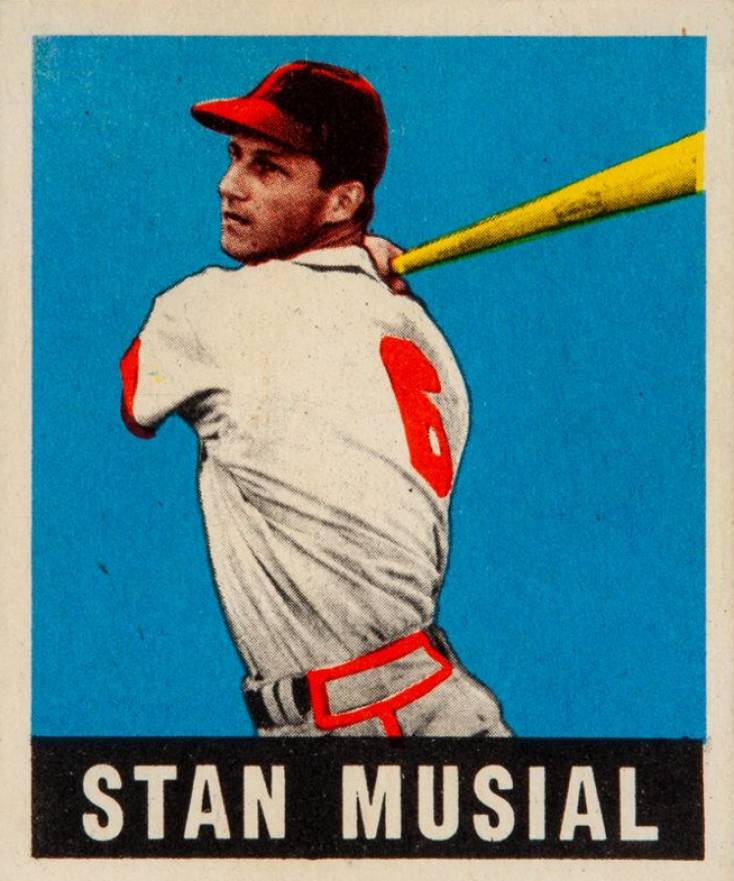
“Stan the Man” played in the Majors for twenty-two years from 1941 to 1963 with a gap year in ’45 for military service. He wore uniform number 6 for all twenty-two and played outfield and first for the St. Louis Cardinals his entire career. He is eleventh all-time with a career WAR of 128.6.
I love this 1948 Leaf card. Not only is it beautiful in its simplicity, with Musial finishing a powerful swing against a vibrant blue background, but his uniform number is in the photo. That’s something I’ve found unusual for older cards. In 1948 Musial was an All-Star and the National League MVP. He led the league in almost every offensive category; WAR (11.3) runs (134), hits (230), doubles (46) triples (18), RBIs (131), batting average (.376), as well as OBP, SLG, OPS and Total Bases. Leading the league in offensive categories was a regular occurrence for Musial throughout his career.
Although he played for only twenty-two years, he was an All-Star twenty-four times! That’s because of the double All-Star games in the late 50s early 60s he was an All-Star eight times in four years (59, 60, 61, 62). Willie Mays and Hank Aaron are the only other players in history with twenty-four All-Star appearances.
He was National League MVP three times (43,46,48) and led the league in batting average seven different seasons. Speaking of batting average, he hit .300 or better in seventeen seasons. He also led the league in WAR four times, runs five times, hits six times (getting over 200 in six seasons), he led the league in doubles eight times, triples five times and RBIs twice. Aside from his 3 MVPs, he was the runner up in MVP voting four additional seasons.
He was a part of three World Series Championships with the Cardinals, in 1942 when they defeated the Joe DiMaggio led Yankees, in 1944 when they beat the St. Louis Browns in a cross-town rivalry and in 1946 when they beat Bobby Doerr, Ted Williams and the Red Sox.
When he retired after the 1963 season, he had 3,630 hits which is 4th all-time in Major League history. One crazy fact, he had exactly 1,815 hits at home and 1,815 hits on the road! In his career he had 5 hits in eight different games and 4 hits in fifty-nine games.
He is 3rd all-time in doubles (725), 19th in triples (177), 8th in RBIs (1,951), 10th in runs (1,949) and 3rd in total bases. He also had 475 career home runs (32nd) and a career .331 batting average (34th).
He is a member of the St. Louis Cardinals Hall of Fame and was voted onto the MLB All-Century team.
He was inducted into the National Baseball Hall of Fame in 1969.
His number 6 was retired by the Cardinals in 1963.
Musial passed away at the age of 92 in 2013.
Number 1

Al Kaline played for twenty-two years in the majors from 1953 to 1974 as a right fielder and first baseman exclusively with the Detroit Tigers. This longevity with Detroit earned him the nickname “Mr. Tiger”. He wore uniform number 6 every season aside from his first. His career WAR was a wonderful 92.8.
This 1969 Topps card is a wonderful addition to my posts. Not only is the 69 Topps a cool looking card, but it has Kaline’s number showing right out front. I really like it when the uniform numbers are on the front of the uniforms. In 1969, Kaline had an average season. He only played 131 games, batted .272 with 21 home runs and 69 RBIs.
Al Kaline was an eighteen-time All-Star including twice each in ‘59, ‘60, and ’61. He was the batting champ in 1955 when he had a .340 average on 200 hits. Kaline had over 100 RBIs in three seasons, he hit over .300 in nine seasons and came in second in MVP voting twice. Aside from his great hitting, he was a fantastic fielder, winning ten Gold Gloves.
Along with Eddie Mathews, Kaline was a member of the 1968 World Series Champion Tigers who beat the Red Schoendienst managed St. Louis Cardinals, 4 games to 3.
He would retire at the end of the 1974 season after reaching the 3,000-hit milestone. He would end his career with a .297 batting average, 3,007 hits, 498 doubles, 399 home runs and 1,582 RBIs. He also had a career fielding percentage of .987.
Kaline would go on to be a color commentator for the Tigers from 1975 to 2002.
He was elected to the Baseball Hall of Fame in 1980 and was the first to have his number retired by the Tigers in 1980.
Kaline passed away at age 85 in 2020.
Number 2

Sal Bando played third base for sixteen years in the Major Leagues from 1966 to 1981 for two teams. He played for the Athletics while the team was still in Kansas City (66 and 67) then stayed with them as they moved to Oakland. In 1977 he went to the Milwaukee Brewers where he remained for the rest of his career. He wore uniform number 6 his entire career. He had a career WAR of 61.5.
In 1972, Bando, a member of the “Swingin’ A’s”, batted .236 with 15 homes runs, 77 RBIs and was an All-Star. This ’72 Topps “In Action” card is a perfect fit for the post. I really like these special Topps cards, so much so that I will be using another one later in the post. I love that this photo captures his swing, with his number and name visible. The card design is super ‘70s retro too.
From 1971-1975 the A’s won five straight division titles. During this time, Bando was a 3x All-Star, with one additional All-Star season in 1969. He was 2nd in MVP voting in 1971 when he batted .271 with 23 doubles, 24 home runs and 94 RBIs. He lost the MVP to his teammate Vida Blue who also won the Cy Young award. In 1973, Bando had his best season with a 6.5 season WAR, he played all 162 games and batted .287 with 29 home runs and 98 RBIs and led the league in doubles with 32 and total bases with 295.
He was a World Series Champ three times with the A’s in 1972, ’73 and ’74. A team that featured Vida Blue, Reggie Jackson, Catfish Hunter, Gene Tenace and Rollie Fingers.
Bando retired in 1981. He is a member of the Oakland Athletics Hall of Fame and the Milwaukee Brewers Wall of Honor.
Bando passed away at age 78 in 2023.
Number 3

At one point I was looking through a bunch of my old baseball cards and was surprised at how many Willie Wilson cards I had collected. I remember liking him but never realized I had so many of his cards. It’s always fun to look through your old cards and find these gems.
Willie Wilson played outfield for nineteen seasons from 1976 to 1994. He played for the Kansas City Royals until 1990 when he left for Oakland where he played two seasons before finishing his career with the Chicago Cubs. He wore uniform number 6 for sixteen seasons and had a career WAR of 46.1.
Most of Wilson’s playing career was during my formative baseball card collecting years. This 1985 Fleer is awesome. I must have really liked it because I have still have a few copies. It’s a great photo of Wilson with his number 6 front and center. I love the design of these Fleer cards, with the team logo on the front and the nice border, and those Royals uniforms are perfect. In 1985 Wilson batted .278. He led the league in triples with 21 and had 43 stolen bases.
Wilson was a two-time All-Star. A speedy player, he led the league in stolen bases only once (with 83 in 1979) but had over 30 stolen bases in eleven seasons. He also led the league in triples five times. He was the batting champ in 1982 with a .332 average. He won two Silver Sluggers, one in 1982 and one in 1980. He also won his only Gold Glove in 1980. 1980 was his best year, along with the Gold Glove and Silver Slugger, he led the league in runs (133), hits (230), triples (15) and had an 8.5 season WAR.
He was a member of the World Series winning Kansas City Royals team of 1985 that also featured George Brett. Wilson helped the team win the Series by batting .367.
He played only 17 games in 1994 before being released by the Cubs and leaving baseball.
He is 12th all-time with 668 stolen bases in his career. He had a career batting average of .285 with 2,207 hits, 281 doubles, and 147 triples.
He is a member of the Kansas City Royals Hall of Fame.
Number 4
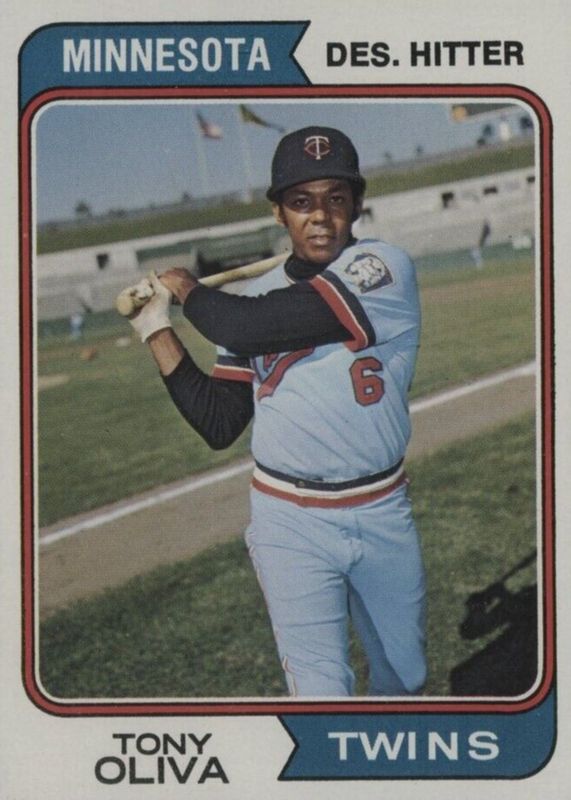
Tony Oliva was a Cuban born baseball player who played in the Majors for fifteen years from 1962 to 1976. He was a right fielder who played exclusively with the Minnesota Twins. He wore uniform number 6 for thirteen seasons and finished his career with a 43.1 WAR.
I love this 1974 Topps card. Even though it was toward the end of his career, this card is a fantastic companion to the post. The design of these cards is beautiful, with the white borders, the city and team names in the banners along the inner border and the wonderful photo in the center. I’m starting to think I can find something wonderful in every set of old Topps. This photo is great, I really like these old Twin’s uniform colors and, as I’ve mentioned plenty, the uniform number on the front makes this card the whole package. 1974 was close to the end of Oliva’s career, but he played well, batting .285 with 131 hits, 16 doubles, 13 home runs and only struck out 31 times in 459 at bats.
Olivia broke into baseball with a bang. His first eligible season, 1964, he played in 161 games and won the Rookie of the Year with an All-Star season. He led the league in batting average (.323), runs (109), hits (217), doubles (43) and total bases (374). His season WAR of 6.8 would be the best of his career.
He was an eight-time All-Star who led the league in hits five times (with two over 200 hit seasons), doubles four times and batting average three times. He hit over .300 seven times. He also won a Gold Glove in 1966.
After he retired as a player, he became a Twins coach and was also a part of all three World Series appearances for the Minnesota Twins, as a player in 1965 when they lost to the Dodgers 4 games to 3 and as a coach when they won in 1987 and 1991.
He is a member of the Twins Hall of Fame, and his number 6 was retired by the Twins in 1991.
In 2022 he was inducted into the National Baseball Hall of Fame through the Golden Days Era Committee. Also inducted was former Twins teammate Jim Kaat. Fun Fact: I was at that induction ceremony. I had taken a trip to Cooperstown to meet up with my uncle and cousins to support “Big Papi”. It was a great experience!
Number 5
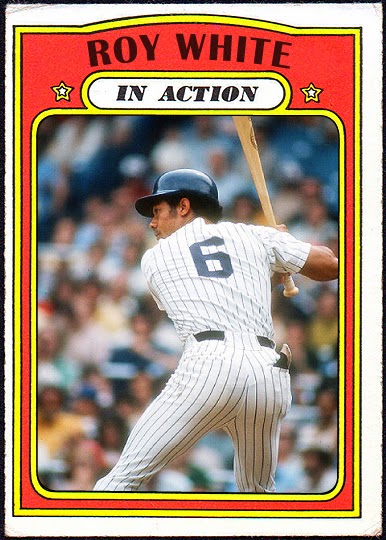
Roy White played fifteen seasons in the Majors from 1965 to 1979 as a leftfielder. He played his entire career with the New York Yankees and wore uniform number 6 for eleven of them. He had a career WAR of 46.8.
Like Sal Bando above, this 1972 Topps “In Action” card was the perfect compliment to this post. Not only is the card design awesome, but the photo is perfect and includes his uniform number. White had a good year in 1972. He led the league in walks with 99 and had a season WAR of 5.4. He batted .270 and only struck out 59 times (40 less than he walked). He had 150 hits, 10 home runs and 23 steals with an OBP of .384.
White was a two-time All-Star. He is 4th all time for single season sacrifice flies with 17, set in 1971 and led the majors in sacrifice flies in both ’71 and ’69. He was a member of the Yankees World Series winning teams in 1977 and 1978 along with Catfish Hunter and Reggie Jackson.
He ended his career with a .271 batting average, 1,803 hits, 300 doubles, and more walks (934) than strikeouts (708). He also had 233 stolen bases.
After retirement he would go on to coach in the Major and Minor Leagues. He started a foundation to help low-income children and young adults attend college.
Number 6
Another player who stayed with one team for his entire career, Stan Hack played sixteen seasons with the Chicago Cubs from 1932 to 1947, as a third baseman. He wore uniform number 6 for nine seasons, having worn six additional numbers throughout his career. He had a career WAR of 55.2.
This 1934 Diamond Stars had to be used, because as you all know I love me some Diamond Stars cards. This one is perfect with its art deco background colors and Hack with his signature smile on his face. Hack was known as “Smiling Sam” and a bit of research shows many pictures of Hack with a big grin. 1934 was his first full season. He batted .289 with 116 hits, 16 doubles, a home run and 11 stolen bases. He would become an All-Star just a few years later.
Hack was an All-Star five times. He led the league in hits and stolen bases two times each. He batted lefty but threw righty and was a stanch defender at third. He led the National League in putouts five times, in double plays three times and in assists and fielding percentage twice each.
In 1935, the Cubs held a promotion in which they gave the fans mirrors with Hack’s smiling face on the reverse side. The promotion was called “Smile with Stan” with the goal of having the fans smiling into the mirrors. Hack was a popular player, and this was sort of like the 30’s version of bobblehead day. Unfortunately, things did not go as planned. The fans found the mirrors to be a perfect way to screw up the opposing team by reflecting the bright sun into their eyes. The umpires had to threaten a forfeit if the fans didn’t stop and banned mirrors in future promotions. I always wondered why we didn’t get mirrors at baseball games.
Hack retired from baseball in 1947 and went on to manage and coach in both the Majors and the Minors.
He had a career batting average of .301, with 2,193 hits, 361 doubles, 57 home runs to go along with a career OBP of .394 having 1,092 walks to only 466 strikeouts.
He is a member of the Chicago Cubs Hall of Fame.
Hack passed away in 1979 at the age of 70.
Number 7
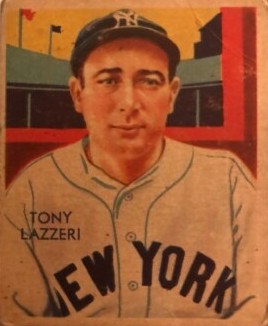
Part of the Yankees famous “Murderers Row” lineup in the 1920s, Tony Lazzeri played for fourteen years from 1926 to 1939. He was a second baseman and played for the Yankees from ’26 to’37. He would then play for the Chicago Cubs, Brooklyn Dodgers and New York Giants. He wore uniform number 6 for his first five seasons and had a career WAR of 47.6.
I may have picked both Hack and Lazzeri just to use these 1935 Diamond Stars cards. Lazzeri’s card is another great product, again with the art deco colors and graphic in the background and the nice portrait with New York written on his jersey. It’s another great looking old card. 1935 was an average year for the second baseman. He batted .273 with 130 hits, 18 doubles, 13 home runs and 83 RBIs. He also added 11 stolen bases.
Lazzeri was an All-Star in one season. Keeping in mind he played his best years prior to the All-Star game’s inception. He hit .300 or better in five seasons. He hit over 100 RBI in seven seasons. In 1927 he batted .309 with 18 home runs and 102 RBI. His 18 home runs were third in the American League behind his teammates Babe Ruth and Lou Gehrig. He holds the American League record for most RBIs in a game with 11 and was the first player in history to hit two grand slams in one game. He is also the only player in major league baseball to hit for the cycle with the final home run being a grand slam.
Lazzeri was a member of five World Series Championships all with the New York Yankees.
He was voted into the National Baseball Hall of Fame by the Veterans Committee in 1991.
Lazzeri passed away at the young age of 42 in 1946 after a fall due to a suspected epileptic seizure.
Final Score
There are a few players that I want to shout out for uniform number 6. Rogers Hornsby, Brooks Robinson, Jim Thome, Scott Rolan and Larry Doby all wore it for one season.
Hall of Famer and 9x All-Star Joe Gordon of the Yankees wore it for seven seasons. He had a career WAR of 55.6 and almost made the list, but I already featured a couple of Yankees, so he didn’t make the cut.
Current All-Star Sterling Marte has worn number 6 for fourteen seasons. Former Red Sox great Rico Petrocelli had the number for eleven seasons.
There are always several players left off who I would have liked to use, but I’m sticking to my seven and already pushing it by adding the Legends spot.
I do hope that you are enjoying Baseball by the Numbers and will check out the uniform number 7. It’s my favorite number just in general. As a uniform number it should be a fun one with one Legend and some cool players. As always: Thanks for the support!!
| PLAYER NAME | YEARS WORN | CAREER WAR | NUMBER RETIRED | OTHER ACHIEVEMENTS |
| Al Kaline | 21 | 92.8 | Yes (Detroit Tigers 1980) | 18x All-Star 10x Gold Glove World Series Champ (68) HOF (80) |
| Sal Bando | 16 | 61.5 | No | 4x All-Star 3x World Series Champ (72-74) |
| Willie Wilson | 16 | 46.1 | No | 2x All-Star Gold Glove (80) 2x Silver Slugger World Series Champ (85) |
| Tony Oliva | 13 | 43.1 | Yes (Minnesota Twins 1991) | 8x All-Star 1 Gold Glove ROY (64) 3x Batting Champ World Series Champ (c87, c91) HOF (2022) |
| Roy White | 11 | 46.8 | no | 2x All-Star World Series Champ (77, 78) |
| Stan Hack | 9 | 55.2 | no | 5x All-Star |
| Tony Lazzeri | 5 | 47.6 | no | 1x All-Star World Series Champ (27, 28, 32,36,37) |
Sources:
https://www.baseball-almanac.com/
https://www.baseball-reference.com/
Shout out to all the cool cards and creative commons for my pictures! Thanks Topps and Upper Deck and Fleer and Donruss and all the rest!
 Weekly Windup
4 thoughts on “Baseball by the Numbers: 6”