
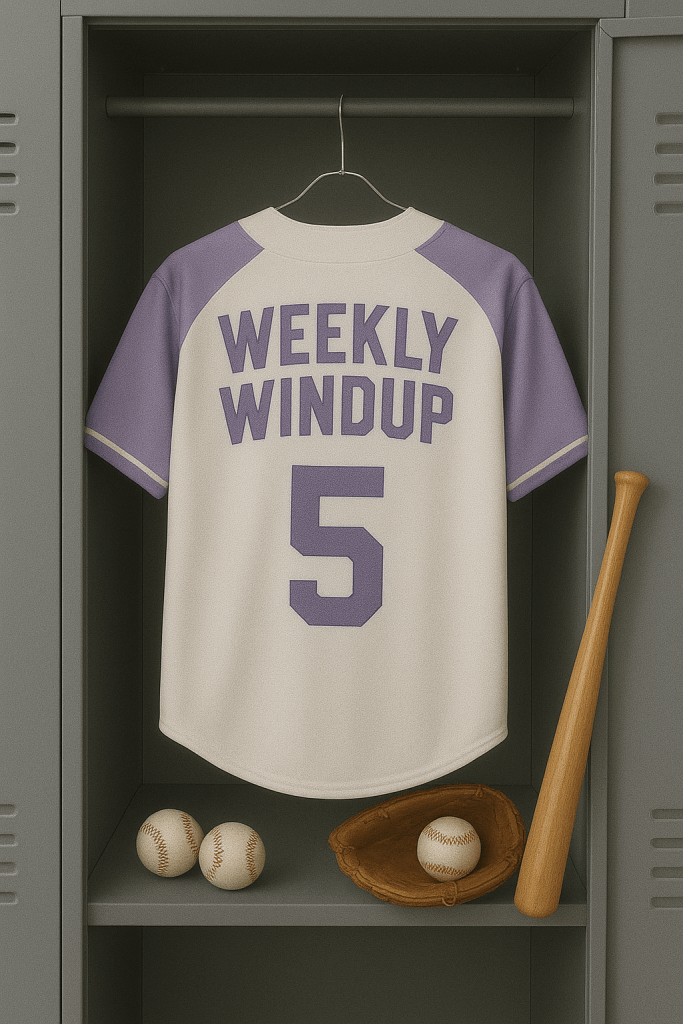
5
Welcome back to Baseball by the Numbers. Today we are looking at uniform number 5. Uniform number 5 had over 600 players wear it at some point. Using my criteria (here), I was able to narrow things down. There were eighty-five players who wore uniform number 5 for five years or more and thirty-seven with a career WAR over 40. Between those two criteria, only seventeen players overlap. There was also a Legend player (career WAR over 100), so I had sixteen players to choose from.
Two players wore number 5 for only one season each and also had a career WAR over 100. Mel Ott, who wore it in 1932 with the New York Giants, and was already featured in a prior post for number 4. and Hank Aaron, who wore it during his rookie season in 1954 with the Milwaukee Braves, and will be featured much later.
As I looked through the list, I realized this post was going to be a challenge, with so many great players who fit the criteria, and several personal favorites. Choosing seven was not easy, but I managed to do it, so here you go!
The Legend:
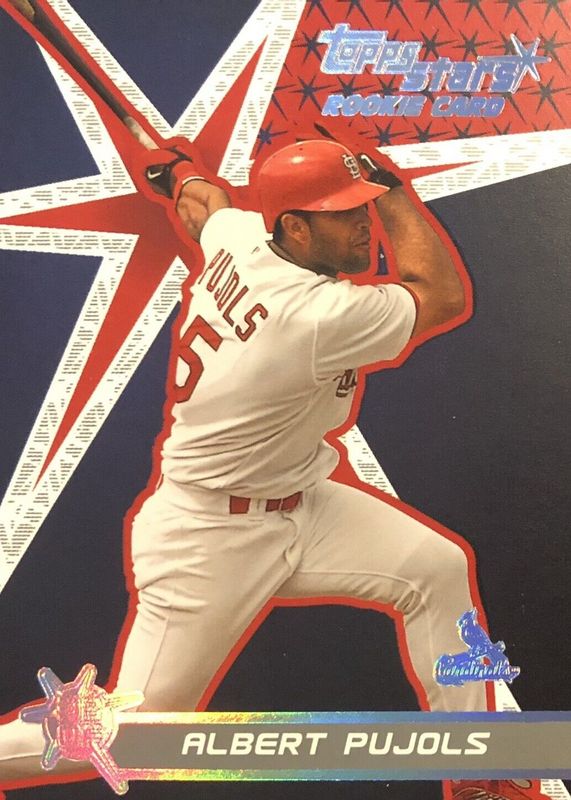
Pujols played for twenty-two seasons in the MLB, and wore uniform number 5 for all twenty-two, though he had a brief 85 game stint with the Dodgers at the end of his career with the number 55. His career WAR was 29th all-time at 101.2.
Pujols played first base and DH from 2001 to 2022 with the St. Louis Cardinals, Los Angeles Angels, the previously mentioned Dodgers, and then finished with the Cardinals again.
The card I picked is the 2001 Topps Stars card. It’s his first season and he was already shaping up to be a future star. The card is awesome, with flashy colors and the cool star design. He’s finishing his swing, and his number is easy to see on the card. In fact, when looking for a card I found the Pujols uniform number was visible on so many different options it was hard to choose, so I went with his rookie season.
In 2001, Pujols had an All-Star campaign hitting .329 with 37 home runs, 130 RBIs (an NL rookie record), 47 doubles, 194 hits, and a 1.013 OPS. He was the easy favorite for NL Rookie of the Year and won a Silver Slugger. He joined Wally Berger (1930), Ted Williams (1939), Walt Dropo (1950) and Mike Piazza (1993) as the fifth MLB rookie to hit .300 with 30 home runs, 100 runs, and 100 RBIs. Jose Abreu would add his name to the group in 2014. It was the start of an amazing career for Pujols.
“La Máquina” “the Machine” was an eleven-time All-Star. He was Rookie of the Year in 2001 and won the National League MVP award three times in 2005, 2008, and 2009. He led the league in WAR six different seasons, in home runs twice, runs five times, hits, batting average, doubles and RBIs once, and SLG and OPS three times each. He was a six-time Silver Slugger and hit over .300 in ten straight seasons.
In 2004, Pujols helped the Cardinals get to their first World Series since 1987 and he was named the NLCS MVP after batting .500 with 4 home runs and 9 RBI. Pujols was a part of two World Series winning teams with the St. Louis Cardinals in 2006 and 2011.
He won the Hank Aaron award twice in 2005 and 2009, and the Clemente award in 2008. He was the comeback player of the year in 2022 (his last season) when he rejoined the Cardinals and was an All-Star batting .270 with 24 home runs. He retired after the season.
He ended his career in tenth place all-time with 3,384 hits, fourth in home runs (703), fifth in doubles (686), and second in RBIs (2,218). He has a career .296 batting average, .387 OBP, .544 SLG and .918 OPS. He joined Hank Aaron as the only players in history with 3,000 hits, 700 home runs, and 2,200 RBIs. He never struck out more than 100 times in a season which is incredible, especially in today’s baseball.
Pujols is eligible for the Hall of Fame in 2028 and should be a guaranteed inductee. I’ve been lucky to have been able to watch Pujols his entire career.
Number 1:
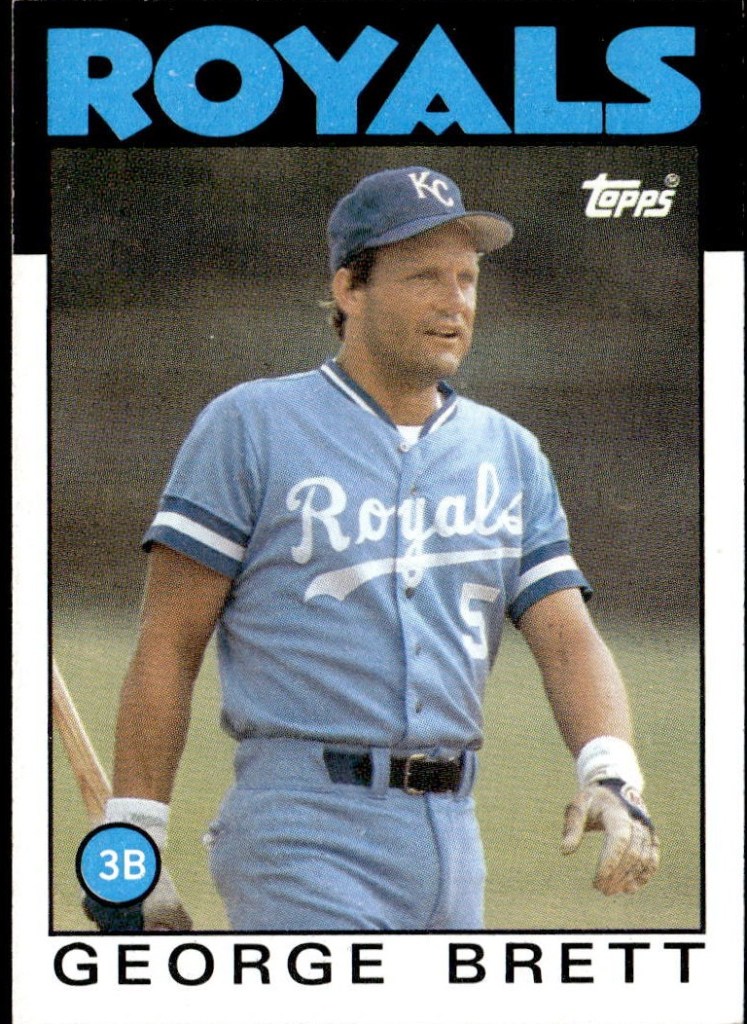
George Brett was one of my absolute favorite players growing up. I loved collecting his cards and watching him play whenever possible on TV or on the highlights of This Week in Baseball. He was such a great player.
Brett played twenty-one seasons in the MLB from 1973 to 1993 as a third and first baseman. He spent his entire career with the Kansas City Royals. He wore uniform number 5 for nineteen seasons, having worn 25 his first two. He has a career WAR of 88.6.
Yes, another 1986 Topps! I’ve said it before, I like this set, and this card is a personal favorite. I think I have a half dozen of them, none of which would grade above a six (lol). The card is gorgeous. The Royals team name in blue against that black background looks so nice with the photo. Brett walking along carrying his bat, the number 5 so nicely displayed on the front of that Royal blue uniform. Perfect! In 1986, Brett was an All-Star. He had a .290 batting average with 16 home runs and 73 RBIs.
Throughout his career, Brett was a thirteen-time All-Star (nine times in the 80s). He was the American League MVP in 1980 when he batted .390, and led the league not only in batting average, but in OBP, SLG, OPS, OPS+ and WAR. He won a Gold Glove in ’85, was a three-time Silver Slugger and a three-time batting champ.
In 1985 he helped the Royals win their first World Series in history after a wonderful season which saw him bat .335 with 30 home runs and 112 RBIs while leading the league in SLG and OPS. He would win the ALCS MVP award batting .348 with 8 hits, 3 home runs, and 5 RBIs in the seven games against Toronto. He also batted .370 in the World Series win against St. Louis. He was clutch in the postseason and batted .337 with 10 home runs and 23 RBIs in 43 career postseason games.
Brett would finish his career in 1993. He is 18th all-time in hits with 3,154. He has a .305 career batting average, 317 home runs, 665 doubles (7th all-time), 1,583 runs, 1,596 RBIs and 201 stolen bases. He joined Stan Musial, Willie Mays and Hank Aaron as the only players with 3,000 hits, 300 home runs, and a career .300 batting average (Miggy Cabrera would also join this group).
Brett is a member of the Royals Hall of Fame.
His uniform number 5 was retired by the Royals in 1994.
He was inducted into the National Baseball Hall of Fame in 1999.
Number 2:

Brooks Robinson was considered by many to be the greatest defensive third baseman in major league history. Because of his defensive prowess, he earned two very cool nicknames, “Mr. Hoover” and “the Human Vacuum Cleaner”.
Robinson played for twenty-three years in the MLB from 1955 to 1977, all of them at third base and all of them with the Baltimore Orioles. This earned him the fan nickname of “Mr. Oriole”. He wore uniform number 5 for twenty-one seasons. His career WAR was 78.3.
I was excited to see that this 1959 Topps card showcased Robinson’s uniform number. It’s a nice card. I like the ’59 Topps design, the photo in the circle, with the yellow border, the old school Orioles logo in the bottom corner and Robinson’s signature across the front. In ’59 he only played 88 games, in part due to an injury that could have been career ending. He was in the minors working on his hitting and fell into the dugout while catching a ball. His arm was impaled on a hook that severed several tendons but luckily missed any nerves. Once he was back, he hit .284 for the season. He would become an All-Star the next year (twice!).
Robinson was an eighteen-time All-Star. He would be an All-Star in fifteen straight seasons (there were two All-Star games in the ’60, ‘61’ and ’62 seasons). He would also win sixteen straight Gold Gloves, living up to his vacuum cleaner nicknames.
He was the American League MVP in 1964 when he hit .317 with 28 home runs, 118 RBIs (led the league), 35 doubles and 194 hits. He also led the league in putouts, assists, double plays and fielding percentage.
He was part of two World Series Championships with the Orioles (1966 and 1970) and was the MVP of the 1970 World Series batting .429 with 2 home runs, 6 RBIs, and 9 hits. He also played phenomenal defense against the hard-hitting Cincinnati Reds.
He retired after the 1977 season with several defensive records at third, including most putouts (2,697), assists (6,205) and double plays (618). He had a career .267 batting average with 2,848 hits, 482 doubles, 268 home runs, 1,357 RBIs and only 990 strikeouts in 10,654 at bats.
His twenty-three seasons with the Orioles is tied for longest tenure exclusively with one team with Carl Yastrzemski of the Boston Red Sox. Go Yaz! You’ll be seeing him soon.
Robinson is a member of the Orioles Hall of Fame, and his number 5 was retired in 1978.
He was inducted into the National Baseball Hall of Fame in 1983.
Brooks Robinson passed away in 2023 at 86 years old.
Number 3:
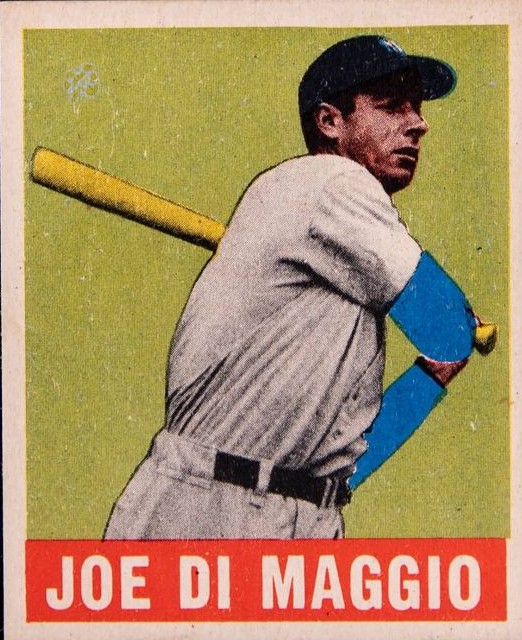
Joe DiMaggio was so good he had three nicknames. Most of us know “Joltin Joe” and “the Yankee Clipper”, but he also went by simply “Joe D.”. From 1936 to 1951 he was a baseball icon and after baseball, he was a social icon with his high-profile relationships and marriage to the actress Marilyn Monroe. During his career he played centerfield for thirteen seasons (he missed ’43-’45 for military service), exclusively with the New York Yankees. He wore uniform number 5 twelve seasons (he wore 19 his rookie year) and had a career WAR of 79.1.
As is often the case with these older cards, it was difficult to find a card photo with the uniform number showing. I choose this 1948 Leaf because it has such an iconic look, perfect for an iconic figure like DiMaggio. It seems to encapsulate his larger-than-life persona so well. In 1948 DiMaggio was an All-Star (he was an All-Star every season he played). That season, he batted .320 and led the league in home runs (39) and RBIs (155) and was second in MVP voting to another player who also wore uniform number 5 and will be featured soon, Lou Boudreau.
DiMaggio was an All-Star thirteen times, every season in which he played. He is the only player to have accomplished this feat. He was a three-time AL MVP (1939, 1941, 1947). He led the league twice in batting average, home runs and RBIs, three times in season WAR, once in triples and once in runs. He hit over .300 in all but two of his seasons, and in 1941 he would get a hit in 56 straight games, a record that seems unbreakable. In modern times only two players, Pete Rose in 1984 (44) and Paul Molitor in 1987 (39) have even come within fifteen games.
From 1936 to 1951, he was a member of the nearly unbeatable “Bronx Bombers” a Yankees team that consisted of Bill Dickey, Lou Gehrig, and Joe Gordon and later Yogi Berra. With the Yankees he won nine World Series rings, second in history only to Yogi.
He would retire after the 1951 season at 37 years old citing aches and pains after a variety of injuries had plagued his season.
He would finish his career with a .325 batting average (forty-eighth all-time), 2,214 hits, 361 home runs, 1,390 runs, 389 doubles and 1,537 RBIs.
His uniform number 5 was retired by the New York Yankees in 1952.
He was inducted into the National Baseball Hall of Fame in 1955.
DiMaggio passed away in 1999 at the age of 84.
“Where have you gone, Joe DiMaggio?
Our nation turns its lonely eyes to you
Woo, woo, woo
What’s that you say, Mrs. Robinson?
Joltin’ Joe has left and gone away”
Mrs. Robinson: Paul Simon (Simon and Garfunkel) 1968.
Number 4:
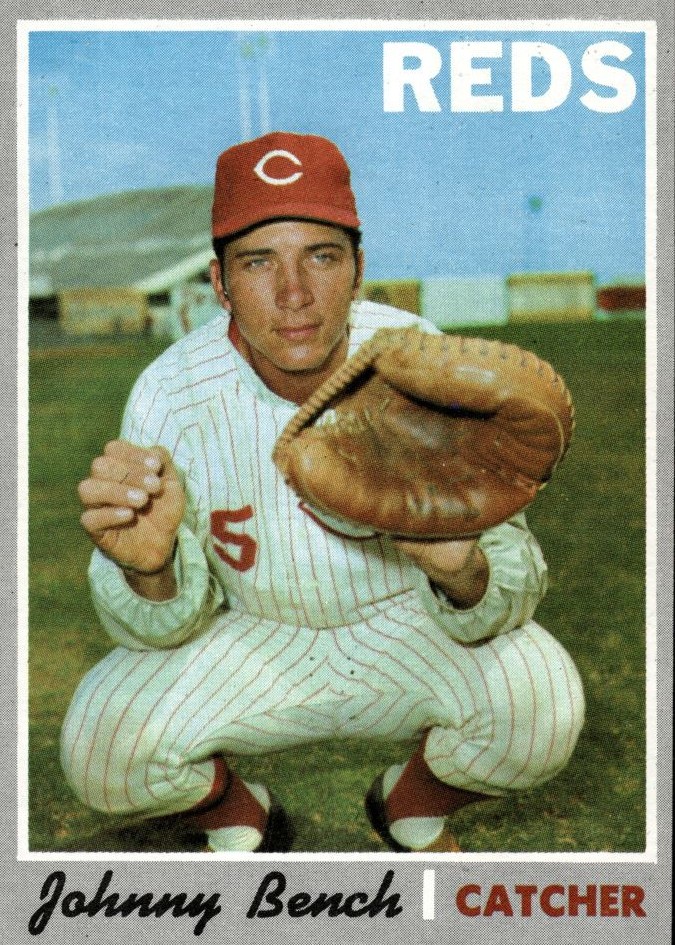
Johnny Bench played seventeen years from 1967 to 1983 in the MLB, primarily as a catcher, though he did short stints at first, third and all the outfield positions. He played all seventeen years with the Cincinnati Reds and wore number 5 the entire time. His career WAR was 75.1.
This 1970 Topps card was perfect for this post! Literally perfect! It is a beautiful card, that shows Bench in his catching position (Is it just me or does it look like his glove could catch cantaloupes?), with his number 5 just popping. Seriously, this card was made for my post. He looks so suave, but then Bench always does. Not only is the photo perfect, but it was one of his best seasons. He was an All-Star and the NL MVP after leading the league in season WAR (7.4), home runs (45) and RBIs (148) while hitting .293.
Bench was the Rookie of the Year in 1968. He was a fourteen-time All-Star and was the NL MVP in 1970 and 1972. He was an excellent defensive catcher winning ten straight Gold Gloves, a record at the position.
He won two World Series Championships with the Reds “Big Red Machine” in 1975 and 1976. From 1970 to 1979, Bench led a dominant Reds team that averaged 95 wins a season and featured players like Pete Rose, Joe Morgan, Tony Perez, George Foster, Ken Griffey Sr. pitchers Don Gullett and Gary Nolan and was managed by the great Sparky Anderson.
In the 1976 World Series, Bench hit an amazing .533 with 2 home runs and 6 RBIs winning the World Series MVP award.
Bench retired at the end of the 1983 season at age 35 with a career batting average of .267, 2,048 hits, 381 doubles, 389 home runs and 1,376 RBIs and a .990 fielding percentage at catcher.
He is a member of Baseball’s All-Century team and All-Time team.
He is a member of the Reds Hall of Fame, and his uniform number 5 was retired by the Reds in 1984.
He was inducted in the National Baseball Hall of Fame in 1989.
Number 5:
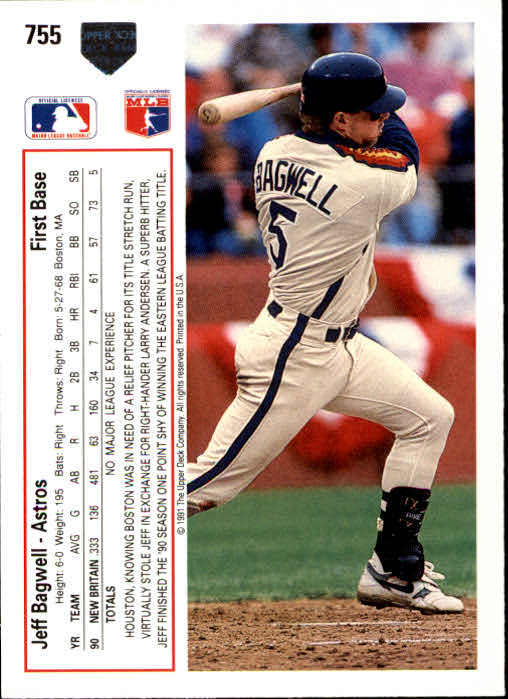
I remember watching Jeff Bagwell dominate the Majors with both awe and a sense of disappointment. As a Red Sox fan, it was always difficult to move past the fact that Bagwell could have been a Sox legend. He was drafted by the Red Sox and was traded to the Astros in 1990 for pitcher Larry Anderson. It was the Curse of the Bambino all over again! I’m being dramatic, but it was one of the worst trades in MLB history. I guess hindsight is 20-20, right? Right?!
Jeff Bagwell played first base for fifteen years from 1991 to 2005 exclusively with the Houston Astros. He wore uniform number 5 his entire career and finished with a WAR of 79.9.
This is the first time I used the back of a baseball card for these posts. This is Bagwell’s 1991 Upper Deck, his rookie season. Upper Deck was all the rage in the early 90s, and I remember this card well. In fact, I think I have a few in my closet. It was during the junk wax era, but collecting as a kid we were unaware that the bubble was about to burst. I’m sure this card went for a pretty penny when it first came out. Either way, this is a great photo, showcasing Bagwell’s uniform number after a powerful swing.
After being traded from the Red Sox (I will not get over it!), Bagwell was the NL ROY in 1991. He hit .294 with 15 home runs and 82 RBIs.
Jeff Bagwell was a four-time All-Star. He was the National League MVP in 1994 when he led the league in WAR (8.2), runs (104), RBIs (116), SLG (.750) and OPS (1.201) and got his only Gold Glove award. Bagwell also won three Silver Slugger awards. He displayed uncommon speed for a first baseman, and he and Barry Bonds are the only two players in history with two 40-30 seasons. In 1997 Bagwell had 43 home runs and 31 steals and in 1999, 42 and 30.
Bagwell was a part of the Astros’ “Killer Bs” along with teammates Craig Biggio and Lance Berkman. (I think there was even a cool 90s poster of the three-I loved those posters!) They never won a World Series, but the Astros were a force between 1994 and 2005, making the playoffs on six occasions and losing to the White Sox in their lone World Series appearance of 2005.
Aside from losing the World Series, Bagwell had a tough season in 2005. He was plagued with arthritis in his shoulder and would miss several games. He eventually had surgery and tried to continue to play but never made it through spring training of 2006 before opting to retire.
He would finish his career with a .297 batting average, having hit over .300 in six seasons. He is forty-second in home runs with 449 for his career (tied with Vladimir Guerrero). He has 2,314 career hits, 488 career doubles and 1,529 career RBIs. His .948 OPS is twenty-sixth all-time. He also has 202 career stolen bases making him the only the first baseman to reach 400 home runs and 200 stolen bases together.
Bagwell is a member of the Astros Hall of Fame, and his uniform number 5 was retired by the Astros in 2007.
He was inducted into the National Baseball Hall of Fame in 2017.
Number 6:
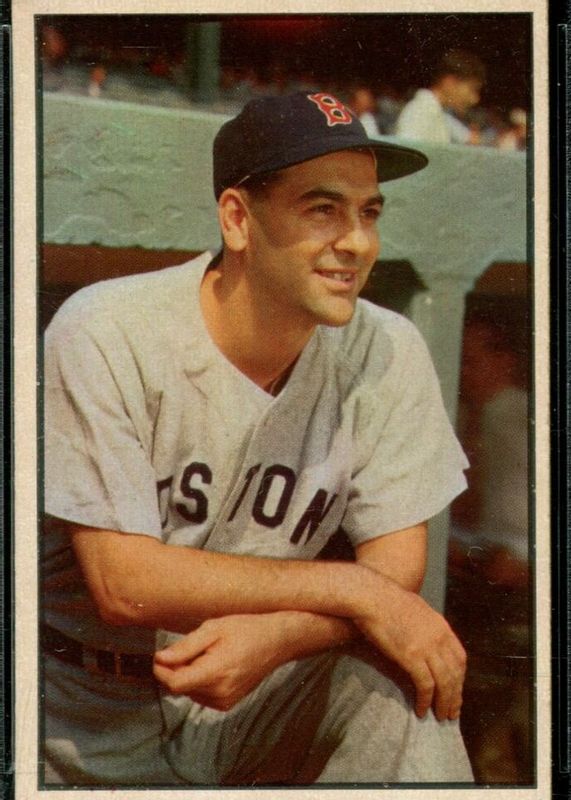
Lou Boudreau played for fifteen seasons in the MLB from 1938 to 1952. He played for Cleveland until 1950, then did a two-year stint with the Boston Red Sox. He had three distinct nicknames, “the Good Kid”, “Handsome Lou” and “Old Shufflefoot”. The last one is likely due to the way he moved at shortstop, the position he played for most of his career. Lou was also a player/manager for many years. He wore uniform number 5 for twelve seasons and had a career WAR of 63.1.
Even though he only played for the Red Sox in 1951 and 1952, I had to go with this card. It’s old school 1953 Bowman and the photo is great, and of course it’s the Red Sox. It’s a nice card! ‘52 was Boudreau’s last as a player, and he only had two at-bats, so this might be a manager card. I never looked at the back, but he is in the managerial posture. The’53 Red Sox were 4th in the AL going 84-69.
Boudreau was an eight-time All-Star. He was the batting champ in 1944 with a .327 average.
1948 was a great year for Boudreau, he was the American League MVP with a league leading 10.4 season WAR, he batted .355 with 199 hits, 34 doubles, 18 home runs and 106 RBIs. He only struck out 9 times in 560 at bats! He was also a part of the 1948 Cleveland Indians World Series winning team. A team that included Larry Doby, Bob Feller, Bob Lemon and Satchel Paige, and was the first World Series to be widely televised.
Boudreau would retire as a player after the 1952 season eventually moving into broadcasting for the Chicago Cubs where he would remain until 1987.
He finished his career with 1,779 hits, 385 doubles and a .295 career batting average.
He is a member of the Chicago Cubs Hall of Fame as a broadcaster.
He is a member of the Cleveland Guardians Hall of Fame, and his uniform number 5 was retired by Cleveland in 1970.
He was inducted into the National Baseball Hall of Fame in 1970.
Boudreau passed away at age 84 in 2001.
Number 7:

Hank Greenberg played thirteen seasons in the MLB from 1930 to 1947. He only had one at bat in 1930 and did not play in 1931 or 1932. He was out for 47 months of military service from ’42 to ’44, the longest of any Major League player. He played most of his career with the Detroit Tigers as a first baseman and center fielder, but played his last season with the Pittsburgh Pirates. He wore number 5 eleven seasons and had a career WAR of 55.5.
Any chance I get to showcase a Goudey card, I’m taking it. This 1934 Hank Greenberg is perfect. I love the photo on the front in his Detroit uniform, the light blue background with the baseball diamond outline. Man, I wish I had some of these cards! In 1934, Greenberg was an All-Star, batting .317 with 33 home runs and 113 RBIs.
Greenberg was an All-Star five times, he led the league in home runs four different seasons, RBI’s four seasons and hit over .300 in eight seasons. He was the American League MVP twice in 1935 and 1940. He was a member of two World Series Championship teams both with the Tigers, once in 1935 with Charlie Gehringer , and ten years later in 1945.
He played his final season, 1947, with the Pirates and although he was productive, he decided to retire. He would finish his career with a .313 career batting average, 1,628 hits, 379 doubles, 331 homeruns, 1,274 RBI’s. He’s tenth all-time with a career OPS of 1.017 and tenth in career SLG with .605. One can only wonder what he would have accomplished had he not missed three seasons in the prime of his career.
Like fellow uniform number 5 player Joe DiMaggio, Greenberg also married a famous actress, Linda Douglas, in 1966.
Greenberg was inducted into the National Baseball Hall of Fame in 1956. His uniform number 5 was retired by the Detroit Tigers in 1983.
Greenberg passed away in 1986 at the age of 75.
Final Score:
Uniform number 5 was a very difficult number to narrow down. There were several personal favorite players that I left off. First a couple of Boston Red Sox shout outs; Vern Stephens who played for Boston from ’48 to ‘52 wore it for eleven years and had a career WAR of 46.4 and Nomar!! Man leaving Nomar Garciaparra off was tough, he wore number 5 for fourteen years and was a member of the Red Sox for eight and a half seasons, his career WAR was 44.3.
Freddie Freeman currently has a career WAR of 64.1 and has worn uniform number 5 his entire sixteen year career so far. He is currently still playing well and is a future Hall of Famer, but I left him off this list, mainly because he still plays. I’m sure he’ll make my list at some point.
A few other players I wanted to mention who wore uniform number 5 for fourteen years each; Brian Downing (51.5 WAR) played with the Angels for thirteen years and was a player whose cards I would often get in packs in the ‘80s, David Wright (49.1 WAR) was a seven-time All-Star who played exclusively with the Mets and had two Gold Gloves and two Silver Sluggers, Ron Gant (34.1 WAR) was a two-time All-Star and had a rookie card that was all the rage when I was collecting and Ray Durham (33.8 WAR) who was a two-time All-Star and wore the number 5 his entire career.
Doing these shout outs makes it clear that once I finish this series, I may need to revisit and start another list. If you’re enjoying these posts, please subscribe and stay tuned for uniform number 6!
| PLAYER NAME | YEARS WORN | CAREER WAR | NUMBER RETIRED | OTHER ACHIEVEMENTS |
| George Brett | 19 | 88.6 | Yes (1994 Kansas City Royals) | 13 x All-Star AL MVP (80) Gold Glove (85) 3x Silver Slugger 3x Batting Champ World Series Champ (85) HOF (99) |
| Brooks Robinson | 21 | 78.3 | Yes (1978 Baltimore Orioles) | 18 x All-Star 16x Gold Glove AL MVP (64) World Series Champ (66, 70) HOF (83) |
| Joe DiMaggio | 12 | 79.1 | Yes (1952 New York Yankees) | 13x All Star 3x AL MVP (39,41,47) 9 x World Series Champ (36-39, 41,47,49-51) 56 Game Hitting Streak HOF (55) |
| Johnny Bench | 17 | 75.1 | Yes (1984 Cincinnati Reds) | 14x All Star 10x Gold Glove 2x NL MVP (70,72) NL ROY (68) HOF (89) |
| Jeff Bagwell | 15 | 79.9 | Yes (2007 Houston Astros) | 4x All-Star NL ROY (91) NL MVP (94) 3 x Silver Slugger 1x Gold Glove HOF (17) |
| Lou Boudreau | 12 | 63.1 | Yes (1970 Cleveland Guardians) | 8x All-Star World Series Champ (48) AL MVP (48) HOF (70) |
| Hank Greenberg | 11 | 55.5 | Yes (1983 Detroit Tigers) | 5x All-Star 2x AL MVP (35,40) 4x AL HR Leader 4x AL RBI leader 2x World Series Champ (35, 45) HOF (56) |
Sources:
https://www.baseball-almanac.com/
https://www.baseball-reference.com/
Shout out to all the cool cards and creative commons for my pictures! Thanks Topps and Upper Deck and Fleer and Donruss and all the rest!
 Weekly Windup
9 thoughts on “Baseball by the Numbers: 5”