

4
Welcome back to Baseball by the Numbers. Today we are looking at uniform number 4. Uniform number 4 had over 550 players listed at the number. Just like number 3, there were a lot of great names on the list. Using my criteria, I was able to narrow things down. There were seventy-three players to wear the number 4 for five years or more and thirty-eight had a career WAR of 40 plus.
Last post I made a special spot for Babe Ruth, highest career WAR in history, and after I did that, I decided it would be cool to just have anyone with a career WAR over 100 listed as a Legend, that is of course depending on a few factors (see A-Rod). In all of history there are only thirty-two players with a 100 or more career WAR and three have some significant controversies, asterisks if you will (Bonds, Clemens, A-Rod). I think nine played prior to uniform numbers (Ty Cobb, Tris Speaker, Cy Young, Walter Johnson, Honus Wagner, Kid Nichols, Grover Alexander, Nap Lajoie, and Christy Mathewson). I may have to do a post at some point of pre-uniform numbered players (spoiler: those nine will probably be the list). I also already used two (Ruth and A-Rod). So, I’m down to eighteen possible Legends. I figured, “what the hell, let’s do it.” and turned my attention to uniform number 4. Well, to my surprise, three of the Legends wore this number! Crazy! In this post there will be three Legends and my top seven after that. Enjoy!
The Legends:

With a 127.3 career WAR “the Rajah” is ranked twelfth all-time. Rogers Hornsby played for twenty-three years in the MLB. He was one of the greatest hitters of all time. He played from 1915 to 1937 for the St. Louis Cardinals, New York Giants, Boston Braves, Chicago Cubs, the Cardinals again, and finally the St. Louis Browns. He wore uniform number 4 for four years.
Hornsby won his only World Series ring in 1926 with the Cardinals. He was a two-time National League MVP. He won the Triple Crown in 1922 when he hit .401 with 42 home runs and 152 RBIs. That season he also led the league in WAR (10.1), runs (141), hits (250), doubles (46), OBP (.459), OPS (1.181) and SLG (.722). He then won the Triple Crown for a second time in 1925. Over his career, he led the league in batting average seven times, hitting .400 or better in three of those seasons. He had 200 or more hits in seven seasons.
Not only could he get on base, but he had a lot of power, leading the league in home runs twice, RBIs four times, and doubles four times.
Later in his career Hornsby continued with baseball as a player/manager and as a manager and coach. He managed the St. Louis Cardinals (’25-’26), New York Giants (’27), Boston Braves (’28), Chicago Cubs (’30-’32), St. Louis Browns (’33-’37 and ’52), and Cincinnati Reds (’52-’53).
Like three players who I have already written about, Bobo Newsom (00 post) and Frankie Frisch and Babe Ruth in the uniform number 3 post, he is mentioned in Ogden Nash’s 1949 poem “Line-Up for Yesterday” . Spoiler alert, this poem will be mentioned at least two more times later in this post as well.
Hornsby would finish his career with a 127.3 WAR (12th all-time). He is third all-time in batting average (.358), tenth in OBP (.434), fifteenth in SLG (.577) and eleventh in OPS (1.010). He also had 2,930 career hits, 541 doubles, 169 triples, 301 home runs and 1,584 RBIs.
Hornsby is a member of the Chicago Cubs and St. Louis Cardinals Hall of Fame; he was voted onto both the All-Century Team and the All-Time Team and was elected to the National Baseball Hall of Fame in 1942.
Hornsby passed away in 1933 at age 66.
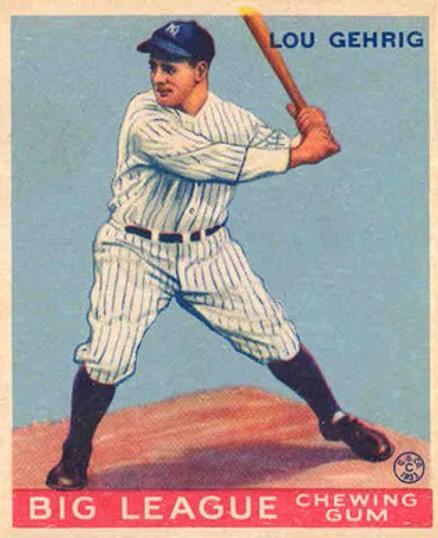
“The Iron Horse” played for seventeen years in the majors, all of them with the New York Yankees. He is not only a legend in New York, but a legend to all baseball fans (see? even as a Red Sox fan, I can admit that). He played from 1923 to 1939, and wore uniform number 4 for eleven seasons, starting in 1929 when the Yankees started using uniform numbers. His career WAR of 113.7 is 18th all-time.
That 1933 Goudey card is legendary. Anyone who collects cards should recognize it. I say this all the time, but I love the art-deco style of these old ‘30s cards. Gehrig’s signature left-handed batting stance backdropped in blue is just so beautiful and full of baseball nostalgia. In 1933 Gehrig was an All-Star. He led the league with 138 runs. He had a .334 batting average, with 198 hits, 41 doubles, 32 home runs and 140 RBIs.
On April 30th, 1939, after struggling to start the season, Gehrig sat out for the first time in 2,130 consecutive games. A record that remained unbroken until Cal Ripken Jr. broke it on September 6th, 1995. Sadly, Gehrig’s career was cut short in 1939 when he was diagnosed with ALS.
Gehrig was a seven-time All-Star who was part of six World Series Championships with the Yankees. His World Series production is incredible. He played 34 total World Series games across his six World Series wins and batted .361 with 8 doubles, 3 triples, 10 home runs, 35 RBIs, a .483 on-base percentage, .731 slugging percentage, and 1.214 OBP.
He was a two-time AL MVP in 1927 and 1936. He won the triple crown in 1934 with 49 home runs, 160 RBIs and a .363 batting average. He led the league in batting average once (1934), home runs three times (’31,’34,’36) and RBIs five times (’27,’28,’30,’31,’34). Like Hornsby, he was a part of the MLB All-Century team and All-Time Team. He was elected to the Baseball Hall of Fame in a special election in 1939.
Like Bobo Newsom in the 00 post ,Frankie Frisch and Babe Ruth in the uniform number 3 post, and Rogers Hornsby above, he is mentioned in Ogden Nash’s 1949 poem “Line-Up for Yesterday” .
In 1941, at the young age of 37, Lou Gehrig died from complications of ALS only two years after his diagnosis.
His number 4 was retired by the Yankees in 1939.

Mel Ott’s career WAR of 111 is 20th all-time. Ott played for twenty-two years from 1926 to 1947 with the New York Giants. He spent his entire career as a right fielder and third baseman with New York and wore uniform number 4 for fifteen seasons. Like Hornsby and Gehrig, Ott was also a part of Ogden Nash’s 1949 poem “Line-Up for Yesterday”.
His 1935 Diamond Stars shows a great depiction of his intense stare. What MLB pitcher wouldn’t be intimidated facing him? The card is another beautiful example of the art-deco style of ’30 baseball cards. I love this card’s picture, especially the red flag flying in the background.
Ott was a twelve-time All Star who led the National League in home runs six different seasons and RBIs once. He was a member of the 1933 World Series winning New York Giants team, in which he hit .389, with 2 home runs, 4 RBIs and 4 runs. Ott was another player manager from 1942 to 1946, but in ’46 a serious knee injury forced him to miss most of the season. He still got four at bats in 1947, before officially leaving as a player, but continued to manage for two more seasons.
Ott finished his career with a .304 batting average, including 2,876 hits. He is 9th all-time in walks with 1,708. His 511 career home runs are tied at 25th with Miggy Cabrera. He’s 14th all-time in RBIs with 1,860. He has 488 career doubles, .414 OBP, .533 SLG and .947 OPS.
Ott was elected to the Baseball Hall of Fame in 1957.
His uniform number 4 was retired by the Giants in 1949.
After managing, he would eventually enter the broadcast booth from 1956 until 1958 when he would pass away at the age of 49 from complications due to an auto accident.
Now that the Legends are covered, we can get to my seven selections. I don’t think any other number will have three heroes, but there are still fifteen players left with over 100 career WAR, so I guess we’ll find out together.
Number 1:

Luke Appling played shortstop for twenty seasons in the MLB, from 1930 to 1950. He did miss one season (1944) due to his military service. He played his entire career with the Chicago White Sox and wore uniform number 4 for seventeen seasons. His career WAR was 77.2.
Another awesome card, his 1936 Diamond Stars is one of my favorites so far. I know I’m getting repetitive, but these cards are so fun! This one has the coolest colors, and I love the two players in the background. I’m not sure, but based on the picture in the foreground, it’s possible the background fielder also depicts Appling, only showing off his fielding skills. In 1936 Appling was an All-Star. He had a 7.1 season WAR and led the league in batting average (.388).
Appling was a seven-time All-Star, who led the American League in batting average twice (1936 and 1943). He hit over .300 in sixteen of his twenty seasons. He is 5th all-time in double plays turned by a shortstop with 1,424.
He had a funny nickname, “Old Aches and Pains”, as he was said to constantly have minor complaints about such things as a sore back or sprained finger. It didn’t stop him from playing hard though.
Appling had a career .310 batting average with 2,749 hits (4th all-time at shortstop), 440 doubles and a .399 OBP. Appling was great at getting on base, having had over 100 walks a season on three separate occasions and an over .400 OBP eight times. He wasn’t a huge power hitter and in fact only 27% of his hits went for extra bases.
Appling was inducted into the Baseball Hall of Fame in 1967. His uniform number 4 was retired by the White Sox in 1975.
In 1991 Appling passed away at the age of 83.
Number 2:
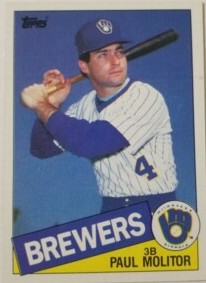
Paul Molitor is a player that I grew up watching and collecting. He played twenty-one years in the majors from 1978 to 1998. Primarily a third and second baseman, Molitor played with the Milwaukee Brewers for fifteen seasons. He then played with the Toronto Blue Jays and the Minnesota Twins. He wore uniform number 4 for eighteen seasons, with only his three seasons in Toronto the exception (#19). His career WAR is 75.7.
Known as “the Ignitor” due to his ability to make things happen on the diamond. He could hit and steal with the best of them and is one of only five players in history with a career batting average of .300 or more, over 500 stolen bases and over 3,000 hits. The others being Ty Cobb, Honus Wagner, Eddie Collins, and Ichiro Suzuki.
This 1985 Topps is just a thing of beauty. I love the 1985 Topps cards. I didn’t start really collecting in earnest until 1986, but I remember I started getting packs of cards in the early ‘80s and just loving every single design. This one is wonderful, with Molitor’s batting stance backed by the blue sky, his Brewers uniform crisp and clean, the number 4 perfectly visible on the front, it’s such a great card. In 1985 Molitor would be an All-Star for the 2nd time with a .297 batting average, 21 stolen bases, 28 doubles and 174 hits.
Molitor was a seven-time All-Star. He was 2nd in ROY voting in 1978 losing to sweet Lou Whitaker who was already featured under the uniform number 1 post.
He was a World Series champion with the 1993 Blue Jays and was the MVP of the series hitting .500 with 2 doubles, 2 triples, 2 home runs, 4 RBIs, 1 stolen base and 4 runs.
He is a four-time Silver Slugger, and in 2017 was the American League Manager of the Year with the Minnesota Twins.
His career 3,319 hits ranks 11th all-time, and he is 15th all-time in doubles (605). Molitor has a career batting average of .306 with 234 home runs, 1,782 runs, 114 triples and 504 stolen bases.
Molitor was elected to the Baseball Hall of Fame in 2004, and his uniform number 4 had been retired by the Milwaukee Brewers in 1999.
Number 3:
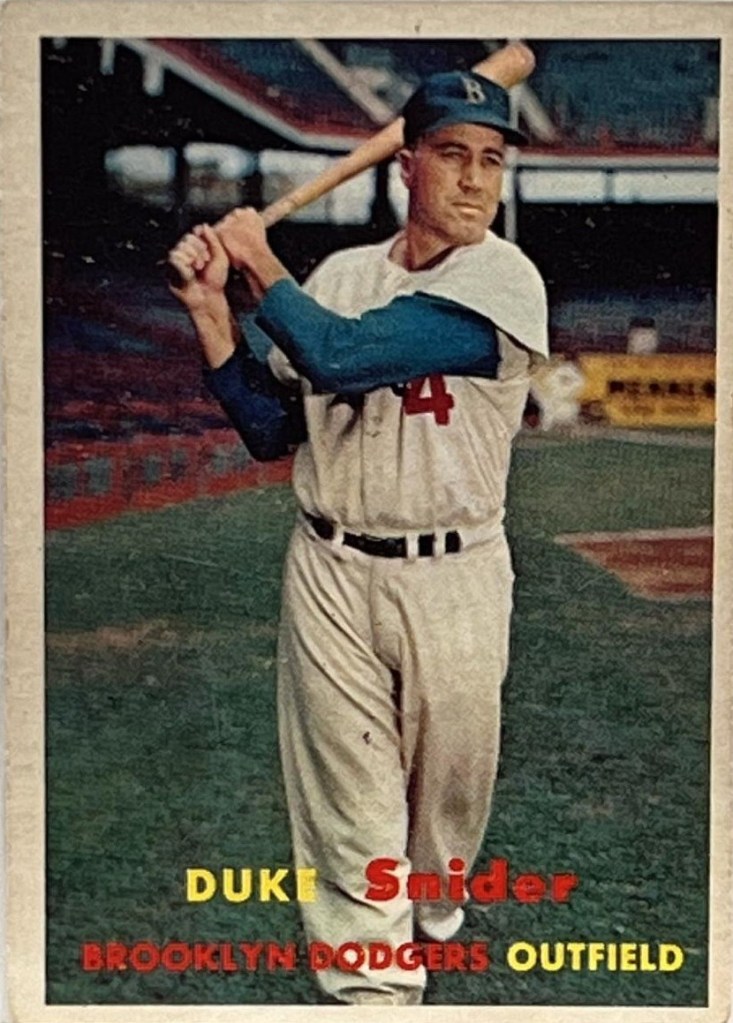
Known as “the Duke of Flatbush”, Snider played eighteen years in the MLB, sixteen with the Brooklyn/Los Angeles Dodgers and a season each with the New York Mets and the San Francisco Giants. He was an outfielder who wore uniform number 4 seventeen seasons. He also wore it for half a season with the Mets and while on the Giants, number 4 was already retired due to the previously mentioned Mel Ott. His career WAR was 66.
This 1957 Topps card was a perfect fit for my post. The photo of Snider is wonderful, with his uniform number front and center. I like most Topps cards, but I’ll be honest, I’m not a huge fan of this design. The photo is nice, but the player and team name colors are off putting, and the card is just basic. Still, I got that uniform number on there, so I’m happy with that. In 1957, Snider batted .274, he had 40 home runs (it was his fifth straight season with 40+ home runs) and 92 RBIs.
Snider was a eight-time All-Star who led the National League in home runs in 1956 with 43 and RBIs in 1955 with 136. He won two World Series rings with the Dodgers in 1955 and 1959 on teams that included Pee Wee Reese , Jackie Robinson, Sandy Koufax, Roy Campanella and Don Drysdale. He was a great fielder too, leading the league in center field fielding average 3 different seasons.
Snider led the league in WAR twice, runs three times and had over 190 hits in three different seasons. He ended his career with a .295 batting average, 407 home runs, 2,116 hits and 1,333 RBIs.
He was voted to the Hall of Fame in 1980.
His uniform number 4 was retired by the Dodgers in 1980.
Duke passed away at the age of 84.
Number 4:
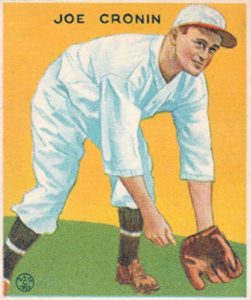
Joe Cronin was involved with the MLB for almost fifty years as a player, manager, GM and as president of the American League for fifteen years from 1959 to 1973.
As a player, Cronin was a shortstop for twenty years from 1926 to 1945. He played two seasons with the Pittsburgh Pirates, then seven with the Washington Senators, and finally eleven seasons with my Boston Red Sox. He wore uniform number 4 for fourteen seasons with Washington and the Sox and had a career WAR of 64.8.
Joe Cronin’s 1933 Goudey card is one of the more basic cards of the set, but it’s still cool. The shortstop is bent down, glove at the ready overlapping a bright yellow background. In ’33 Cronin was selected to his first All-Star appearance. He led the league in doubles with 45 and had a .309 batting average. He had 118 RBIs with 5 home runs! Is it just me or does that seem a little crazy sounding?
Cronin would go to seven more All-Star games. He was the MVP in 1930, and hit over .300 eight times, and had over 100 RBIs eight times.
In 1933 as a player/manager, his Senators lost the World Series to the New York Giants. While playing he managed the Senators in the ’33 and ’34 seasons, and he managed the Red Sox all eleven seasons plus two more after retiring as a player. In 1946 he was again managing a World Series team, but the Red Sox lost to the Cardinals. He finished his managing career with an over .500 winning percentage.
He had a career .301 batting average with 2,285 hits, 515 doubles and 1,424 RBIs, and a career .390 OBP.
After his stint as the Red Sox manager, he would go on to become their General Manager for eleven years from 1947 to 1959 before becoming the president of the American League.
Cronin is a member of the Boston Red Sox Hall of Fame, and he was inducted into the National Baseball Hall of Fame in 1956.
His number 4 was retired by the Red Sox in 1984.
Cronin passed away in 1984 at 77 years old.
Number 5:

Ralph Kiner only played for 10 seasons from 1946 to 1955. He was an outfielder and played on the Pittsburgh Pirates, the Chicago Cubs and the Cleveland Indians. He had a career WAR of 48.1 and wore uniform number 4 for eight seasons.
This 1952 Bowman shows Kiner in his Pirates uniform who he played with for seven seasons. He wore number 4 with the Pirates, although I couldn’t find a card with the number showing. In 1952 he was an All-Star for the 5th time and led the league in home runs for the 7th year in a row with 37. He also led the league in walks with 110.
Kiner was a six-time All-Star, who led the league in home runs seven straight years from 1946 to 1952. He also led the league in RBIs in 1949. He had two seasons with over 50 home runs and five with over 40. He also had over 100 RBIs in six seasons. Unfortunately he was forced to retire after a serious back injury at only 32 years old.
He finished his career with 369 home runs, 1,015 RBIs and a .279 batting average. Imagine if he had played just a couple more seasons.
He went on to become a popular broadcaster with the New York Mets, staying behind the mic for fifty-three seasons. He was honored with the New York Mets “microphone” in 2014 and is a member of the Mets Hall of Fame.
As a player he is a member of the Pirates Hall of Fame and was inducted into the National Baseball Hall of Fame in 1975.
His number 4 was retired by the Pirates in 1987.
Kiner passed away at the age of 91 in 2014.
Number 6:
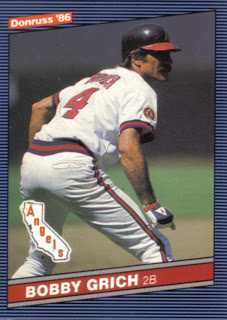
It’s Bobby Grich not Grinch, which for some reason I just keep typing, even though he looks like a happy dude in most pictures. Still, I’d be a grinch if I played as well as Bobby and wasn’t in the Hall of Fame!
Grich played second base for seventeen seasons from 1970 to 1986 with the Baltimore Orioles and the California Angels. He wore uniform number 4 for ten seasons and had a career WAR of 71.1.
1986 was his last season, but I found Grich’s ’86 Donruss to be a nice looking card. His uniform number is easy to see, which is part of my criteria for these posts, and the card design is perfect ‘80s style. Grich didn’t have a great season in ’86 as he was starting to slow down, getting only 313 at bats for the season. When the Angels lost the ’86 ALCS to the Boston Red Sox after being up three games to one, Grich announced his retirement.
During his career, Grich was a six-time All-Star. He won four Gold Gloves and a Silver Slugger Award in 1981 while leading the American League in home runs with 22. He is a member of both the Angels and Orioles Hall of Fame.
Number 7:
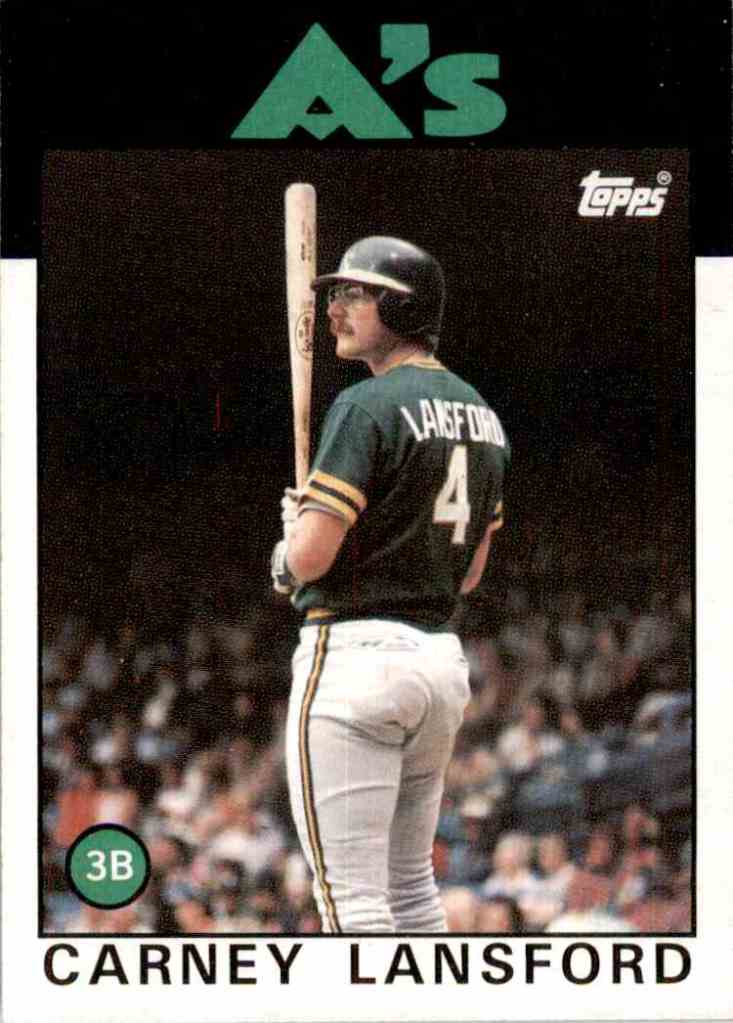
I was very happy to include Carney Lansford on this list. There were a few players I could have put ahead of him, but growing up, he was a player I really liked, so he got the nod.
Lansford played for fifteen years in the MLB from 1978 to 1992. He was primarily a third baseman but also played a little first as well. He played for the California Angels until 1980 when he was traded to the Boston Red Sox. He played with Boston in 1981 and 1982, but with Wade Boggs emerging as a future Hall of Famer, Lansford was traded to the Oakland Athletics where he would remain the rest of his career. Lansford had a Career WAR of 40.4 and wore uniform number 4 for twelve seasons.
I really love the 1986 Topps. I know there are many who don’t, and I understand why. I would say it’s probably the worst design of the ‘80s Topps cards, but it is a set that I have a lot of memories of. This Lansford card was a perfect choice because his number is so prominently displayed. I also love the way his photo and the A’s name at the top match so well. In 1986, Lansford batted .284 with 19 home runs, 72 RBIs and 16 stolen bases.
Lansford was an All-Star once in 1988. He won a Silver Slugger and was the American League batting champion in 1981 with the Red Sox. He batted over .300 five different seasons. He also won a World Series ring in 1989 with an Oakland team that included Dennis Eckersley, the great Rickey Henderson, Dave Parker and the Bash Brothers (Jose Canseco and Mark McGwire). There was a major earthquake during this World Series, giving it the name, “The Earthquake Series”. I remember it well.
Lansford was great during the postseason. In 33 postseason games he hit .305 with 2 home runs and 18 RBIs. After retiring, he would go on to coach with multiple franchises.
He is a member of the Athletics Hall of Fame.
Final Score:
I found it crazy that out of the thirty-two players in all of MLB history with a career WAR over 100, three of them wore number 4. The great part about that was it let me write about three extra players. (Carney Lansford would have never made it on the post without the Legend category)
There are some players I’d like to mention who wore number 4 that I didn’t include. Jimmie Foxx wore it one season (old giant arms was in my last post here). Hall of Famers Craig Biggio (2 seasons) Billy Herman (5 Seasons) and Bill Terry (1 season) all wore it. Kansas City Royals All-Star and defensive player extraordinaire, Alex Gordon, had it for thirteen seasons. Lenny Dykstra had it for twelve. There are also a couple of currently active players who have number 4 and could make this list someday (George Springer and Ketel Marte). There is one player who I really could have included if I had eight spots, so why not stick him in here.
Yadier Molina played catcher for the St. Louis Cardinals for nineteen years from 2004 to 2022 and had uniform number 4 for seventeen of those. He got edged out by Lansford, but only because I liked Lansford growing up. Molina was a 10x All-Star, 9x Gold Glove winner, a 4x Platinum Glove winner and won two World Series rings with the Cardinals (06,11). Let’s end this post with a card!
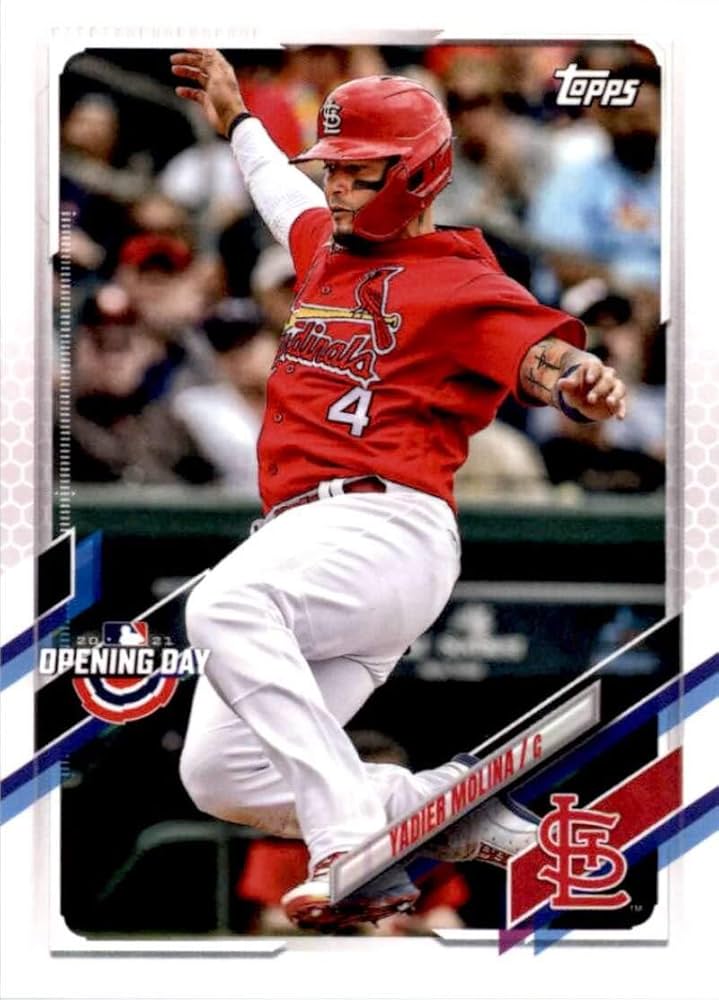
I hope you come back for uniform number 5! Thanks for reading and please leave some comments or likes or shares.
| PLAYER NAME | YEARS WORN | CAREER WAR | NUMBER RETIRED | OTHER ACHIEVEMENTS |
| Luke Appling | 17 | 77.2 | Yes (White Sox 1975) | 7 x All-Star 2x AL Batting Champ HOF (64) |
| Paul Molitor | 18 | 75.7 | Yes (Brewers 1999) | 7 x All-Star World Series Champ (93) 4 x Silver Slugger AL Manager of the Year (17) HOF (04) |
| Duke Snider | 17 | 66 | Yes (Dodgers 1980) | 8 x All-Star World Series Champ (55,59) NL Home Run Leader (56) NL RBI leader (55) |
| Joe Cronin | 14 | 64.8 | Yes (Boston Red Sox 1984 | 7x All-Star HOF (56) |
| Ralph Kiner | 8 | 48.1 | Yes (Pirates 1981) | 6x All-Star 7x NL Home Run Leader New York Mets “microphone” HOF (75) |
| Bobby Grich | 10 | 71.1 | no | 6x All-Star 4 X Gold Glove Silver Slugger (81) AL home run leader (81) |
| Carney Lansford | 12 | 40.4 | no | 1 x All-Star World Series Champ (89) Silver Slugger (81) AL Batting Champ (81) |
Sources:
https://www.baseball-almanac.com/
https://www.baseball-reference.com/
Shout out to all the cool cards and creative commons for my pictures! Thanks Topps and Upper Deck and Fleer and Donruss and all the rest!
 Weekly Windup
6 thoughts on “Baseball by the Numbers: 4”