
Posted March 27, 2025 by jake
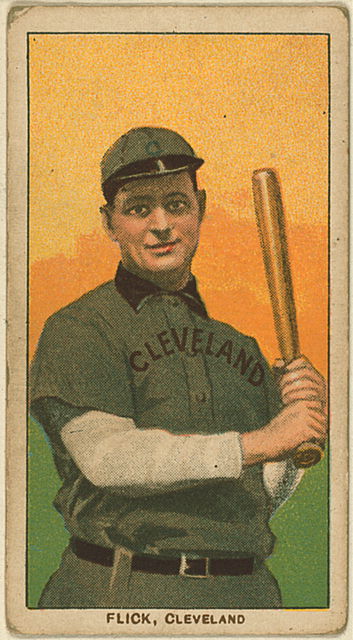
When I saw the name Elmer Flick the other day, I had to learn more, especially when I found out he was a Hall of Famer (Class of 1963). I personally could not remember hearing the name Flick in the past, but I quickly discovered an underrated and often forgotten old school star.
Flick was born in Bedford, Ohio in 1876, the son of a farmer and Civil War Veteran. In true 1800’s style, he joined a semi-pro team when he was 15 years old because the team was short a player and Flick happened to be hanging around the train station when they were leaving for a game. He played catcher in high school and was waving the local team on when they realized they needed the help. For a youngster, he did well, and not long after, Flick began to play minor league ball with the Youngstown Puddlers in 1896.
Using a baseball bat that he handmade (that is old school baseball gold), Flick hit over .400 but struggled in the outfield. Flick had always played catcher, so his .826 fielding percentage was no surprise; there would be an adjustment to the outfield. Luckily, he was a quick study, and his defense improved.
His hitting skills were never a question, and with the improved defense, he found himself playing left-field for the Dayton Old Soldiers. (I Love these team names!!) His fielding percentage increased to .921, and his offense was legendary. Flick batted .386 with 183 hits. This included 42 doubles, 10 home runs, an impressive 135 runs and even 25 stolen bases. He also led the league in triples with 20 and total bases with 295.
In 1898 he was signed to the Philadelphia Phillies as a reserve outfielder, but due to injuries, he quickly became a starter. It was a great rookie season for the young slugger as he finished with a .302 average including 16 doubles, 13 triples, 8 homeruns, and 81 RBI’s. He also stole 23 bases and only struck out 36 times in 453 at bats.
In 1900, still with the Phillies, he had an amazing season. In 545 at-bats, he had only 30 strikeouts, batting .367 (a career high) which included additional career highs in hits (200) home runs (11), slugging (.545), OPS (.986) and a league leading 110 RBIs. He also had 32 doubles, 16 triples and 35 stolen bases. His high batting average put him in a tense race for the batting title against super star Honus Wagner, who would end up winning the title at the end of the season. Wagner spoke of the race, “I’ve had a lot of thrills, but don’t think I was ever happier than in 1900 when I won after battling Elmer Flick to the last day of the season for the title.” Lieb, Fred (January 27, 1971)
Not only was he great at the plate, but he was becoming a solid outfielder with a .914 fielding percentage and 232 put-outs’ and 23 assists, often throwing out hitters at first. He was also a feisty player, one time getting into a fist fight with teammate and future Hall of Famer, Nap Lajoie, over a bat! Lajoie would end up breaking his thumb in the altercation, missing 5 weeks.
Apparently Flick and Lajoie buried the hatchet, and both left the Phillies in 1902 joining the American League Philadelphia Athletics. They only played 11 games with the Athletics before moving to the Cleveland Bronchos. This was due to a legal injunction obtained by the Philadelphia Phillies which prevented players under contract with their team from moving to other teams. This injunction was found to only be valid in Pennsylvania and couldn’t be enforced in Ohio. To avoid legal ramifications, Flick and Lajoie would travel together, ensuring never to step foot in Pennsylvania until 1903 when the two leagues made peace.
Born and raised in Ohio, Flick would stay with Cleveland, now called the Naps, for the remainder of his Major League career. He would continue to play well for Cleveland, leading the league in batting average (.308) , triples(18), SLG (.432) and OPS (.845) in 1905, leading in games (157), plate appearances (707) at bats (624), runs (98), triples (22) and stolen bases (39) in 1906 and again in triples (18) in 1907, his last full season.
By 1907, Flick had second thoughts about his baseball career. He was stressed from the constant playing and felt physically run down. He considered retiring but stayed on for the season. Flick was so highly regarded by the Naps that in spring training of 1907 they turned down a trade from the Detroit Tigers, who offered a straight up deal, Flick for future AL MVP and Hall of Famer Ty Cobb! Based on the rest of these two players’ careers, I’d guess that the Naps regretted turning that deal down.
Although Flick had another productive year in 1907, even leading the league in triples again with 18, by 1908 his health had severely deteriorated. He was plagued with an unexplained gastrointestinal illness which caused him to miss almost the whole season, playing in only 9 games. He continued with the Naps in 1909 and 1910, but played in only 66 and 24 games respectively. He was replaced by a pre–Black Sox Scandal Shoeless Joe Jackson, and eventually sold to the Kansas City Blues, however the deal was canceled when Flick refused to go to Kansas City and, without a team, he would return to the minor leagues.
He played two more seasons for the Minor League Toledo Mud Hens in 1911 and 1912 before being released and retiring from baseball.
He would move back to his hometown of Bedford, Ohio and take up raising horses and real estate. He got married and had five children. He also did some scouting for Cleveland as well.
Flick seemed to live in relative obscurity until 1961 when Ty Cobb passed away. A few stories about Cobb mentioned the failed trade of Cobb for Flick in the 1907 season, and with some influence from Branch Rickey, Flick was inducted into the Hall of Fame by the Veteran’s Committee. Flick was 87 years old, and didn’t believe that he had been elected. He had to be convinced that it was real. Flick was the oldest living inductee, and at the ceremony he said, “This is a bigger day than I’ve ever had before. I’m not going to find the words to explain how I feel.” Corcoran, Dennis (2010)
Flick passed away at the age of 94 in 1971, one of only 4 19th century players who were still alive. Flick played 13 years in the Majors accumulating a 52.7 WAR with 1752 hits, 48 home runs, 756 rbis, 950 runs, 268 doubles, 164 triples and 330 stolen bases. His career batting average was .313 with a .389 career OBP.
Flick’s Hall of Fame induction was met with much criticism, but anyone who can hit .400 with a homemade bat, get in a fist fight during a season and still almost beat Honus Wagner for the batting title, have his team refuse to trade him for Ty “freaking” Cobb, and then live to be 94 years old, is one tough ball player, and I, for one, am glad he was inducted and got to be around to not believe it. I’m glad Flick found fame.

Sources:
https://www.baseball-reference.com/players/f/flickel01.shtml
Corcoran, Dennis (2010). Induction Day at Cooperstown: A History of the Baseball Hall of Fame Ceremony. McFarland. pp. 78–80.
Lieb, Fred (January 27, 1971). “Rickey, Honus Remembered Flick”. St. Petersburg Times. Retrieved March 26, 2025.
Louisa, Angelo “Elmer Flick” via https://sabr.org/ Retrieved on March 26th, 2027
https://en.wikipedia.org/wiki/Elmer_Flick
Photos:
1: This media file is in the public domain in the United States.
2: This work is from the George Grantham Bain collection at the Library of Congress. According to the library, there are no known copyright restrictions on the use of this work.
 Weekly Windup