Baseball by the Numbers: 5

Read about the project

Checklist

5

Welcome back to Baseball by the Numbers. Today we are looking at uniform number 5. Uniform number 5 had over 600 players wear it at some point. Using my criteria (here), I was able to narrow things down. There were eighty-five players who wore uniform number 5 for five years or more and thirty-seven with a career WAR over 40. Between those two criteria, only seventeen players overlap. There was also a Legend player (career WAR over 100), so I had sixteen players to choose from.

Two players wore number 5 for only one season each and also had a career WAR over 100. Mel Ott, who wore it in 1932 with the New York Giants, and was already featured in a prior post for number 4. and Hank Aaron, who wore it during his rookie season in 1954 with the Milwaukee Braves, and will be featured much later.

As I looked through the list, I realized this post was going to be a challenge, with so many great players who fit the criteria, and several personal favorites. Choosing seven was not easy, but I managed to do it, so here you go!

The Legend:
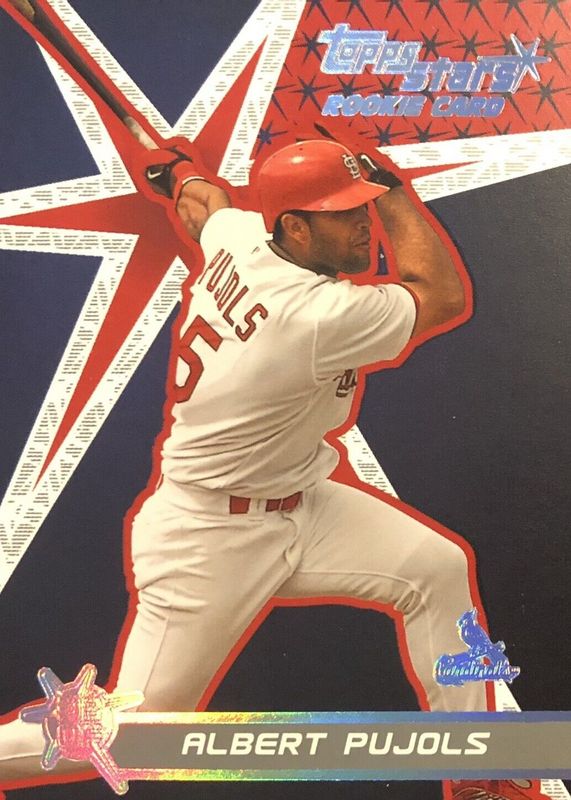
Albert Pujols, 2001 Topps Stars, #198

Pujols played for twenty-two seasons in the MLB, and wore uniform number 5 for all twenty-two, though he had a brief 85 game stint with the Dodgers at the end of his career with the number 55. His career WAR was 29th all-time at 101.2.

Pujols played first base and DH from 2001 to 2022 with the St. Louis Cardinals, Los Angeles Angels, the previously mentioned Dodgers, and then finished with the Cardinals again.  

The card I picked is the 2001 Topps Stars card. It’s his first season and he was already shaping up to be a future star. The card is awesome, with flashy colors and the cool star design. He’s finishing his swing, and his number is easy to see on the card. In fact, when looking for a card I found the Pujols uniform number was visible on so many different options it was hard to choose, so I went with his rookie season.

In 2001, Pujols had an All-Star campaign hitting .329 with 37 home runs, 130 RBIs (an NL rookie record), 47 doubles, 194 hits, and a 1.013 OPS. He was the easy favorite for NL Rookie of the Year and won a Silver Slugger. He joined Wally Berger (1930), Ted Williams (1939), Walt Dropo (1950) and Mike Piazza (1993) as the fifth MLB rookie to hit .300 with 30 home runs, 100 runs, and 100 RBIs. Jose Abreu would add his name to the group in 2014. It was the start of an amazing career for Pujols.

“La Máquina” “the Machine” was an eleven-time All-Star. He was Rookie of the Year in 2001 and won the National League MVP award three times in 2005, 2008, and 2009. He led the league in WAR six different seasons, in home runs twice, runs five times, hits, batting average, doubles and RBIs once, and SLG and OPS three times each. He was a six-time Silver Slugger and hit over .300 in ten straight seasons.

In 2004, Pujols helped the Cardinals get to their first World Series since 1987 and he was named the NLCS MVP after batting .500 with 4 home runs and 9 RBI. Pujols was a part of two World Series winning teams with the St. Louis Cardinals in 2006 and 2011.

He won the Hank Aaron award twice in 2005 and 2009, and the Clemente award in 2008. He was the comeback player of the year in 2022 (his last season) when he rejoined the Cardinals and was an All-Star batting .270 with 24 home runs. He retired after the season.

He ended his career in tenth place all-time with 3,384 hits, fourth in home runs (703), fifth in doubles (686), and second in RBIs (2,218). He has a career .296 batting average, .387 OBP, .544 SLG and .918 OPS. He joined Hank Aaron as the only players in history with 3,000 hits, 700 home runs, and 2,200 RBIs. He never struck out more than 100 times in a season which is incredible, especially in today’s baseball.

Pujols is eligible for the Hall of Fame in 2028 and should be a guaranteed inductee. I’ve been lucky to have been able to watch Pujols his entire career.

Number 1:
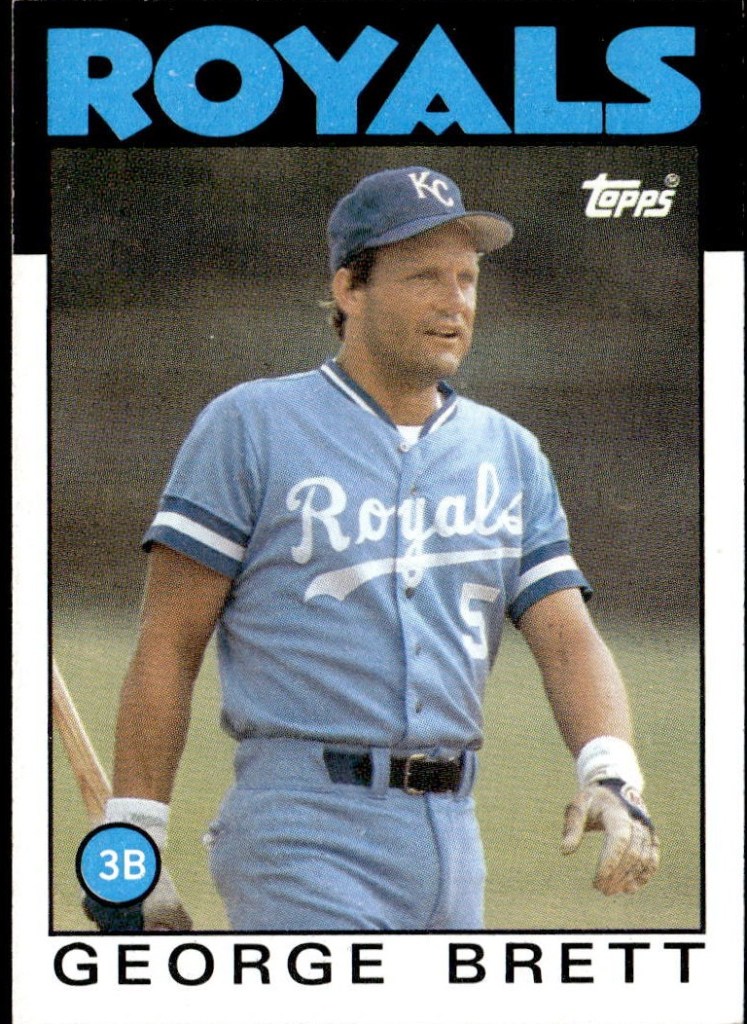
George Brett, 1986 Topps, #300

George Brett was one of my absolute favorite players growing up. I loved collecting his cards and watching him play whenever possible on TV or on the highlights of This Week in Baseball. He was such a great player.

Brett played twenty-one seasons in the MLB from 1973 to 1993 as a third and first baseman. He spent his entire career with the Kansas City Royals. He wore uniform number 5 for nineteen seasons, having worn 25 his first two. He has a career WAR of 88.6.

Yes, another 1986 Topps! I’ve said it before, I like this set, and this card is a personal favorite. I think I have a half dozen of them, none of which would grade above a six (lol). The card is gorgeous. The Royals team name in blue against that black background looks so nice with the photo. Brett walking along carrying his bat, the number 5 so nicely displayed on the front of that Royal blue uniform. Perfect! In 1986, Brett was an All-Star. He had a .290 batting average with 16 home runs and 73 RBIs.

Throughout his career, Brett was a thirteen-time All-Star (nine times in the 80s). He was the American League MVP in 1980 when he batted .390, and led the league not only in batting average, but in OBP, SLG, OPS, OPS+ and WAR. He won a Gold Glove in ’85, was a three-time Silver Slugger and a three-time batting champ.

In 1985 he helped the Royals win their first World Series in history after a wonderful season which saw him bat .335 with 30 home runs and 112 RBIs while leading the league in SLG and OPS. He would win the ALCS MVP award batting .348 with 8 hits, 3 home runs, and 5 RBIs in the seven games against Toronto. He also batted .370 in the World Series win against St. Louis. He was clutch in the postseason and batted .337 with 10 home runs and 23 RBIs in 43 career postseason games.

Brett would finish his career in 1993. He is 18th all-time in hits with 3,154. He has a .305 career batting average, 317 home runs, 665 doubles (7th all-time), 1,583 runs, 1,596 RBIs and 201 stolen bases. He joined Stan Musial, Willie Mays and Hank Aaron as the only players with 3,000 hits, 300 home runs, and a career .300 batting average (Miggy Cabrera would also join this group).

Brett is a member of the Royals Hall of Fame.

His uniform number 5 was retired by the Royals in 1994.

He was inducted into the National Baseball Hall of Fame in 1999.

Number 2:

Brooks Robinson, 1959 Topps, #439

Brooks Robinson was considered by many to be the greatest defensive third baseman in major league history. Because of his defensive prowess, he earned two very cool nicknames, “Mr. Hoover” and “the Human Vacuum Cleaner”.

Robinson played for twenty-three years in the MLB from 1955 to 1977, all of them at third base and all of them with the Baltimore Orioles. This earned him the fan nickname of “Mr. Oriole”.  He wore uniform number 5 for twenty-one seasons. His career WAR was 78.3.

I was excited to see that this 1959 Topps card showcased Robinson’s uniform number. It’s a nice card. I like the ’59 Topps design, the photo in the circle, with the yellow border, the old school Orioles logo in the bottom corner and Robinson’s signature across the front. In ’59 he only played 88 games, in part due to an injury that could have been career ending. He was in the minors working on his hitting and fell into the dugout while catching a ball. His arm was impaled on a hook that severed several tendons but luckily missed any nerves. Once he was back, he hit .284 for the season. He would become an All-Star the next year (twice!).

Robinson was an eighteen-time All-Star. He would be an All-Star in fifteen straight seasons (there were two All-Star games in the ’60, ‘61’ and ’62 seasons). He would also win sixteen straight Gold Gloves, living up to his vacuum cleaner nicknames.

He was the American League MVP in 1964 when he hit .317 with 28 home runs, 118 RBIs (led the league), 35 doubles and 194 hits. He also led the league in putouts, assists, double plays and fielding percentage.

He was part of two World Series Championships with the Orioles (1966 and 1970) and was the MVP of the 1970 World Series batting .429 with 2 home runs, 6 RBIs, and 9 hits. He also played phenomenal defense against the hard-hitting Cincinnati Reds.

He retired after the 1977 season with several defensive records at third, including most putouts (2,697), assists (6,205) and double plays (618). He had a career .267 batting average with 2,848 hits, 482 doubles, 268 home runs, 1,357 RBIs and only 990 strikeouts in 10,654 at bats.

His twenty-three seasons with the Orioles is tied for longest tenure exclusively with one team with Carl Yastrzemski of the Boston Red Sox. Go Yaz! You’ll be seeing him soon.

Robinson is a member of the Orioles Hall of Fame, and his number 5 was retired in 1978.

He was inducted into the National Baseball Hall of Fame in 1983.

Brooks Robinson passed away in 2023 at 86 years old.

Number 3:
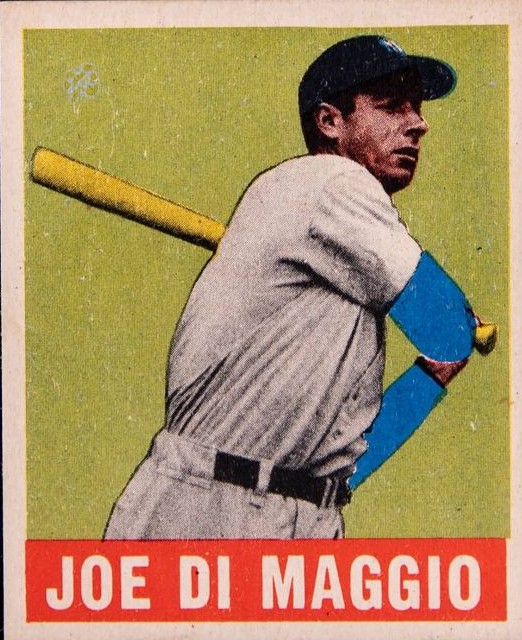
Joe DiMaggio, 1948 Leaf, #1

Joe DiMaggio was so good he had three nicknames. Most of us know “Joltin Joe” and “the Yankee Clipper”, but he also went by simply “Joe D.”. From 1936 to 1951 he was a baseball icon and after baseball, he was a social icon with his high-profile relationships and marriage to the actress Marilyn Monroe. During his career he played centerfield for thirteen seasons (he missed ’43-’45 for military service), exclusively with the New York Yankees. He wore uniform number 5 twelve seasons (he wore 19 his rookie year) and had a career WAR of 79.1.

As is often the case with these older cards, it was difficult to find a card photo with the uniform number showing. I choose this 1948 Leaf because it has such an iconic look, perfect for an iconic figure like DiMaggio. It seems to encapsulate his larger-than-life persona so well. In 1948 DiMaggio was an All-Star (he was an All-Star every season he played). That season, he batted .320 and led the league in home runs (39) and RBIs (155) and was second in MVP voting to another player who also wore uniform number 5 and will be featured soon, Lou Boudreau.

DiMaggio was an All-Star thirteen times, every season in which he played. He is the only player to have accomplished this feat. He was a three-time AL MVP (1939, 1941, 1947). He led the league twice in batting average, home runs and RBIs, three times in season WAR, once in triples and once in runs. He hit over .300 in all but two of his seasons, and in 1941 he would get a hit in 56 straight games, a record that seems unbreakable. In modern times only two players, Pete Rose in 1984 (44) and Paul Molitor in 1987 (39) have even come within fifteen games.

From 1936 to 1951, he was a member of the nearly unbeatable “Bronx Bombers” a Yankees team that consisted of Bill Dickey, Lou Gehrig, and Joe Gordon and later Yogi Berra. With the Yankees he won nine World Series rings, second in history only to Yogi.

He would retire after the 1951 season at 37 years old citing aches and pains after a variety of injuries had plagued his season.

He would finish his career with a .325 batting average (forty-eighth all-time), 2,214 hits, 361 home runs, 1,390 runs, 389 doubles and 1,537 RBIs.

His uniform number 5 was retired by the New York Yankees in 1952.

He was inducted into the National Baseball Hall of Fame in 1955.

DiMaggio passed away in 1999 at the age of 84.

“Where have you gone, Joe DiMaggio?
Our nation turns its lonely eyes to you
Woo, woo, woo
What’s that you say, Mrs. Robinson?
Joltin’ Joe has left and gone away”

Mrs. Robinson: Paul Simon (Simon and Garfunkel) 1968.

Number 4:
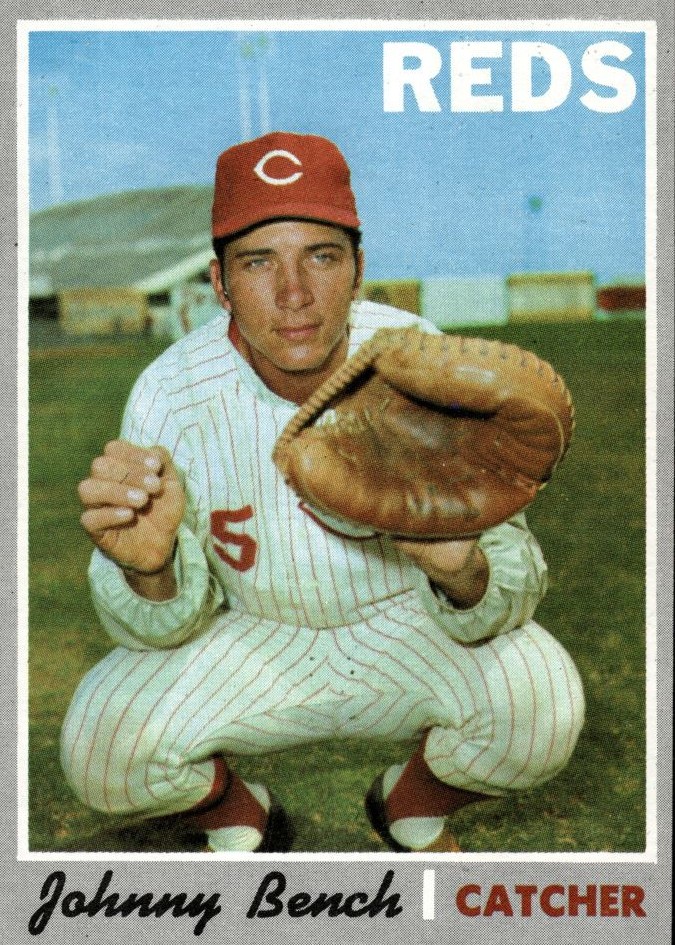
Johnny Bench, 1970 Topps, #660

Johnny Bench played seventeen years from 1967 to 1983 in the MLB, primarily as a catcher, though he did short stints at first, third and all the outfield positions. He played all seventeen years with the Cincinnati Reds and wore number 5 the entire time. His career WAR was 75.1.

This 1970 Topps card was perfect for this post! Literally perfect! It is a beautiful card, that shows Bench in his catching position (Is it just me or does it look like his glove could catch cantaloupes?), with his number 5 just popping. Seriously, this card was made for my post. He looks so suave, but then Bench always does. Not only is the photo perfect, but it was one of his best seasons. He was an All-Star and the NL MVP after leading the league in season WAR (7.4), home runs (45) and RBIs (148) while hitting .293.

Bench was the Rookie of the Year in 1968. He was a fourteen-time All-Star and was the NL MVP in 1970 and 1972. He was an excellent defensive catcher winning ten straight Gold Gloves, a record at the position.

He won two World Series Championships with the Reds “Big Red Machine” in 1975 and 1976. From 1970 to 1979, Bench led a dominant Reds team that averaged 95 wins a season and featured players like Pete Rose, Joe Morgan, Tony Perez, George Foster, Ken Griffey Sr. pitchers Don Gullett and Gary Nolan and was managed by the great Sparky Anderson.

In the 1976 World Series, Bench hit an amazing .533 with 2 home runs and 6 RBIs winning the World Series MVP award.

Bench retired at the end of the 1983 season at age 35 with a career batting average of .267, 2,048 hits, 381 doubles, 389 home runs and 1,376 RBIs and a .990 fielding percentage at catcher.

He is a member of Baseball’s All-Century team and All-Time team.

He is a member of the Reds Hall of Fame, and his uniform number 5 was retired by the Reds in 1984.

He was inducted in the National Baseball Hall of Fame in 1989.

Number 5:
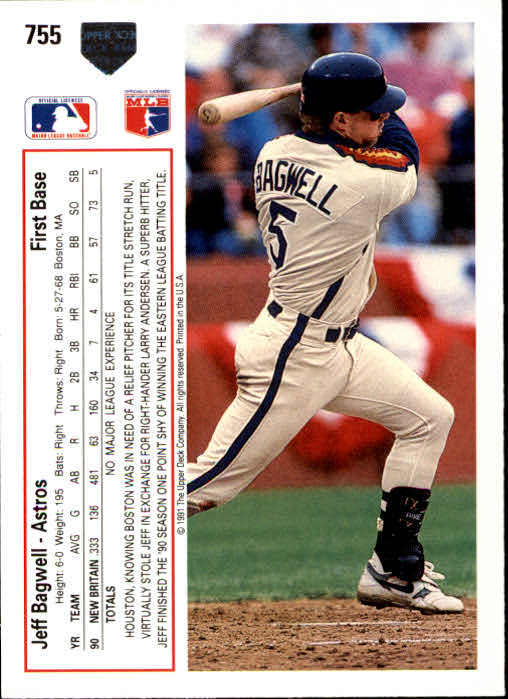
Jeff Bagwell, 1991 Upper Deck, #755 Back

I remember watching Jeff Bagwell dominate the Majors with both awe and a sense of disappointment. As a Red Sox fan, it was always difficult to move past the fact that Bagwell could have been a Sox legend. He was drafted by the Red Sox and was traded to the Astros in 1990 for pitcher Larry Anderson. It was the Curse of the Bambino all over again! I’m being dramatic, but it was one of the worst trades in MLB history. I guess hindsight is 20-20, right? Right?!

Jeff Bagwell played first base for fifteen years from 1991 to 2005 exclusively with the Houston Astros. He wore uniform number 5 his entire career and finished with a WAR of 79.9.

This is the first time I used the back of a baseball card for these posts. This is Bagwell’s 1991 Upper Deck, his rookie season. Upper Deck was all the rage in the early 90s, and I remember this card well. In fact, I think I have a few in my closet. It was during the junk wax era, but collecting as a kid we were unaware that the bubble was about to burst. I’m sure this card went for a pretty penny when it first came out. Either way, this is a great photo, showcasing Bagwell’s uniform number after a powerful swing.

After being traded from the Red Sox (I will not get over it!), Bagwell was the NL ROY in 1991. He hit .294 with 15 home runs and 82 RBIs.

Jeff Bagwell was a four-time All-Star. He was the National League MVP in 1994 when he led the league in WAR (8.2), runs (104), RBIs (116), SLG (.750) and OPS (1.201) and got his only Gold Glove award. Bagwell also won three Silver Slugger awards. He displayed uncommon speed for a first baseman, and he and Barry Bonds are the only two players in history with two 40-30 seasons. In 1997 Bagwell had 43 home runs and 31 steals and in 1999, 42 and 30.

Bagwell was a part of the Astros’ “Killer Bs” along with teammates Craig Biggio and Lance Berkman. (I think there was even a cool 90s poster of the three-I loved those posters!) They never won a World Series, but the Astros were a force between 1994 and 2005, making the playoffs on six occasions and losing to the White Sox in their lone World Series appearance of 2005.

Aside from losing the World Series, Bagwell had a tough season in 2005. He was plagued with arthritis in his shoulder and would miss several games. He eventually had surgery and tried to continue to play but never made it through spring training of 2006 before opting to retire.

He would finish his career with a .297 batting average, having hit over .300 in six seasons. He is forty-second in home runs with 449 for his career (tied with Vladimir Guerrero). He has 2,314 career hits, 488 career doubles and 1,529 career RBIs. His .948 OPS is twenty-sixth all-time. He also has 202 career stolen bases making him the only the first baseman to reach 400 home runs and 200 stolen bases together.

Bagwell is a member of the Astros Hall of Fame, and his uniform number 5 was retired by the Astros in 2007.

He was inducted into the National Baseball Hall of Fame in 2017.

Number 6:
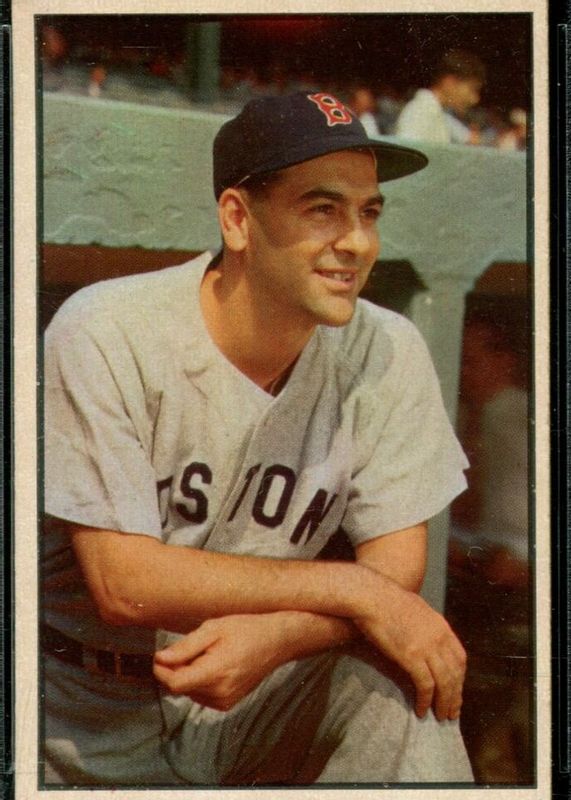
Lou Boudreau, 1953 Bowman, #57

Lou Boudreau played for fifteen seasons in the MLB from 1938 to 1952. He played for Cleveland until 1950, then did a two-year stint with the Boston Red Sox. He had three distinct nicknames, “the Good Kid”, “Handsome Lou” and “Old Shufflefoot”. The last one is likely due to the way he moved at shortstop, the position he played for most of his career. Lou was also a player/manager for many years. He wore uniform number 5 for twelve seasons and had a career WAR of 63.1.

Even though he only played for the Red Sox in 1951 and 1952, I had to go with this card. It’s old school 1953 Bowman and the photo is great, and of course it’s the Red Sox. It’s a nice card! ‘52 was Boudreau’s last as a player, and he only had two at-bats, so this might be a manager card. I never looked at the back, but he is in the managerial posture. The’53 Red Sox were 4th in the AL going 84-69.

Boudreau was an eight-time All-Star. He was the batting champ in 1944 with a .327 average.

1948 was a great year for Boudreau, he was the American League MVP with a league leading 10.4 season WAR, he batted .355 with 199 hits, 34 doubles, 18 home runs and 106 RBIs. He only struck out 9 times in 560 at bats! He was also a part of the 1948 Cleveland Indians World Series winning team. A team that included Larry Doby, Bob Feller, Bob Lemon and Satchel Paige, and was the first World Series to be widely televised.

Boudreau would retire as a player after the 1952 season eventually moving into broadcasting for the Chicago Cubs where he would remain until 1987.

He finished his career with 1,779 hits, 385 doubles and a .295 career batting average.

He is a member of the Chicago Cubs Hall of Fame as a broadcaster.

He is a member of the Cleveland Guardians Hall of Fame, and his uniform number 5 was retired by Cleveland in 1970.

He was inducted into the National Baseball Hall of Fame in 1970.

Boudreau passed away at age 84 in 2001.

Number 7:

Hank Greenberg, 1934 Goudey, #62

Hank Greenberg played thirteen seasons in the MLB from 1930 to 1947. He only had one at bat in 1930 and did not play in 1931 or 1932. He was out for 47 months of military service from ’42 to ’44, the longest of any Major League player. He played most of his career with the Detroit Tigers as a first baseman and center fielder, but played his last season with the Pittsburgh Pirates. He wore number 5 eleven seasons and had a career WAR of 55.5.

Any chance I get to showcase a Goudey card, I’m taking it. This 1934 Hank Greenberg is perfect. I love the photo on the front in his Detroit uniform, the light blue background with the baseball diamond outline. Man, I wish I had some of these cards! In 1934, Greenberg was an All-Star, batting .317 with 33 home runs and 113 RBIs.

Greenberg was an All-Star five times, he led the league in home runs four different seasons, RBI’s four seasons and hit over .300 in eight seasons. He was the American League MVP twice in 1935 and 1940. He was a member of two World Series Championship teams both with the Tigers, once in 1935 with Charlie Gehringer , and ten years later in 1945.

He played his final season, 1947, with the Pirates and although he was productive, he decided to retire. He would finish his career with a .313 career batting average, 1,628 hits, 379 doubles, 331 homeruns, 1,274 RBI’s. He’s tenth all-time with a career OPS of 1.017 and tenth in career SLG with .605. One can only wonder what he would have accomplished had he not missed three seasons in the prime of his career.

Like fellow uniform number 5 player Joe DiMaggio, Greenberg also married a famous actress, Linda Douglas, in 1966.

Greenberg was inducted into the National Baseball Hall of Fame in 1956. His uniform number 5 was retired by the Detroit Tigers in 1983.

Greenberg passed away in 1986 at the age of 75.

Final Score:

Uniform number 5 was a very difficult number to narrow down. There were several personal favorite players that I left off. First a couple of Boston Red Sox shout outs; Vern Stephens who played for Boston from ’48 to ‘52 wore it for eleven years and had a career WAR of 46.4 and Nomar!! Man leaving Nomar Garciaparra off was tough, he wore number 5 for fourteen years and was a member of the Red Sox for eight and a half seasons, his career WAR was 44.3.

Freddie Freeman currently has a career WAR of 64.1 and has worn uniform number 5 his entire sixteen year career so far. He is currently still playing well and is a future Hall of Famer, but I left him off this list, mainly because he still plays. I’m sure he’ll make my list at some point.

A few other players I wanted to mention who wore uniform number 5 for fourteen years each; Brian Downing (51.5 WAR) played with the Angels for thirteen years and was a player whose cards I would often get in packs in the ‘80s, David Wright (49.1 WAR) was a seven-time All-Star who played exclusively with the Mets and had two Gold Gloves and two Silver Sluggers, Ron Gant (34.1 WAR) was a two-time All-Star and had a rookie card that was all the rage when I was collecting and Ray Durham (33.8 WAR) who was a two-time All-Star and wore the number 5 his entire career.

Doing these shout outs makes it clear that once I finish this series, I may need to revisit and start another list. If you’re enjoying these posts, please subscribe and stay tuned for uniform number 6!

PLAYER NAMEYEARS WORNCAREER WARNUMBER RETIREDOTHER ACHIEVEMENTS
George Brett1988.6Yes (1994 Kansas City Royals)13 x All-Star
AL MVP (80)
Gold Glove (85)
3x Silver Slugger 3x Batting Champ World Series Champ (85)
HOF (99)
Brooks Robinson2178.3Yes (1978 Baltimore Orioles)18 x All-Star 16x Gold Glove AL MVP (64) World Series Champ (66, 70) HOF (83)
Joe DiMaggio1279.1Yes (1952 New York Yankees)13x All Star
3x AL MVP (39,41,47)
9 x World Series Champ (36-39, 41,47,49-51)
56 Game Hitting Streak
HOF (55)
Johnny Bench1775.1Yes (1984 Cincinnati Reds)14x All Star
10x Gold Glove
2x NL MVP (70,72) NL ROY (68)
HOF (89)  
Jeff Bagwell1579.9Yes (2007 Houston Astros)4x All-Star
NL ROY (91)
NL MVP (94)
3 x Silver Slugger 1x Gold Glove HOF (17)
Lou Boudreau1263.1Yes (1970 Cleveland Guardians)8x All-Star
World Series Champ (48)
AL MVP (48)
HOF (70)
Hank Greenberg1155.5Yes (1983 Detroit Tigers)5x All-Star
2x AL MVP (35,40) 4x AL HR Leader 4x AL RBI leader 2x World Series Champ (35, 45) HOF (56)

Sources:

https://www.baseball-almanac.com/

https://www.baseball-reference.com/

https://www.sabr.org

Shout out to all the cool cards and creative commons for my pictures! Thanks Topps and Upper Deck and Fleer and Donruss and all the rest!
Baseball by the Numbers: 3

Read about the project

Checklist

3

Welcome back to Baseball by the Numbers. Today we are looking at uniform number 3. Another number with a lot of players. At least 650 players have worn uniform number 3 in the history of baseball, so my criteria will come in handy to narrow things down. Still, I found it a lot harder than anticipated. There were a lot of great players on this list.

Some, like greats Mel Ott and Arky Vaughan wore number 3 for just one season. One of my favorite players mentioned in the uniform number 2 post, Charlie Gehringer, wore it in 1931 for one year with the Tigers, probably because he batted 3rd that season. Hall of Famer Ken Griffey Jr. wore it for three seasons with the Reds toward the end of his career.

Out of the 650 players who wore uniform number 3, ninety of them had the number for five years or more and thirty-seven had a career WAR over 40, so picking seven was a bit of a challenge. Aside from excluding A-Rod (I’ll get to that at the end of the post), there was another player I struggled with. Not because he wasn’t deserving of the number one spot, but more because I felt he was deserving of his own special place on the list. So, I created a spot. The Legend spot. I may reserve this spot for players who have a career WAR over 100 (there’s only thirty-two in history-a couple controversial) or for some other reason, but for now I think this player deserves it.

The Legend:

Babe Ruth, 1933 Goudey, #53

I don’t know if I could say anything about the great Babe Ruth that hasn’t already been said. When I was a kid, just learning about baseball, I remember legends about the mythical Babe Ruth. Documentaries and books were everywhere and of course in Massachusetts “The Curse of the Bambino” was more popular than Bloody Mary.

The Sultan of Swat is an American sports icon. His 182.6 career WAR is the highest in all of baseball, and for players who wore the number 3, it was 65 points higher than any other player to wear the number. Ruth played baseball for twenty-two years and wore number 3 for seven. Keeping in mind it was the only number he ever wore, but he played most of his career before teams wore numbers on their uniforms.

Like all of Ruth’s cards, this 1933 Goudey card is iconic. To own a piece of this legend would be amazing, but most of his cards sell for the price of a car or a house or more! Here’s a link to a cool guide on Babe Ruth cards and prices from Throwback Sports Cards. The pictures are worth a click alone.

Ruth played for the Red Sox, Yankees and the Boston Braves. He was both an amazing pitcher and a prolific hitter. Ruth was a two-time All-Star, which sounds crazy, but the All-Star game started in 1933, at the end of his career. He won seven World Series rings. He led the American League in home runs twelve times and in RBIs six times. His career pitching record was 94-46 with an amazing 2.24 ERA and 488 strikeouts. He is third in history with 714 home runs, third in RBIs with 2,214 and thirteenth all time in batting average with .342. He is the all-time MLB leader in slugging (.690), OPS (1.164) and WAR 182.6.

Ruth was elected to the Baseball Hall of Fame in 1936, with the Hall’s inaugural class that included four other legends; Honus Wagner, Christy Mathewson, Ty Cobb, and Walter Johnson.

Like Bobo Newsom in the 00 post, Ruth is mentioned in Ogden Nash’s 1949 poem “Line-Up for Yesterday” .

Ruth’s uniform number 3 was retired by the New York Yankees in 1948.

Ruth passed away at the age of 53 in 1948 after a battle with cancer.

Number 1:

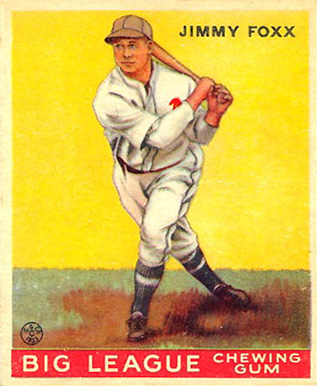
Jimmie Foxx, 1933 Goudey, #154

Jimmie Foxx is the clear number 1 pick after Babe Ruth, even if I had decided to include A-Rod, I would have put Foxx above him. His nicknames alone are the stuff of legend. “Double X” and “the Beast” both sound like characters from an X-Men comic. Foxx was a living action hero, with huge muscles and a confident swagger. Seriously, if you’ve never seen a picture of Foxx with his cut off sleeves and bulging muscles, here’s a link to a great article on SABR. He wore uniform number 3 for twelve seasons and had a career WAR of 92.9.

Jimmie Foxx played for twenty years in the Majors from 1925 to 1945. Foxx played first base for the Philadelphia Athletics, Boston Red Sox (woot, woot!), Chicago Cubs and Philadelphia Phillies.

I’ve said it many times, but I love these old baseball cards. Foxx’s 1933 Goudey is another wonderful example of these beautiful and nostalgic cards (even if his name is spelled wrong). You’ll find a lot of errors and misspellings on older cards from pre WWII, because cards weren’t as regulated at the time. Jimmie Foxx is one I’ve seen a few times with the Jimmy spelling.

In 1933 he won the triple crown with 48 home runs, 163 RBIs and a .356 batting average. He also only struck out 93 times that season. I found it interesting that in 1932, he had more home runs (58), RBI’s (169) and a better batting average (.364) than his 1933 season, but he didn’t win the crown. This was due to a player named Dale Alexander who hit .367, beating out Foxx by just a few points. Alexander was a great hitter in his own right (he has a career .331 batting average), but by today’s rules he would not have qualified for the batting title as he only played in 124 games that season. Foxx would have had two triple crowns in a row.

Foxx was a nine-time All-Star. He was the AL MVP three times (’32, ’33, ’38). He was a two-time batting champ, four-time home run leader and a three-time RBI leader. He also won two World Series (1929 and 1930) both with the Philadelphia A’s.

For his career, Foxx had 2,646 hits with a career .325 batting average. He is nineteenth all-time in home runs with 534 and tenth all-time in RBIs with 1,922. His career OPS of 1.038 is sixth all-time and his career slugging percentage of .609 is eighth.

He is a member of the Philadelphia Wall of Fame, the Red Sox Hall of Fame and the Athletics Hall of Fame. Foxx was elected to the National Baseball Hall of Fame in 1951.

Like Bobo Newsom in the 00 post, and Babe Ruth above, Foxx is mentioned in Ogden Nash’s 1949 poem “Line-Up for Yesterday” . He is in the X spot due to his “Double X” nickname.

He passed away in 1967 at 59 years old.    

Number 2:

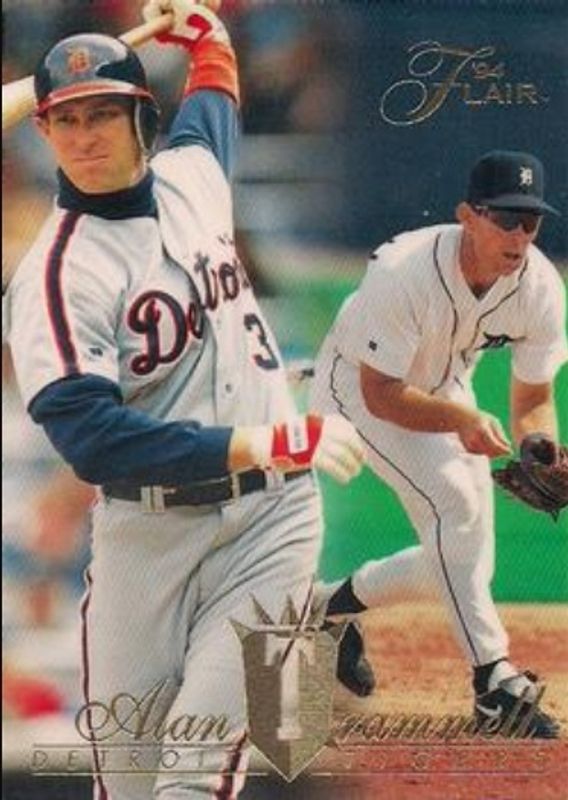
Alan Trammell, 1994 Flair, #53

Alan Trammell played for twenty years in the Majors from 1977 to 1996, all of them as a shortstop with the Detroit Tigers. Aside from the nineteen games he played in the ’77 season, Trammell wore uniform number 3 for the entirety of his career (nineteen seasons).

Trammell was another one of my favorite players when I was in elementary school. As I mentioned with his teammate Lou Whitaker, I was a Tigers fan for a short period in the beginning of my baseball journey because Tigers were cool animals. At that time my Zoobooks and Becketts were piled together on the shelf (oh to be 10 years old again, when cool animals and baseball were all that mattered).

Trammell has a career WAR of 70.6 and, as I mentioned, wore number 3 a long time, so he was an easy choice here. I looked at a lot of different cards but just loved this 1994 Flair card. Flair was a product from Fleer for a few years in the early and mid ‘90s (I think 93 to 96). Personally, I think they made some great cards. This Trammell not only shows his number 3 on the front of that awesome Tigers uniform and also has the added fielding photo. Such a cool card.

Trammell was a six-time All-Star. He was a part of the World Series winning 1984 Tigers and was the MVP of the World Series having hit .450 with two home runs. He was a four-time Gold Glove winner and a three-time Silver Slugger. He batted over .300 seven times in his career.

During the early ‘90s he saw a significant dip in production due to injuries and missing time. He retired in 1996 and would become a manager and a coach. He had a career .285 batting average, with 2,365 hits, 1,231 runs, 412 doubles and 236 stolen bases.

In 2018 Trammell would become a member of the National Baseball Hall of Fame.

His number 3 was retired by the Tigers in 2018.

Number 3:

Harmon Killebrew, 1972 Topps, #51

Harmon Killebrew played for twenty-two years in the Majors from 1954 to 1975. He played first, third and leftfield for the Washington Senators, staying with them when they became the Minnesota Twins in 1961. He would play almost exclusively with the Twins until 1975 when he joined the Kansas City Royals for one season. Killebrew wore uniform number 3 for nineteen of his twenty-two seasons.

As you’ve probably noticed by now, I sort of like almost all of the older Topps sets. 1972 is another design that I just love, and I felt that this card captured the essence of Killebrew perfectly. The way he’s holding the bat toward the lens, a steely gleam in his eye, centered in the archway of the design. It just felt powerful, like the man himself. 1972 was the first year after nine straight that Killebrew was not named to the All-Star team. He was nearing the end of his career by ’72 but still had a great season with 26 home runs and 74 RBI’s.

Killebrew had two nicknames, “Hammerin’ Harmon” and “the Killer” both of which make him sound quite intimidating, and I’m sure he was…to the pitchers facing him, but to those who knew him, he was described as a quiet and kind man who never drank or smoked, and stayed away from drama and controversy.

Killebrew was a powerful home run threat having led the league in home runs six different times. He was a thirteen-time All-Star, the AL MVP in 1969 and lead the AL in RBIs three times.  He retired in 1976 and became a broadcaster in the late 70s and ‘80s.

His 573 career home runs make him twelfth in history. He had 1,584 RBIs and a .256 career batting average with a career OPS of .884.

Killebrew was a member of the Minnesota Twins Hall of Fame and was voted to the National Baseball Hall of Fame in 1984. His number 3 was retired by the twins in 1975.

Killebrew passed away at the age of 74 in 2011.

Number 4:

Willie Davis, 1972 Kellogg’s 3-D, #03a

Willie Davis played eighteen years in the Majors from 1960 to 1979 (he had a two-year gap where he played in Japan; ’77 and ’78). He was a center fielder who played with the Dodgers for fourteen years, then played with the Expos, Rangers, Cardinals, Padres and ended with the Angels in 1979. He wore uniform number 3 for fifteen seasons. His career WAR was 60.8.

Who doesn’t love Kellogg’s 3-D cards?  For fourteen years Kellogg’s gave out their groundbreaking 3-D cards in boxes of Corn Flakes, and sets could be ordered via mail-ins. If you want to learn more about the cards check out this article in Sports Collector’s Digest.

This 1972 card of Willie Davis is a perfect example of why these Kellogg’s cards are so cool. I was excited when I saw the card had his number 3 easily viewable right on the front (an opportunity to share a Kellogg’s card, sign me up!) In 1972, Davis was a Gold Glove winner with a .289 batting average, 19 home runs and 79 RBI’s, to go along with 20 stolen bases.

Davis was a two-time All-Star who won two World Series rings with the Dodgers in 1963 and 1965. He also won three Gold Gloves. He left baseball first in 1977 to play in Japan for two seasons with the Chunichi Dragons and Crown Lighter Lions. He would come back for one last season in 1979 and play forty-three games with the California Angels before retiring.

He is fourth all-time for games played in centerfield behind only Willie Mays, Tris Speaker and Steve Finley.  He has a career .279 batting average with 182 home runs, 1,053 RBI, 2,561 hits and 398 stolen bases. He is not in the Hall of Fame and has never been on a ballot, which I find to be surprising. Do you think Davis is deserving? His career WAR is 60.8 which is pretty darn good.

Davis passed away in 2012 at the age of 69.

Number 5:

Dale Murphy, 1981 Topps, #504

Another player who is not in the Hall of Fame, Dale Murphy, played eighteen years in the Majors from 1976 to 1993. He played catcher, first base and outfield for the Atlanta Braves for fourteen and a half seasons, with the Philadelphia Phillies for three seasons and the Colorado Rockies for his final season. He’s another player that I remember well growing up. For kids growing up in the ‘80s and ‘90s, Murphy was a popular player even outside of Atlanta.Murphy wore uniform number 3 for eighteen seasons and has a career WAR of 46.5.

1981 Topps was another great ‘80s design. I love the cap logo in the bottom corner. This Dale Murphy card is especially nice. The blue and green color scheme with that great photo of Murphy’s beautiful swing, his name and number visible on the old school Braves uniform. Too bad 1981 wasn’t the best year for Murphy. He was coming off an All-Star season, but only played in 104 games, had a .247 batting average and only 13 home runs and 50 RBIs. A far cry from the next season that would see him become the NL MVP.

Murphy would be the NL MVP two years in a row in 1982 and ’83 while leading the league in RBIs both seasons. He was a seven-time All-Star, a five-time Gold Glove recipient and a four-time Silver Slugger. He led the National League in home runs twice in 1984 and 1985 and in RBIs in 1982 and 1983. He was a member of the 30-30 club in his 1983 MVP season.

In 1993 after only 26 games with the Rockies, he decided to retire from baseball. He finished his career with 2,111 hits, 350 doubles, 398 home runs, 1,266 RBIs and a .265 batting average. He is a member of the Braves Hall of Fame.

Many people feel that Murphy deserves a place in the Hall of Fame. Outside of the steroid era, he and Roger Maris are the only two multiple MVP award winners not in the Hall. Murphy has a stellar reputation on and off the field, including a lot of humanitarian work, which has also led many to feel he is an ideal Hall of Famer. His reputation and charitable work has led to several awards including the Lou Gehrig Memorial Award (‘85), “Sportsman of the Year” (‘87), Roberto Clemente Award (‘88), Bart Giamatti Community Service Award (‘91) and the World Sports Humanitarian Hall of Fame (1991).

I think he deserves the Hall and would love to see him in. He is a great example of a baseball star both on and off the field. Do you, my readers, agree or disagree and why?

Murphy’s uniform number 3 was retired by the Braves in 1994.

Number 6:

Frankie Frisch, 1934 Diamond Stars, #17

I love this project! There are always amazing players who I’m not familiar with, like Frankie Frisch, who had an amazing career and stories. Frisch had a couple of awesome, DC Hero like nicknames, “the Fordham Flash” and “the Old Flash”. As you probably guessed, he was fast, leading the NL in stolen bases three separate years.

Frisch played in the MLB for nineteen years from 1919 to 1937. He played second base with the New York Giants until 1926. In 1926 he was traded from the New York Giants to the St. Louis Cardinals for the great Rogers Hornsby, and stayed with them from ‘27 to ’37, while also managing the Cardinals as a player/manager from ’33.

This card is awesome! I absolutely love it. It’s a 1934 Diamond Stars and I’m starting to think there are no cards in those old ‘30s sets that I don’t love. The colors, the picture, the background art are all wonderful. It might be one of my favorite Diamond Stars cards yet. In 1934 Frisch was an All-Star. He had a .305 batting average with 30 doubles and 75 RBI.

Frisch was a switch hitter who was an All-Star three times as the All-Star game just started toward the end of his career. He was part of four World Series winning teams, two with the New York Giants (’21 and ’22) and two with the St. Louis Cardinals (’31 and ’34). In 1934 he was also the Cardinals Manager. He was the NL MVP in 1931.

Frisch was the player/manager for the Cardinals from 1933 to 1937 when he would retire. He remained manager through 1938. He went on to manage the Pittsburgh Pirates from 1940 to 1946 and the Chicago Cubs from 1949 to 1951.

Frisch would end his career with a .316 batting average, the highest career batting average for a switch hitter in MLB history. He would end up with 2,880 hits, 466 doubles and 419 stolen bases. He is third in career World Series hits with 58, and tied with Reggie Jackson at eighth for career World Series total bases with 74, and tied for first with Yogi Berra for career World Series doubles with 10. His career managerial winning percentage is .514.

He is a member of the Cardinals Hall of Fame and was inducted into the National Baseball Hall of Fame in 1947. Like Bobo Newsome from the uniform number 00 post, and Babe Ruth, Frisch is mentioned in Ogden Nash’s 1949 poem “Line-Up for Yesterday” . I wonder if I will get every player from that poem in the lists.

Frisch passed away at the age of 75 in 1973.

Number 7:

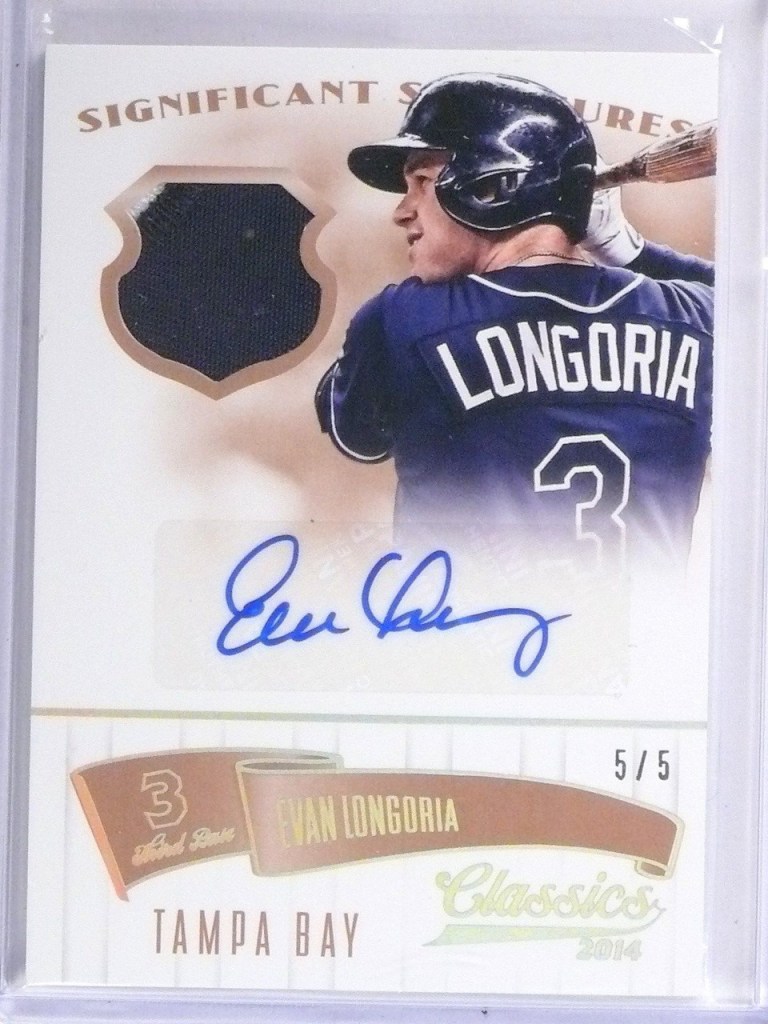
Evan Longoria, 2014 Panini Classics Signatures, #44

Evan Longoria is the most current player to make this list. Longoria played for sixteen years in the majors from 2008 to 2023. Known as “Longo”, he was a third baseman for the Tampa Bay Rays, San Francisco Giants and Arizona Diamondbacks. Longoria wore number 3 for eleven seasons and has a career WAR of 58.9.

This 2014 panini auto was one of the only cards I could find with his number 3 displayed where he was on the Tampa Bay Rays. I found a couple on Arizona, but I really wanted his Rays jersey as he was a hero in Tampa. Though I’m not a fan of Panini baseball cards overall, this is a nice card with his signature, and I like that it’s a relic card. In 2014, Longo played in all 162 games, which is quite an accomplishment in today’s game. He had 22 home runs and 91 RBIs for the Rays.

Longoria is a three-time All-Star and a three-time Gold Glove award winner. He was AL Rookie of the Year in 2008 and won a Silver Slugger in 2009. He has been to two World Series (2008 and 2023) and although his team lost both, his fifteen years between the two are the longest gap for any player in MLB history (there’s a trivia question for you). He has hit a home run against all 30 current MLB teams (a bonus trivia question).

He owns several Tampa Bay records, and in 2025 Longoria signed a contract with the Rays to retire with the team that started it all. He would complete his career with a .264 batting average, 1930 hits, 431 doubles, 342 home runs and 1159 RBIs.

Final Score:

This is so much fun for me! My lists never go as expected and sometimes I must be flexible and change things around a bit (like adding the Legend spot for Ruth). Which brings me to this next little bonus.

There was a player who had the number 3 for twenty-two seasons from 1980 to 2001. He played DH and outfield for five teams, including the White Sox and Orioles three different times each. His career WAR was 38.8, just missing my criteria of 40. His name is Harold Baines. He was a six-time All-Star, a World Series champ in 2005 and won a Silver Slugger in 1989. His number 3 was retired by the White Sox in 1989, and he was inducted into the National Baseball Hall of Fame in 2019. I didn’t pick Baines, but he deserves a card just for having the number 3 so long. Would you have made him a top seven and in whose place? Here’s a 1983 Topps (another favorite design from the ‘80s) with the awesome White Sox ‘80s uniform and the number 3 on his leg!

Harold Baines, 1983 Topps, #684

Aside from the players I mentioned in the intro, I wanted to shout out a few other players who wore uniform number 3. Bobby Grinch (WAR 71.1) wore it for five years with the Orioles. Johnny Mize (WAR 70.6) and Carlos Beltran (WAR 70) for two seasons. Hall of Famers Bill Terry (WAR 56.6) and Mickey Cochran (WAR 49.8) both wore it for 4 seasons. Controversial players like Rafael Palmeiro (one season) and Gary Sheffield (two seasons) also wore it.

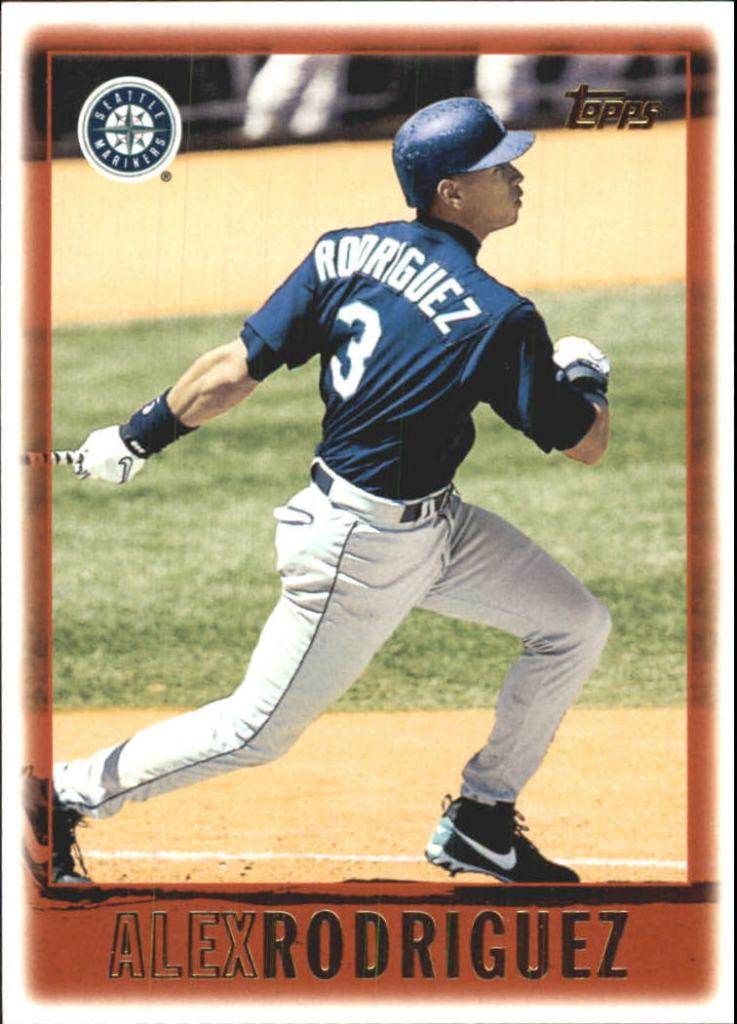
Another controversial player who met all my selection criteria was Alex Rodriguez. He wore number 3 for ten years (which is quite a long time) and his career WAR was well above 40 coming in at a whopping 117.4. He wasn’t controversial just because he was on my least favorite team, the Yankees, either, but I just do not like him as a player. That’s my personal preference, but I’m sure there are many who feel the same. It’s also not just the PED issues, or the 162-game suspension or the fact he has not been included in the Hall of Fame, though these would all be reasons to leave him off the list. While I have criteria, I also reserve the right to include, leave off or move players based on my own personal thoughts, and truth is, I just liked the players I chose more than him. Although I left him off, I still felt he was worth mentioning and for any Alex Rodriguez fans who are offended, here’s a card just to make amends.

Alex Rodriguez, 1997 Topps, #4

There were many other players I could mention, but these posts would get ridiculous if I just started naming everyone, so I’ll leave it here. I hope you’re enjoying this series and come back for uniform number 4. Like uniform number 3,  I think it’s going to be another tough one that will pose more challenges to my criteria. Like the fact that three players had a career WAR over 100.

PLAYER NAMEYEARS WORNCAREER WARNUMBER RETIREDOTHER ACHIEVEMENTS
Jimmie Foxx1292.9No9x All-Star
3x AL MVP Triple Crown (33)
World Series Champ (29, 30) HOF (51)
Alan Trammell1970.6YES (Detroit Tigers 2018)6 x All-Star
4x Gold Glove
3x Silver Slugger World Series Champ (84)
HOF (18)
Harmen Killebrew1960.4YES (Minnesota Twins 1975)13x All Star
6x AL HR Leader AL MVP (69)
HOF (84)
Willie Davis1560.8No2x All-Star
World Series Champ (63, 65)
3 X Gold Glove
Dale Murphy1846.5YES (Atlanta Braves 1994)7x All-Star
2x NL MVP
5x Gold Glove
4x Silver Slugger
Frankie Frisch672No3x All-Star
NL MVP (31) World Series Champ (21,22, 31,34)
Evan Longoria 11 58.9 No3x All-Star
3x Gold Glove ROY (2008)
Silver Slugger

Sources:

https://www.baseball-almanac.com/

https://www.baseball-reference.com/

https://www.sabr.org

Lehman, 2017 “Kellogg’s baseball card set in 1970 started a 14-year run” Sports Collector’s Digest

Shout out to all the cool cards and creative commons for my pictures! Thanks Topps and Upper Deck and Fleer and Donruss and all the rest!
Baseball by the Numbers: 1

Read about the project

Checklist

1

Welcome back! Now things are starting to get difficult. Uniform number 1 has five hundred options to choose from. Way more than 00 (twenty-one players) and 0 (forty-five players). It was quite a challenge. There were twenty-three players who wore number 1 for ten years or more and another fifty-six who wore it over five years. There were eighteen players who had a career WAR over 40 and eleven Hall of Famers. There were some really cool names too, Rabbit, Snuffy, Granny, Sparky, Kiddo, Bubba and Sibby. There will be a nice group of honorably mentioned players. So, without further ado (I’ve always wanted to say that!), here are my top seven players for uniform number 1.

All seven choices wore uniform number 1 for well over five years, in fact, they all wore it over ten years, and all of them had career WAR over 40.  

Number 1:

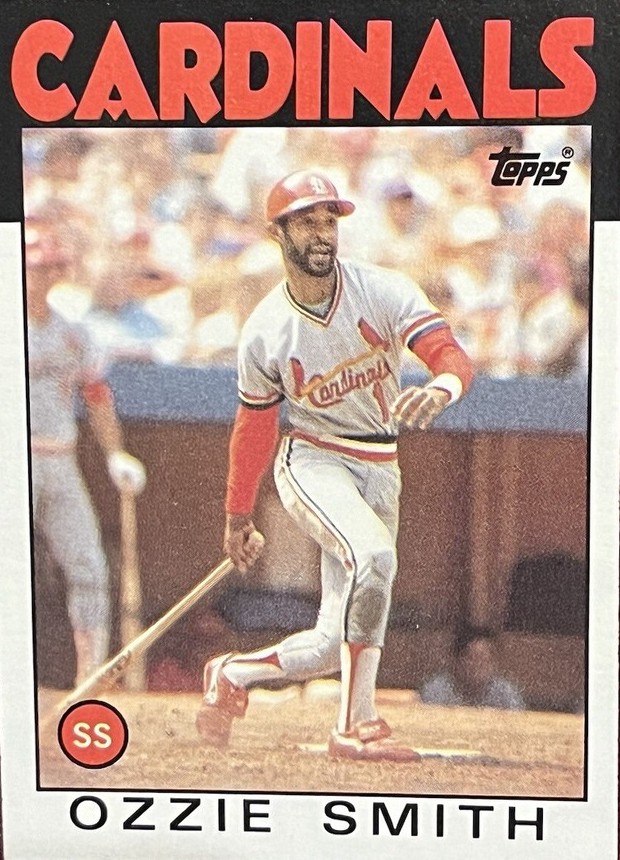
Ozzie Smith, 1986 Topps, #730

“The Wizard of Oz”. What an amazing nickname for an amazing player. I always loved the 1986 Topps cards. It’s one of my favorite sets, probably more for nostalgic reasons than aesthetics, but this Ozzie Smith one is sweet. I was so happy to see his uniform number on full display.

Ozzie Smith probably doesn’t need an introduction. He played shortstop for nineteen years in the majors from 1978 to 1996 wearing uniform number 1 the entire time. He was on the Padres until 1981 when he was traded in a six-player deal to the St. Louis Cardinals, with Cardinal’s shortstop Garry Templeton (who also wore number 1) and Sixto Lezcano as the key pieces. Initially hesitant, Smith met with Cardinal’s manager Whitey Herzog and was convinced this was the right team. He would play the rest of career for St. Louis. He was with those Cardinals when I first discovered my love of baseball, and baseball cards, and the Wizard was a key player during the 80s and 90s. He was so much fun to watch, with his crazy backflips and infectious smile. Whenever I found an Ozzie Smith card in a pack, I was delighted. 

Smith was a 15-time All-Star. On the defensive end, he won the Gold Glove 13-times in a row. He also helped the Cardinals win the World Series in 1982. He won a Silver Slugger in 1987 and was honored with the Roberto Clemente Award in 1995. He would finish his career with a 76.9 WAR, accumulating 2460 hits with only 28 home runs. He had a career .337 OBP and a .268 batting average, with 580 stolen bases. Smith was elected to the Cardinals Hall of Fame.  He was elected to the Baseball Hall of Fame in 2002 with a 91.7% vote, his first time on the ballot.

His uniform number 1 was retired by the Cardinals.

Number 2:

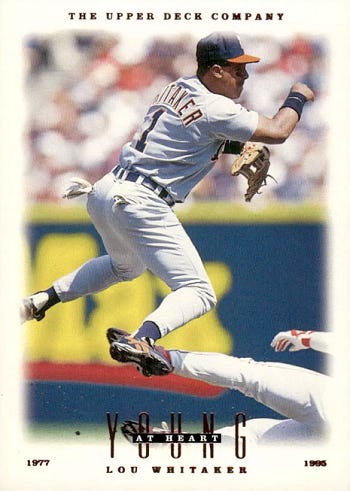
Lou Whitaker, 1996 Upper Deck, # 107

“Sweet Lou” Whitaker played second base for the Tigers for nineteen years and wore uniform number 1 for eighteen of those. He played from 1977 to 1995. During the ’80s the Tigers were a great team, with Lou Whitaker, Alan Trammell, Lance Parrish, Kirk Gibson, Chet Lemon and pitcher Jack Morris. They won the World Series in 1984.

Like Ozzie Smith, Lou Whitaker played during my formative baseball years. In fact, when I was a kid, I wouldn’t pick a favorite team. I’m now a diehard Red Sox fan, but you know how kids are. For a period, I remember being a Tigers fan. I think it was more because I thought Tigers were cool than any actual baseball reason, but man those early ’80s Tiger’s players still hold a special place for me. I loved getting their cards. For Whitaker, I found this awesome 1996 Upper Deck with him making a leaping defensive play, the number 1 displayed prominently on his back. So cool!

Whitaker was a five-time All-Star. He won ROY in 1978, was a three-time Gold Glove winner and a four-time Silver Slugger. He has a career WAR of 75.1 with a .276 lifetime BA, 420 doubles, 244 home runs and a .363 OBP. He is not in the Baseball Hall of Fame, but I think he could be. Do you?

His uniform number 1 was retired by the Detroit Tigers.

Number 3:

Pee Wee Reese, 1958 Topps, #375

Next, we are going back a bit into baseball history, to the time before I was born. Pee Wee Reese played shortstop for sixteen years from 1940 to 1958 (he missed the ‘43, ‘44, and ‘45 seasons due to military service). He spent his entire career with the Brooklyn Dodgers (LA for his last season).

This 1958 Topps cards is so beautiful. I love the colors on these cards. This would be Pee Wee’s last season, and the Dodgers were newly moved to LA. I like this card because you can see the uniform number 1 on Reese’s back. He wore that number for his entire career.

Pee Wee’s real name was Harold Peter Henry Reese, but he gained the nickname when he was a young boy playing and winning marble championships (yes that was a thing) in Kentucky. I didn’t know much about Pee Wee until I watched the movie “42” (which is amazing and a must watch for everyone; baseball fan or not). I really respected that he was a player who supported the integration of Jackie Robinson into baseball. He didn’t just support him, he also showed solidarity by putting a comforting arm around Robinson during a rough fan heckling situation. That’s a stand up shortstop and person in my book.

Reese was a ten-time All-Star, winning a World Series ring with the Brooklyn Dodgers in ’55 and then again in ‘59 as a coach. He has a career 69.5 WAR with 2,170 hits, 126 home runs, 232 stolen bases and a career batting average of .269. He was elected to the Baseball Hall of Fame in 1984 via the Veterans Committee.

Reese passed away at 81 years old in 1999.

His number 1 was retired by the Dodgers.

Number 4:

Richie Ashburn, 1956 Topps, #120

Another player with a couple of great nicknames, Richie Ashburn played centerfield for fifteen years from 1948 to 1962, mostly for the Phillies (twelve years) and later in his career, two years with the Cubs and one with the Mets. He was sometimes known as “Putt-Putt” and “the Tilden Flash”, but regardless of what you called him, Ashburn makes uniform number 1 proud. He wore it for all fifteen of his seasons, while becoming a legend in Philadelphia.

I couldn’t find a card with his number displayed, but I’m a huge fan of the 1956 Topps design, so I picked it to highlight Ashburn on my uniform number 1 list. You must admit…it is a sweet looking card.

Ashburn started his Phillies career strong. He led the league in stolen bases and was voted into the All-Star game in 1948, his rookie season, while he finished 3rd in ROY voting, behind Al Dark and Gene Bearden. He would go on to have five more All-Star appearances. He was also the NL batting champ in ’55 and ’58. 

Ashburn had a nice career. His career WAR was 64.3 with a .308 career batting average, 2,574 hits, 1,322 runs, and 234 stolen bases. He also had a nice .396 OBP. He is also 3rd in putouts for centerfield, behind greats Willie Mays and Tris Speaker.

After retirement, Ashburn would become a popular commentator for the Phillies until his death. He is a member of the Philadelphia Phillies Hall of Fame and was voted into the Baseball Hall of Fame in 1995 by the veterans committee behind plenty of fan support.

Ashburn passed away at the age of 70 in 1997 just a couple hours after broadcasting a game.

His uniform number 1 was retired by the Phillies.

Number 5:

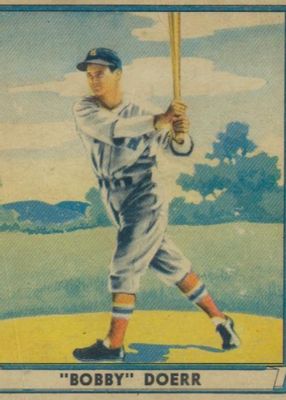
Bobby Doerr, 1941 Play Ball, #64

I was very excited to include Bobby Doerr on the list. He spent his entire fourteen-year career as a second baseman for the Boston Red Sox from 1937 to 1951 (missing ’45 for military service). His 1941 Play Ball card is a great example of cards from the ‘40s. I’m not an art connoisseur, so I can’t adequately explain how elegant these cards are, but I’ll try. Beautiful colors, vibrant pictures, a great art-deco style. It’s like looking at a time machine. The perfect card to capture the essence of the era.

Doerr wore uniform number 1 his entire career with the Red Sox. He was a nine-time All-Star while batting over .300 three times and hitting 100 RBIs in 6 seasons. He was a forefather on a team with a storied past, known for some of the best players in Major League history (and I’m not just saying that because I’m a Red Sox fan).

After leaving the game, Doerr would become a coach, helping shape Carl Yastrzemski’s legendary triple crown season. He finished with a career WAR of 54.4 along with 2,042 hits, 381 doubles, 89 triples, 223 home runs, and .288 career batting average. Doerr is a member of the Red Sox Hall of Fame and in 1986 was enshrined in the Baseball Hall of Fame.

Doerr passed away in 2017 at 99 years old.

Like all the players picked before him, his uniform number 1 was retired by the Red Sox.

Number 6:

Buddy Myer, 1934 Diamond Stars, #4

Another example of a beautiful card, the 1934 Diamond Stars Buddy Myer is pure nostalgia. Myers played for seventeen years in the Majors from 1925 through 1941. He mostly played second base (with occasional stints at third and in the outfield), predominantly with the Washington Senators, but he also had two seasons with the Red Sox. He wore uniform number 1 for eleven seasons, all with Washington. He started his career during the time when numbers were rare, so it appears he wore number 1 his entire career.

Myer was a great player whose batting average was .300 or better in nine seasons. He won the batting title in 1935 and was a two-time All-Star. In 1933 he got into a fight was Ben Chapman, a player known not only for his dirty play, but his use of racist remarks (he infamously heckled Jackie Robinson in 1947 when Chapman managed the Phillies). Myer, who was not himself Jewish, but had Jewish heritage, was spiked by Chapman, who then berated Myer with anti semitic remarks, causing one of the craziest fights in baseball history; one that spread to the dugout and the fans.

Myer ended his career with a 48.4 WAR and a .303 batting average. He had career .389 OBP and struck out only 428 times in over 7000 at bats. That’s like 6%! He also had 965 walks, double the amount of career strikeouts.

Myer passed away in 1974 at the age of 70.

Number 7:

Tony Fernandez, 1993 Fleer Ultra, # 426

Another player I grew up watching, Tony Fernandez played for seventeen seasons from 1983 to 2001 (He missed the 1996 season due to injury). Fernandez played for the Blue Jays from ‘83-‘90, then was traded to the Padres along with his teammate “The Crime Dog” Fred McGriff for Joe Carter and Roberto Alomar. He would then bounce around a lot, playing for the Mets and Blue Jays in ’93, then the Reds, Yankees, Cleveland (Blue Jays again! ‘98-‘99), then went to Japan and was on the Seibu Lions, came back to play for the Brewers and ended his career with (Bueller, Bueller?), yep, the Blue Jays again. He wore uniform number 1 for fourteen of his seventeen seasons.

Fernandez was a five-time All-Star who was known for his stellar defensive play, winning four Gold Gloves. He was part of the 1993 World Series Champion Blue Jays and holds the record for RBIs in the World Series for a shortstop with nine. He’s also a member of the Canadian Baseball Hall of Fame.

 He ended his career with a WAR of 45.3, a .288 batting average, 2,276 hits, 414 doubles, 92 triples and 246 stolen bases.

Fernandez passed away at the age of 57 in 2020.

Final Score:

Uniform number 1 had a lot of players to choose from. I suspect that will be the case for many of the numbers moving forward. There are a lot of solid players coming up, so many of my lists will be very subjective. There will likely be some Red Sox bias, a lot of players I enjoyed watching in my lifetime, and a lot of snide remarks about the Yankees.   

Out of the seven players above three only played for one team. They also all had their uniform number for a long time. 4 had it 100% of their career, the other three 80%. THis is likely the case for all-stars and Hall of Famers, especially those who stayed with one team, but it seems common to have players wear a uniform number for a few seasons and then switch up (likely when traded or signing elsewhere).

As I mentioned at the start of this post, there were eleven Hall of Famers who wore uniform number 1, and over fifty players also met the five years plus criteria. There were also so many fun nicknames on this list. So, a few honorable mentions. Garry Templeton (3x All-Star) had number 1 for fifteen seasons and was traded for Ozzie Smith. Mookie Wilson (stupid 1986 Mets!) also for fifteen seasons. Hall of Fame pitcher Earle Combs had the number for seven seasons. Hall Of Famer “Rabbit” Maranville also had it for 3 seasons. He also has an awesome nickname and looks very rabbit like in some of his pictures. There were many great choices, but I digress. Maybe when I finish the first set of posts, I’ll do more.   

Make sure to check out the next post where things are sure to heat up with uniform number 2. I already know of one player that I’m not looking forward to putting on the list, but he deserves to be there. Can you guess who it is? Thanks for joining me!

PLAYER NAMENUMBER of YEARS WORNCAREER WARALL-STAR APPEARENCESOTHER ACHIEVEMENTS
Ozzie Smith1976.91513 Gold Gloves World Series Champ (82) HOF (02)
Lou Whitaker1875.15ROY (78) 3x Gold Glove 4x Silver Slugger World Series champ (84)
Pee Wee Reese1668.510World Series Champ (55) HOF (84)
Richi Ashburn1564.36HOF (95)
Bobby Doerr1351.49HOF (96)
Buddy Myer1148.42 
Tony Fernandez1445.354 x Gold Glove World Series Champ (93)

Sources:

https://www.baseball-almanac.com/

https://www.baseball-reference.com/

https://www.sabr.org

Shout out to all the cool cards and creative commons for my pictures! Thanks Topps and Upper Deck and Fleer and Donruss!