
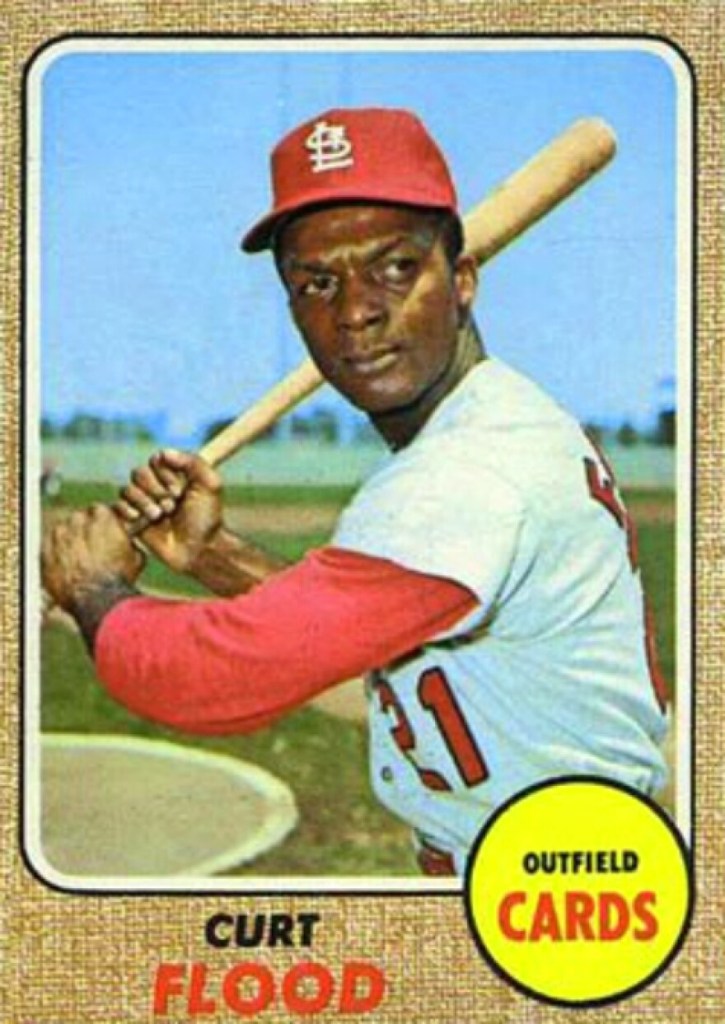
I started rewatching Ken Burns “Baseball” documentary the other night. To me it is the ultimate in baseball documentaries. I remember looking forward to watching it each September night in 1994 when it came out. I would have my Doritos and Mountain Dew at the ready, or Easy Cheese and Ritz, and watch it on my little 13’ TV in my basement bedroom while sorting my baseball card collection. I was just a teenager but always enjoyed documentaries, and PBS in general. I watched Doctor Who when I was younger and all the Nature shows; my mom was partial to Are You Being Served?. As I rewatched the documentary from an adult perspective, I couldn’t help but see that baseball is filled with little known people who, due to the synchronicities in their lives, suddenly impact the game in a big way, and through that American history. Many people will say, “It’s just a game”, and while this sentiment is true, sports have and will likely always play a major role in our society. Like everything else in this world, baseball is comprised of people, people with stories, with interesting lives and those unique experiences fascinate me to no end.
There are some larger-than-life figures in baseball who have become household names. Everyone knows about Babe Ruth, right? Or amazing inspirational players like the great Jackie Robinson, who not only impacted the game, but society as a whole. These players have movies and books about them. There are players who have reached amazing statistical achievements, like Cal Ripken’s 2,632 consecutive games played or Cy Youngs 511 career wins. Their stories are legendary.
But for all those legendary stories out there, there are so many other players whose names are slowly fading from the memory of all but the die-hard fans. Until recently many of the players I write about here, I had never heard of or only knew of because of their cards. Take Curt Flood.
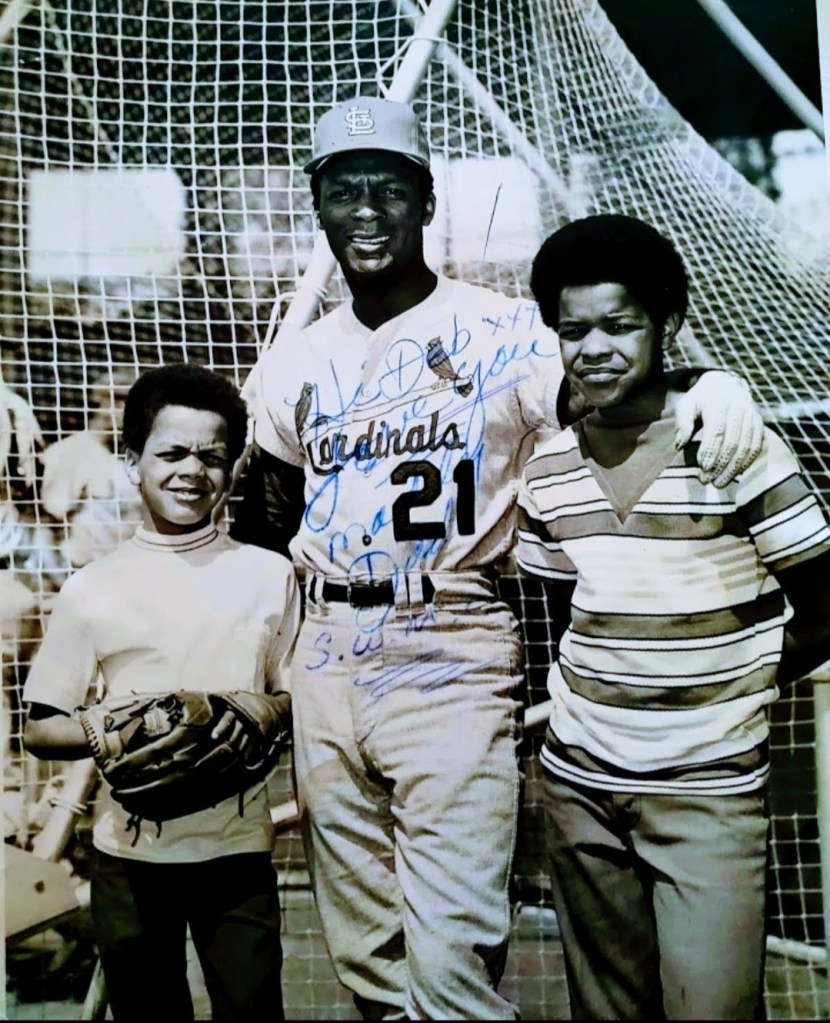
The name was familiar, I’m sure I’d seen his cards now and again, but he didn’t play in my lifetime and died while I was still a teen. But man is he cool! Not only was he one of the best defensive outfielders in baseball history, but he played a pivotal role in ending the players reserve clause and allowing for free agency to take shape. The clause, “kept players on their teams for life – or could trade them without the player’s wishes – while denying players the ability to test the market or sign with other teams.” Collier, The Madison Times, March 2024
Curt Flood was born in Texas in 1938. His family later moved to Oakland California, and it was there that Flood got his first taste of baseball. At 9 years old, Flood joined a local little league team and was coached by George Powles, who became an inspiration and mentor to him. Powells was a bird-dog scout for the Cincinnati Redlegs, and Flood continued to play for Powells through High School. Aside from being a great ball player, Flood was also known as a wonderful artist and according to Terry Sloop, “teammates and other players around the league also commissioned family portraits from Flood and called him “Rembrandt.”” SABR, retrieved May 2025
In 1956 Flood was signed by the Cincinnati Redleg’s, where he would learn some harsh truths about racial hatred during his first spring training in Florida. He had to be housed in a different hotel than his teammates due to being black. While in the minor leagues he was not allowed to eat with his white teammates, could not stay with them, and could not use restrooms while they traveled. He had to endure abuse from fans and teammates alike. It was so bad Flood found himself crying at night and considered quitting. Still, he faced the adversity head on and took inspiration from players like Jackie Robinson.
In a 1962 interview with Clifford Evens, Flood spoke of his respect for his idol. “Of course, the one real idol that I had was Jackie Robinson. He set a real wonderful example for most of the young fellas coming along during his time. Everyone had the desire in the back of their mind to follow in his footsteps. And I was no different. I respected him as a man and as a ballplayer as well.” (Retrieved May 24 from Classic Baseball Broadcasts)
Flood tour up the minor leagues. He was named Player of the Year after leading the league in average (.340) and runs scored (133), and coming in second in RBI’s (128). He also showed off his defensive mastery, leading the league with 388 putouts. He hit 29 home runs, setting a team record. He would be called up to the Majors in September of 1956, only seeing one at bat, and striking out.
In 1957 he would again find himself in the minors. He once again showed off his hitting skills but had 42 errors after a move to third base. He was called up and played in 3 games, getting his first Major league hit, a home run, but was traded to the Cardinals in the off season. He would spend the next 12 years with St. Louis.
1958, 1959 and 1960 were not great seasons offensively for Flood. His rookie season saw him hit .261 with 10 home runs and 41 RBI. He was caught stealing 12 out of 14 attempts. His slugging was .382. In ’59 he hit .255 in 208 at bats. This could be due to the racism of Cardinals Manager Solly Hemus who, despite Flood’s obvious talent, especially on defense, sat him often. In 1960, it was more of the same. Flood had 398 at-bats and hit only .237.
By 1961, the Cardinals replaced Hemus with Johnny Keane, and Flood began to put things together. By the end of the summer, Keane named him the starter in Centerfield and he finished the season hitting .322. He would continue to play well for the Cardinals the rest of his time with them.
In 1964 he was named to his first Major League All Star game as he co-led the league with 211 hits, tied with Roberto Clemente. He received his second Gold Glove and first World Series ring as the Cardinals defeated the Yankees in seven games.
He would be named an All Star two more times (’66 and ’68) and would win another 5 straight Gold Gloves. Flood was a key member of the Cardinals World Series win in 1967 against the Boston Red Sox. He had a great season in ’67 batting .335.
While Flood had another great year in ’68 and the Cardinals once again found themselves in the World Series, he made a key error in game 7 that led to his slipping and falling on the wet grass. The batter, Jim Northrup, ended up with a triple, knocking in two runs for the Tigers. The Tigers would go on to win 4-1. This error along with some personal issues led to a souring of the relationship between Flood and the Cardinals.
Throughout the ’69 season Flood dealt with off field issues and continued stress between himself and the front office. This culminated in his being traded to the Phillies. He was upset with this trade, and had no intention of going to Philadelphia, but due to the reserve clause, his only other choice was to retire. This led to Flood fighting the league and an eventual lawsuit against then commissioner Bowie Kunh and the MLB. The case made it to the Supreme Court, but Flood eventually lost. “Despite the loss in the Supreme Court, Flood’s litigation motivated the player’s union to continue to fight against the reserve clause, and it was finally removed in 1975 by an arbitrator who ruled that two other players were eligible to negotiate contracts with any team. A year later, in 1976, the players’ union and the owners agreed to a contract that included provisions permitting free agency.” Collier, The Madison Times, March 2024 To read more about this case please check out the links in my sources and this link to the full case file (Flood v. Kuhn, 407 U.S. 258 (1972).
Flood would miss the entirety of the 1970 season and would play in only 13 more games in 1971 before leaving baseball for good. For many years after this Flood’s life was difficult. He drank too much, was in debt, and was even homeless for a time. In 1978 he would try his hand at broadcasting with the Oakland Athletics, but failed miserably.
He would eventually fight his way back. He married a former flame, actress Judy Pace, and was able to maintain his sobriety. He created the Curt Flood Youth Foundation and was named President of the Senior Professional Baseball Association for a couple of years. He also got back into painting. In 1994 he was featured in the aforementioned Ken Burns’ documentary Baseball.
He would pass away in 1997 at the age of 59 from complications of throat cancer.
“In 1998 Congress passed the Curt Flood Act, which eliminated baseball’s antitrust exemption in regard to labor issues. Flood received one final posthumous accolade in 1999, when Time magazine named him one of the ten most influential athletes of the past century. Sloop, SABR, Retrieved May 26th, 2025
Curt Flood played a pivotal role in baseball as we know it today. Although the end of his career was difficult, I’d like to end with one of those interesting facts I’m always talking about. One of those synchronicities.
In 1969 the Montreal Expos would become the newest expansion team in Major League Baseball and the first team located outside of the United States. They would play their first home game on April 14th, 1969. This was the first Major League baseball game played outside of the United States. They would face the St. Louis Cardinals at Jarry Park Stadium.
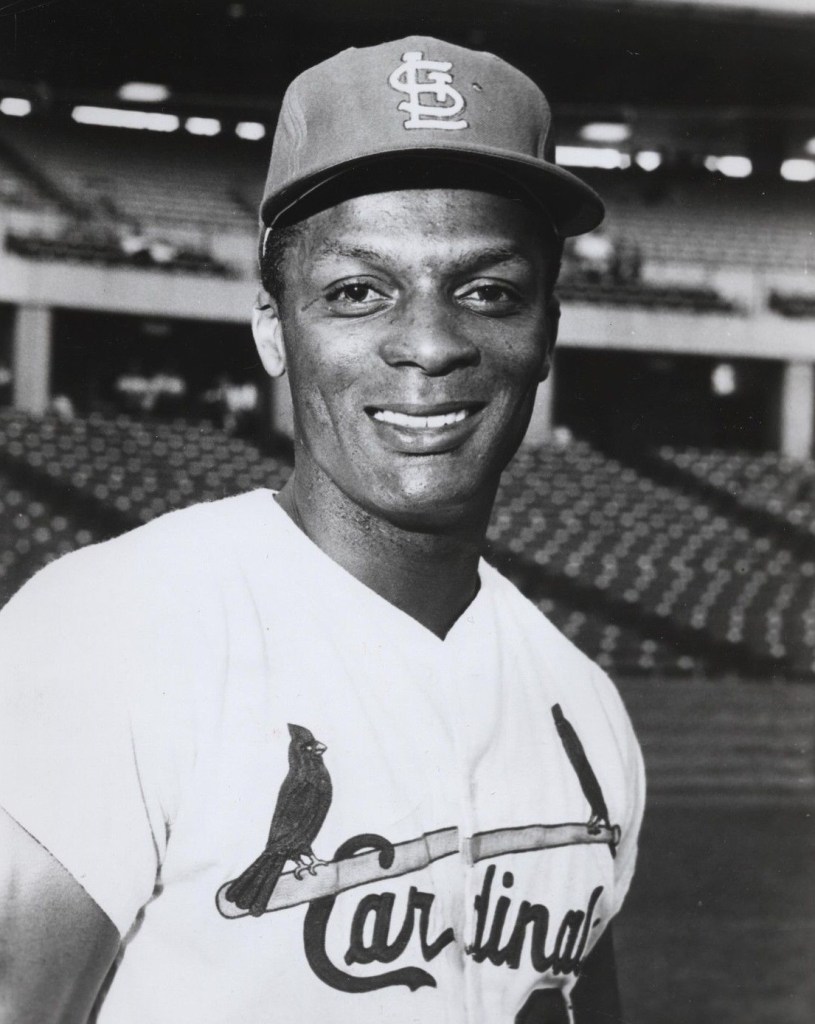
In the first inning of that game, Curt Flood would smack a double off pitcher Larry Jaster thus recording the first-ever hit in a Major League Baseball regular-season game played in Canada. The Expos would go on to win the game 8-7, but Flood would accomplish a feat that will never happen again.Flood might not be in the Hall of Fame, but he is definitely a player worth remembering.
Sources:
Acocella, Nick “Flood of Free Agency”, Special to ESPN.com retrieved May 22nd, 2025
Collier, Charles “Curt Flood Had the Courage to do the Right Thing”, The Madison Times, March 2nd 2024
Evens, Clifford “1962 interview with Curt Flood” retrieved from Classic Baseball Broadcasts
Sloop, Terry “Curt Flood” SABR, retrieved May 23rd, 2025
Spatz, Lyle “The Best and Worst St. Louis Cardinals Trades” The National Pastime, Volume 25, 2005
Swinton, Elizabeth, “This Day in Sports History: First MLB Game Played Outside U.S. in Montreal” SI.com, April 14th, 2020
“Curt Flood, Baseball Player, and Union Activist born”. African American Registry. Retrieved May 25th, 2025
“Players hope Flood returns”. Free Lance-Star. (Fredericksburg, Virginia). Associated Press. April 28, 1971. p. 8.
“Maverick Flood dies of cancer”. Spokesman-Review. (Spokane, Washington). wire services. January 21, 1997. p. C1.
Flood v Kunh https://supreme.justia.com/cases/federal/us/407/258/
 Weekly Windup