Smoky in a Pinch

posted May 6th, 2025 by jake
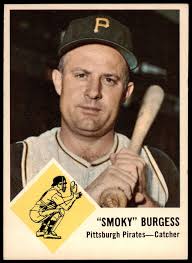
Smoky Burgess,1963 Fleer #55

I believe that everyone has an interesting story, and I love reading about people. People in history, music, Hollywood, writers, inventors, but I also love the randomness of finding someone I have never heard of before and learning their stories. In baseball, for every Mickey Mantle, there is a Don Demeter. Which is an awesome name if I’m honest. Aside from interesting stories, I also get pulled in by names, especially when I’m researching players for…yep you guessed it, my Immaculate Grids! So, imagine the level of my interest meter when I saw the name Smoky Burgess. Then I saw this picture and I was hooked. He did not look like a prototypical baseball All Star.

Smoky Burgess, 1967 Topps #506

Like many of the players with cool names, Smoky was not his given name. Forrest “Smoky” Burgess was born in 1927 in North Carolina. His father was a semi-professional player, and Smoky followed in his father’s footsteps. Smoky was a solid left-handed hitting catcher (he threw righty), and played well in high school. He was noticed by scouts and in 1943 the St. Louis Cardinals tried to sign him at the age of 16, but he was considered too young and had to wait until a year later before he was grabbed by the Chicago Cubs.

1944 was a great year for Smoky. After signing with the Cubs, he bought himself a shiny new Mercury and would meet the woman of his dreams, Margaret, who would eventually become his wife.

At 17, he had a great season for the Lockport Cubs, hitting .325 in 1944. He would only play 12 games in 1945 before joining the Army. He would remain enlisted through the rest of the 1945 season and almost all of 1946. Smoky would return with a bit of extra weight and a serious injury to his throwing arm, the result of a jeep accident while in the Army in Germany.

Upon his return, Smoky would continue his hard-hitting ways, though he had to be moved from catcher to outfield due to the injury. He would win the batting title in 1947 for the Fayetteville Cubs, batting .387 with a 1.008 OPS including 11 home runs and 28 doubles. In 1948 it was more of the same for the Nashville Volunteers as he would once again win the batting title, this time hitting .386 was an OPS of 1.082 and 22 home runs, 102 RBIs and 38 doubles. He was promptly promoted. He was also moved back to catcher as his arm began to improve.

Smoky was 22 years old when he made his major league debut on April 19, 1949, for the Chicago Cubs. He would only play in 46 games and didn’t play well. He was sent back to the minors where he would stay for all of 1950. After hitting .325 for the Springfield Cubs he found himself back in Wrigley for the 1951 season.

It wasn’t a great start for Smoky as he hit only .251 in 94 games with 2 home runs and .632 OPS. After the season, he was traded to Cincinnati, where he played exactly 0 games before being traded again, this time to the Philadelphia Phillies.

With the Phillies, Smoky started to blossom. His aggressive approach at the plate lead to his first (1954) of 9 All Star selections and he routinely hit for average. His All Star season was his best to date. He hit .368 with 127 hits and only 11 strikeouts with an OBP of .432. Unfortunately, he only had 392 plate appearances, disqualifying him for the 1954 batting title.

In 1955 after only 7 games, he was traded to the Cincinnati Redlegs (as they were called from ’53 to ‘58). He was once again an All Star, hitting .306 in 421 at bats, with 20 home runs. On July 29th he went 4-6 with 3 home runs and 9 RBI’s helping the Redlegs beat the Pirates. His best game in the majors! In 1956, he was the catcher for a 10-inning no-hitter against the Milwaukee Braves. Three pitchers combined to hold the Braves hitless through 10 innings, but the Redlegs lost in the 11th inning.

He was a good teammate in the locker room and had a solid reputation off the field as well. He was known to be a good family man, attended church regularly and avoided vices like tobacco and alcohol. If there was one weakness, it was probably his defense.

He struggled defensively since his Army injury. His defensive contribution was rated -96 by Total Baseball, he was an easy catcher to steal against and “he routinely ranked among the league leaders in passed balls, stolen bases allowed, and errors by a catcher.” Sturgill, Andy. “Sweet ’60: The 1960 Pittsburgh Pirates” (SABR, 2013. pg 45)

Still, he was known to be a real pain to batters at the plate. According to Bill James, “Some catchers like to chatter at the hitters to see if they can mess them up while they’re trying to hit. Smoky was the world’s champion. He used to drive Richie Ashburn nuts. He’d say, ‘Get ready, Rich; it’s a fastball.’ Ashburn would pop up or something, so Burgess would say ‘You didn’t do too well on the fastball, Richie; let’s try a curve.’ Of course, Ashburn never could believe him and couldn’t ignore him. One time he asked the umpire, ‘Isn’t there some rule that will make that guy shut up?'” (The New Bill James Historical Baseball Abstract. Free Press Publishing. 13 June 2003. Pg 392)

He would remain with the Redlegs through the 1958 season before being traded to the Pirates where he would become an All Star in his first three seasons with Pittsburgh. In ’59 he hit .297 and once again found himself on the receiving end of a no hitter.

On May 26th 1959, pitcher Harvey Haddox, who happened to be traded with Smoky from the Redlegs earlier in the year, pitched a perfect game through 13 innings against the Milwaukee Braves. The same team as the last no-hitter Burgess was a part of in 1956. Like that game, this one also ended in a loss. After 13 perfect innings, in which Haddox would retire 36 straight batters, a throwing error by the Pirate’s third baseman landed a player on first. The Braves Eddie Mathews would then hit a sacrifice, moving the runner to second. With his perfect game tanked, Haddix still had a no hitter going, so when “Hammerin’ Hank” Aaron came up to bat the obvious move was an intentional walk to face Joe Adcock, who was sitting at 0-4 for the day. Adcock would nail the ball to deep right center for a game winning double. This made Burgess the catcher for two no hitters that both ended in losses in extra innings to the Milwaukee Braves. That’s crazy right!?

1960 was an awesome year for the Pirates and for Smoky. He played solid defense, posting the top fielding percentage among NL catchers. He also hit well, with a .294 average in 337 at-bats, and he was a key contributor to the Pirates World Series run making the All Star game for the 2nd year in a row.

For Smoky, it was his first time in the playoffs, and he went 6-18 for a .333 average and had a key hit in the seventh game of the World Series against the Yankees. The Pirates would eventually win the title on a ninth inning home run in game seven by Bill Mazeroski. This was the only time a World Series was won on a game winning home run in the 9th inning of game seven and is one of the most iconic World Series wins in history. It was the Pirates first title in 35 years and their third overall. It was also the one and only World Series ring for Smoky Burgess.

Smoky would remain with the Pirates through most of the 1964 season. During ’64, he would play 68 games, but only fielded in 44, the rest of the time pinch hitting. In September of ’64 he was released and picked up on waivers by the Chicago White Sox. He would spend the rest of his career with Chicago and would become one of the premier pinch hitters in baseball. This was prior to the DH position which may have been great for Burgess. Smoky currently ranks fourth all time with 145 pinch hits with 16 pinch home runs.

Smoky would retire at the age of 40 on October 1st, 1967.

For his career, he was selected to the All-Star game nine times and was the first catcher in baseball history to be selected from three different teams (the Phillies 1954, Redlegs 1955, Pirates in 1959, 1960, 1961, and 1964). Later joined by two other outstanding catchers; Lance Parrish (a personal favorite of mine) and Paul La Duca.  He also won that World Series ring in 1960. He had a career batting average of .295 (nice for a catcher/pinch hitter), 126 home runs, 673 RBI’s and a .362 OBP along with 230 doubles.

He would go on to run a car dealership in North Carolina and spend time with his family. Smoky eventually became a scout and minor league batting coach with the Braves, helping players like Dale Murphy hone their skills.

Smoky Burgess passed away at the age of 64 in 1991.

“Everything went well, I have no regrets. I don’t know a thing I would have changed. If I hadn’t played baseball, I would have probably had to work in the cotton mills. That’s real hard work. I’m certainly glad I had baseball.”-Smoky Burgess (Sturgill, Andy pg 50)
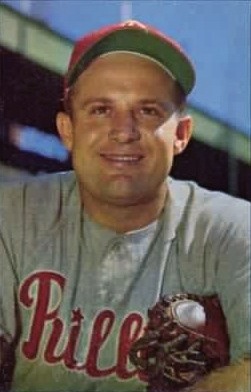
Smoky Burgess, 1953, Public Domain

Sources

https://www.baseball-almanac.com

https://www.baseball-reference.com

Grosshandler, Stanley, “Unsung Heroes: No-Hit Catchers”, 1979 Baseball Research Journal

Hurte, Bob “Sweet ’60: The 1960 Pittsburgh Pirates” (SABR, 2013), e-book pg 340-352

James, Bill. “The New Bill James Historical Baseball Abstract “Free Press Publishing. 13 June 2003. E-book Page 392

https://sabr.org

Schatz, Michael ballparksavvy.com February 2025

Sturgill, Andy “Sweet ’60: The 1960 Pittsburgh Pirates” (SABR, 2013), e-book pg 41-50
https://en.wikipedia.org/wiki/Smoky_Burgess

“Moyer” Age is Just a Number

Posted April 26th, 2025 by Jake

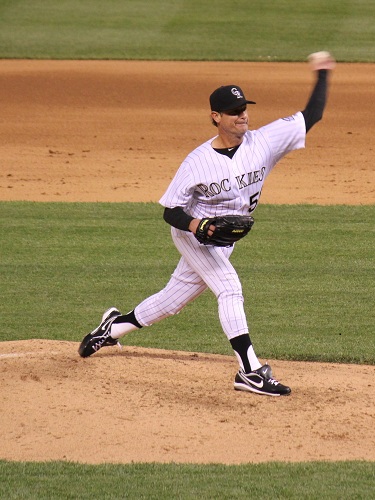
Jamie Moyer pitching for the Colorado Rockies during a game against the Atlanta Braves on May 5, 2012.
By MrMcPhoto – Own work, CC BY-SA 3.0

This is my second entry in the Age is Just a Number series featuring a pitcher who defied the critics and his own struggles to break a number of records and have a pretty awesome career.

Jamie Moyer played Major League baseball for 25 years, on eight different teams, including a stint with my Red Sox in 1996. I remember opening packs of cards, looking for players like Griffey Jr, Frank Thomas, of course Cal Ripken, who I just loved, and always Red Sox players. In fact, that might be the only time I would have given Moyer a second look. Sure, I remember his cards, in fact I probably have a bunch in my common’s boxes from my junk wax openings. He’s got plenty of cards out there, hell he played in four decades!

Moyer was no superstar. He was the opposite of Nolan Ryan, throwing an assortment of pitches, relying on control and mixing things up, rather than speed. Moyer was never the first name that came to mind when thinking of the greatest pitchers in baseball. He was an All Star only once in 2003 with the Seattle Mariners and, in 2018, he failed to meet the 5% threshold to remain on the Hall of Fame ballot, receiving only 10 votes. Still, there’s something to be said for longevity, especially for a pitcher, and that Moyer had in spades. He was also an honorable family man and cared deeply for his community.

Moyer was born in 1962. He was a natural sports star, playing baseball, basketball and golf in High school, where he pitched 3 consecutive no-hitters, going 10-0 in his junior year. He was a record breaker in college for the Saint Joseph’s Hawks. He holds the season records for most wins (16) for ERA (1.99) and for strikeouts (90). He is a member of his Alma Mata’s Hall of Fame and had his number retired at Saint Joseph’s in 2018.

He started his Major League career with the Cubs in 1986 and won his first game against Steve Carlton and the Phillies, which was of huge significance because Moyer grew up in Pennsylvania as a Phillies fan and Carlton was a boyhood hero. He didn’t have a great rookie season though, with a horrible 5.05 ERA and a 7-4 record.

Moyer didn’t fare much better in his sophomore season finishing with a 5.10 ERA and a losing record of 12-15 in 33 starts. He pitched 201 innings with 147 strikeouts and led the league in earned runs with 114.

By 1988, Moyer started to put things together…a little. Although his record would be 9-15, he had a much-improved ERA at 3.48. Still, he had done little to gain the Cubs confidence and in December he was traded along with Rafael Palmeiro and Drew Hall to the Texas Rangers for 6 players.

In 1989 Moyer had only 15 starts due to a lat strain and was a terrible 4-9 with a 4.70 ERA. In 1990 he mostly played out of the bull pen and again had a pretty poor performance at 2-6 with a 4.66 ERA and a measly 58 strikeouts in 102 innings. After the season he was unceremoniously released by Texas and this was the start of a few poor showings for Moyer who joined the Cardinals in 1991 for one season, but was sent to the minors after a poor start to the season and subsequently released. He was picked back up by the Cubs in 1992, now 29 years old, but didn’t make the team out of spring training. He was released again and played in Detroit’s minor league system.

By 1993, Moyer had been released by four teams and was 30 years old when the Baltimore Orioles signed him. According to The Sporting News, “Jamie Moyer, 30, has had significant major league experience with the Cubs, Rangers, and Cardinals, but he is fighting to keep his career alive.” He did just that, finishing the season for Baltimore with a winning record (12-9) and a 3.43 ERA in 25 games. He also pitched three complete games, including his first shutout in three years.

1994 was shortened by the strike and Moyer had a 5-7 record and 4.77 ERA in 23 starts. By 1995 he was back in the bullpen and working to earn another role in the starting rotation. He would go 8-6 with a 5.21 ERA and was again released. Now over 30, Moyer was struggling to find a home after 9 tumultuous seasons in the Majors.

1996 would see Moyer join the Boston Red Sox, but they struggled to find a place for him, shifting the embattled pitcher between the bullpen and rotation. He was not happy in Boston, and they traded him to the Seattle Mariners. He started 11 games and went 6–2 with a 3.31 ERA. Moyer’s record of 13–3 between Boston and Seattle led the majors in winning percentage at .813. It seemed that Moyer was finally figuring things out, and he would continue to have his best years with Seattle, where he played for the next 11 seasons.

From 1996 to 2006, he would be one of the better pitchers in the league. Over his 11 seasons with the Mariners, he would compile a franchise leading 2,093 innings pitched, 323 starts, and 188 quality starts, and his 1,239 strikeouts are the third most for the Seattle franchise. He would have 145 wins, second most in Seattle history. Moyer was the Mariners Opening Day starting pitcher in 2000, 2004-2006. He also got his one and only All-Star selection in 2003 when he went 21-7 with a 3.27 ERA. By 2006 he was the oldest active Major League player at 43 years old.

During the 2006 season, Moyer was on the decline and considered retirement, but Seattle offered to trade Moyer to his childhood team, the Phillies, and he was off to the City of Brotherly Love. He would become the oldest pitcher in Philadelphia franchise history to win a game and would finish 5–2 with a 4.03 ERA. This earned him a 2-year contract at 44 years old.

In August of 2007 Moyer struck out his 2,000th batter. He had a winning record that year at 14-12 but had a 5.01 ERA. He is said to have had the slowest fastball of all NL starters, averaging 81.1 miles per hour. The Phillies were good in 2007, they won the division, but failed to win a playoff game.

2008 was a great year for Moyer, who at 45, was the oldest active player in the MLB. He also set a couple of other oldest player records. He would get a hit in a game against the Padres in April, becoming the oldest Phillie ever to get a hit. After beating the Rockies in May, he secured his 235th career win, and for his career, a win against every Major League team. 2008 continued to provide Moyer was some amazing moments.

He earned his 16th win of the year and became the second-oldest pitcher to win 16. Moyer also became the second-oldest pitcher to ever start a postseason game at the age of 45 years 321 days. Jack Quinn started for the Philadelphia Athletics in 1929 at 46 years 103 days.

Moyer became the oldest pitcher at 45 years 329 days to pitch in a National League Championship Series game, starting in Game 3. With all he had accomplished, I think most importantly for Moyer was winning his first World Series ring when the Phillies defeated the Rays. After 23 Major League seasons, he finally had a ring, and the best part; it was with his childhood team. The last time the Phillies had won the World Series was 1980 when Moyer was still in High School.  It was only the second time Philly had won, and Moyer was overjoyed.

Aside from the World Series win and all the oldest pitcher records, Moyer had a decent season. He would finish 16-7 with a 3.71 ERA. Good enough for Philly to give him another 2-year contract.

In 2009 Moyer struggled out of the gate, and the Phillies sent him to the bull pen. Manager Charlie Manuel said, “Jamie was a total professional and team player when we let him know of the decision to move him to the bullpen. He has been, and will continue to be, a very important part of this team.” (Miller, 2009). This showed just how important Moyer was to the team and the type of player and person he was. By the end of 2009, Moyer pulled three muscles, the wear and tear becoming apparent, and would miss the rest of the season and playoffs. He would finish 2009 with a 12-10 record and a 4.94 ERA.

Moyer was entering his age 47 season in 2010, and he would again break the age barrier, becoming the sixth-oldest pitcher to appear in a game and the eighth major league pitcher to start a game in four different decades. He was also, along with Omar Vizquel, the only other player left who played in the 1980’s. Moyer became the oldest player in Major League Baseball history (47 years, 170 days) to pitch a shutout on May 7, 2010, against the Braves. This was a momentous moment for Moyer as he was the only MLB pitcher to throw a shutout in four different decades (1980s, 1990s, 2000s, and 2010s). Sadly, his season was cut short due to a sprain in his ulnar collateral ligament, ending his season.

At the end of 2010 Moyer had Tommy John Surgery, causing him to miss all of 2011. His contract with Philly would end, and there was speculation that he would retire. He was, after all, 48 years old and coming off major surgery and an entire missed season. Still, in 2012 at 49 years old, the Rockies would give the old veteran a chance.

In 2012, Moyer would become the oldest pitcher to record a win as well as the oldest player to record RBI (remember there was a time when pitchers still hit). By 2012, Moyer had pitched in 50 Major League stadiums, the most of any pitcher since 1900. Unfortunately, he was released in June after going 2-5 with a 5.70 ERA.

He would sign a couple of minor league contracts with the Orioles and then the Blue Jays but was released by both.

In 2013 Jamie Moyer would retire from Major League Baseball at the age of 50.

Moyer didn’t have a Hall of Fame career, but he was a determined pitcher who never gave up on his dreams. His longevity earned him several interesting records and a World Series ring with his childhood team. He would finish his career with a 49.8 WAR, 269 wins to 209 losses, 2,441 strikeouts in 4,074 innings and a 4.25 ERA.

He was a great member of his communities, wherever he played. Moyer won both the Branch Rickey and Roberto Clemente awards for community service and is also an advocate for children, starting The Moyer Foundation to help children deal with their grief over the loss of a loved one. Moyer was always considered a strong teammate and a resilient person who loves baseball and his community. He’s also an inspiration to those who agree that age is just a number.

Sources:

Baseball-Reference.com

Bush, Federick SABR.org

Miller, Doug (August 11, 2009).”Pedro to make ’09 debut Wednesday”. Major League Baseball. Retrieved April 23rd, 2025.

Peebles, Laura “April 17, 2012: Jamie Moyer sets record as oldest winning pitcher as Rockies beat Padres, 5-3.” SABR.org

“Moyer proves that some things get better with age,” The Sporting News, October 1, 2001, vol :58.

Wikipedia Page