

7
Welcome back to Baseball by the Numbers. Today we are looking at uniform number 7. Uniform number 7 had 752 players who wore it during their career. There was one Legend (career WAR over 100) and thirty-two players with a career WAR over 40. 107 players wore uniform number 7 for five years or more. That is a lot to choose from!
Overall, the uniform number 7 list was much easier than I anticipated. The Legend was obvious and the other seven players all matched the criteria (5 yrs + worn and career 40+ WAR). There were two very good players who wore number 7 but only for a shorter duration.
Barry Bonds, who had a career WAR of 162.8, good for 4th all-time, wore number 7 during his rookie season with the Pirates. Eddie Mathews (career WAR of 96) also wore number 7, but only for two seasons with the Tigers at the end of his career. Both will make it onto later posts.
I wanted to add a little factoid about number 7. The reason I chose to feature seven players as part of my criteria was due to my love of number 7. 7 or 77 has always been the number of my players in games like MLB The Show and Madden, and I use it as part of my username in many computer games. I have always liked the number and felt it to be lucky. Most people have lucky numbers, and 7 or 17 or 77 is the one for me. I will literally go out of my way to park in a spot with a 7 or use a locker with a 7! I don’t know how this came to be, but it has always been like this since as long as I can remember. With that said, none of the players who wore uniform number 7 were exactly my favorite. In fact, two of my absolute favorite baseball players wore uniform number 8, so I’m really looking forward to that post. Still, there were quite a few on this list who played during my initial card collecting years, which is always great, and of course there is this Legend.
The Legend:

If ever a player fits the legend spot, “the Mick” is it, especially to the New York Yankees fans. Mickey Mantle played mainly outfield for eighteen seasons from 1951 to 1968. He played his entire career under the big city lights of New York City. He was a legend of the Big Apple. He wore uniform number 7 his entire eighteen-year career (he wore 6 for a few months as a rookie), and his career WAR of 110.3 ranks 21st in MLB history.
Iconic. That is the word that best describes this Mantle 1952 Topps card. It wouldn’t be a stretch to say that the 1952 Topps are the most popular cards in existence. And the Mantle is the Holy Grail. In 2022, a grade 9.5 of this card sold for a record 12.6 million dollars. 1952 Topps was the foundation on which modern trading cards was built. It’s a beautiful set, filled with stars and nostalgia. In 1952, Mantle was already becoming a superstar in only his sophomore season. He batted .311, led the league in OPS (.924), hit 23 home runs and had 87 RBIs and made his first All-Star game while placing 3rd in MVP voting.
Mantle would be an All-Star twenty times (this includes twice from 59-62). He was the American League MVP on three separate occasions, including 1956 when he led the league in season WAR (11.3), runs (132), batting average (.353), home runs (52) and RBIs (130) winning the elusive Triple Crown. (Spoiler! Another player in this very post is also a Triple Crown recipient!) He also led the league in SLG, OPS and Total Bases.
Mantle led the league in season WAR during six seasons, led in runs five seasons, home runs four times, walks five times and triples, batting average and RBIs one season each. He also had the highest OBP on three occasions, the highest SLG four times and the highest OPS six different times. He also won a Gold Glove in 1962.
Mantle was a member of 7 World Series Championships (51-53,56,58,61 and 62) with the Yankees, playing alongside other Yankees legends like Yogi Berra, Joe DiMaggio, Whitey Ford, Johnny Mize, Enos Slaughter and manager Casey Stengel. He holds World Series records in home runs (18), runs (42), and RBIs (40).
Mantle retired in 1969 with a career .298 batting average including 2415 hits and 344 doubles. He is 18th all-time with 536 home runs and has 1509 RBIs, he’s 8th all-time in walks with 1733, 19th in OBP (.420), 22nd in SLG (.557) and 14th in OPS (.977).
Mantle was inducted into the National Baseball Hall of Fame in 1974.
His number 7 was retired by the Yankees in 1969.
Mantle passed away at the age of 63 in 1995.
Number 1:
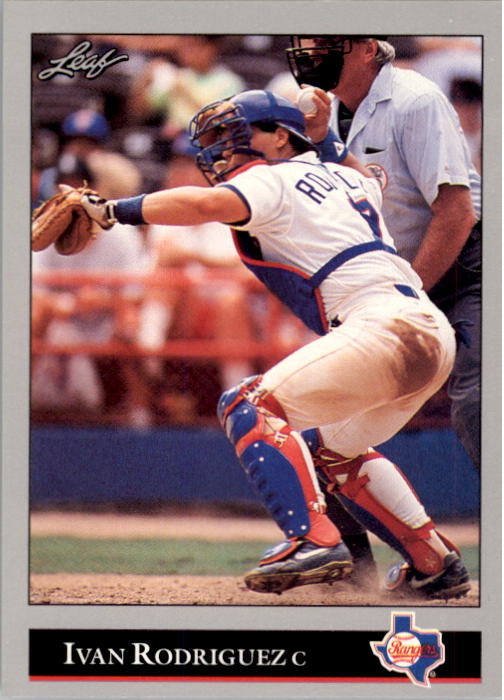
Iván Rodríguez was a catcher for twenty-one seasons from 1991 to 2011. He played for the Texas Rangers until 2002 (and again in 2009), then moved around the league, playing for the Florida Marlins, Detroit Tigers, New York Yankees, Houston Astros and the Washington Nationals. He wore uniform number 7 for nineteen years and had a career WAR of 68.7.
1992 Leaf is a set that I remember well. When I was collecting cards, Leaf packs weren’t readily available, but if you went to a show or a card shop you could usually get a pack or two. I liked these cards, and I chose this Rodríguez card because I wanted to showcase him in his full catchers’ gear, showing off that defensive prowess that made him so great. Plus, if you look closely, you can see his uniform number on the back. In ’92 “Pudge” got his first All-Star nod and his first Gold Glove starting his career off strong, a precursor the great catcher he would become.
“Pudge” was a fourteen-time All-Star. He was the American League MVP in 1999 when he batted .332 with 199 hits, 35 home runs, 113 RBIs and 25 stolen bases, while winning a Gold Glove. Rodríguez won thirteen Gold Gloves during his career and seven Silver Slugger Awards. He hit .300 or better ten times.
In 2003 he won a World Series Championship with the Florida Marlins and was the MVP of the NLCS when he batted .321 with 2 home runs and 10 RBI.
He would retire in 2012 signing a one-day contract with the Texas Rangers.
He is first in history with 2427 defensive games played at catcher and had a 46% caught stealing percentage and .991 fielding percentage.
On the offensive end, he has a career batting average of .296 while leading all catchers in hits (2,844), runs (1,354), and doubles (572) to go along with 311 career home runs, 1,332 RBIs and 127 stolen bases. There are only six players in history to have a career .290 or batter batting average, with 2,500 or more hits, over 550 doubles, over 300 home runs and over 1,300 RBI’s, Babe Ruth, Hank Aaron, Stan Musial, Barry Bonds, George Brett, and Iván “Pudge” Rodríguez.
He is a member of the Texas Rangers Hall of Fame, and his uniform number 7 was retired by the Rangers in 2017.
He was inducted into Cooperstown in 2017.
Number 2:
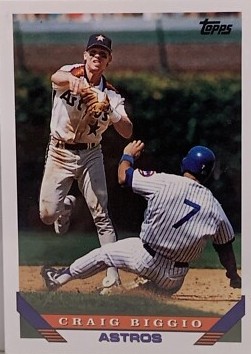
From 1988 to 2007, Craig Biggio played catcher, second base and outfield for twenty seasons exclusively with the Houston Astros. Aside from his first season and half, he wore uniform number 7 for the rest of his career, nineteen seasons. He had a career WAR of 65.5
Along with his teammates Jeff Bagwell, Lance Berkman and Roy Oswalt, I loved collecting Biggio cards and have a bunch. Highlighting these late ‘80s and early ‘90s players is such a joy for me!
1993 was a down season in the middle of some of Biggio’s most productive years, but I had to use this card. Not only is it a great action shot of Biggio fielding the ball, but it also features another player, Joe Girardi, sliding into second as Biggio tags the base and throws to first. Girardi, a fellow catcher, wore uniform number 7 for seven seasons, and it is shown on this card. While Girardi didn’t make the list (his career WAR was only 5.6) it was evidence that a lot of catchers wore the number (like Rodríguez above, and Biggio). I also thought it was cool to have a photo of two players with the same uniform number interacting, and wonder if this photo was taken on purpose or is it just a crazy synchronicity. Anyone know?
Biggio was a seven-time All-Star with five Silver Slugger awards. He was also a great defender and won the Gold Glove Award four times. Along with Jeff Bagwell and Lance Berkman, he was a member of the Astros “Killer Bees” from 1994 to 2003 when the Astros made it to six postseasons. In 2007, he joined the 3000 hits club, becoming the first player in Astros’ history to do so. He would retire at the end of that season.
Biggio is the only player in the history of baseball with 3,000 hits, 600 doubles, 400 stolen bases, and 250 home runs. He finished his career with a .281 batting average, 3,060 hits (26th all-time), 668 doubles (6th all-time), 291 home runs, 1,175 RBIs and 414 stolen bases.
His uniform number 7 was retired by the Astros in 2008, and he is a member of the Astros Hall of Fame.
He was elected to the National Baseball Hall of Fame in 2015 alongside three great pitchers, John Smoltz, Randy Johnson and one of my favorite all-time players, Pedro Martinez.
Number 3:

Joe Medwick played left field for twenty years from 1932 to 1948 with four teams. He started off with the St. Louis Cardinals for his first eight and a half seasons but was traded to the Brooklyn Dodgers in 1940. He played for the Dodgers 4 seasons, then played for the New York Giants, Boston Braves, back to Brooklyn, and finished his final two seasons back with St. Louis.
I got to use another Diamond Stars card! This 1935 Medwick card has his nickname “Ducky” on the front. He was also sometimes called “Muscles”. I love it! This is another beautiful Diamond Stars card. The vibrant colors look great and the photo of Medwick swinging the bat in his Cardinals uniform is perfect. I love the background with the players behind him. Medwick was an All-Star in 1935, he led the league in Total Bases with 365, and batted .353 with 224 hits, 46 doubles, 23 home runs, 126 RBIs and was 5th in MVP voting. And this wasn’t even his best season.
Medwick was a ten-time All-Star who had over 200 hits four times and had 190 and 198 hits in two more seasons. He also hit over .300 fourteen times. He led the league in WAR once, runs once, hits twice, doubles three times, triples once, home runs once and RBIs three times.
In 1937 he won the Triple Crown and was the National League MVP when he batted .374 with 31 home runs and 154 RBIs, while also leading the league with an 8.5 season WAR, 237 hits, 56 doubles and in SLG (.641), OPS (1.056) and Total Bases (406).
He was a member of the 1934 World Series Champion St. Louis Cardinals, the team known as the “Gashouse Gang”, who were managed by Hall of Famer, Frankie Frisch (who also played), and featured Dizzy Dean, Dazzy Vance, Leo Durocher, and Jessie Haines.
He retired after the 1948 seasons with a career batting average of .324 (50th all-time), 2,473 hits, 540 doubles, 113 triples, 205 home runs and 1,383 RBIs. He also hit .326 in his 12 World Series games.
He is in the St. Louis Cardinals Hall of Fame.
Medwick was elected to the National Baseball Hall of Fame in 1968.
Joe Medwick passed away at the age of 63 in 1975.
Number 4:

Kenny Lofton was an outfielder for seventeen seasons and played on eleven teams, including the Cleveland Indians who he played for on three different occasions. He played from 1991 to 2007, right in the middle of some of my biggest collecting years. I remember him being a fun player to watch. He wore uniform number 7 thirteen seasons and had a career WAR of 68.4.
This 2008 Topps would be Lofton’s final Topps during his career. He left baseball in 2007 after one final season with Cleveland. I chose this card for two reasons: it shows his number and he’s with Cleveland. While switching teams often, he spent ten years at different points with Cleveland, most of his career. In 2008 he was no longer playing after becoming a free agent after the 2007 season.
Loften was an All-Star six times and won four Gold Gloves. He led the AL in stolen bases five years in a row from ’92 to ’96. He was fast, having over 30 stolen bases in nine seasons with six of those seasons over 50 stolen bases. Known to provide a spark for playoff bound teams, Lofton played in 95 postseason games.
He has a career .299 batting average with 2,428 hits, 383 doubles, 116 triples and 130 home runs. His 622 stolen bases is 15th in history. He’s tied for 5th for most postseason triples and is first in postseason stolen bases with 34.
He is a member of the Cleveland Guardians Hall of Fame.
Number 5:
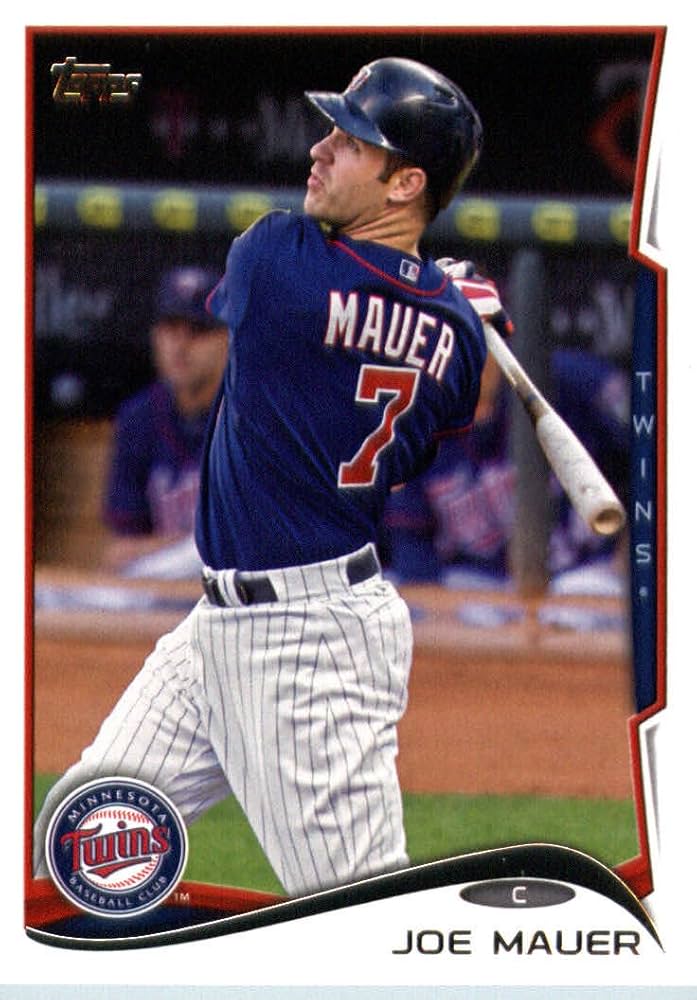
For fifteen seasons Joe Mauer was behind the plate in Minnesota. He played exclusively for the Twins from 2004 to 2018. He wore uniform number 7 his entire career and had a career WAR of 55.6.
This 2014 Topps Joe Mauer not only showcases his beautiful swing but has the uniform number in the photo. 2014 Topps is not my favorite set, but it’s a nice-looking card overall. I do like the team logo on the front and the black trim, which is nice, and I really like the photo. Mauer didn’t have a great season in 2014, but this card makes up for it.
The first overall draft pick in 2001, Mauer was a six-time All-Star who earned 3 Gold Glove Awards and 5 Silver Slugger awards. He was the American League MVP in 2009 when he batted .365 and led the league in OBP (.444), SLG (.587), OPS (1.031), and had 191 hits, 30 doubles, 28 home runs and won a Gold Glove. He led the league in batting two other seasons (2006 and 2008). His three league leading batting titles are a record for catchers, and his 2009 .365 average and .444 OBP are the highest for any catcher in history in a single season. He batted over .300 in eight different seasons.
Mauer left baseball in 2018 with a career .306 batting average, 2,123 hits, 428 doubles and 143 home runs. He had a career .995 fielding percentage at catcher.
He’s a member of the Twins Hall of Fame and his number 7 was retired in 2019.
He was elected to the Baseball Hall of Fame in the class of 2024. Only three other players who were picked first in the draft are in the Hall of Fame, Ken Griffey Jr., Chipper Jones and Harold Baines.
Number 6:
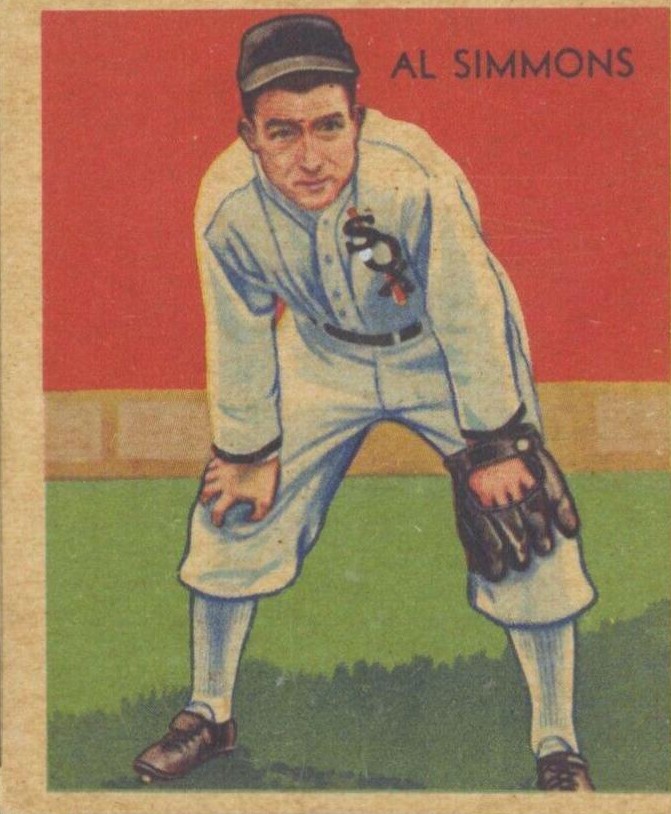
Al Simmons played twenty seasons in the Majors as an outfielder from 1924 to 1944 for nine separate teams. “Bucketfoot Al” played his first nine seasons with the Philadelphia Athletics, he then played for the Chicago White Sox, Detroit Tigers, Washington Senators, Boston Bees, Cincinnati Reds, Philly again, the Boston Red Sox and finished with Philly for one more season. Playing a half dozen seasons before uniform numbers were widely used, he wore uniform number 7 for five seasons with the Athletics (2 seasons), White Sox (2 Seasons) and the Senators (one season). His career WAR is 68.5. His nickname, “Bucketfoot” is an old baseball term for a flawed batting stance, one that Simmons used to great success.
As you have all figured out by now, I love to use these old Diamond Stars cards. This 1934 Al Simmons is great. The card is another nice-looking vintage photo, and Simmons is on the White Sox, where he wore the number 7 for two of his five seasons worn. 1934 was an All-Star season for Simmons. He batted .344 with a .403 OBP and .530 slugging. He had 102 runs, 192 hits, 36 doubles, 18 home runs, and 104 RBIs.
Simmons started his career prior to the All-Star game and from 1924 to 1932 he was in the top 5 for MVP voting 6 times. Once the All-Star game started, he made it to the roster 3 times. He batted over .300 fourteen times, leading the league twice in 1930 and 1931 when he batted .381 and .390. He also had 200 or more hits six times, leading the league with 253 in 1925. He drove in 100 or more RBIs in twelve seasons, including the 157 in 1929.
Simmons was a member of two World Series Championship teams with the Connie Mack led Philadelphia Athletics in 1929 and 1930. Both teams won over 100 games each season and featured Hall of Famers Mickey Cochrane, Jimmie Foxx, Lefty Grove and Eddie Collins.
He would finish his career with The Athletics in 1944 with a career batting average of .334 (27th all time), 2,927 hits, 539 doubles, 149 triples, 307 home runs and 1,828 RBIs (21st all-time). He was also spectacular in the World Series having batted .329 with 6 home runs, 17 RBIs and a .658 SLG in 19 games.
Simmons is a member of the Athletics Hall of Fame.
He was elected to Cooperstown in 1953.
He would pass away a few years later at the young age of 54 in 1956.
Number 7:

From 1966 to 1982 Reggie Smith played seventeen seasons in the Majors, primarily in the outfield. He was a switch-hitter, who played on 4 different teams throughout his career. Starting with the Boston Red Sox where he played for eight seasons, he would move to the St. Louis Cardinals for two and a half, the Los Angeles Dodgers for five and a half and finish with the San Francisco Giants for one last season. He wore uniform number 7 for ten seasons and had a career WAR of 64.6.
I love when I get to feature players from the Boston Red Sox, it’s always nice to learn about my favorite team. Smith played before I was into baseball and collecting, but this 1975 Topps card is awesome. Although I would have liked to showcase a card when Smith was with Boston, this one had his uniform number in the photo. I do like the 1975 Topps design, with the cool color blending border. In 1975 Smith was an All-Star. He batted .302 with 144 hits, 19 home runs and 76 RBIs.
Smith was a seven-time All-Star who hit .300 or better seven times and over 20 home runs eight times. He won a Gold Glove Award in 1968 and was a member of the World Series Champion 1981 Dodgers who were managed by the great Tommy Lasorda.
He left the Majors in 1982 and went on to play in Japan for the Yomiuri Giants in 1982 and 1983.
He ended his career with .287 batting average, 2,020 hits, 363 doubles, 314 home runs, 1,092 RBIs and a career .978 fielding percentage.
He would later go on to coach for the Dodgers and Team USA.
Smith is a member of the Boston Red Sox Hall of Fame.
Final Score:
There were a few players left off who deserve a mention for uniform number 7. Hall of Famers Hank Greenberg, Gabby Hartnet, Tony Lazzeri, Heinie Manush and Red Schoendienst all wore uniform number 7 one season. 8x Gold Glove winner Mark Belanger wore it for sixteen seasons, Mets legend Jose Reyes wore it for his entire sixteen-year career, and All-Star J.D. Drew wore it for thirteen years.
This was a fun number, with a lot of interesting players to choose from, but I’m really looking forward to the next post. Even though the number 7 is my favorite number, when it comes to baseball uniform numbers 8 was worn by two of my all-time favorite players. One while collecting and growing up, the other is a family legend. I hope you will check out the next post!
Box Score:
Legend Mickey Mantle: 18 yrs worn | Career WAR 110.3 | Number retired by Yankees (69) | 20x All-Star | 3x AL MVP | Triple Crown (56) | Gold Glove | World Series Champ (51-53, 56, 58, 61 and 62) | HOF (74)
Iván Rodríguez: 19 yrs worn |Career WAR 68.7 | Number Retired Rangers (2017) | 14x All-Star | AL MVP (99) | 7x Silver Slugger | 13x Gold Glove | World Series Champ (2003) | HOF (2017)
Craig Biggio: 19 yrs worn | Career WAR 65.5 |Number Retired Astros (2008) | 7x All-Star | 4x Gold Glove | 5x Silver Slugger | HOF (2015)
Joe Medwick: 9 yrs worn | Career WAR 54.4 | 10x All-Star | NL MVP (37) | Triple Crown (37) | World Series Champion (34) | HOF (68)
Kenny Lofton: 13 yrs worn | Career WAR 68.4 | 6x All-Star | 4x Gold Glove | 5x AL stolen base leader
Joe Mauer: 15 yrs worn | Career WAR 55.6 | Number Retired Twins (2019) | 6x All-Star | 3x Gold Glove | 5x Silver Slugger | AL MVP (2009) | HOF (2024)
Al Simmons: 5 yrs worn | Career WAR 68.5 | 3x All-Star | World Series Champion (29, 30) | HOF (53)
Reggie Smith: 10 yrs worn | Career WAR 64.6 | 7x All-Star | 1x Gold Glove | World Series Champion (81)
Sources:
https://www.baseball-almanac.com/
https://www.baseball-reference.com/
Shout out to all the cool cards and creative commons for my pictures! Thanks Topps and Upper Deck and Fleer and Donruss and all the rest!


 Weekly Windup