
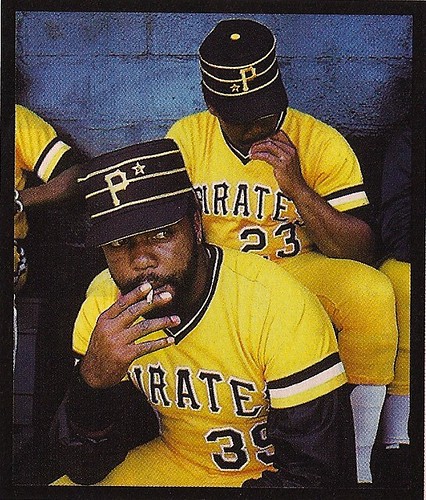
Does a power hitter who had 339 homers in his career deserve the ultimate owner that can be bestowed upon a player? On first glance, you might say no. But what if that former player, who happens to be 1978 National League Most Valuable Player Dave Parker, was also a seven time All-Star, three time Gold Glove winner and a guy who won two batting titles?
True, 339 homers isn’t a ton for a guy like Parker, but that said, he wasn’t the most prodigious power hitter in his prime. He didn’t have as much power as a guy like Jim Rice, for example. But much like Rice, Parker was a feared hitter for over a decade. Parker got MVP votes in 1975 and in 1990 as well when he was an All-Star for the Milwaukee Brewers at 39 years old.
Parker is one of those rare hitters who could hit for average and power and had five straight seasons hitting at least .308 and during this period (1975-79), he also led the National League in slugging twice, so he wasn’t just hitting singles. Also in that five year peak, his 345 extra base hits trailed only Rice and Mike Schmidt. His 942 hits ranked sixth in all of baseball and his .321 average was second only to Rod Carew. He also had 72 outfield assists during these five years which was the most of anyone.
He had nearly 3,000 hits (2,712) and is 35th all time in intentional walks which shows how feared he was as a hitter. There are 26 right fielders in the Hall of Fame. Parker would rank 15th out of that group in hits — ahead of, for example, Vladimir Guerrero (2,590). He’d rank 10th in extra-base hits, 11th in homers and 13th in RBIs. Among all Hall of Famers, Parker would rank just outside the top 50 in hits (right behind Lou Gehrig), 44th in RBIs (right behind Guerrero) and 38th in extra-base hits (just ahead of Eddie Mathews and Ivan Rodriguez).
Parker struggled after that excellent five year run in the late 1970s. In his early 1980s years, he struggled with weight gain, injuries and off field issues. But he rebounded after he signed with his hometown Cincinnati Reds in 1983. At ages 34 and 35, he had back to back top five MVP finishes, and was the runner-up for the NL MVP in 1985 when he hit .312 with 34 homers, 198 hits, 42 doubles and a .365 OBP. He also led the NL in total bases that year.
The rub is that WAR does mean a lot, and Parker comes up short here. His career WAR of 40.1 and for Hall of Fame right fielders, the average is 71.5 and that is a big difference. For comparison, recent right-field inductees like Guerrero (59.4 WAR) and Tony Gwynn (69.2) easily exceed Parker. So do Parker’s outfield contemporaries who were elected, like Andre Dawson (64.8), Winfield (64.2) and Reggie Jackson (74.0). Then again, he’s higher than Harold Baines (38.7).
Parker had four seasons with a .900 OPS or higher, but only one of these seasons came after the 1970s. He had six seasons hitting .300 or better, and five seasons slugging .500 or better; only one of each came after the ’70s. Four of his five highest extra-base hit totals were in the ’70s, as were each of his four highest stolen base totals. So while Parker’s eventual Hall of Fame candidacy at the end of the 1970s was likely certain, for the rest of his career, he does not compare well to Jim Rice and compares a bit better to non-Hall of Famers like Dwight Evans and Dale Murphy who have had their struggles with getting Hall of Fame votes. Both Evans and Murphy had longer primes and post 1980, Evans actually had better numbers than Parker, especially with OBP (From 1980-1991, Evans .383, Parker .322).
Ultimately, while I am completely biased because Dave Parker is one of my favorite players, I can’t possibly see how The Cobra belongs in the Hall of Fame. Because outside of those fantastic 1970s numbers, he was below average in the early 1980s and then anywhere from average to occasionally excellent in the late 1980s and early 1990s, but nothing that exhibited Hall of Fame numbers.
Posted by JD
 Weekly Windup