Flick Finds Fame

Posted March 27, 2025 by jake

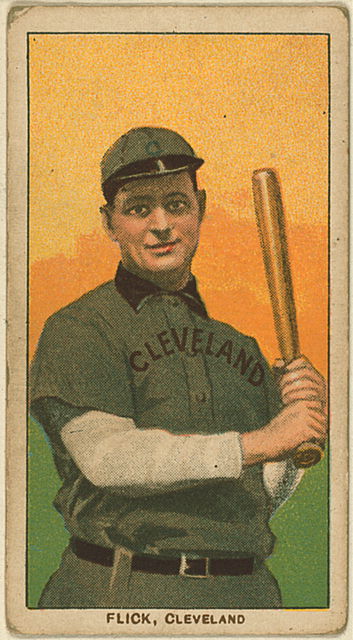
Elmer Flick, outfielder with the Cleveland Bronchos/Naps, image from the 1910 American Tobacco Company baseball card.

When I saw the name Elmer Flick the other day, I had to learn more, especially when I found out he was a Hall of Famer (Class of 1963). I personally could not remember hearing the name Flick in the past, but I quickly discovered an underrated and often forgotten old school star.

Flick was born in Bedford, Ohio in 1876, the son of a farmer and Civil War Veteran. In true 1800’s style, he joined a semi-pro team when he was 15 years old because the team was short a player and Flick happened to be hanging around the train station when they were leaving for a game. He played catcher in high school and was waving the local team on when they realized they needed the help. For a youngster, he did well, and not long after, Flick began to play minor league ball with the Youngstown Puddlers in 1896.

Using a baseball bat that he handmade (that is old school baseball gold), Flick hit over .400 but struggled in the outfield. Flick had always played catcher, so his .826 fielding percentage was no surprise; there would be an adjustment to the outfield. Luckily, he was a quick study, and his defense improved.

His hitting skills were never a question, and with the improved defense, he found himself playing left-field for the Dayton Old Soldiers. (I Love these team names!!) His fielding percentage increased to .921, and his offense was legendary. Flick batted .386 with 183 hits. This included 42 doubles, 10 home runs, an impressive 135 runs and even 25 stolen bases. He also led the league in triples with 20 and total bases with 295.

In 1898 he was signed to the Philadelphia Phillies as a reserve outfielder, but due to injuries, he quickly became a starter. It was a great rookie season for the young slugger as he finished with a .302 average including 16 doubles, 13 triples, 8 homeruns, and 81 RBI’s. He also stole 23 bases and only struck out 36 times in 453 at bats.

In 1900, still with the Phillies, he had an amazing season. In 545 at-bats, he had only 30 strikeouts, batting .367 (a career high) which included additional career highs in hits (200) home runs (11), slugging (.545), OPS (.986) and a league leading 110 RBIs. He also had 32 doubles, 16 triples and 35 stolen bases. His high batting average put him in a tense race for the batting title against super star Honus Wagner, who would end up winning the title at the end of the season. Wagner spoke of the race, “I’ve had a lot of thrills, but don’t think I was ever happier than in 1900 when I won after battling Elmer Flick to the last day of the season for the title.”  Lieb, Fred (January 27, 1971)

 Not only was he great at the plate, but he was becoming a solid outfielder with a .914 fielding percentage and 232 put-outs’ and 23 assists, often throwing out hitters at first. He was also a feisty player, one time getting into a fist fight with teammate and future Hall of Famer, Nap Lajoie, over a bat! Lajoie would end up breaking his thumb in the altercation, missing 5 weeks.

Apparently Flick and Lajoie buried the hatchet, and both left the Phillies in 1902 joining the American League Philadelphia Athletics. They only played 11 games with the Athletics before moving to the Cleveland Bronchos. This was due to a legal injunction obtained by the Philadelphia Phillies which prevented players under contract with their team from moving to other teams. This injunction was found to only be valid in Pennsylvania and couldn’t be enforced in Ohio. To avoid legal ramifications, Flick and Lajoie would travel together, ensuring never to step foot in Pennsylvania until 1903 when the two leagues made peace.

Born and raised in Ohio, Flick would stay with Cleveland, now called the Naps, for the remainder of his Major League career. He would continue to play well for Cleveland, leading the league in batting average (.308) , triples(18),  SLG (.432) and OPS (.845)  in 1905, leading in games (157), plate appearances (707) at bats (624), runs (98), triples (22) and stolen bases (39) in 1906 and again in triples (18) in 1907, his last full season.

By 1907, Flick had second thoughts about his baseball career. He was stressed from the constant playing and felt physically run down. He considered retiring but stayed on for the season. Flick was so highly regarded by the Naps that in spring training of 1907 they turned down a trade from the Detroit Tigers, who offered a straight up deal, Flick for future AL MVP and Hall of Famer Ty Cobb! Based on the rest of these two players’ careers, I’d guess that the Naps regretted turning that deal down.  

Although Flick had another productive year in 1907, even leading the league in triples again with 18, by 1908 his health had severely deteriorated. He was plagued with an unexplained gastrointestinal illness which caused him to miss almost the whole season, playing in only 9 games. He continued with the Naps in 1909 and 1910, but played in only 66 and 24 games respectively. He was replaced by a pre–Black Sox Scandal Shoeless Joe Jackson, and eventually sold to the Kansas City Blues, however the deal was canceled when Flick refused to go to Kansas City and, without a team, he would return to the minor leagues.

He played two more seasons for the Minor League Toledo Mud Hens in 1911 and 1912 before being released and retiring from baseball.

He would move back to his hometown of Bedford, Ohio and take up raising horses and real estate. He got married and had five children. He also did some scouting for Cleveland as well.

Flick seemed to live in relative obscurity until 1961 when Ty Cobb passed away. A few stories about Cobb mentioned the failed trade of Cobb for Flick in the 1907 season, and with some influence from Branch Rickey, Flick was inducted into the Hall of Fame by the Veteran’s Committee. Flick was 87 years old, and didn’t believe that he had been elected. He had to be convinced that it was real. Flick was the oldest living inductee, and at the ceremony he said, “This is a bigger day than I’ve ever had before. I’m not going to find the words to explain how I feel.” Corcoran, Dennis (2010)

Flick passed away at the age of 94 in 1971, one of only 4 19th century players who were still alive. Flick played 13 years in the Majors accumulating a 52.7 WAR with 1752 hits, 48 home runs, 756 rbis, 950 runs, 268 doubles, 164 triples and 330 stolen bases. His career batting average was .313 with a .389 career OBP.

Flick’s Hall of Fame induction was met with much criticism, but  anyone who can hit .400 with a homemade bat, get in a fist fight during a season and still almost beat Honus Wagner for the batting title, have his team refuse to trade him for Ty “freaking” Cobb, and then live to be 94 years old, is one tough ball player, and I, for one, am glad he was inducted and got to be around to not believe it. I’m glad Flick found fame.

Elmer Flick, outfielder with the Cleveland Naps (AL), before a game, circa 1910


Sources:

https://www.baseball-reference.com/players/f/flickel01.shtml

Corcoran, Dennis (2010). Induction Day at Cooperstown: A History of the Baseball Hall of Fame Ceremony. McFarland. pp. 78–80.

Lieb, Fred (January 27, 1971). “Rickey, Honus Remembered Flick”. St. Petersburg Times. Retrieved March 26, 2025.

Louisa, Angelo “Elmer Flick” via https://sabr.org/ Retrieved on March 26th, 2027

https://en.wikipedia.org/wiki/Elmer_Flick

Photos:

1: This media file is in the public domain in the United States.

2: This work is from the George Grantham Bain collection at the Library of Congress. According to the library, there are no known copyright restrictions on the use of this work.

The Priceless “Junk Wax”

March 18th, 2025 by jake

It’s funny the things that different people can find relaxing. Two years ago, I was scrolling around on social media and saw a video of this guy opening packs of baseball cards. These weren’t modern packs, with all their flashy, shiny parallels, in-card relics and on-card autographs…they were cards from the late 1980’s and early 1990’s, affectionately called “The Junk Wax” era. I loved every second of those videos, and down the rabbit hole I went, scrolling through video after video. I watched as someone’s disembodied fingers opened packs of mostly baseball cards with the occasional pack of basketball, football, movie cards and even Garbage Pail Kids, thrown in. Sometimes the crazier folks would even eat the 30 plus year old gum that is found in most old packs of Topps. I’ve tried it, it’s horrible!

There was something so soothing about watching a pack of instantly recognizable 1987 Topps being opened for the first time in 38 years. With its wood grain borders, team logos at the top and player names in the color filled box at the bottom, the memories came flooding in. Watching as players like Terry Pendleton, Doug Drabek, Ken Oberkfell, Candy Maldonado, and Storm Davis flashed by the screen. Then suddenly, a Future Stars card! “Could it be? Will Bo know 2025? Nope!” …It’s Tim Pyznarski, next card Atlee Hammaker. Then I catch a glimpse of the Red Sox logo peeking out and it’s… Wade Boggs! Sweet! I was hooked. Next thing I knew I was scouring EBAY for old packs of cards from the Junk Wax era to open myself.

The Junk Wax Era of baseball cards spans roughly from 1986 to 1994. It was a time of overproduction, inflated expectations, and eventual market collapse. The industry was booming, fueled by speculative investors hoping to cash in on future rarities and rookies. Though the average collector was unaware of this at that time, card manufacturers like Topps, Fleer, Donruss, Score, and Upper Deck flooded the market with millions (sometimes billion)of cards. The sheer volume meant that even rookie cards of legendary players like Ken Griffey Jr., Frank Thomas, and Chipper Jones were so overproduced that they never became the scarce, high-value collectibles investors had hoped for.

In the mid-’90s the bubble burst. As the supply outstripped the demand, card values plummeted, card stores closed, and investors lost small fortunes. Warehouses and garages filled with unopened packs and collectors found themselves sitting on mountains of once-hyped cards that were now worth little more than sentimental value. But, to me, sentimental value is where it’s at!

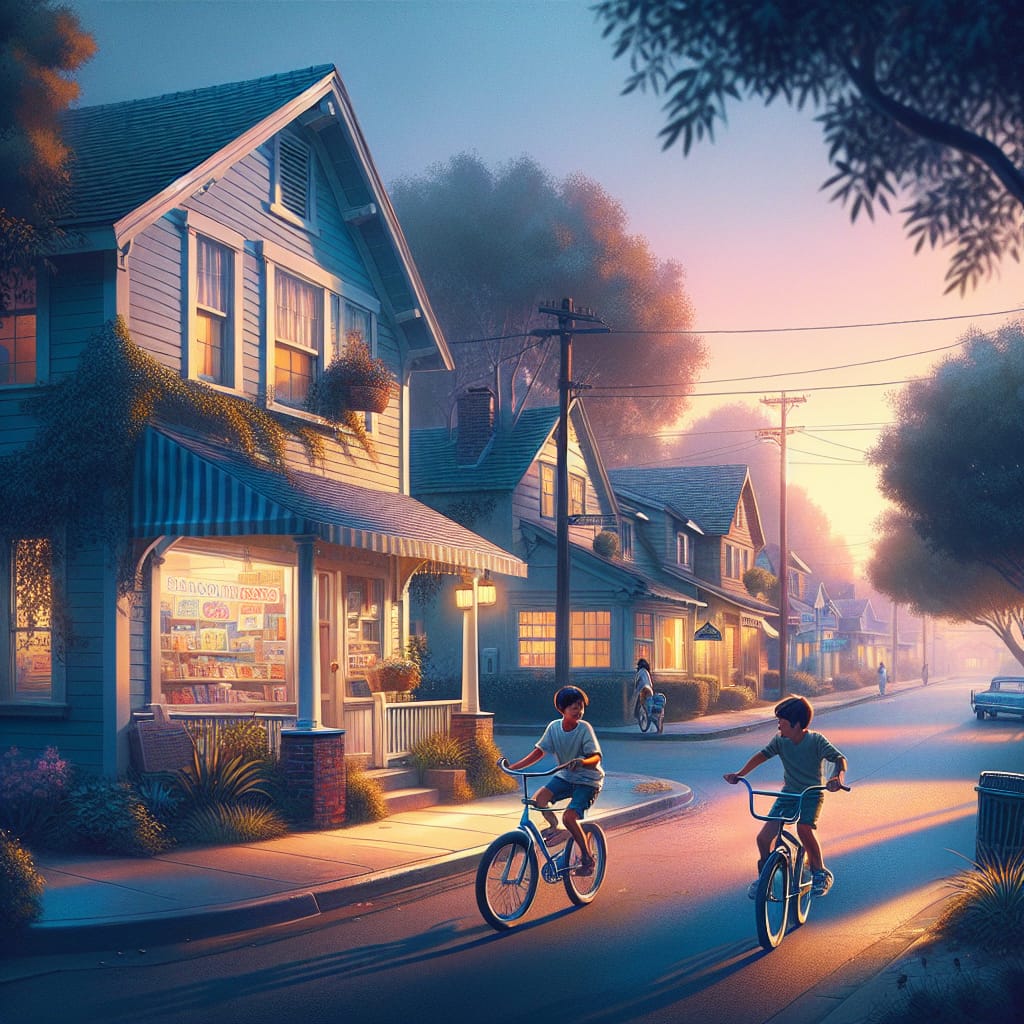
None of this mattered to an elementary and middle school kid who would readily take out the trash every night for a chance at making a buck, then excitedly ride his bike to the local convenience store with some friends to buy a couple of packs of the newest Topps. Yes, most packs were 50 cents back then, and yes you could find them in almost any convenience store.

Made with Dall-e by Jake

My friends and I would open these packs up with gusto while listening to DJ Jazzy Jeff and the Fresh Prince singing about Elm Street from the cassette player. After guzzling a Mountain Dew and finishing off some Doritos, it was time for talking trades. Mark McGwire for Cal Ripken Jr., Tony Gwynn for Darryl Strawberry. We were wheeling and dealing like Sandy Alderson and Dallas Green (GMs for the Oakland Athletics and Chicago Cubs respectively), at the 1987 Winter Meetings. We were not thinking about investments or rarity, about future returns. We were just kids having fun while we searched for our favorite players and teams. Though I was a Red Sox fan, I loved Cal Ripken, and collected around 500 of his cards. I still have them, my wife calls it stalkery.

As I got older, somewhere in High School, my attention shifted from cards to…other things. I still loved baseball, but things changed, and I stopped collecting. Most of my cards ended up being sold for gas money or traded for a joint, while my favorites, the ones I just couldn’t part with(like those Cal’s I mentioned earlier), sat in boxes and binders collecting dust in my mom’s basement as they faded into my subconscious. They found a home in that place where GI Joe is pitching curveballs to Ken Griffey Jr. while Harry meets The Hendersons and The Bangles Walk like Egyptians through my cerebral cortex.

It’s that place, the cerebral cortex, the long-term memory center, where the streetlights came on as I sat scrolling through those videos. Each pack elicited a new memory of days gone by. The sound of the wrappers being torn open, that sweet scent of paper and ink, the images of those silly, wood-grained borders, of those worthless pieces of cardboard with the pictures of childhood heroes looking up from the front as their yearly achievements lined the back. It was the nostalgia that made those videos so relaxing for me and led me to create my own videos and social media pages, and ultimately this blog.

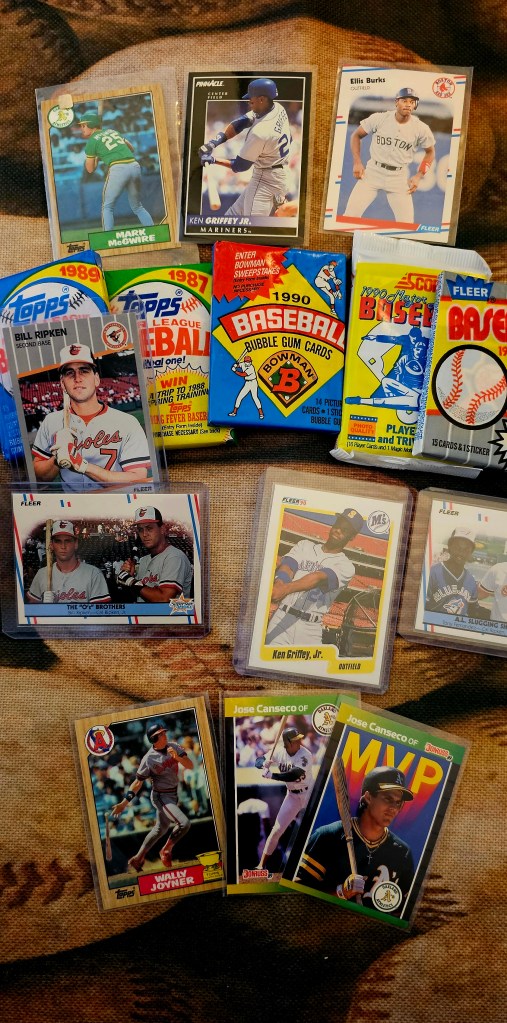
A lot of people watch and comment, mostly having fun, some to remind me of how worthless each pack I open is. Those latter people don’t understand that value is in the cerebral cortex of the beholder. I know these cards are worthless, but there is no value I can place on that time I opened a pack of 1989 Fleer, and there it was, the infamous Bill Ripken F%$# Face card in all its glory. It was awesome! As a kid I remembered drooling as I looked at that card in the display cases of long closed card shops, with no chance of buying it. I remember hoping that I would someday be so lucky as to open a pack and find it. I never did, but I also never imagined that Thirty-Five years later I would pull one! Here’s a link to the original post. Billy Ripken FF Pull.

After that I was hooked and rediscovered the fun of opening packs of cards from my youth. I know it’s not going to make me a millionaire, but that’s not the point. It’s the memories, the nostalgia. It’s finding that child-like joy once again, and that to me is why “Junk Wax” is priceless.

*If you’d like to take a walk down memory lane with me, I post videos to Facebook, Instagram, Tik-Tok and YouTube. All links are on the Home page menu of the blog. Thanks for reading!!!*

A Series of Firsts

March 13th, 2025 by Jake

Wheeler “Doc” Johnston

Welcome to another post directly inspired by the most recent Immaculate Grid. Today’s research was for players who played for both Cleveland and Cincinnati. This player only played 3 games with the Reds in 1909, but I love players with the name Doc, which reminds me of the Old West, sort of like baseball in the late 1800’s and early 1900’s, only with balls and gloves instead of pistols, though I’m sure I’ll find a story about some pistol carrying pitcher at some point. I digress, let’s get to the player, and why, even though he only has a career 3.2 WAR, I still felt there was a cool story to tell.

Doc Johnston was born September 9th, 1887, in Cleveland…Tennessee! (See already a twist!) His first name wasn’t really Doc. (Did you really think it would be?) But rather, his full name was Wheeler Roger Johnston. Doc to his teammates.

Doc started his career as a first baseman on the Reds in 1909, but played in only 3 games. He then spent most of his career with the Cleveland Naps (1912,1913,1914) and Cleveland Indians (1918,1919,1920). In the middle he was with the Pittsburgh Pirates (1915 and 16), where he had possibly his best season in 1915, with a 2.1 WAR. That season, he committed only 13 errors at first base in 1,514 chances for a fielding percentage of .991. He also hit 5 HR, had 12 triples, 19 Doubles and 26 Stolen Bases, though he was also caught stealing 17 times! But what I really want to look at is 1920, a historic season for Cleveland, ending with an interesting trip to the World Series for Doc.

The 1920 Cleveland Indians had a 98-56 record which brought them to the World Series and, ultimately, their first World Series Title after beating the Brooklyn Robins 5 games to 2. The fifth game of this series was historical in many ways. First, it featured an unassisted triple play by Second Baseman Bill Wambsganss, who leapt to catch a line drive, landed on second forcing the out there, then tagged the runner coming from first. Game 5 also featured the first ever grand slam in World Series history, a smoking shot in the first inning by Elmer Smith, giving the Indians a quick 4-0 lead. Finally, Jim Bagby, Cleveland’s starting pitcher and the winner of the game, helped himself with a 3-run home run in the fourth inning, the first by a pitcher in World Series history. Winning the World Series was bittersweet for the 1920 Cleveland Indians who had lost a teammate and a friend in Short Stop Ray Champman, who, on August 17, was hit by a pitch, becoming the only Major League player to die on the field.

Though not the best player on the team, Doc Johnston had a great season in 1920. His stellar defensive play was on display again as he committed only 12 errors in 1530 chances with a .992 fielding percentage. He batted .292 in 535 AB, with 2 HR, 71 RBI, 24 doubles, 10 Triples and 13 Stolen Bases, though he didn’t do much during the World Series with only 3 singles in 11 AB.

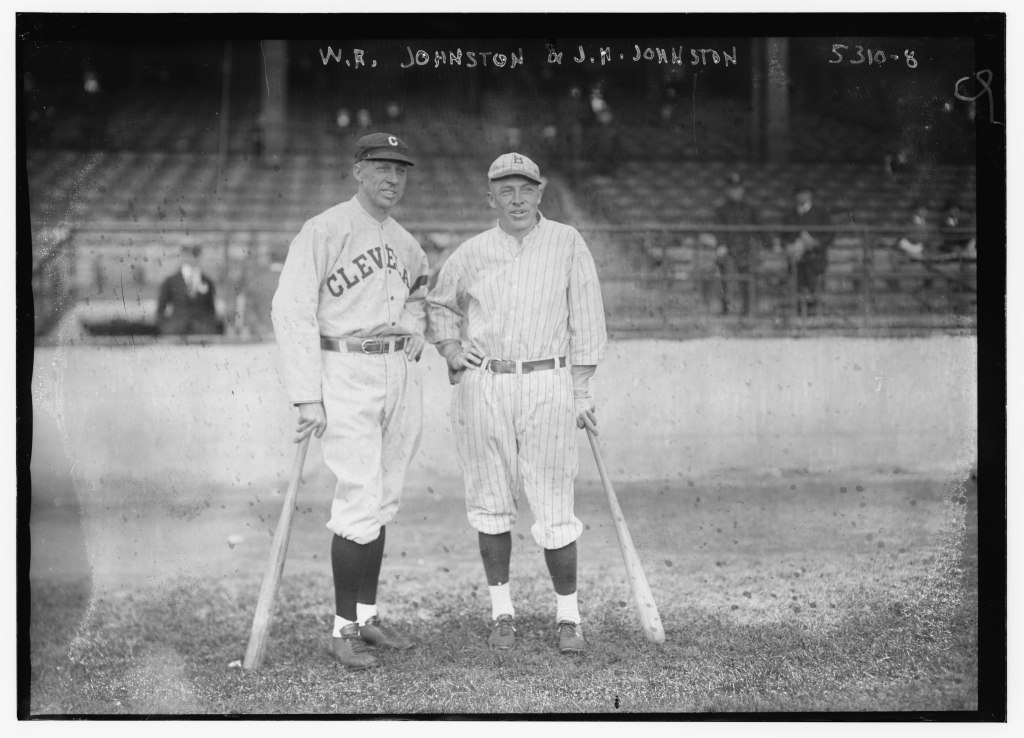
Still, the 1920 World Series was a notable one for Doc Johnston. Aside from getting a ring, there was a familiar face on the Brooklyn Robins, his younger brother Jimmy Johnston, who played third base. This was another first for the World Series; the first time two brothers would face each other in the big game. Jimmy was in the World Series twice, both with Brooklyn (1916 and 1920), and both losses, while older brother Doc got his ring.

Doc Johnston would go on to play two more seasons. In 1921, he would remain in Cleveland and play 118 games. In 1922, he would move on to the Philadelphia Athletics where he would play 71 more games before leaving the Majors. He finished his career with a 3.2 WAR hitting .263 in 3774 AB with 992 hits, 14 home runs, and 381 RBI’s. He was considered a terrific defensive player and would end his career with a .989 fielding percentage at first base. After leaving the Major Leagues, he would go on to manage a few years in the minors.

On February 17th, 1961, Wheeler “Doc” Johnston would pass away at the age of 73.

Below are brothers Wheeler “Doc” Roger Johnston and James “Jimmy” Harle Johnston 1920 World Series.

Photos:

1st: Library of Congress, Prints and Photographs Division, Washington, D.C. 20540 USA, hdl.loc.gov/loc.pnp/pp.print Public Domain

2nd: Bain News Service, publisher – Library of Congress Catalog: https://lccn.loc.gov/2014711589 Public Domain

A Phenomenal Nickname

Recently I started playing the Immaculate Grid (baseball only), a browser game in which you have 9 guesses to fill a 3×3 grid with MLB players from the start of baseball in the 1800’s to present.  Very rarely do I complete the whole grid successfully (although my baseball knowledge has increased a lot since playing), but it is so much fun. My friends and I share our results with each other and have great text conversations about our favorite guesses and failures, while also learning about our favorite sport. After I finish with my guesses, I love to research all the grid categories and in doing so I discover so many of the fun baseball stories and legends of old.  

Today’s grid had a category for a player who was on both the Dodgers and the Phillies. Keep in mind the grid goes back to the very beginnings of baseball, so Dodgers can be Los Angeles Dodgers (1958-present), Brooklyn Dodgers (1911-1957), Brooklyn Robins (1916-1931), Brooklyn Superbas (1899-1910), Brooklyn Grooms (1895-1898), Brooklyn (1884-1894), Brooklyn Bridegrooms (1889-1890) and Philly consists of Philadelphia Phillies (1886-present), Philadelphia Phils (1942) and Philadelphia (1883-1885). So, a freaking deep pool to say the least. When I did my research after playing, I found a player from the 1880’s whose name was so awesome I just had to learn more.

“Phenomenal” Smith was born in Philadelphia on December 12th, 1864. Unfortunately, Phenomenal wasn’t his given name. (That would have been so cool!)

He was born John Francis Gammon, which at some point became John Francis Smith and began his baseball career in 1883 at the young age of 18 as a pitcher in the minors. He didn’t play much in his first few seasons, with only 4 Major League games in 1884 and 4 more in 1885. He played quite a bit in the minors in 1885 and 1886, mostly with the Newark Little Giants.

Legend has it that Smith gained the nickname Phenomenal after pitching a no-hitter against Baltimore on October 3, 1885. The nickname clearly stuck as it is found on all the baseball cards and literature of the day. It is possible he loved the nickname because another legend tells of an arrogant young ball player who, in his very brief stint with the Major League Brooklyn Greys, claimed to be so good he didn’t need his teammates to win. (Talk about no team in I.)

On June 17th, 1885, this cocky comment led to his teammates reportedly committing 14 intentional errors to punish Smith and losing the game 18-5. This incident led to Phenomenal’s release after only one game with Brooklyn, and a trip back to the minor leagues. (This is why I love these old stories, as this is something that would never happen in today’s Major Leagues.)

In 1886 while with Newark, he was, well, phenomenal, pitching 292 innings with a .74 ERA and 317 strikeouts, while going 22-10. In 1887, he was back in the Major Leagues and started 55 games for Baltimore. In true old school fashion, he completed 54 of them for 491 innings but only had 209 strikeouts and a 3.79 ERA and was 25-30.

He would go on to play with Baltimore until 1888 when he was purchased by the Philadelphia Athletics for around $1000 dollars. He wouldn’t play much with them and was released in June 1889. In 1890 and 1891, he played a few games for the Philadelphia Phillies and the Pittsburgh Alleghenys, until his final game, June 15, 1891, with the Phillies. He was only 26. His final Major League statistics did not nearly justify his phenomenal nickname as he would finish his career 54-74, with a 3.89 ERA and 519 strikeouts in 1169.1 innings and a 7.7 War.

After he left major league baseball for good, Phenomenal would spend another 15 years as a player-manager in the minor leagues. He would play-manage over a dozen minor league teams, some of which were even named after him (The Norfolk Phenoms and The Portland Phenoms). While a player-manager with Norfolk, he has been credited with discovering and managing the future Hall of Famer, Christy Mathewson, then only 19. In 1890, after one season with Phenomenal as his manager, Mathewson would be sent to the major leagues and would go on to become one of the most dominant pitchers in baseball history.

Phenomenal Smith spent 5 more years in baseball as the player-manager of The Manchester New Hampshire Baseball Club. In 1901 at the age of 36 he would win the batting title in the New England league after hitting .363.

Phenomenal stayed in New Hampshire, becoming a police officer in 1904 and having many children. He retired from police work in 1932 and would live until the age of 87, passing away in Manchester in 1952.  

Posted by Jake

ARTICLE REFERENCES: