Baseball by the Numbers: 13

Read about the Project
Checklist

13

Welcome back to Baseball by the Numbers. Today we are looking at lucky uniform number 13. Only 367 players in history wore this number, which makes me think that superstitions may be at play. And it might be justified because only eight players with uniform number 13 have a career WAR over 40, and one of them, the legend, is filled with controversy. Due to this, I will be using a couple of players with under 40 career WAR for this post. Sixty-four players who wore number 13, wore it for five years or more. The legend is a player who is 16th in career WAR yet has never been voted into the Hall of Fame. The reason involved his positive test and subsequent admission to and suspension for the use of performance enhancing drugs (PEDs). I’m sure most of you can guess who it is.

The Legend

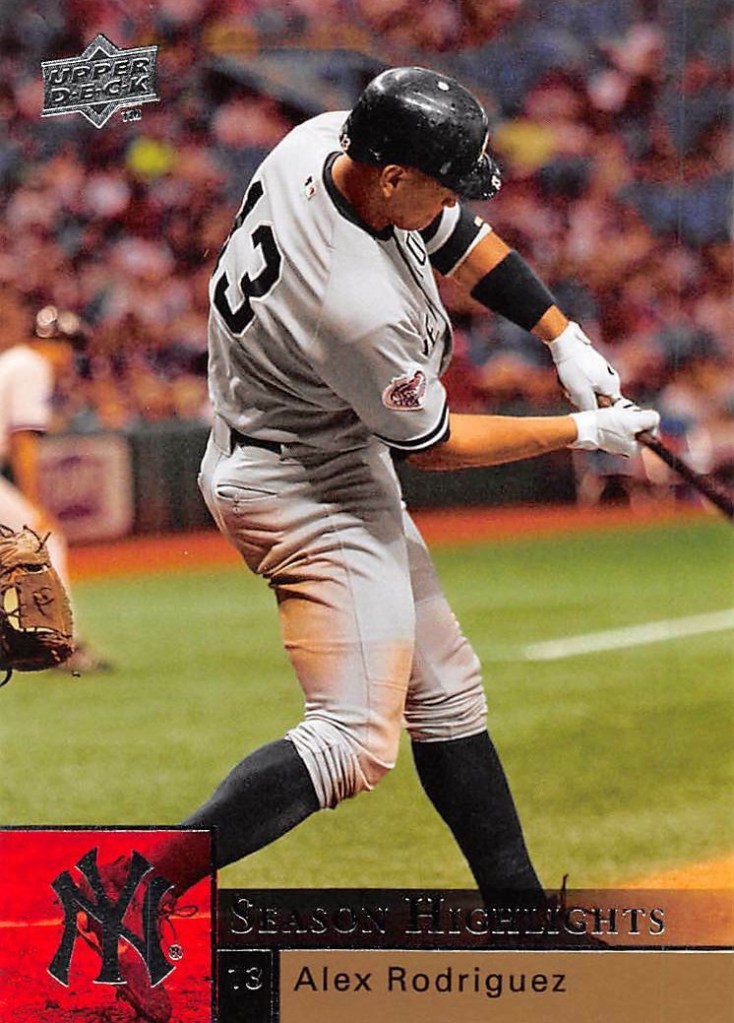
Alex Rodriguez, 2009 Upper Deck, #469

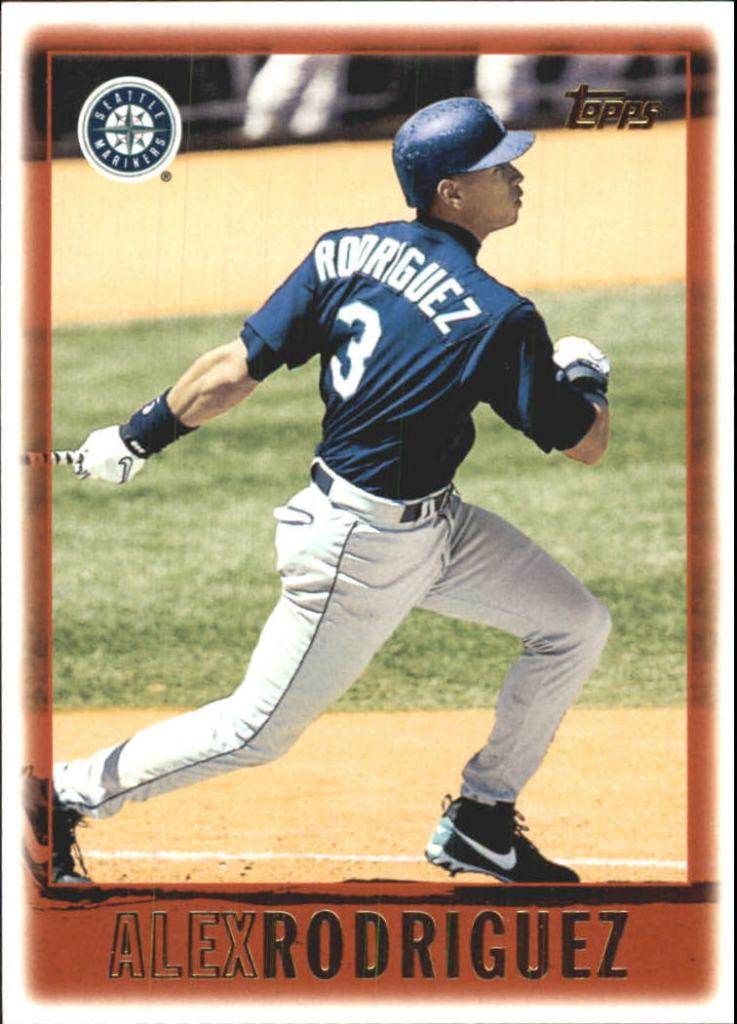
One of the greatest players of all time, Alex Rodriguez played shortstop and third base for twenty-two years. From 1994 to 2016, “A-Rod” played for the Seattle Mariners (1994 -2000), Texas Rangers (2001-2003) and the New York Yankees (2004-2013, 2015-2016). He missed 2014 due to a suspension from baseball. He is 16th all-time in career WAR with a 117.4 and he wore uniform number 13 for twelve seasons while with the Yankees. Rodriguez also wore number 3 the rest of his career and I mentioned him in that post, but left the legend spot to The Babe.

On September 3rd, 2008, Alex Rodriguez smashed his 549th home run. The two-run bomb came in the 9th inning off Tampa pitcher Troy Percival. Tampa manager Joe Maddon thought the ball went foul and contested it. For the first time in MLB history the umpires used instant replay, the home run was ruled fair, and the Yankees won the game 8-4. This 2009 Upper Deck Highlights card commemorates that event, and it has his number 13 showing so a win-win!

A-Rod was a 14-time All-Star with ten Silver Slugger Awards, two Gold Gloves and he won the American League Hank Aaron Award four times. He batted over .300 in nine seasons, leading the league in 1996 with a .358 average. He led the league in home runs 5 times, with over 40 home runs in five seasons and over 50 in three seasons. He was the American League MVP in 2003, 2005 and 2007. He is also a member of the 40-40 club when in 1998 he had 42 home runs and 46 stolen bases.  A-Rod was a member of the World Series Champion New York Yankees in 2009 along with star shortstop Derek Jeter, pitcher CC Sabathia and closer Mariano Rivera.  

A-Rod was suspended for the entire 2014 season due to his involvement in the Biogenesis scandal related to performance enhancing drugs. He would come back in 2015 as a DH for the Yankees, but in 2016 he would be regulated to pinch hitting and after 65 games, Rodriguez retired as a player.

Rodriguez’s overall stats are amazing, placing in the top 50 in many categories. He has a career batting average of .295 with 3,115 hits (24th all-time), 548 doubles (33rd) and is 5th all-time in home runs with 696. A-Rod is 8th in runs (2,021), 4th in RBIs (2,086), 29th in SLG (.550), 43rd in OPS (.930) and 7th in Total Bases (5,813). He also has a career OBP of .380 and 329 stolen bases.

Due to the controversies surrounding his suspension and use of PEDs, Rodriguez has not been voted for the Baseball Hall of Fame. His number is not retired either. He is currently 50, ans is a businessman and has been a baseball analyst and host for a number of networks.

 Number 1:

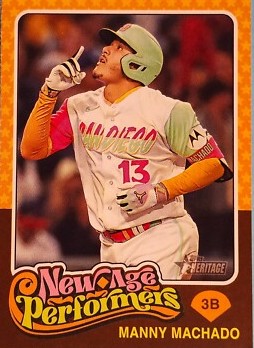
Manny Machado, 2024 Topps Heritage New Age Performers, #NAP-13

Another active player to make the list, Manny Machado is entering his 15th season in the Majors. He has played shortstop and third base since 2012. Machado started his career with the Baltimore Orioles until he was traded to the Dodgers during the 2018 season. Machado only stayed with the Dodgers for 66 games. He signed a 10-year, $300 million contract (the largest at the time) with the San Diego Padres in 2019 which would run through the 2028 season. He currently has a career WAR of 61.7 (9th best of all active players) and aside from that half season with the Dodgers (number 8), he has worn number 13 for fourteen years.

I thought this 2024 Topps Heritage card was a great one to use for the post. Machado is in the Padres cool City Connect uniform, with his number visible on the front. I think this is a nice-looking card with a vintage feel, cool photo and of course the number showing.

Machado has been selected for the All-Star team seven times in his career. He has 2 Gold Glove Awards, 1 Platinum Glove, and is a 3-time Silver Slugger. He has seven seasons with 30 or more home runs and nine with 30 or more doubles, leading the league once in doubles with 51. He is also a 2-time All-MLB First Team member.

Machado is currently 33 years old. He plays for the Padres and should remain with them through 2028. In 2025, he was an All-Star and batted .275 with 169 hits, 33 doubles, 27 home runs, 95 RBIs and 14 stolen bases.

Number 2:

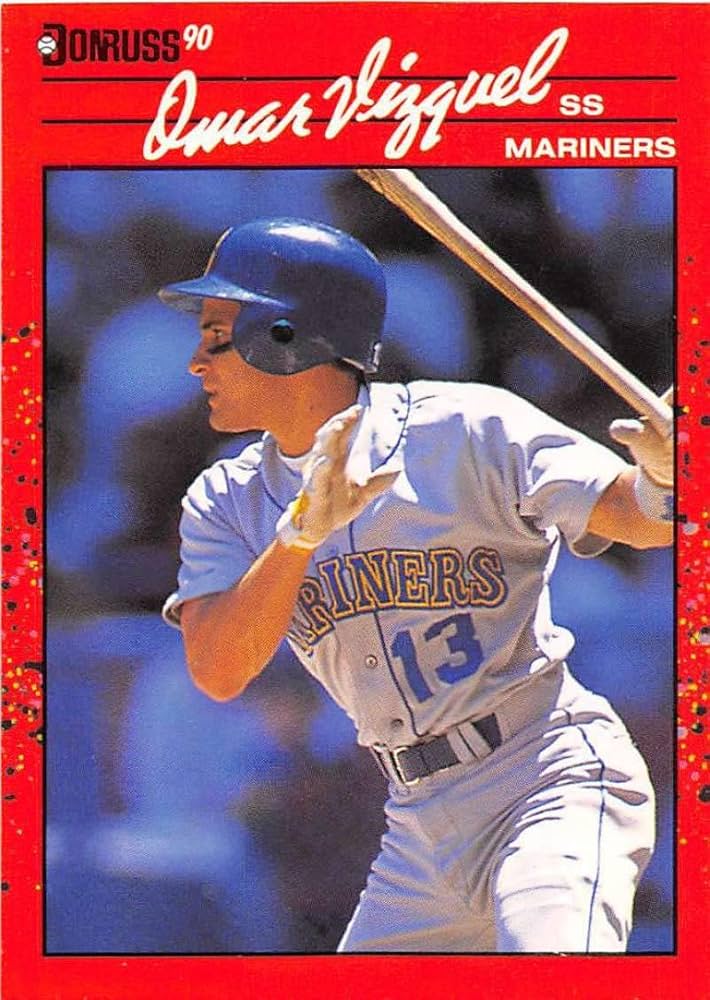
Omar Vizquel, 1990 Donruss, #483

Omar Vizquel played 24 seasons as a shortstop and third baseman from 1989-2012. He played for the Seattle Mariners (1989-1993), Cleveland (1994-2004), San Francisco Giants (2005-2008), Texas Rangers (2009), Chicago White Sox (2010-2011) and Toronto Blue Jays (2012). He had a career WAR of 45.6 and wore uniform number 13 for twenty-two seasons.

I’m always happy to use a card from my collecting days. 1990 Donruss never disappoints. It was such a popular set when I was a kid, mainly due to the poor quality control and the dozens of error cards that we all thought were going to be worth a fortune (spoiler: they weren’t). This card of Vizquel works perfectly. It’s a nice photo that shows his uniform number on the front.

Vizquel was a 3-time All-Star known more for his outstanding defense than his hitting. He was an 11-time Gold Glove Award winner and led the league’s shortstops in putouts once and fielding percentage six times. He went 95 games without an error between September 1999 to July of 2000, a record at the time. In 2000, he tied the record for lowest number of errors in a season at shortstop with 3.

Vizquel retired after the 2012 season. His career 2,877 hits are 44th all-time. He has a career .272 batting average with 456 doubles, 77 triples, 80 home runs, 1,445 runs, 951 RBIs and 404 stolen bases. He has the highest career fielding percentage of all shortstops in history at .9847. He also has the most double plays made at short and is fifth all-time in assists at all positions.

Vizquel is a member of the Cleveland Guardians Hall of Fame.  

Number 3:

Claude Passeau” by RebelNation1947 is licensed under cc by-sa 2.0.

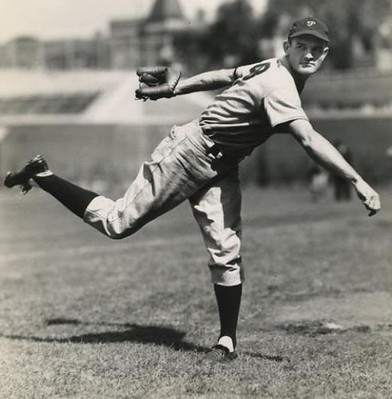
In the history of the World Series there have only been a handful of low hit games. One of those came in 1945 between the Chicago Cubs and the Detroit Tigers. In game three, Claude Passeau of the Cubs threw a complete game, one-hit gem against the Tigers. He got a nice win, but the Tigers eventually won the series 4 games to 3.

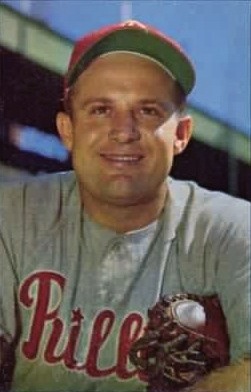
Claude Passeau had a short but productive thirteen-year career from 1935-1947. He was a right-handed pitcher who played for the Pittsburgh Pirates (1935), Philadelphia Phillies (1936-1939) and the Chicago Cubs (1939-1947). He wore uniform number 13 for ten seasons and had a career WAR of 45.1.

I couldn’t find many cards of Passeau, so I grabbed this photo off creative commons. It’s a nice action shot from 1936. In 1936, Passeau was with the Phillies and wore uniform number 48. He went 11-15 that season with a 3.48 ERA in 217 innings. He also had 8 complete games.

Passeau was a five-time All-Star who led the league in strikeouts in 1939 with 137. Like many pitchers at the time, he pitched a lot of innings, over 200 eleven times, leading the league with 292 in 1937. He also had 10 or more complete games ten times.

He would finish his career with a .519 w/l% going 162-150. He had a career ERA of 3.32 with 1,104 strikeouts in 2,719.2 innings.

Claude Passeau passed away in 2003 at the age of 94.

Number 4:

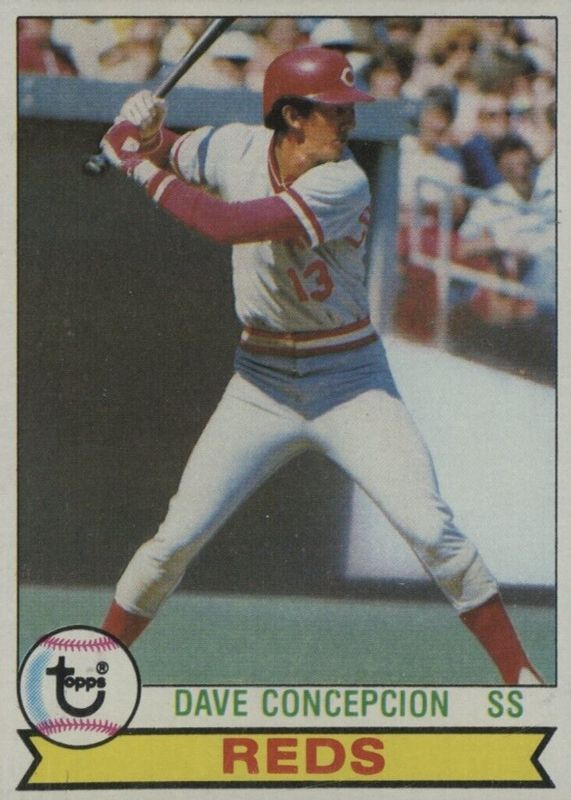
Dave Concepción, 1979 Topps, #450

A career Cincinnati Red, Dave Concepción played shortstop for nineteen seasons from 1970-1988. He and fellow shortstop Barry Larkin are tied for most seasons with the Reds. He wore uniform number 13 his entire career and has a career WAR of 40.1.

I love this 1979 Topps card. I like the set, and the design is great with the little Topps logo in the corner, and the team’s name in the banner under the photo. This is a beautiful photo of Concepción, and I love when the uniform number is on the front of the jersey.

Concepción was an All-Star in nine seasons winning the All-Star game MVP in 1982. He won five Gold Glove awards and two Silver Sluggers. He was a strong defender and led the league in assists twice, putouts once and fielding percentage once. He was a member of The Big Red Machine, a Reds team that won the World Series in 1975 and 1976. The team was managed by the great Sparky Anderson and featured Pete Rose, Joe Morgan, Tony Perez, George Foster, Ken Griffey Sr. and Johnny Bench.   

He retired at age 40 after the 1988 season with a .267 career batting average, 993 runs, 2,323 hits, 389 doubles, 48 triples, 101 home runs, 950 RBIs and 321 stolen bases.

Concepción is a member of the Reds Hall of Fame, and his uniform number 13 was retired by Cincinnati in 2007. He is also a member of the Venezuelan Hall of Fame.

Number 5:

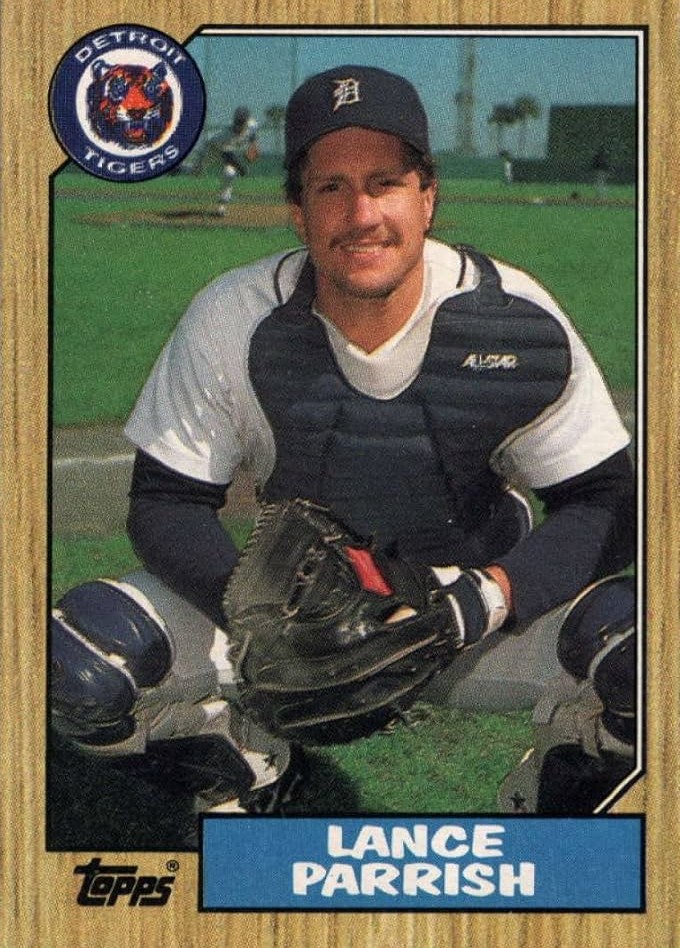
Lance Parrish, 1987 Topps, #791

One of my favorite players growing up, Lance Parrish played catcher for nineteen seasons from 1977-1995. He played for the Detroit Tigers from 1977-1986, which is when I started collecting his cards. I loved the Tigers in the mid 80’s and Parrish, along with “Sweet Lou” Whitaker, were my favorites on the team. Parrish also played for the Philadelphia Phillies (1987-1988), he was traded to the California Angels in 1988 and stayed with them until 1992. He then bounced around a lot playing for the Seattle Mariners (1992), Cleveland Indians (1993), Pittsburgh Pirates (1994) and Toronto Blue Jays (1995). He wore uniform number 13 eighteen seasons and had a career WAR of 39.5.

I just loved this 1987 Topps photo of Parrish. As you all know I’m a huge 1987 Topps fan, it was my first full set of cards as a kid and holds such a strong place in my nostalgic filled heart. This card is so awesome. Parrish is decked out in his full catcher’s gear, the cool Tigers logo is in the top corner (I love the team logo on the front of the cards!), and his name is in the blue box at the bottom of that familiar wood border. 

Parrish was nicknamed “Big Wheel”. Fantastic Nickname! He was a strong defensive catcher who could also hit the ball. He made the All-Star team eight times, won six Silver Slugger awards and was a three-time Gold Glove winner. He led the league’s catchers in double plays three times, assists once, caught stealing twice and caught stealing percentage twice. On the offensive end, he had six seasons of 20 plus home runs and had 114 RBIs in 1983. He was a member of the Detroit Tigers 1984 World Series Championship. The team was managed by Sparky Anderson (who I mentioned earlier with Dave Concepción) and included Kirk Gibson, Alan Trammell, Chet Lemon, Lou Whitaker, Darrell Evans and pitcher Jack Morris.

After bouncing around a bit his last few seasons, Parrish played his final game in 1995. He had a career .252 batting average with 1,782 hits, 305 doubles, 324 home runs, 1,070 RBIs and a .991 lifetime fielding percentage.

Now 69 years old, Parrish has been involved in coaching and managing and is a special assistant in the Tigers organization.

Number 6:

Carl Crawford, 2008 Upper Deck, #784

“The Perfect Storm”, Carl Crawford played leftfield for fifteen years from 2002 to 2016, most notably with the Tampa Bay Rays (2002-2010). He also played with the Boston Red Sox (2011-2012) and the Los Angeles Dodgers (2013-2016). He had a career WAR of 39.2 and wore uniform number 13 for ten seasons.

Crawford was a speedy player. The four-time All-Star led the league in stolen bases and triples four times each. He had over 40 stolen bases in seven seasons, eclipsing 50 four times and had 60 stolen bases in 2009. He batted over .300 in six seasons and won both a Gold Glove and a Silver Slugger award in 2010.

He finished his career with a lifetime .290 batting average, 1,931 hits, 989 runs, 309 doubles, 123 tiples, 136 home runs, 766 RBIs and is 43rd all-time with 480 stolen bases.

Crawford is a member of the Tampa Bay Rays Hall of Fame.

He is currently the CEO of record label 1501 Certified Entertainment who signed then newcomer Megan Thee Stallion in 2018. 

Number 7:

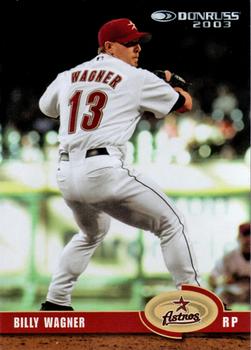
Billy Wagner, 2003 Donruss, #298

Although he has a lower career WAR then most of the players I’ve chosen in this series (27.7), “Billy the Kid” deserves a spot on this list. He is also the first relief pitcher I’ve featured. Billy Wagner was an elite closer who played sixteen seasons from 1995 to 2010. From 1995 to 2003 he played for the Houston Astros until he was traded to the Philadelphia Phillies (2004-2005). He then played for the New York Mets (2006-2009), the Reds Sox (2009) and the Atlanta Braves (2010). He wore uniform number 13 for his entire career.

The left-handed closer was an All-Star seven times. He won the Rolaids Relief Man Award in 1999.

Wagner is 8th all-time with 422 saves. He pitched for 903 innings and had 47 wins. His lifetime ERA is 2.31, with 1,198 strikeouts and .998 WHIP. Among pitchers with at least 800 innings, he has the highest k/9 (11.9) and strikeout rate (33.2 %) and only a .187 average against him.

Wagner is a member of the Houston Astros Hall of Fame, and they retired his uniform number 13 in 2025.

Wagner was inducted into the Baseball Hall of Fame in 2025.

Final Score:

This was the first time I’ve dipped below the 40 career WAR threshold since my first two posts (00 and 0), but it was well worth it, especially since I got to feature Parrish. There were a few players who I could have put on this list ahead of Wagner, but the Hall of Fame closer deserved a place.

A few great players wore uniform number 13 for short periods of time. Hall of Famer Roberto Clemente (95 WAR, 1955/Pirates), Pitcher Zack Greinke (77.4 WAR, 2011-2012/Brewers), pitcher David Cone (62.3 WAR, 1986/Royals) and current Atlanta Brave Matt Olsen (39.7 WAR, Athletics/2016).

Infielder Hanley Ramírez wore uniform number 13 for eight seasons. He was the ROY in 2006 and was a 3-time All-Star who played fifteen seasons with a career WAR of 38.3. Nine-time All-Star and current Kansas City Royals great Salvador Perez wore 13 for his entire fourteen-year career thus far. I’d be remiss if I didn’t mention John Valentin who wore uniform number 13 from 1992-2001 while with the Boston Red Sox and has a career WAR of 32.5.

As always, I could go on all day. If I missed someone that you like feel free to give them a shoutout in the comments. Thanks for reading and please hit the subscribe. Stay tuned for uniform number 14!

Sources:

https://www.baseball-almanac.com/

https://www.baseball-reference.com/

Jaffe, Jay (December 19, 2017). “Billy Wagner’s dominance gives him a surprisingly strong Hall of Fame case”Sports Illustrated.

Rodriguez makes history Ninth-inning home run becomes first replay 9/4/2008 The Spokesman Review

https://www.sabr.org

Shout out to all the cool cards and creative commons for my pictures! Thanks Topps and Fleer and Donruss and Upper Deck and all the rest.

Baseball by the Numbers: 10

Read about the Project

Checklist

10

Welcome back to Baseball by the Numbers. Today we are looking at uniform number 10. I found that around 689 players in history wore the number 10 at some point in their career. Out of that group, one player had a career WAR of over 100. This player is a pitcher, which is important because so far I’ve posted uniform number 00 to uniform number 9 and have featured a total of 89 players with only 4 being pitchers (two in 00 post and 2 in the 0 post). This is mainly due to the way in which numbers have had been distributed historically, with the numbers being assigned based on batting order.

Twenty-six additional players who wore number 10 had a career WAR of 40+ and 109 players wore the number for 5 years or more. There was one player who is on this list who was already featured for wearing a different number at one point in his career, but deserves to make both lists. I’m sure this will happen on occasion in the future too. So let’s get to it!

The Legend:

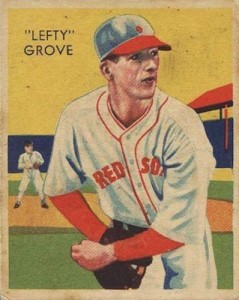
Lefty Grove, 1934 Diamond Stars, #1

Robert Moses Grove, better known as Lefty, was a left-handed (bet that was hard to guess) pitcher who played for 17 seasons from 1925 to 1941. He was a member of the Philadelphia Athletics until 1933 and then played on the Boston Red Sox from 1934 to 1941. Grove wore uniform number 10 for eleven years and had a career WAR of 106.8 good for 26th all-time. This is only the 5th time out of all these post that features a pitcher.

I had to use this 1934 Diamond Stars card because Lefty is in his Red Sox uniform, and I love Diamond Stars. Luckily, he did wear number 10 while on the Sox, so it works. 1934 was his first year in Boston and due to an injury, he only pitched 109 innings. He usually averaged over 250 innings a season. He went 8-8 with 43 strikeouts.

Grove was a 6-time All-Star. Lefty won his first Triple Crown in 1930 when he had 28 wins with a 2.54 ERA and 209 strikeouts in 291 innings. He also led the league in WAR (10.4), W-L % (.848), games (50), Whip (1.14) and saves with 9. He was the American League MVP in 1931 when he won his second pitching Triple Crown with 31 wins, a 2.06 ERA and 175 strikeouts. Although he only had 200 strikeouts once, he led the league in strikeouts on seven occasions. He also led the league in ERA a record 9-times and wins 4-times.

Grove was a member of the 1929 and 1930 Philadelphia Athletics World Series Champions. Managed by Connie Mack, the teams featured Mickey Cochrane, Eddie Collins, Jimmie Foxx and Al Simmons.

Grove retired in 1941. He had a career record of 300-141 for a .680 w/l % (13th all-time). His 300 wins are good for 23rd all-time. Grove pitched in 3,940.2 innings, the 44th most in history.  He had a career ERA of 3.06 with an ERA+ of 148 (9th all-time), 2,266 strikeouts (SO/9 of 5.2) and a 1.278 WHIP. He also saved 54 games.

Grove is a member of the Athletics and the Boston Red Sox Hall of Fame and was voted into the MLB All-Century Team.

He was inducted into the National Baseball Hall of Fame in 1947.

Lefty Grove passed away in 1975 at the age of 75.

Number 1:

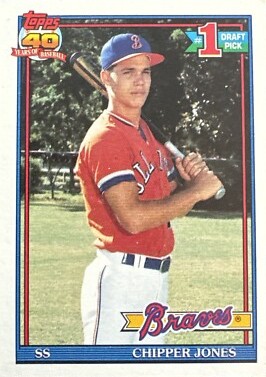
Chipper Jones, 1991 Topps, #333

From 1993 to 2012, Chipper Jones played third base and left field with the Atlanta Braves for his entire nineteen-year career. He wore uniform number 16 in 1993, then wore uniform number 10 for the rest of his career, eighteen seasons. He had a career WAR of 85.3.

Jones was the first overall pick in the 1990 draft. The Braves originally wanted a pitcher and intended to draft Todd Van Poppel, a coveted prospect at the time. Van Poppel was not interested in playing in Atlanta and made it known early on. This turned out to be the best possible turn of events as the Braves opted for Jones, and the rest is history. Rogers, Phil (June 4, 1990). 

This 1991 Topps card represents Jones being the first pick in the draft. I love this card! It brings back so many memories. When I was a kid, the 1991 Chipper Jones Topps card was always on our wish lists. I remember also wanting Todd Van Poppel cards, but he turned out to be a dud, while Chipper was a stud. Chipper didn’t make it to the Majors until 1993 when he had only 3 at-bats, then missed all of 1994 with an injury. By 1995, he would start to show the world why he was the number 1 draft pick, placing second in ROY voting that season. He lost to Hideo Nomo (One of my favorites!).

Jones was an 8-time All-Star. He won the National League MVP in 1999 when he batted .319 with 181 hits, 41 doubles, 45 home runs, 110 RBIs and 25 stolen bases, while walking 126 times with .441 OBP, .633 SLG and 1.074 OPS. Oddly enough, Jones was not an All-Star selection in 1999. I had to look this up, and found that the MVP has not made the All-Star game at least twelve other times. This article by Jason Foster at MLB.com, highlights those instances.

Jones won two Silver Slugger awards. He batted over .300 in 10 different seasons with 30 or more home runs in 6 seasons, 100 or more RBIs in nine and an OBP of over .400 in ten seasons. He was a member of the 1995 World Series Champion Braves, a team managed by Bobby Cox, and featuring pitching greats Greg Maddux, John Smoltz and Tom Glavine, and the “Crime Dog”, first baseman Fred McGriff.

Chipper would retire in 2012 finishing in the top 50 all-time in many offensive categories. He had a career batting average of .303 with 2,726 hits, 549 doubles (32nd), 468 home runs (35th), 1,623 RBIs (35th), and 1,619 runs (46th). He added 150 stolen bases and 1,512 walks (16th all-time) to go with a .401 OBP, .529 SLG and a .930 OPS (41st all-time).

Jones is a member of the Braves Hall of Fame, and his uniform number 10 was retired by Atlanta in 2013.

He was inducted into the National Baseball Hall of Fame in 2018. He is one of only four number one draft picks in the Hall, the others being Ken Griffey Jr., Joe Mauer and Harold Baines.

Chipper has since been a coach and consultant for the Braves and has done some work in the broadcast booth.

Number 2:

Johnny Mize, 1936 R312, #39

Known as “Big Jawn”, Johnny Mize played for fifteen seasons in the MLB from 1936 to 1953 (he missed 1943-1945 for military service). Mize played first base for the St. Louis Cardinals, New York Giants and New York Yankees. He wore uniform number 10 for six seasons while with the Cardinals, and had a career WAR of 70.6.

This is the 1936 R312 baseball card. I chose it due to Mize being on the Cardinals at the time this card was released, which was when he wore the number 10. These cards were produced by National Chicle, a gum company. I found some interesting information about these cards at oldcardboard.com.

Johnny Mize was a ten-time All-Star. He batted over .300 in nine seasons, leading the league in 1939 with a .349 average. He also led the league in home runs 4 times smashing 51 in 1947. In eight seasons he drove in over 100 RBIs, leading the league in that category on 3 occasions. 

From 1949 to 1953, Mize was a member of the New York Yankees that won the World Series Championship a record five straight years. Members of that team included, Manager Casey Stengel and Hall of Famers Yogi Berra, Phil Rizzuto, Joe DiMaggio, Whitey Ford and Mickey Mantle

Mize retired in 1953. He had a career batting average of .312 with 2,011 hits, 359 home runs, 1,337 RBIs with a .397 OBP, and is ranked 19th all-time in SLG (.562) and 20th in OPS (.959).

Mize is a member of the St. Louis Cardinals Hall of Fame and was inducted into the National Baseball Hall of Fame in 1981.

Johnny Mize passed away at the age of 80 in 1993.

Number 3:

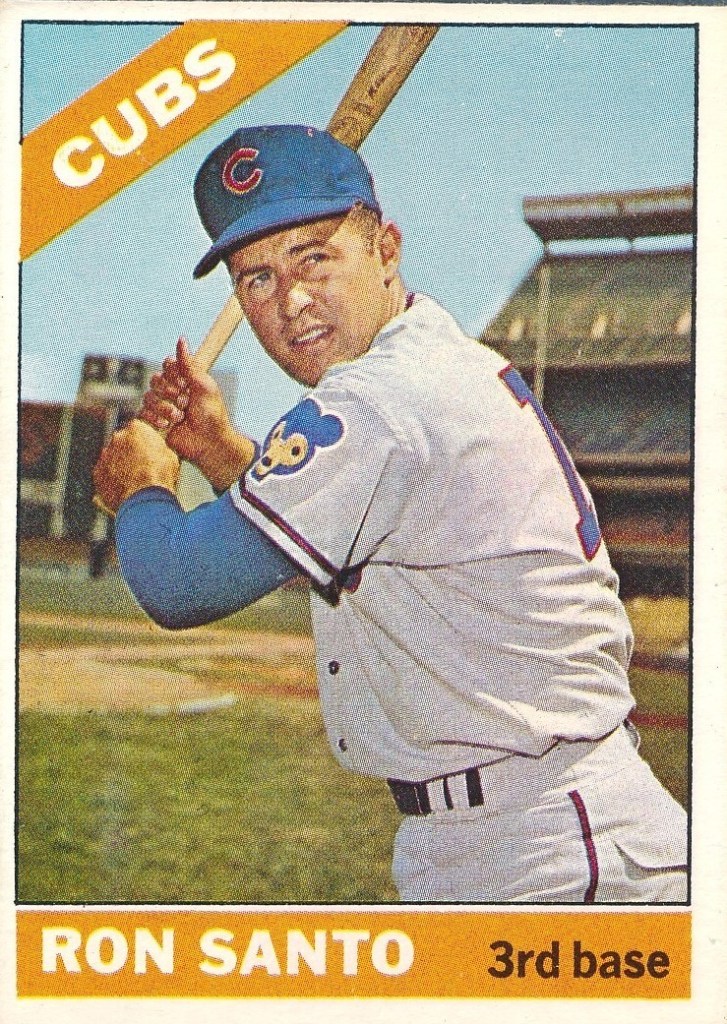
Ron Santo, 1966 Topps, #290

Ron Santo spent fifteen seasons in the Majors, all of them in the Windy City from 1960 to 1974. Santo was the third baseman for the Chicago Cubs until 1973 and spent his final season on the South Side with the White Sox in 1974. Santo wore uniform number 10 his entire career, save for a few games in 1960, and had a career WAR of 70.5.

I haven’t used too many 1966 Topps cards. I like this one, you can see Santo’s number just a little on his back, the design is nice, and the old 1966 Cubs uniform is sweet, especially the logo on the sleeve.

Santo was a 9-time All-Star who batted over .300 four times. He led the league in season WAR once, walks four times and on base percentage twice. He also hit over 30 home runs in four seasons and is the only third baseman to have over 90 RBIs in eight straight seasons.

Santo was an excellent defender. He had 5 straight Gold Glove winning seasons while leading the league’s third basemen in assists and putouts seven times and double plays six times.

Santo retired in 1974 after being traded to the White Sox and having an awful season. He would finish his career with a .277 career batting average, 2,254 hits, 1,138 runs, 365 doubles, 342 home runs and 1,331 RBIs.

He is a member of the Chicago Cubs Hall of Fame, and his uniform number 10 was retired by the Cubs in 2003.

He was inducted into the National Baseball Hall of Fame in 2012.

He went on to become a broadcaster for the Cubs. Santo suffered from Type 1 Diabetes his entire life and had both of his lower legs amputated in 2001 and 2002, he would eventually pass away from complications of the disease in 2010 at the age of 70.

Number 4:

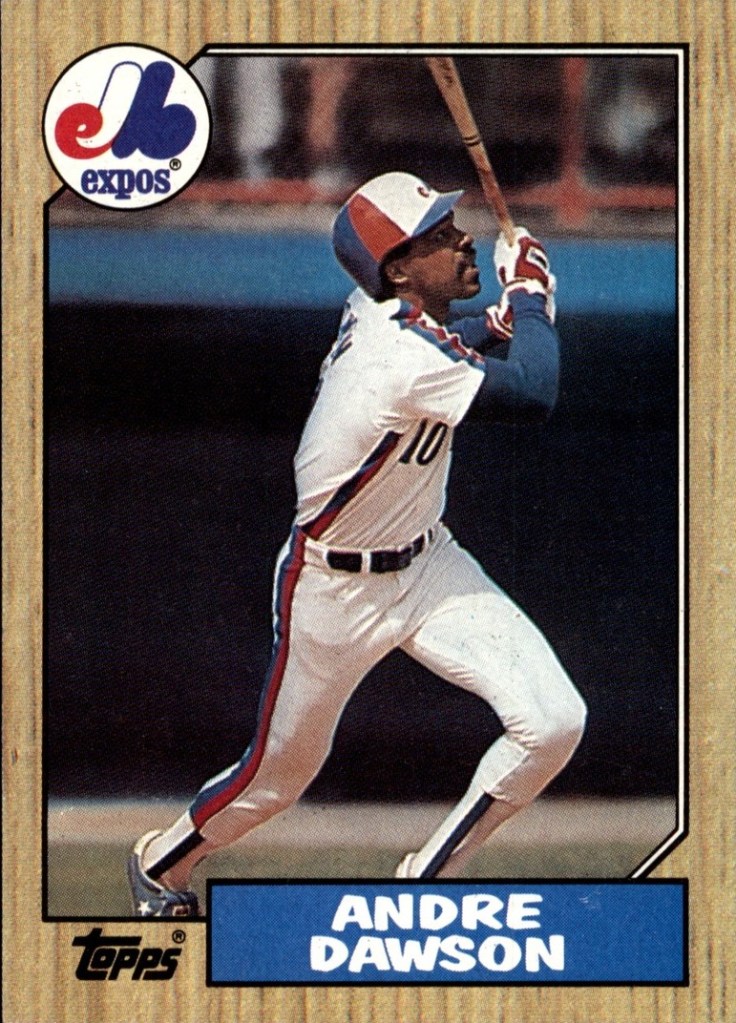
Andre Dawson, 1987 Topps, #345

“the Hawk” is another player whose cards I have a lot of. He played for twenty-one seasons from 1976 to 1996 as an outfielder. Andre Dawson started his career with the Montreal Expos where he played for eleven seasons. In 1987, he joined the Cubs where he stayed until 1992. He finished his career with two-year stints on the Boston Red Sox and the Florida Marlins. He wore uniform number 10 for twelve seasons (with the Expos and Red Sox) and had a career WAR of 64.8.

Dawson is the first player that I have featured twice. He wore uniform number 8 while with the Chicago Cubs for 8 seasons.

1987 Topps, oh how I love thee. While not the most aesthetically pleasing set of Topps, 1987 holds a special place in my heart. It is the first set that I received as a kid from my grandmother for Christmas. She would go on to buy me the full Topps sets for the next five years. I always looked forward to getting those sets. This Dawson card is cool because he’s with the Expos, whose cards I always liked, and his number is front and center. He was the MVP in 1987, when he led the league in home runs (49), RBIs (137) and Total Bases (353).

 Dawson was an eight-time All-Star. He was the National League ROY in 1977 and as mentioned earlier, was the MVP in 1987. He was a great defender, having won eight Gold Glove Awards in his career. He was a four-time Silver Slugger who batted over .300 on five occasions. He was also fast on the bases and stole 25 or more bases in six seasons. By 1994, injuries began to reduce his playing time and he played less than 80 games in each of his last few seasons before retiring in 1996.

Dawson finished his career with a .279 career batting average. He had 2,774 hits with 503 doubles. His 438 home runs are 47th all-time and his 1,591 RBIs are 40th. He also had 314 stolen bases and is 31st in Total Bases with 4,787.

Dawson is a member of the Montreal Expos and Chicago Cubs Hall of Fame.

He was inducted into the National Baseball Hall of Fame in 2010.

Number 5:

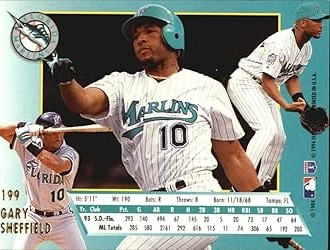
Gary Sheffield, 1994 Fleer Ultra, #199

I feel like Sheffield is a controversial pick due to his implication in the PED scandals, but I’ve decided to let that go and just highlight the players, no place for negativity in these posts. So you will see other controversial players as we move along. These posts are for the nostalgia and Sheffield was a fun player to watch when I was a kid.

Gary Sheffield played outfield and third for twenty-two seasons from 1988 to 2009 on eight different teams. He started on the Brewers (we all wanted those Sheffield Future Stars cards), and went on to play for the San Diego Padres, Florida Marlins, Los Angeles Dodgers, Atlanta Braves, New York Yankees, Detroit Tigers and finally the New York Mets. He wore uniform number 10 for eleven seasons with the Padres, Marlins (6 years) and the Mets. He had a career WAR of 60.5.

The Marlins are the primary team that I remember Sheffield playing for, and the team in which he wore uniform number 10 the longest, so I chose this 1994 Fleer Ultra. I loved the Ultra; they were glossy and colorful and had these great card backs. This one is awesome and shows his uniform number twice! It’s only the second time I’ve used the photo from the back of a card, the first being Jeff Bagwell.

Sheffield was a 9-time All-Star. He batted .290 or more fourteen times, while winning 5 Silver Slugger awards. He was a member of the 1997 World Series Champion Marlins team, the first in franchise history. The team was managed by Jim Leyland and included slugger Bobby Bonilla, speedster Édgar Rentería, the clutch Moisés Alou, pitchers Kevin Brown and Alex Fernandez and closer Robb Nenn.

Sheffield never played after 2009. He finished his career with a .292 batting average, 2,689 hits and 467 doubles and 253 stolen bases. He is 27th in home runs with 509, 39th in runs scored (1,636), 30th in RBIs (1,676), 21st in walks (1,475), and 35th in Total Bases (4,737). Sheffield holds the record for most MLB ballparks played in (51) and he and Fred McGriff, who was mentioned earlier in the Chipper section, are the only players to have 30 or more home runs in one season for 5 different teams.

Sheffield was eligible for the Hall of Fame in 2015, but due to his implications with steroids, fell off the ballot in 2024, having never received enough votes to be inducted.

His uncle is New York Mets legend Dwight “Doc” Gooden.

Number 6:

Ron Cey, 1981 Fleer, #126

Ron Cey played for seventeen seasons from 1971 to 1987. He was a third baseman who played for the Los Angeles Dodgers, Chicago Cubs and spent one season on the Oakland Athletics. Cey wore uniform number 10 for the twelve seasons he was with the Dodgers. He had a career WAR of 53.7. He was also one of Batman’s biggest enemies. I jest, but with his nickname, “the Penguin” , what was I supposed to think? The nickname was based on his unusual running style.

I wasn’t collecting when this 1981 Fleer came out, but I somehow had a lot of early 80s cards in my collection once I got going. The 1981 Fleer I remember well. The design is cool, and I’m a fan of the color borders and the little baseballs on the front with the team’s name is a nice touch. This Ron Cey also shows his uniform number, which works for my posts.

Cey was a 6-time All-Star. He was never much of a power hitter, having only hit 30 home runs once, but he did have 20 or more in ten seasons. He also never batted .300. He was consistent at driving in runs, having over 100 RBIs twice and over 90 five times. “the Penguin” wasn’t fast and only stole 24 bases in his entire career. He was, however, a hustler, who played hard and came in clutch when needed.

He was a member of the 1981 Dodgers World Series winning team, managed by Tommy Lasorda and featuring Pedro Guerrero and Steve Yeager. Cey, along with those two, were the co-MVPs of the 1981 Series.

He retired from baseball in 1987 with a .261 batting average, 1,868 hits, 316 home runs, 1,139 RBIs and a .961 fielding percentage.

Cey tried his hand at acting when he appeared in an episode of Columbo in 1990. He continues to work in an administrative role with the Los Angeles Dodgers.

Number 7:

Tommy Bridges, 1934 Diamond Stars, #5

Tommy Bridges pitched for sixteen seasons from 1930 to 1946 exclusively with the Detroit Tigers. He was a right-handed pitcher known for his curveball. Bridges wore uniform number 10 for thirteen seasons, wearing number 16 his first three. He had a career WAR of 50.4.

Any chance I get to feature a Diamond Stars card, I’m taking it, and in this post I got two. This Tommy Bridges 1934 Diamond Stars features another wonderful art-deco style photo. I love the colors and style of these pre-World War 2 cards.

Bridges was a 6-time All-Star who led the American League in wins once and strikeouts twice. He had 20+ wins three seasons in a row from 1934-1936.

Bridges was a member of Detroit’s World Series Championship teams in 1935 and ten years later in 1945. In 1935, he was on a Tigers team that also featured Hank Greenberg, Mickey Cochrane, Charlie Gehringer and Goose Goslin. The 1945 team featured Greenberg again and fellow pitcher Hal Newhouser.

Bridges didn’t play in 1944 due to military service and only played 13 games between 1945 and 1946, when he would retire. He had a final record of 194-136 with a career ERA of 3.57. He had 1,674 strikeouts in 2,826.1 innings (5.3 SO/9). His career WHIP was 1.368 and his ERA+ was 126. He also had 10 career saves.

Tommy Bridges passed away in 1968 at the age of 61.

Final Score:

There were a few players who wore uniform number 10 for one season and whose career WAR was over 40. These include, Carl Hubbell (68.5, New York Giants, 1932), Al Simmons (68.5, Red Sox, 1943), Wes Ferrell (60.1, Washington Nationals, 1938), and Dave Stieb (56.4, Chicago White Sox, 1993). Evan Longoria who was already featured in the uniform number 3 post, wore it for 5 seasons with the San Francisco Giants.

Three others I’d like to mention here are 6-time All-Star Rusty Staub (WAR 45.8) who wore uniform number 10 for nineteen seasons, Yankees Hall of Famer Phil Rizzuto (WAR 42.1) wore it his entire thirteen season career, and Rangers great Jim Sundberg wore it for twelve seasons with Texas (1974 to 1983, and in 1988-89).

Thank you for joining me. If you’re enjoying these posts, feel free to share, follow, like and comment, and of course check out the next post as well explore uniform number 11!

Sources:

https://www.baseball-almanac.com/

https://www.baseball-reference.com/

Bolton, Barry (March 24, 2010). “Ron Cey sets record straight on ‘The Penguin'”. Coug Fan.  

Foster, Jason (July 2025). MVP Award Winners Who Did Not Make the All-Star Team. mlb.com

Rogers, Phil (June 4, 1990). “The Class of ’90: TO EARN OR TO LEARN”. Sports Illustrated. Archived from the original on September 24, 2015.

https://www.sabr.org

https://baseballhall.org/discover/yankees-five-year-title-stretch-still-unmatched

Shout out to all the cool cards and creative commons for my pictures! Thanks Topps and Fleer and Donruss and Upper Deck and all the rest.
Baseball by the Numbers: 9

Read about the Project

Checklist

9

Welcome back to Baseball by the Numbers. Today we are looking at uniform number 9. I found that around 715 players in history wore the number 9. Out of that group there were two who had a career WAR of over 100. Rogers Hornsby, who was featured in the uniform number 4 post, wore it with the Chicago Cubs in 1934. The other player will be our Legend in this post. After those two, twenty-one additional players who wore uniform number 9 had a career WAR of 40+ and 103 players wore the number for 5 years plus.

The Legend:

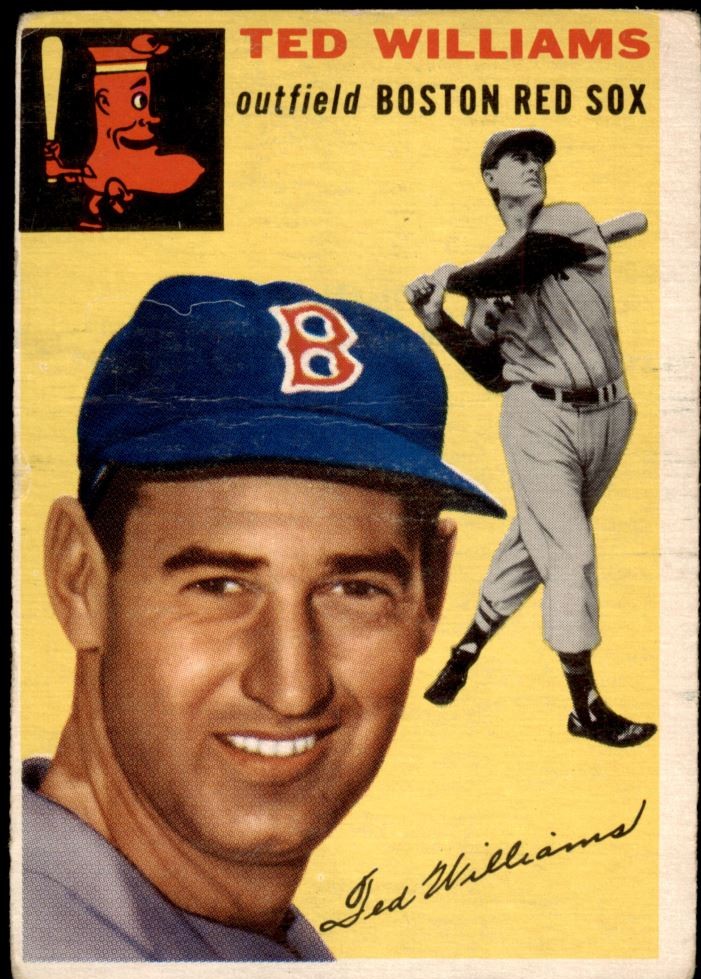
Ted Williams, 1954 Topps, #250

One of the greatest hitters in history, Ted Williams went by many names, “Teddy Ballgame”, “The Thumper”, “the Splendid Splinter, “the Kid”, but to Red Sox fans he was the hero of Boston. One of the greatest players to wear the Red Sox uniform, Williams patrolled the left field of Fenway Park for his entire 19-year career. Williams played from 1939 to 1960, missing 1943-1945 and parts of 1952 and 1953 for military service. He wore uniform number 9 all nineteen seasons and had a career WAR of 121.8, good for 14th all-time.

This 1954 Topps card of Williams is a favorite of mine. I love that old Red Sox logo and the dual pictures, the portrait and the action shot. In 1954, Williams was an All-Star. He batted .345 and led the league in walks (136), OBP (.513), SLG (.635), and OPS (1.148).

Williams was an All-Star nineteen times. He was the American League MVP in 1946 and 1949. He won the Triple Crown twice. In 1942, when he batted .356 with 36 home runs and 137 RBIs and in 1947 when he batted .343 with 32 home runs and 114 RBIs. Interestingly, he didn’t win the MVP in his Triple Crown seasons, he was the runner up for MVP in both, losing to Joe Gordon in 1942 and Joe DiMaggio in 1947. Williams batted over .300 in almost every season he played, hitting .406 in 1941, the last time any player has accomplished this feat. Williams also led the league in season WAR (6x), runs (6x), doubles twice, home runs (4x), RBIs (3x), he led the league in walks 8-times, OBP an insane 12-times, SLG 9-times and OPS 10-times. He was one of the best all-around hitters to ever play the game.

Williams retired in 1960 after batting .316 in his final season. He ended his career 11th all-time with a .344 batting average. His career .482 OBP is 1st all-time. He also finished with 2654 hits, 525 doubles, 521 home runs (22nd all-time), 1839 RBIs (16th all-time). He is 4th all-time in walks (2021), 2nd in SLG (.634) and 2nd in OPS (1.116).

He is a member of the Boston Red Sox Hall of Fame and although he never played for anyone other than Boston, he is a member of the San Diego Hall of Fame as he was from that city.

He was voted for the MLB All-Century team and the MLB All-Time Team and he was inducted into the National Baseball Hall of Fame in 1966.

His number 9 was retired by the Boston Red Sox in 1984.

Ted Williams passed away at the age of 83 in 2002.

Number 1:

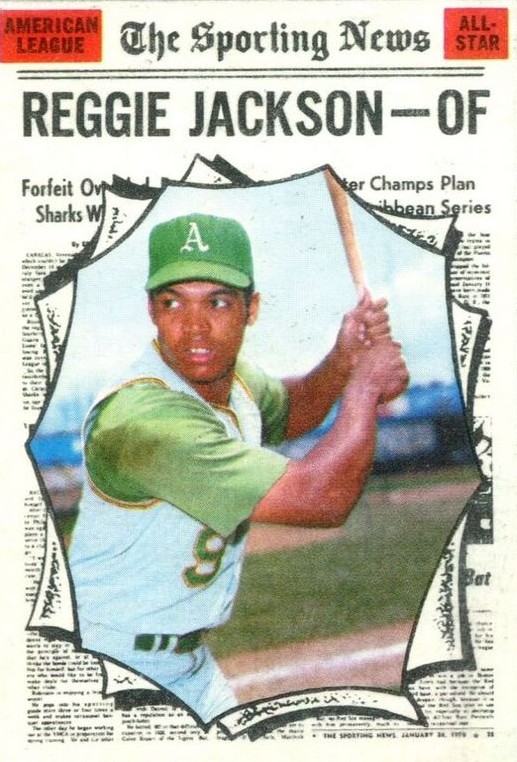
Reggie Jackson, 1970 Topps, #459

Reggie Jackson played right field for twenty-one seasons from 1967 to 1987 for four teams. He started and ended his career with the Athletics for ten total seasons, and played one season in Baltimore, five with the Yankees and five with the California Angels. He was with the Angels when I was collecting. I have a lot of his cards from the 80s and a lot of memories of Jackson in that uniform. He wore uniform number 9 for nine different seasons and had a career WAR of 74.

I choose this 1970 Topps for two reasons, he was on the A’s his main team, and you can see his number on the front. These 1970 Topps All-Star cards have a great design, with the photo of the player ripping through the newspaper background. They need to bring these back.

Jackson was a 14-time All-Star. He won the American League MVP in 1973, led the league in home runs four times and RBIs once, and won two Silver Slugger Awards.

Known as “Mr. October” for his post season heroics, Jackson was a member of five World Series Championship teams, three with the Athletics (1972-1974) and two with the Yankees (1977 and 1978). He was the World Series MVP in both 1973 and 1977.

In 1987, Jackson signed with the Athletics for his final season. He wore number 44 that year, which Jackson was more known for by then.

Jackson finished his career with a .262 batting average with 2584 hits, 463 doubles, 563 home runs (14th all-time), 1702 RBIs (27th all-time) and 228 stolen bases. Jackson also struck out a lot and leads all batters in history with 2597, probably not the best stat to be 1st in, but it’s a testament to how good he was that even with all those strikeouts, he was so clutch.  

Jackson is a member of the Athletics Hall of Fame, and his uniform number 9 was retired by them in 2004.

He was inducted into the Baseball Hall of Fame in 1993

Number 2:

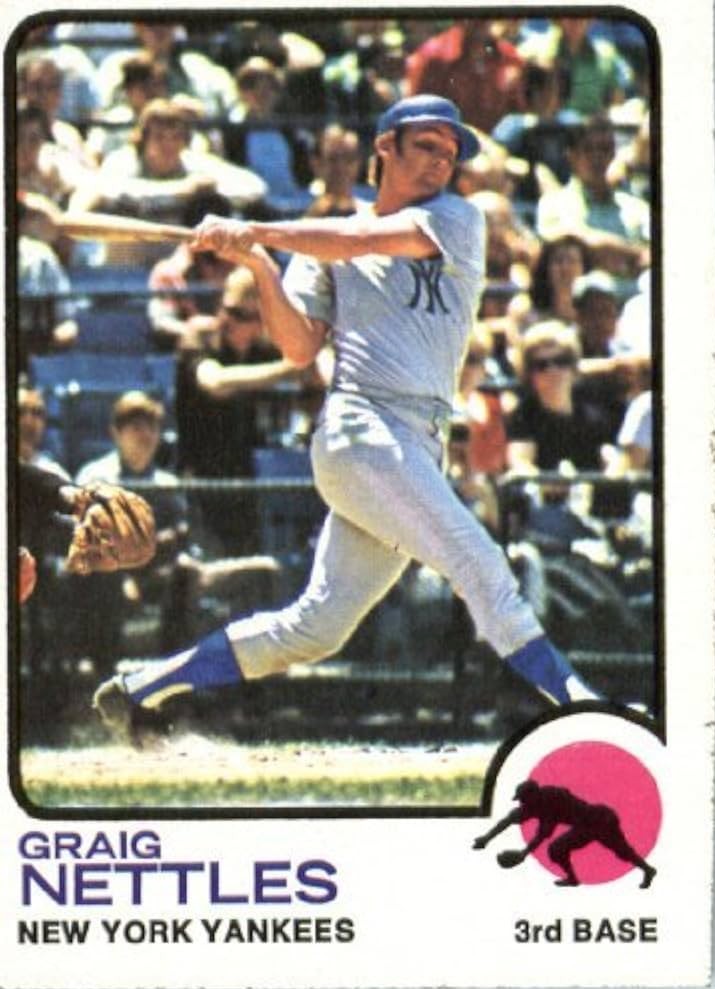
Graig Nettles, 1973 Topps, #498

Graig Nettles played third base for twenty-two seasons in the MLB from 1967 to 1988. During his career, “Puff” (yes that was his nickname) played for the Minnesota Twins, Cleveland Indians, New York Yankees (ten seasons), San Diego Padres, Atlanta Braves and the Montreal Expos. He wore uniform number 9 for fifteen seasons and had a career WAR of 68.

I picked this 1973 Topps card to represent Nettles because I love the design and the photo. I also wanted to choose a card with Nettles on the Yankees since that was the team where he spent his best years. In 1973, Nettles had 22 home runs and 81 RBIs.

Nettles was a 6-time All-Star who won 2 Gold Glove awards. He led the league in home runs with 32 in 1976, his best overall season. Nettles was on two World Series Championships with the Yankees, 1977 and 1978. His was teammates with the number 1 player on this post, Reggie Jackson, though at that time Jackson wore number 44 and Nettles 9.

Nettles retired after the 1988 season with a career batting average of .248, 390 home runs and 1,314 RBI. He also had a .964 fielding percentage at third.

The 81-year-old Nettles is not in the Hall of Fame though he has the highest career WAR of all third basemen who are not in the Hall.

Number 3:

John Olerud, 1994 Fleer, #340

Another player that I really enjoyed collecting as a kid was John Olerud. Olerud played for seventeen seasons from 1989 to 2005. He was a first baseman, known for his signature batting helmet, which he wore while batting and fielding. He wore the helmet due to brain surgery while in college and was recommended to always wear it. Olerud began his career with the Blue Jays for 8 seasons, then played for the Mets, Mariners, Yankees and finished with the Red Sox. He wore uniform number 9 for all eight seasons with the Blue Jays and finished his career with a 58.1 career WAR.

1994 Fleer is one of my least favorite sets. I’m not a fan of the design, especially the difficult to read name and position up top. Also, if you ever open 1994 Fleer packs now, 30 years later, the cards tend to stick together. Still, this card works because this is during one of his Blue Jays seasons and his number 9 is visible, as well as that helmet.

Olerud was an All-Star twice and won three Gold Gloves. His best season was 1993 when he led the league in doubles (54), batting average (.363), OBP (.473) and OPS (1.072). He was on two World Series Championship teams with the Blues Jays in 1992 and 1993.

Olerud retired in 2005 with a career batting average of .295, 2239 hits, 500 double, 225 home runs and 1230 RBIs.

Olerud was inducted into the Canadian Baseball Hall of Fame in 2020.

Number 4:

Joe Torre, 1972 Topps, #500

When I think of Joe Torre, I think of him as the manager of the “Damn” Yankees, but Torre has been a staple in Major League Baseball since 1960. For this post we are focusing on his playing career, which spanned eighteen years from 1960 to 1977. At different points, Torre was a catcher, first baseman and third baseman who played for three teams: the Milwaukee/Atlanta Braves till 1968, the St. Louis Cardinals from 1969 to 1974 and the New York Mets 1975 to 1977. He wore uniform number 9 for his nine seasons with the Cardinals and Mets.

This 1972 Topps is a perfect fit. He’s with the Cardinals, the uniform number is visible on the front, and those sideburns are epic! I love the 1972 Topps design too.

Torre was a 9-time All-Star. He won the National League MVP in 1971 leading the league in hits (230), RBIs (137) and batting average (.363). Torre had two seasons with 200+ hits. He also batted .290 or more seven times. He won the Gold Glove in 1971.

Torre finished his career with 2342 hits for a .297 career batting average. He had 344 doubles, 252 home runs, and 1185 RBIs.

After Torre retired as a player he went on to manage for twenty-nine seasons. He won 4 World Series Championships as the Yankees manager in 1996 and 1998-2000. He is 5th all-time in managerial wins with 2326 and was a 2-time Manager of the year. He has continued in baseball in several key roles including color commentator and special assistant to the Commissioner. 

He is a member of the Braves and the Cardinals Hall of Fame.

Torres was inducted into the National Baseball Hall of Fame in 2014.

Number 5:

Enos Slaughter, Red Heart Dog Food, #28

Enos Slaughter (don’t you love his last name), played right field in the Majors for nineteen seasons from 1938 to 1959 (military service 1943-1945). He played for the St. Louis Cardinals from 1938 -1950 and played for the New York Yankees twice and the Kansas City Athletics and Milwaukee Braves once each. He wore uniform number 9 for thirteen seasons with the Cardinals and had a career WAR of 57.5.

This is a 1954 Red Heart Dog Food card of Slaughter with the Cardinals. I feel like this is a sharp looking card. According to Cardboard Connection, these cards could be received from Red Heart Dog Food as a mail-in offer in which you would receive a group of 11 cards featuring either red, blue, or green backgrounds with the red being the rarest. The full set includes 33 cards.
Born in North Carolina, Enos Slaughter was nicknamed “Country”. He was a 10-time All-Star who batted over .300 nine times. He was a member of four World Series Championship teams, 1942 and 1946 with teammate Stan Musial while on the Cardinals and in 1956 and 1958 with Mickey Mantle, Whitey Ford, and Yogi Berra on the Yankees.

After a progressive decline in playing time, Slaughter ended his career in 1959. He had a career .300 batting average with 2383 hits, 413 doubles, 148 triples, 169 home runs and 1304 RBI.

Slaughter is a member of the St. Louis Cardinals Hall of Fame, and his uniform number 9 was retired by them in 1996.

He was inducted into the Baseball Hall of Fame in 1985.

Enos Slaughter passed away in 2002 at the age of 86.

Number 6:

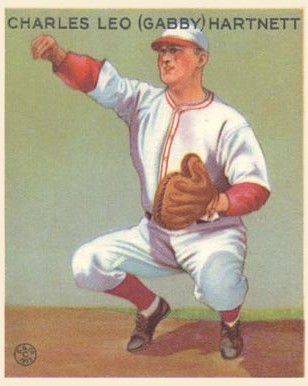
Gabby Hartnett, 1933 Goudey, #202

Okay, this may be my favorite nickname yet! Gabby Hartnett played catcher for twenty years in the Majors from 1922 to 1941. He played for the Chicago Cubs almost his entire career, finishing with one last year on the New York Giants. Hartnett wore uniform number 9 for six seasons and had a career WAR of 55.5. His nickname…” Old Tomato Face”!

1933 Goudey is such a classic card, and this one of Hartnett is perfect. I love that the photo has him in his catcher’s stance, but he just has a giant glove for protection. That’s how they rolled back then.

Hartnett was a 6-time All-Star and was the National League MVP in 1935 when he batted .344. He batted .290 or better in eight seasons. Not only was Hartnett a great hitting catcher, but he was also strong on the defensive end, leading the National League in putouts four times and in assists and fielding percentage six times. Hartnett also led the league seven times in double plays.

Harnett retired in 1941 with a .297 career batting average along with 1,912 hits, 867 runs, 396 doubles, 64 triples, 236 home runs, and 1,179 RBIs, with a .984 career fielding percentage. Hartnett  set the National League record at catcher with 163 career double plays, 4th all-time.

Hartnett is a member of the Chicago Cubs Hall of Fame.

“Old Tomato Face” was inducted into the National Baseball Hall of Fame in 1955.

Gabby Hartnett passed away at 72 years old in 1972.

Number 7:

Minnie Minoso, 1964 Topps, #538

Minnie Miñoso played baseball for twenty years from 1946 to 1964. He started in the Negro Leagues with the New York Cubans until 1949 when he played with Cleveland. He only stayed with Cleveland a short time, then played for the White Sox, back to Cleveland then back to the White Sox again, then St. Louis and Washington Senators for a season each and finally ending with the White Sox again. He wore uniform number 9 for sixteen seasons and had a career WAR of 53.2.

I love this 1964 Topps card of Miñoso. The card design is cool, and I love that uniform number on the sleeve. It’s perfect for the purposes of these posts!

Known as “the Cuban Comet”, Miñoso was a 2-time All-Star in the Negro League and a 9-time All-Star in the Majors. He won 3 Gold Glove Awards and, true to his nickname, led the league in stolen bases three times.

In 1947, he was a member of the Negro League World Series Champion New York Cubans along with future Major Leaguers Pat Scantlebury, Ray Noble and Lino Donoso.

Miñoso retired in 1964 but played in Mexico for eight more years until he was 47. He eventually became a coach for the White Sox and made three game appearances with the White Sox in 1976 when he was 52! Four years later, in 1980, he would again be activated and pinch hit twice at age 57. In 1993, at the age of 67, Miñoso appeared with the independent St. Paul Saints, he then returned to the Saints and drew a walk in 2003 at 77 years old. He is the only player in history to appear professionally in seven different decades.

Miñoso finished his career with a .299 batting average, 1228 runs, 2113 hits, 365 doubles, 195 home runs, 1089 RBIs and 216 stolen bases.

“Mr. White Sox” uniform number 9 was retired by Chicago in 1983.

Minnie Miñoso passed away in 2015 at the age of 90.

I had the opportunity to attend Minnie Miñoso’s Hall of Fame induction in 2022. I was there for David Ortiz but hearing Miñoso’s widow’s speech was so emotional. It inspired me to was inducted along with another player who I have feature in a prior post, Tony Oliva.

Bonus:

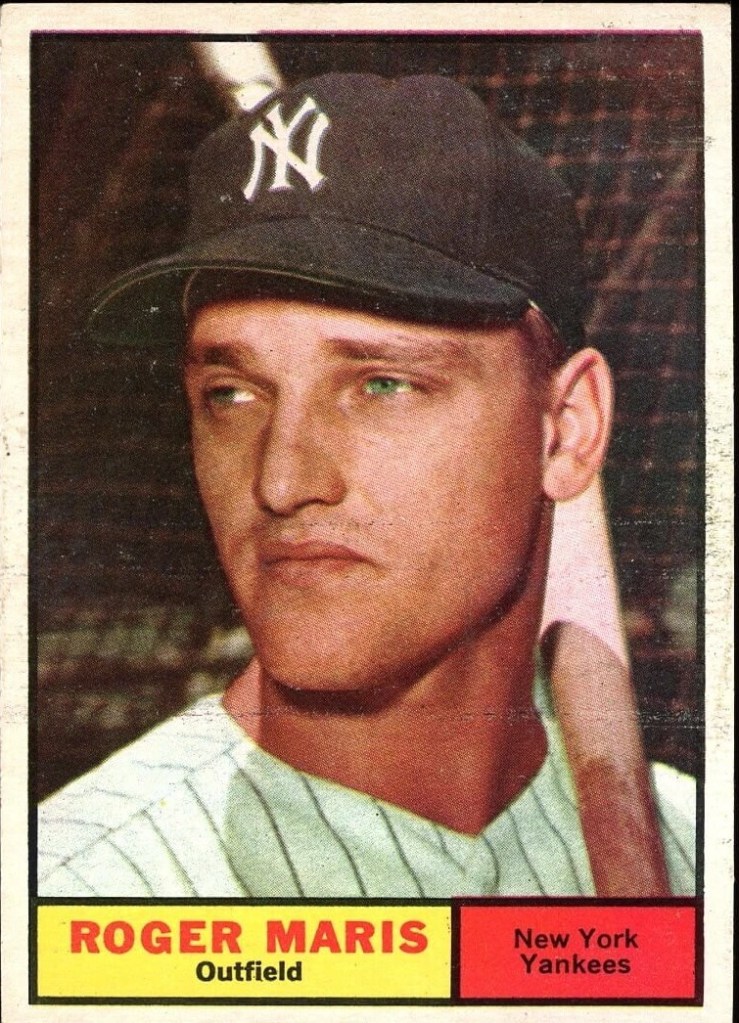
Roger Maris, 1961 Topps, #2

I just finished watching the movie “61” with Barry Pepper (Maris) and Thomas Jane (Mantle) and felt that despite his not meeting my WAR criteria (Maris had a 38.2), Maris deserved a little bonus mention.

Roger Maris played for only twelve years in the Majors from 1957 to 1968. He was a right fielder who played with the Cleveland Indians, Kansas City Athletics, New York Yankees and the St. Louis Cardinals. He wore uniform number 9 for nine seasons while with the Yankees and the Cardinals. His best years were with the Yankees where he would win the American League MVP 2-times (1960 and 1961) and broke Babe Ruth’s single season home run record in 1961 with 61 home runs. Maris is not in the Hall of Fame, but his uniform number 9 was retired by the Yankees in 1984.

Maris passed away at the young age of 51 in 1985 from non-Hodgkin lymphoma.

Final Score:

I had to add a quick spotlight on Roger Maris, but there were a few other notable players who wore uniform number 9. Matt Williams wore it for fifteen seasons and had a career WAR of 46.6, he played during my young collecting years and was a 5-time All-Star. A few other players of note; Bill Mazeroski (17 years, 36.5 WAR), Marquis Grissom (16 years, 29.6), Brady Anderson (14 years, 35 WAR), Terry Pendleton (14 years, 28.4 WAR) and Joe Adcock (10 years, 33.5 WAR). Of course there are many more, so once I finish with all the numbers, I may do a revisit to start spotlighting those I skipped.

I hope you’re enjoying the series, and I’m excited to now be working on uniform number 10! Double digits baby! Give me a follow or a like or leave a comment. I’m always happy to engage.

Sources:

https://www.baseball-almanac.com/

https://www.baseball-reference.com/

https://www.cardboardconnection.com/top-10-enos-slaughter-baseball-cards

https://sabr.org

 “White Sox legend Minnie Miñoso dies at age 90”. SBNation.com. Vox Media. March 2015.

 “Sarasota Herald-Tribune – Google News Archive Search”. Sarasota Herald-Tribune. Retrieved November 14, 2025 – via Google News Archive Search.

Shout out to all the cool cards and creative commons for my pictures! Thanks Topps and Upper Deck and Fleer and Donruss and all the rest!

Baseball by the Numbers: 8

Read about the Project

Checklist

8

Welcome back to Baseball by the Numbers. Today we are looking at uniform number 8, and I am so excited and I just can’t hide it! As I’ve mentioned previously, probably more than a few times, uniform number 8 holds a very special place in my heart. My favorite player of all-time wore this number, and I still have 100s of his cards and other memorabilia. Most of you can probably guess who it is, but if not, you’ll find out below. Number 8 is also special to my family since another player who wore that number is a family legend (not related, just idolized). Is the suspense killing you? I hope so, because it will keep you reading, and this may be my longest post yet.  

Uniform number 8 had 672 players who wore it in their career. There was one Legend (career WAR over 100) and thirty-nine players with a career WAR over 40. Ninety players wore uniform number 8 for five years or more.

There were a few players who wore number 8 for only one season. Three, Luke Appling, Al Simmons and Bobby Bonds, I have covered in past posts. Appling, featured in the 4 post, wore it for one season with the White Sox in 1932. Simmons, featured in the 7 post, wore it with the Red Sox in 1943. Go Sox! Bonds (featured in the 00 post and will be seen again) wore it in 1981 with the Chicago Cubs. Hall of Famer Paul Warner also wore number 8 for one seasons in 1942 with the Boston Braves.

Out of the 672 players who wore the number, only one player had a career WAR that exceeded 100 and will make the coveted Legends spot.

The Legend:

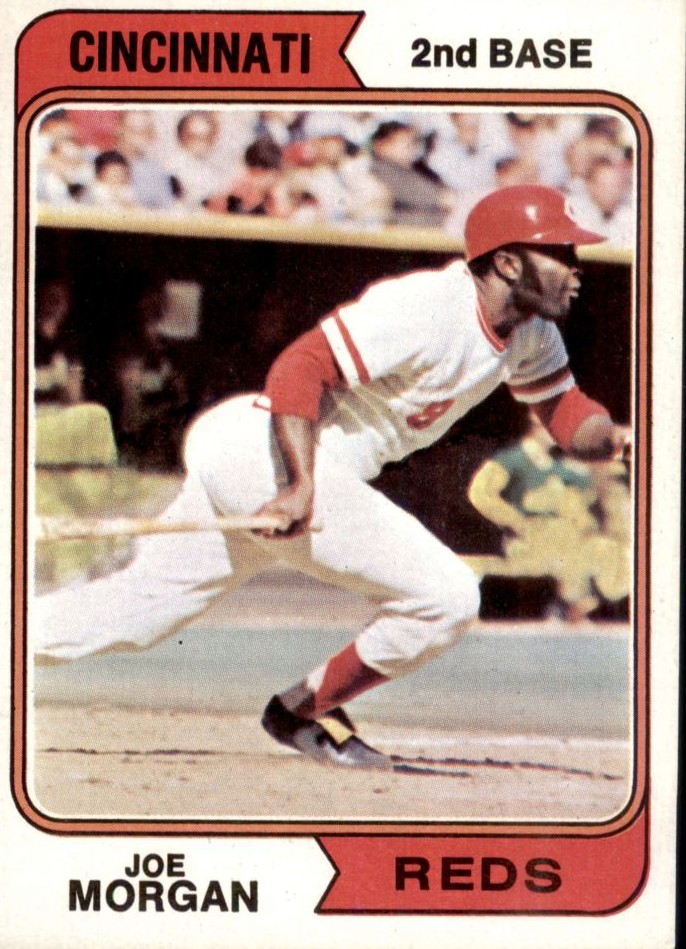
Joe Morgan, 1974 Topps, #85

For twenty-two seasons, Joe Morgan played perhaps some of the best baseball ever seen at second base. From 1963 to 1984, Morgan played on five teams. He started his career with the Houston Colt .45s/Astros for nine seasons before being traded during the 1971 Winter Meetings to the Cincinnati Reds, where he would become a pivotal cog in the “Big Red Machine”. After seven seasons with the Reds, he was back with the Astros for one season in 1980, then went to the San Francisco Giants (2 yrs), Philadelphia Phillies (1 yrs) and finished his career with one final season on the Oakland Athletics. He wore uniform number 8 for thirteen seasons and had a career WAR of 100.6 good for thirty-first all-time.

I used the 1974 Topps for this post because the card is fantastic. Morgan started wearing number 8 with the Reds, and the number is visible on the front of his uniform in this card’s photo.  The photo is a cool action shot of Morgan about to take off after a hit…and look at those epic sideburns! I like the style of these 1974 cards, with the team city and name in the banners around the border. Morgan was an All-Star in 1974. He batted .293, with 150 hits, 31 doubles, 22 home runs, 67 RBIs and 58 stolen bases. He had 120 walks to only 69 strikeouts and a league leading .427 OBP.

Morgan was a ten-time All-Star who won the National League MVP award twice (75, 76), both times with the Reds. In 1975, he led the league in season WAR (11), walks (132), OBP (.466), and OPS (.974) while hitting .327 with 67 stolen bases and winning the Gold Glove Award. In 1976, Morgan led the league in WAR (9.6) OBP (.444), SLG (.576), OPS (1.020) and sacrifice flies with 12.

He won five Gold Glove Awards and was a Silver Slugger in 1982. Morgan was known for his speed stealing over 40 bases in nine different seasons (with 60 or more three times). He was a tough player to strike out with 77 strikeouts being the most in any season. He also led the league in walks 4 separate times.

As a member of the “Big Red Machine”, Morgan was a two-time World Series Champion in 1975 and 1976 (his two MVP seasons) while playing alongside Pete Rose, Johnny Bench and Tony Perez with Sparky Anderson as the manager.  

He retired after the 1984 season with a .271 career batting average, 2517 hits, 449 doubles, 268 home runs, 1133 RBIs, 689 stolen bases (11th all-time), and 1865 walks (5th all-time). For second basemen he is 4th all-time with 5742 putouts, 3rd in assists with 6967 and 6th in double plays with 1505.

Morgan is a member of both the Houston Astros and the Cincinnati Reds Hall of fame with the Reds retiring his uniform number 8 in 1998.

He was inducted into the Baseball Hall of Fame in 1990.

Joe Morgan passed away at the age of 77 in 2020.

Number 1:

Cal Ripken Jr., 1996 Topps Chrome, #28

I’ve been looking forward to this post since I came up with the idea for this series. In the number one spot! Cal Ripken Jr.! the “Iron Man”.

Although I’ve lived in Massachusetts most of my life and am a Red Sox fan, Cal was my hero. When I first started collecting cards I really hadn’t caught full-on Red Sox fever. As a kid, I would float from team to team based on the silliest of things (like rooting for the Tigers because I liked the animal). As I started collecting cards and watching This Week in Baseball or Sportscenter and reading Sports Illustrated or Beckett I just fell in love with Cal’s game. I started collecting every Ripken card I could find, had his poster on my wall, and his Starting Lineup on my desk. As my love for the Red Sox grew, I made sure the games I went to were against the Orioles. There were plenty of opportunities to see Cal play. He was the standard in hard work and dedication.

When I got older and stopped collecting, I regretfully sold most of my cards, but I kept one binder and a box. Both were filled with Cal Ripken cards, and I still have them all. Cal will always be my favorite player of all-time.

Cal Ripken Jr. played for twenty-one years in the Majors from 1981 to 2001. He was a shortstop and third baseman for the Baltimore Orioles, where he played his entire career and wore uniform number 8 for all twenty-one seasons. He had a career WAR of 95.9 and is considered by many, me included, to be the best shortstop in history.

Ripken was an All-Star nineteen times. He was Rookie of the Year in 1982. He was the American League MVP twice (1983 and 1991) and won two Gold Glove Awards. He was an eight-time Silver Slugger. Ripken was a member of the Orioles 1983 World Series Championship team along with Hall of Famers Eddie Murray and Jim Palmer. During his career he played with his brother Billy for six seasons and was managed by his father, Cal Sr., for three.

I choose this 1996 Topps Chrome Ripken card because it commemorates his greatest achievement, one that is unlikely to ever be duplicated. On September 6th, 1995 Cal Ripken played in his 2131st consecutive game, breaking the streak set by Lou Gehrig 56 years earlier. The game was one of the most watched baseball games in ESPN history. Unfortunately, I could not watch it as I was in military training having joined earlier that year, but I still have a couple of VHS recordings that friends and family taped for me. He would continue to play in every game until September of 1998 when he decided to end his streak at 2632 consecutive games.

The wear and tear of his streak eventually took its toll and Ripken played in less than 100 games in 1999 and 2000 before he retired at the end of the 2001 season.

Aside from his consecutive games streak, he would end his career with a .276 batting average, he is 16th in history with 3184 hits, 17th in doubles with 603, 51st in home runs with 431 (the most of any shortstop in history), 29th in RBIs (1695), and 18th in total bases (5168).

Ripken is a member of the Orioles Hall of Fame, and his uniform number 8 was retired in 2001.

He was inducted into the National Baseball Hall of Fame in 2007.

Currently, Ripken is a best-selling author and is deeply involved in charitable organizations.

Number 2:

Carl Yastrzemski, 1975 Tops, #280

“Carl Yastrzemski, Carl Yastrzemski, Carl Yastrzemski, the man we call Yaz (We love him)”, Jess Cain, The Yaz song (1967)

I remember my uncle singing this song when I was young. I believe he still has the record, and I would bet he still sings it when he’s making his lunch. Carl Yastrzemski was a hero to me growing up. I never saw him play live but heard so many stories. As I became increasingly interested in baseball, my uncle, who is the biggest Red Sox fan in history, was perplexed by my love for Cal Ripken, a rival of the Boston Red Sox. My uncle would tell me stories of the greatest Red Sox teams and taught me all about the Curse of the Bambino (which was finally broken in 2004). Those stories made sure that as I grew up and finally stopped rooting for teams based on their logos, I would land with the best fans for the best team. The Boston Red Sox! They have been my favorite team for over thirty years and will always be.

“Yaz” primarily played left field with the Boston Red Sox for his entire twenty-three-year career (he also played a couple of stints at first and third). He is tied with Brooks Robinson for longest tenure with one team. From 1961 to 1983, Yastrzemski was the hero of Fenway Park, wearing uniform number 8 his entire career, while finishing with a career WAR of 96.4.

I love this 1975 Topps design. The colors along the border, with the team’s name shadowed up top and the player’s name below, just pops. The position in the little baseball is a nice touch, and I love this photo of Yaz, especially with his uniform number visible. Though 1975 was a down year (.269 batting average, 14 home runs, 60 RBIs), he still made an All-Star appearance.

Yaz was an eighteen-time All-Star. He led the league in season WAR three times, runs and hits twice, doubles and batting average three times, walks twice, OBP five times, SLG three and OPS four times. In 1967 he was the American League MVP and led the league in home runs (44), RBIs (121) and batting average (.326), winning the elusive Triple Crown. 

At the end of 1983 he retired from baseball at the age of 44. He finished his career with a .285 batting average. He is 9th all-time in hits (3419), 9th in doubles (646), 41st in home runs (452), and 15th all-time in RBIs (1844). Yaz is also 6th all-time in walks with 1845 and is 10th in Total Bases with 5539. He has a career OBP of .379, SLG of .462 and OPS of .841.

Yastrzemski was also an amazing defender, leading American League left fielders in assists seven times and winning seven Gold Glove Awards. Sabermetrics determines his placement as second all-time defensive left fielder, specifically Total Zone Runs, or as they abbreviate it on their site, “rtot.” Yastrzemski accumulated an rtot of 135 over his 23-year MLB career (Bonds finished with a 184 rtot). Perry, Jeff bosoxinjection.com

He is a member of the Red Sox Hall of Fame, and his uniform number 8 was retired in 1989.

He was inducted into the Baseball Hall of Fame in 1989.

Carl Yastrzemski is still loved by the Fenway Faithful and at 85 years old, threw out the first pitch at Fenway to start the 2025 season.

Number 3:

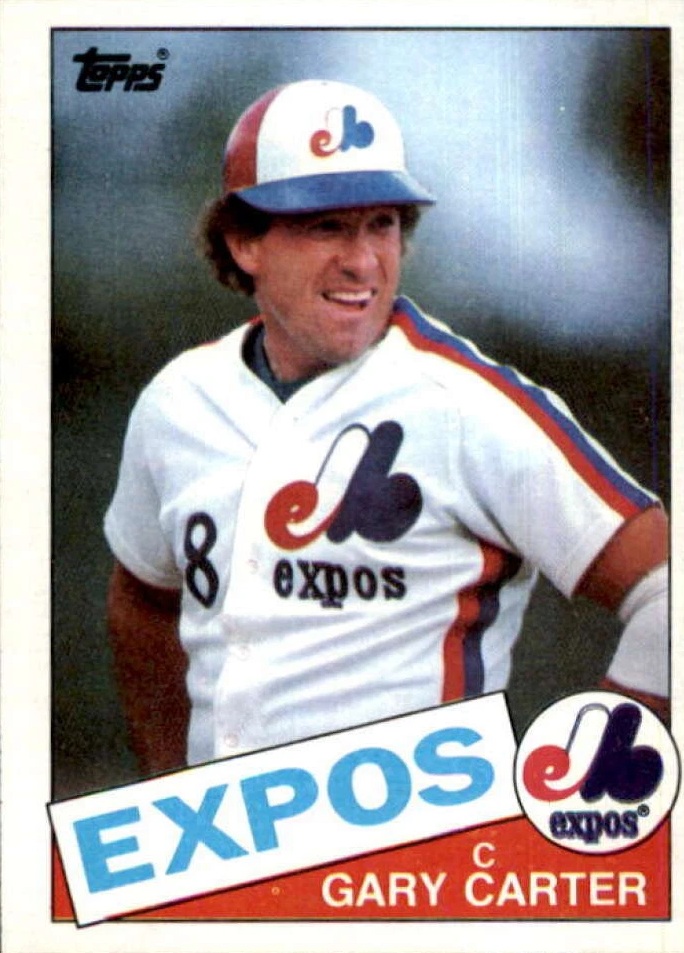
Gary Carter, 1985 Topps, #230

The original “Kid”, Gary Carter was known as an excellent defensive catcher who could hit well and motivate his teammates with his excitement for the game. Carter played nineteen seasons in the Majors from 1974 to 1992 as a catcher with the Montreal Expos for 10 seasons, then the New York Mets, San Francisco Giants, LA Dodgers and his last season back in Montreal. Carter wore uniform number 8 for eighteen seasons, having worn 57 his rookie year. He had a career WAR of 70.1.

I choose this awesome 1985 Topps for Carter. I love the 1985 Topps set, and this card is great. The colors blend perfectly with the Red, White and Blue Expos uniform, Carter’s uniform number visible on the front., and the team logo on the front. A perfect card for the post. Carter was an All-Star in 1985, having hit the most home runs of his career (32) to go along with a .281 batting average and 100 RBIs. He was a member of the 1986 World Series Champion Mets when they beat the Red Sox. The curse had struck again!

Carter was an All-Star in eleven seasons. He won five Silver Slugger awards and hit 100 or more RBIs in four seasons. He also won 3 Gold Gloves while leading the league’s catchers in putouts seven times, assists five times and double plays four times.

Carter finished his career in 1992 with a career batting average .262 and 2092 hits, 371 doubles, 324 home runs, and 1225 RBIs. For his career as a catcher he caught 127 shutouts, had 11785 putouts and 149 double plays.

He is a member of the Montreal Expos and New York Mets Hall of Fame, and his number 8 was retired by the Expos in 1993.

Carter was inducted into the National Baseball Hall of Fame in 2003.

Gary Carter passed away in 2012 at the age of 57 after a courageous battle with brain cancer.

Number 4:

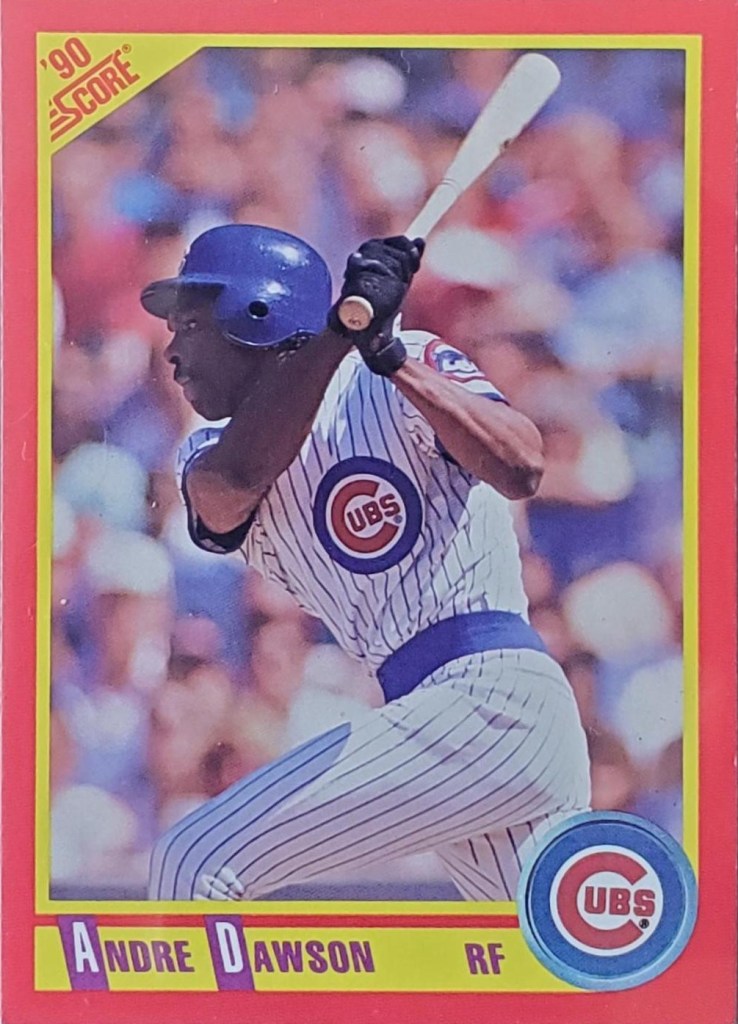
Andre Dawson, 1990 Score, #265

“the Hawk” is another player whose cards have a big place in my binder. He played for twenty-one seasons from 1976 to 1996 as an outfielder. Like Gary Carter above, Andre Dawson started his career with the Montreal Expos where he played for eleven seasons. In 1987, he joined the Cubs where he stayed until 1992. He finished his career with two-year stints on the Boston Red Sox and the Florida Marlins. He wore uniform number 8 for eight seasons and had a career WAR of 64.8.

I had trouble finding cards with Dawson’s number 8 showing. He wore the number while with the Cubs, and my memories of “the Hawk” are mostly during his Cubs tenure so I picked this 1990 Score. I liked collecting the Score cards and have a few of this card. I think it’s a nice action shot of Dawson. In 1990, he was an All-Star with a batting average of .310, 27 home runs, 100 RBIs, 16 stolen bases and led the league with 21 intentional walks.

Dawson was an eight-time All-Star. He was the National League ROY in 1977 and the MVP in 1987. He was also a great defender having won eight Gold Glove Awards. He was a four-time Silver Slugger who batted over .300 on five occasions. He was also fast on the bases and stole 25 or more in six seasons. By 1994 injuries began to reduce his playing time and he played less than 80 games in each of his last few seasons before retiring in 1996.

Dawson finished his career with a .279 career batting average. He had 2774 hits with 503 doubles. His 438 home runs are 47th all-time and his 1591 RBIs are 40th. He had 314 stolen bases and is 31st in Total Bases with 4787.

Dawson is a member of the Montreal Expos and Chicago Cubs Hall of Fames.

He was inducted into the National Baseball Hall of Fame in 2010.

Number 5:

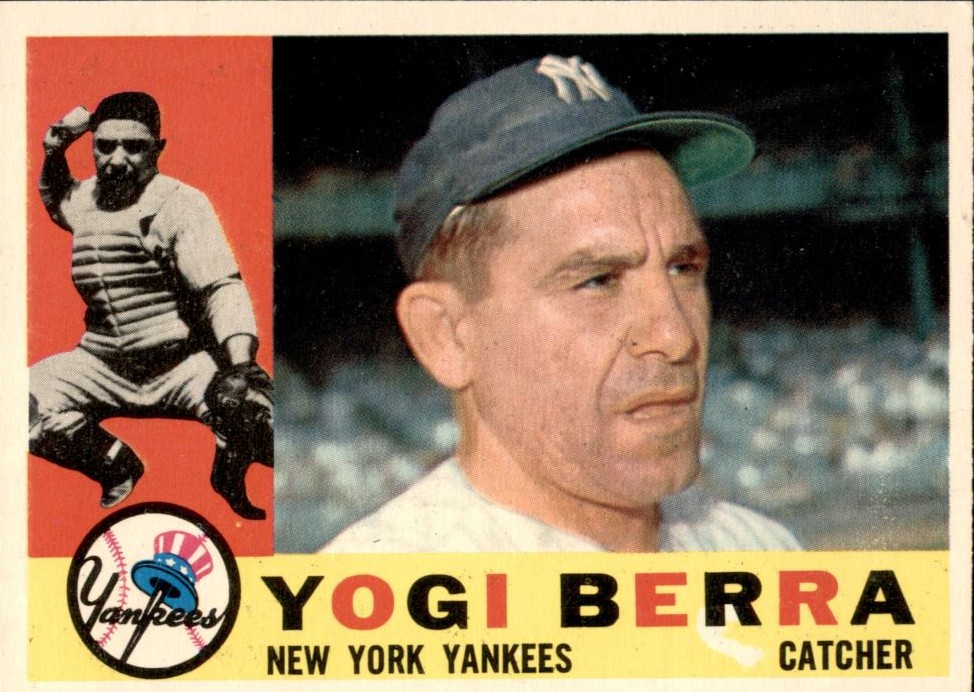
Yogi Berra, 1960 Topps, #480

“Ninety percent of the game is half mental.” ~ Yogi Berra

Yogi Berra was a catcher for nineteen seasons in the Major Leagues. He was well known for his sense of humor and his “yogisms”. Berra played from 1946 to 1965 for the New York Yankees, with his last season for the crosstown New York Mets. He wore uniform number 8 for sixteen seasons and had a career WAR of 59.5.

I used this 1960 Topps card because I like the design and the photo of Berra in his catcher’s gear is great. In 1960 Berra was an All-Star…twice!

For his career, Berra was an All-Star eighteen times (twice from 59-61). He was the American League MVP three times (51, 54, 55). He batted .290 or better seven times, hit 25 or more home runs six times and had over 100 RBIs five times. On the defensive end, he led catchers in putouts eight times, assists three times, and double plays six times. He played with many Yankee greats throughout his career, including Joe DiMaggio, Phil Rizzuto, Johnny Mize, Whitey Ford, and Mickey Mantle.  Berra was a World Series Champion 10 times, the most of any player, and holds many series records.

He has a career .285 batting average with 2150 hits, 358 home runs, 1175 runs, 1430 RBIs and a career .989 fielding percentage at catcher. He holds the World Series records for the most games (75), hits (71), doubles (10), singles (49), games caught (63), and catcher putouts (457). Marcius, Chelsia Rose; McShane, Larry; Madden, Bill (September 2015)

His uniform number 8 was retired by the New York Yankees in 1972 along with his idol Bill Dickey (who will also be on this list). Aside from Jackie Robinson’s 42, I think this is the only instance where a number has been retired twice by one team. If anyone knows otherwise, drop a comment. 

Berra was inducted into the Baseball Hall of Fame in 1972.

Yogi passed away at age 90 in 2015.

Number 6:

Willie Stargell, 1968 Topps, #86

For twenty-one seasons, Wilver “Willie” Stargell, could be seen warming up with a sledgehammer during the Pirates batting practice. From 1962 to 1982, Stargell played left field and first base exclusively for Pittsburgh. He wore uniform number 8 his entire career and had a career 57.6 WAR.

I love this 1968 Topps card! It’s got a great photo of Stargell with his uniform number right on the front of the card. The only thing missing is the sledgehammer. 1968 wasn’t his best year, he batted only .237 with 24 home runs and 67 RBIs.

Stargell was a seven-time All-Star. He shared the 1979 National League MVP award with Keith Hernandez. Stargell batted .281 with 32 home runs and 82 RBIs that season. During his career, he led the league in home runs and OPS twice and in doubles, RBIs, WAR, and SLG once. Stargell had eight seasons with a .290 or better batting average. He was a member of two Pirates World Series Championships, 1971 with teammates Roberto Clemente and Bill Mazeroski and 1979 with teammates Bert Blyleven and Dave Parker. He was the MVP of the 1979 World Series after batting .400 with a .375 OBP, 12 hits, 4 doubles, 3 home runs and 7 RBIs.

Stargell earned the nickname “Pops” later in his career and was a mentor to young players in the Pirates organization until his last game in 1982. He ended his career with a .282 batting average accumulating 2232 hits, 423 doubles, 475 home runs (tied with Stan Musial for 32nd all-time), and 1540 RBIs (49th all-time).

Stargell is a member if the Pirates Hall of Fame and his uniform number 8 was retired by the Pirates in 1982.

He entered Cooperstown in 1988.

Wilver “Willie” Stargell passed away at 61 in 2001.

Number 7:

Bill Dickey, 1934 Diamond Stars, #11

Bill Dickey played catcher exclusively with the New York Yankees for seventeen seasons from 1928 to 1946 (missing the 44 and 45 seasons for military service). He would go on to become a coach and a mentor to the Yankees young catcher, Yogi Berra, who also made it on this list. Dickey wore uniform number 8 every season aside from his first, and had a career WAR of 56.4.

I’m always happy to include a Diamond Stars card! This 1934 Bill Dickey is a beautiful card. The portrait is one of the best I’ve seen, and the background colors are awesome. In 1934 Dickey batted .322 with 12 home runs and 72 RBIs making the All-Star team.

Dickey was an All-Star in eleven seasons. He batted over .300 eleven times and hit over 20 home runs and 100 RBIs in 4 straight seasons from 1936 to 1939, amazing accomplishments for a catcher, especially during the ‘30s. In 1936 he batted .362 which is tied with Mike Piazza for 2nd highest season average by a catcher in history. 

He won seven World Series Championships with the New York Yankees, in 1932 on a team that featured nine Yankees Hall of Famers, including Babe Ruth, and in 1936-1939, 1941 and 1943, all great Bronx Bombers teams.

He finished his career in 1946 as a player/manager. He had a career batting average of .313 with 1,969 hits, 202 home runs, 930 runs and 1,209 RBIs.

His uniform number 8 was retired by the New York Yankees along with the Yogi Berra in 1972. Aside from Jackie Robinson’s 42, I think this is the only instance where a number has been retired twice by one team. If anyone knows otherwise, drop a comment. 

Bill Dickey passed away in 1993 at the age of 86.

Final Score:

Thanks for sticking with me with this long post. I knew uniform number 8 would take a bit, but it was important to me to tell stories about two of my favorite players to wear the number. I only have a couple of shoutouts this time.

Reggie Smith (career WAR 64.8) wore number 8 for six seasons with the Dodgers and was previously featured in the uniform number 7 post.

A few players didn’t make the list but wore the number for a long time. Bob Boone (18 seasons), Gary Gaetti (15 seasons), Ryan Braun (14 seasons) and Javy Lopez (12 seasons). There were quite a few more, so someday I’ll do more posts with all these shoutouts!

Thanks again for reading and if you’re enjoying these posts, leave a like or a comment or subscribe to the newsletter. I’d love to hear from you!

 Sources:

https://www.baseball-almanac.com/

Berra, Yogi (1998) The Yogi Book. New York: Workman Publishing. p. 9. 

Berardino, Mike (2013). “Minnesota Twins: Joe Mauer takes Mike Piazza’s comments in stride”. Twincities.com

https://www.baseball-reference.com/

Marcius, Chelsia Rose; McShane, Larry; Madden, Bill. “Yogi Berra dead at 90: Yankees legend, Baseball Hall of Famer was lovable character, American hero”Daily News. (September 23, 2015 UPDATED: April 9, 2018)

Perry, Jeff (2024) “History: Carl Yastrzemski’s defense somehow rivaled his stellar offense”. bosoxinjection.com

https://www.sabr.org

Shout out to all the cool cards and creative commons for my pictures! Thanks Topps and Upper Deck and Fleer and Donruss and all the rest!

Baseball by the Numbers: 4

Read about the project

Checklist

4

Welcome back to Baseball by the Numbers. Today we are looking at uniform number 4. Uniform number 4 had over 550 players listed at the number. Just like number 3, there were a lot of great names on the list. Using my criteria, I was able to narrow things down. There were seventy-three players to wear the number 4 for five years or more and thirty-eight had a career WAR of 40 plus.

Last post I made a special spot for Babe Ruth, highest career WAR in history, and after I did that, I decided it would be cool to just have anyone with a career WAR over 100 listed as a Legend, that is of course depending on a few factors (see A-Rod). In all of history there are only thirty-two players with a 100 or more career WAR and three have some significant controversies, asterisks if you will (Bonds, Clemens, A-Rod). I think nine played prior to uniform numbers (Ty Cobb, Tris Speaker, Cy Young, Walter Johnson, Honus Wagner, Kid Nichols, Grover Alexander, Nap Lajoie, and Christy Mathewson). I may have to do a post at some point of pre-uniform numbered players (spoiler: those nine will probably be the list). I also already used two (Ruth and A-Rod). So, I’m down to eighteen possible Legends. I figured, “what the hell, let’s do it.” and turned my attention to uniform number 4. Well, to my surprise, three of the Legends wore this number! Crazy! In this post there will be three Legends and my top seven after that. Enjoy!

The Legends:

By Unknown author – The Sporting News via, Public Domain

With a 127.3 career WAR “the Rajah” is ranked twelfth all-time. Rogers Hornsby played for twenty-three years in the MLB. He was one of the greatest hitters of all time. He played from 1915 to 1937 for the St. Louis Cardinals, New York Giants, Boston Braves, Chicago Cubs, the Cardinals again, and finally the St. Louis Browns. He wore uniform number 4 for four years.

Hornsby won his only World Series ring in 1926 with the Cardinals. He was a two-time National League MVP. He won the Triple Crown in 1922 when he hit .401 with 42 home runs and 152 RBIs. That season he also led the league in WAR (10.1), runs (141), hits (250), doubles (46), OBP (.459), OPS (1.181) and SLG (.722). He then won the Triple Crown for a second time in 1925. Over his career, he led the league in batting average seven times, hitting .400 or better in three of those seasons. He had 200 or more hits in seven seasons.

Not only could he get on base, but he had a lot of power, leading the league in home runs twice, RBIs four times, and doubles four times.

Later in his career Hornsby continued with baseball as a player/manager and as a manager and coach. He managed the St. Louis Cardinals (’25-’26), New York Giants (’27), Boston Braves (’28), Chicago Cubs (’30-’32), St. Louis Browns (’33-’37 and ’52), and Cincinnati Reds (’52-’53).

Like three players who I have already written about, Bobo Newsom (00 post) and Frankie Frisch and Babe Ruth in the uniform number 3 post, he is mentioned in Ogden Nash’s 1949 poem “Line-Up for Yesterday” . Spoiler alert, this poem will be mentioned at least two more times later in this post as well.

Hornsby would finish his career with a 127.3 WAR (12th all-time). He is third all-time in batting average (.358), tenth in OBP (.434), fifteenth in SLG (.577) and eleventh in OPS (1.010). He also had 2,930 career hits, 541 doubles, 169 triples, 301 home runs and 1,584 RBIs.

Hornsby is a member of the Chicago Cubs and St. Louis Cardinals Hall of Fame; he was voted onto both the All-Century Team and the All-Time Team and was elected to the National Baseball Hall of Fame in 1942.

Hornsby passed away in 1933 at age 66.

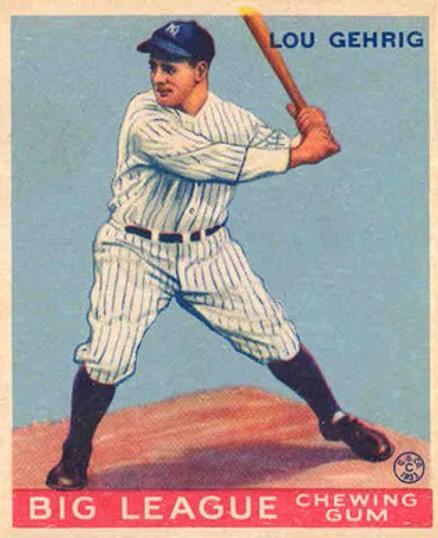
Lou Gehrig, 1933 Goudey, #92

“The Iron Horse” played for seventeen years in the majors, all of them with the New York Yankees. He is not only a legend in New York, but a legend to all baseball fans (see? even as a Red Sox fan, I can admit that). He played from 1923 to 1939, and wore uniform number 4 for eleven seasons, starting in 1929 when the Yankees started using uniform numbers. His career WAR of 113.7 is 18th all-time.

That 1933 Goudey card is legendary. Anyone who collects cards should recognize it. I say this all the time, but I love the art-deco style of these old ‘30s cards. Gehrig’s signature left-handed batting stance backdropped in blue is just so beautiful and full of baseball nostalgia. In 1933 Gehrig was an All-Star. He led the league with 138 runs. He had a .334 batting average, with 198 hits, 41 doubles, 32 home runs and 140 RBIs. 

On April 30th, 1939, after struggling to start the season, Gehrig sat out for the first time in 2,130 consecutive games. A record that remained unbroken until Cal Ripken Jr. broke it on September 6th, 1995. Sadly, Gehrig’s career was cut short in 1939 when he was diagnosed with ALS.

Gehrig was a seven-time All-Star who was part of six World Series Championships with the Yankees. His World Series production is incredible. He played 34 total World Series games across his six World Series wins and batted .361 with 8 doubles, 3 triples, 10 home runs, 35 RBIs, a .483 on-base percentage, .731 slugging percentage, and 1.214 OBP.

He was a two-time AL MVP in 1927 and 1936. He won the triple crown in 1934 with 49 home runs, 160 RBIs and a .363 batting average. He led the league in batting average once (1934), home runs three times (’31,’34,’36) and RBIs five times (’27,’28,’30,’31,’34). Like Hornsby, he was a part of the MLB All-Century team and All-Time Team. He was elected to the Baseball Hall of Fame in a special election in 1939.

Like Bobo Newsom in the 00 post ,Frankie Frisch and Babe Ruth in the uniform number 3 post, and Rogers Hornsby above, he is mentioned in Ogden Nash’s 1949 poem “Line-Up for Yesterday” .

In 1941, at the young age of 37, Lou Gehrig died from complications of ALS only two years after his diagnosis.

His number 4 was retired by the Yankees in 1939.

Mel Ott, 1935 Diamond Stars, #50

Mel Ott’s career WAR of 111 is 20th all-time. Ott played for twenty-two years from 1926 to 1947 with the New York Giants. He spent his entire career as a right fielder and third baseman with New York and wore uniform number 4 for fifteen seasons. Like Hornsby and Gehrig, Ott was also a part of Ogden Nash’s 1949 poem “Line-Up for Yesterday”.

His 1935 Diamond Stars shows a great depiction of his intense stare. What MLB pitcher wouldn’t be intimidated facing him? The card is another beautiful example of the art-deco style of ’30 baseball cards. I love this card’s picture, especially the red flag flying in the background.

Ott was a twelve-time All Star who led the National League in home runs six different seasons and RBIs once. He was a member of the 1933 World Series winning New York Giants team, in which he hit .389, with 2 home runs, 4 RBIs and 4 runs. Ott was another player manager from 1942 to 1946, but in ’46 a serious knee injury forced him to miss most of the season. He still got four at bats in 1947, before officially leaving as a player, but continued to manage for two more seasons.

Ott finished his career with a .304 batting average, including 2,876 hits. He is 9th all-time in walks with 1,708. His 511 career home runs are tied at 25th with Miggy Cabrera. He’s 14th all-time in RBIs with 1,860. He has 488 career doubles, .414 OBP, .533 SLG and .947 OPS.

Ott was elected to the Baseball Hall of Fame in 1957.

His uniform number 4 was retired by the Giants in 1949.

After managing, he would eventually enter the broadcast booth from 1956 until 1958 when he would pass away at the age of 49 from complications due to an auto accident.

Now that the Legends are covered, we can get to my seven selections. I don’t think any other number will have three heroes, but there are still fifteen players left with over 100 career WAR, so I guess we’ll find out together.

Number 1:

Luke Appling, 1936 Diamond Stars, #95

Luke Appling played shortstop for twenty seasons in the MLB, from 1930 to 1950. He did miss one season (1944) due to his military service. He played his entire career with the Chicago White Sox and wore uniform number 4 for seventeen seasons. His career WAR was 77.2.

Another awesome card, his 1936 Diamond Stars is one of my favorites so far. I know I’m getting repetitive, but these cards are so fun! This one has the coolest colors, and I love the two players in the background. I’m not sure, but based on the picture in the foreground, it’s possible the background fielder also depicts Appling, only showing off his fielding skills. In 1936 Appling was an All-Star. He had a 7.1 season WAR and led the league in batting average (.388).

Appling was a seven-time All-Star, who led the American League in batting average twice (1936 and 1943). He hit over .300 in sixteen of his twenty seasons.  He is 5th all-time in double plays turned by a shortstop with 1,424.

He had a funny nickname, “Old Aches and Pains”, as he was said to constantly have minor complaints about such things as a sore back or sprained finger. It didn’t stop him from playing hard though.

Appling had a career .310 batting average with 2,749 hits (4th all-time at shortstop), 440 doubles and a .399 OBP. Appling was great at getting on base, having had over 100 walks a season on three separate occasions and an over .400 OBP eight times. He wasn’t a huge power hitter and in fact only 27% of his hits went for extra bases.

Appling was inducted into the Baseball Hall of Fame in 1967. His uniform number 4 was retired by the White Sox in 1975.

In 1991 Appling passed away at the age of 83.

Number 2:

Paul Molitor, 1985 Topps, #522

Paul Molitor is a player that I grew up watching and collecting. He played twenty-one years in the majors from 1978 to 1998. Primarily a third and second baseman, Molitor played with the Milwaukee Brewers for fifteen seasons. He then played with the Toronto Blue Jays and the Minnesota Twins. He wore uniform number 4 for eighteen seasons, with only his three seasons in Toronto the exception (#19). His career WAR is 75.7.

Known as “the Ignitor” due to his ability to make things happen on the diamond. He could hit and steal with the best of them and is one of only five players in history with a career batting average of .300 or more, over 500 stolen bases and over 3,000 hits. The others being Ty Cobb, Honus Wagner, Eddie Collins, and Ichiro Suzuki. 

This 1985 Topps is just a thing of beauty. I love the 1985 Topps cards. I didn’t start really collecting in earnest until 1986, but I remember I started getting packs of cards in the early ‘80s and just loving every single design. This one is wonderful, with Molitor’s batting stance backed by the blue sky, his Brewers uniform crisp and clean, the number 4 perfectly visible on the front, it’s such a great card. In 1985 Molitor would be an All-Star for the 2nd time with a .297 batting average, 21 stolen bases, 28 doubles and 174 hits.

Molitor was a seven-time All-Star. He was 2nd in ROY voting in 1978 losing to sweet Lou Whitaker who was already featured under the uniform number 1 post.

He was a World Series champion with the 1993 Blue Jays and was the MVP of the series hitting .500 with 2 doubles, 2 triples, 2 home runs, 4 RBIs, 1 stolen base and 4 runs.

He is a four-time Silver Slugger, and in 2017 was the American League Manager of the Year with the Minnesota Twins.

His career 3,319 hits ranks 11th all-time, and he is 15th all-time in doubles (605). Molitor has a career batting average of .306 with 234 home runs, 1,782 runs, 114 triples and 504 stolen bases.

Molitor was elected to the Baseball Hall of Fame in 2004, and his uniform number 4 had been retired by the Milwaukee Brewers in 1999.

Number 3:

Duke Snider, 1957 Topps, #170

Known as “the Duke of Flatbush”, Snider played eighteen years in the MLB, sixteen with the Brooklyn/Los Angeles Dodgers and a season each with the New York Mets and the San Francisco Giants. He was an outfielder who wore uniform number 4 seventeen seasons. He also wore it for half a season with the Mets and while on the Giants, number 4 was already retired due to the previously mentioned Mel Ott.  His career WAR was 66.

This 1957 Topps card was a perfect fit for my post. The photo of Snider is wonderful, with his uniform number front and center. I like most Topps cards, but I’ll be honest, I’m not a huge fan of this design. The photo is nice, but the player and team name colors are off putting, and the card is just basic. Still, I got that uniform number on there, so I’m happy with that. In 1957, Snider batted .274, he had 40 home runs (it was his fifth straight season with 40+ home runs) and 92 RBIs.

Snider was a eight-time All-Star who led the National League in home runs in 1956 with 43 and RBIs in 1955 with 136. He won two World Series rings with the Dodgers in 1955 and 1959 on teams that included Pee Wee Reese , Jackie Robinson, Sandy Koufax, Roy Campanella and Don Drysdale. He was a great fielder too, leading the league in center field fielding average 3 different seasons.

Snider led the league in WAR twice, runs three times and had over 190 hits in three different seasons. He ended his career with a .295 batting average, 407 home runs, 2,116 hits and 1,333 RBIs.

He was voted to the Hall of Fame in 1980.

His uniform number 4 was retired by the Dodgers in 1980.

Duke passed away at the age of 84.

Number 4:

Joe Cronin, 1933 Goudey, #109

Joe Cronin was involved with the MLB for almost fifty years as a player, manager, GM and as president of the American League for fifteen years from 1959 to 1973.

As a player, Cronin was a shortstop for twenty years from 1926 to 1945. He played two seasons with the Pittsburgh Pirates, then seven with the Washington Senators, and finally eleven seasons with my Boston Red Sox. He wore uniform number 4 for fourteen seasons with Washington and the Sox and had a career WAR of 64.8.

Joe Cronin’s 1933 Goudey card is one of the more basic cards of the set, but it’s still cool. The shortstop is bent down, glove at the ready overlapping a bright yellow background. In ’33 Cronin was selected to his first All-Star appearance. He led the league in doubles with 45 and had a .309 batting average. He had 118 RBIs with 5 home runs! Is it just me or does that seem a little crazy sounding?

Cronin would go to seven more All-Star games. He was the MVP in 1930, and hit over .300 eight times, and had over 100 RBIs eight times.

In 1933 as a player/manager, his Senators lost the World Series to the New York Giants. While playing he managed the Senators in the ’33 and ’34 seasons, and he managed the Red Sox all eleven seasons plus two more after retiring as a player. In 1946 he was again managing a World Series team, but the Red Sox lost to the Cardinals. He finished his managing career with an over .500 winning percentage.

He had a career .301 batting average with 2,285 hits, 515 doubles and 1,424 RBIs, and a career .390 OBP.

After his stint as the Red Sox manager, he would go on to become their General Manager for eleven years from 1947 to 1959 before becoming the president of the American League.

Cronin is a member of the Boston Red Sox Hall of Fame, and he was inducted into the National Baseball Hall of Fame in 1956.

His number 4 was retired by the Red Sox in 1984.

Cronin passed away in 1984 at 77 years old.

Number 5:

Ralph Kiner, 1952 Bowman, #11

Ralph Kiner only played for 10 seasons from 1946 to 1955. He was an outfielder and played on the Pittsburgh Pirates, the Chicago Cubs and the Cleveland Indians. He had a career WAR of 48.1 and wore uniform number 4 for eight seasons.

This 1952 Bowman shows Kiner in his Pirates uniform who he played with for seven seasons. He wore number 4 with the Pirates, although I couldn’t find a card with the number showing. In 1952 he was an All-Star for the 5th time and led the league in home runs for the 7th year in a row with 37. He also led the league in walks with 110.

Kiner was a six-time All-Star, who led the league in home runs seven straight years from 1946 to 1952. He also led the league in RBIs in 1949. He had two seasons with over 50 home runs and five with over 40. He also had over 100 RBIs in six seasons. Unfortunately he was forced to retire after a serious back injury at only 32 years old.

He finished his career with 369 home runs, 1,015 RBIs and a .279 batting average. Imagine if he had played just a couple more seasons.

He went on to become a popular broadcaster with the New York Mets, staying behind the mic for fifty-three seasons. He was honored with the New York Mets “microphone” in 2014 and is a member of the Mets Hall of Fame.

As a player he is a member of the Pirates Hall of Fame and was inducted into the National Baseball Hall of Fame in 1975.

His number 4 was retired by the Pirates in 1987.

Kiner passed away at the age of 91 in 2014.

Number 6:

Bobby Grich, 1986 Donruss, #207

It’s Bobby Grich not Grinch, which for some reason I just keep typing, even though he looks like a happy dude in most pictures. Still, I’d be a grinch if I played as well as Bobby and wasn’t in the Hall of Fame!

Grich played second base for seventeen seasons from 1970 to 1986 with the Baltimore Orioles and the California Angels. He wore uniform number 4 for ten seasons and had a career WAR of 71.1.

1986 was his last season, but I found Grich’s ’86 Donruss to be a nice looking card. His uniform number is easy to see, which is part of my criteria for these posts, and the card design is perfect ‘80s style. Grich didn’t have a great season in ’86 as he was starting to slow down, getting only 313 at bats for the season. When the Angels lost the ’86 ALCS to the Boston Red Sox after being up three games to one, Grich announced his retirement.

During his career, Grich was a six-time All-Star. He won four Gold Gloves and a Silver Slugger Award in 1981 while leading the American League in home runs with 22. He is a member of both the Angels and Orioles Hall of Fame.

Number 7:

Carney Lansford, 1986 Topps, #134

I was very happy to include Carney Lansford on this list. There were a few players I could have put ahead of him, but growing up, he was a player I really liked, so he got the nod.

Lansford played for fifteen years in the MLB from 1978 to 1992. He was primarily a third baseman but also played a little first as well. He played for the California Angels until 1980 when he was traded to the Boston Red Sox. He played with Boston in 1981 and 1982, but with Wade Boggs emerging as a future Hall of Famer, Lansford was traded to the Oakland Athletics where he would remain the rest of his career. Lansford had a Career WAR of 40.4 and wore uniform number 4 for twelve seasons.

I really love the 1986 Topps. I know there are many who don’t, and I understand why. I would say it’s probably the worst design of the ‘80s Topps cards, but it is a set that I have a lot of memories of. This Lansford card was a perfect choice because his number is so prominently displayed. I also love the way his photo and the A’s name at the top match so well. In 1986, Lansford batted .284 with 19 home runs, 72 RBIs and 16 stolen bases.

Lansford was an All-Star once in 1988. He won a Silver Slugger and was the American League batting champion in 1981 with the Red Sox. He batted over .300 five different seasons.  He also won a World Series ring in 1989 with an Oakland team that included Dennis Eckersley, the great Rickey Henderson, Dave Parker and the Bash Brothers (Jose Canseco and Mark McGwire). There was a major earthquake during this World Series, giving it the name, “The Earthquake Series”. I remember it well.

Lansford was great during the postseason. In 33 postseason games he hit .305 with 2 home runs and 18 RBIs. After retiring, he would go on to coach with multiple franchises.

He is a member of the Athletics Hall of Fame.

Final Score:

I found it crazy that out of the thirty-two players in all of MLB history with a career WAR over 100, three of them wore number 4. The great part about that was it let me write about three extra players. (Carney Lansford would have never made it on the post without the Legend category)

There are some players I’d like to mention who wore number 4 that I didn’t include. Jimmie Foxx wore it one season (old giant arms was in my last post here). Hall of Famers Craig Biggio (2 seasons) Billy Herman (5 Seasons) and Bill Terry (1 season) all wore it. Kansas City Royals All-Star and defensive player extraordinaire, Alex Gordon, had it for thirteen seasons. Lenny Dykstra had it for twelve. There are also a couple of currently active players who have number 4 and could make this list someday (George Springer and Ketel Marte). There is one player who I really could have included if I had eight spots, so why not stick him in here.

Yadier Molina played catcher for the St. Louis Cardinals for nineteen years from 2004 to 2022 and had uniform number 4 for seventeen of those. He got edged out by Lansford, but only because I liked Lansford growing up. Molina was a 10x All-Star, 9x Gold Glove winner, a 4x Platinum Glove winner and won two World Series rings with the Cardinals (06,11). Let’s end this post with a card!

Yadier Molina, 2021 Topps, #41

I hope you come back for uniform number 5! Thanks for reading and please leave some comments or likes or shares.

PLAYER NAMEYEARS WORNCAREER WARNUMBER RETIREDOTHER ACHIEVEMENTS
Luke Appling1777.2Yes (White Sox 1975)7 x All-Star
2x AL Batting Champ
HOF (64)
Paul Molitor1875.7Yes (Brewers 1999)7 x All-Star
World Series Champ (93)
4 x Silver Slugger AL Manager of the Year (17)
HOF (04)
Duke Snider1766Yes (Dodgers 1980)8 x All-Star
World Series Champ (55,59)
NL Home Run Leader (56)
NL RBI leader (55)
Joe Cronin1464.8Yes (Boston Red Sox 19847x All-Star
HOF (56)
Ralph Kiner848.1Yes (Pirates 1981)6x All-Star
7x NL Home Run Leader
New York Mets “microphone” HOF (75)
Bobby Grich1071.1no6x All-Star
4 X Gold Glove Silver Slugger (81) AL home run leader (81)
Carney Lansford1240.4no1 x All-Star
World Series Champ (89)
Silver Slugger (81) AL Batting Champ (81)

Sources:

https://www.baseball-almanac.com/

https://www.baseball-reference.com/

https://www.sabr.org

Shout out to all the cool cards and creative commons for my pictures! Thanks Topps and Upper Deck and Fleer and Donruss and all the rest!

Baseball by the Numbers: 3

Read about the project

Checklist

3

Welcome back to Baseball by the Numbers. Today we are looking at uniform number 3. Another number with a lot of players. At least 650 players have worn uniform number 3 in the history of baseball, so my criteria will come in handy to narrow things down. Still, I found it a lot harder than anticipated. There were a lot of great players on this list.

Some, like greats Mel Ott and Arky Vaughan wore number 3 for just one season. One of my favorite players mentioned in the uniform number 2 post, Charlie Gehringer, wore it in 1931 for one year with the Tigers, probably because he batted 3rd that season. Hall of Famer Ken Griffey Jr. wore it for three seasons with the Reds toward the end of his career.

Out of the 650 players who wore uniform number 3, ninety of them had the number for five years or more and thirty-seven had a career WAR over 40, so picking seven was a bit of a challenge. Aside from excluding A-Rod (I’ll get to that at the end of the post), there was another player I struggled with. Not because he wasn’t deserving of the number one spot, but more because I felt he was deserving of his own special place on the list. So, I created a spot. The Legend spot. I may reserve this spot for players who have a career WAR over 100 (there’s only thirty-two in history-a couple controversial) or for some other reason, but for now I think this player deserves it.

The Legend:

Babe Ruth, 1933 Goudey, #53

I don’t know if I could say anything about the great Babe Ruth that hasn’t already been said. When I was a kid, just learning about baseball, I remember legends about the mythical Babe Ruth. Documentaries and books were everywhere and of course in Massachusetts “The Curse of the Bambino” was more popular than Bloody Mary.

The Sultan of Swat is an American sports icon. His 182.6 career WAR is the highest in all of baseball, and for players who wore the number 3, it was 65 points higher than any other player to wear the number. Ruth played baseball for twenty-two years and wore number 3 for seven. Keeping in mind it was the only number he ever wore, but he played most of his career before teams wore numbers on their uniforms.

Like all of Ruth’s cards, this 1933 Goudey card is iconic. To own a piece of this legend would be amazing, but most of his cards sell for the price of a car or a house or more! Here’s a link to a cool guide on Babe Ruth cards and prices from Throwback Sports Cards. The pictures are worth a click alone.

Ruth played for the Red Sox, Yankees and the Boston Braves. He was both an amazing pitcher and a prolific hitter. Ruth was a two-time All-Star, which sounds crazy, but the All-Star game started in 1933, at the end of his career. He won seven World Series rings. He led the American League in home runs twelve times and in RBIs six times. His career pitching record was 94-46 with an amazing 2.24 ERA and 488 strikeouts. He is third in history with 714 home runs, third in RBIs with 2,214 and thirteenth all time in batting average with .342. He is the all-time MLB leader in slugging (.690), OPS (1.164) and WAR 182.6.

Ruth was elected to the Baseball Hall of Fame in 1936, with the Hall’s inaugural class that included four other legends; Honus Wagner, Christy Mathewson, Ty Cobb, and Walter Johnson.

Like Bobo Newsom in the 00 post, Ruth is mentioned in Ogden Nash’s 1949 poem “Line-Up for Yesterday” .

Ruth’s uniform number 3 was retired by the New York Yankees in 1948.

Ruth passed away at the age of 53 in 1948 after a battle with cancer.

Number 1:

Jimmie Foxx, 1933 Goudey, #154

Jimmie Foxx is the clear number 1 pick after Babe Ruth, even if I had decided to include A-Rod, I would have put Foxx above him. His nicknames alone are the stuff of legend. “Double X” and “the Beast” both sound like characters from an X-Men comic. Foxx was a living action hero, with huge muscles and a confident swagger. Seriously, if you’ve never seen a picture of Foxx with his cut off sleeves and bulging muscles, here’s a link to a great article on SABR. He wore uniform number 3 for twelve seasons and had a career WAR of 92.9.

Jimmie Foxx played for twenty years in the Majors from 1925 to 1945. Foxx played first base for the Philadelphia Athletics, Boston Red Sox (woot, woot!), Chicago Cubs and Philadelphia Phillies.

I’ve said it many times, but I love these old baseball cards. Foxx’s 1933 Goudey is another wonderful example of these beautiful and nostalgic cards (even if his name is spelled wrong). You’ll find a lot of errors and misspellings on older cards from pre WWII, because cards weren’t as regulated at the time. Jimmie Foxx is one I’ve seen a few times with the Jimmy spelling.

In 1933 he won the triple crown with 48 home runs, 163 RBIs and a .356 batting average. He also only struck out 93 times that season. I found it interesting that in 1932, he had more home runs (58), RBI’s (169) and a better batting average (.364) than his 1933 season, but he didn’t win the crown. This was due to a player named Dale Alexander who hit .367, beating out Foxx by just a few points. Alexander was a great hitter in his own right (he has a career .331 batting average), but by today’s rules he would not have qualified for the batting title as he only played in 124 games that season. Foxx would have had two triple crowns in a row.

Foxx was a nine-time All-Star. He was the AL MVP three times (’32, ’33, ’38). He was a two-time batting champ, four-time home run leader and a three-time RBI leader. He also won two World Series (1929 and 1930) both with the Philadelphia A’s.

For his career, Foxx had 2,646 hits with a career .325 batting average. He is nineteenth all-time in home runs with 534 and tenth all-time in RBIs with 1,922. His career OPS of 1.038 is sixth all-time and his career slugging percentage of .609 is eighth.

He is a member of the Philadelphia Wall of Fame, the Red Sox Hall of Fame and the Athletics Hall of Fame. Foxx was elected to the National Baseball Hall of Fame in 1951.

Like Bobo Newsom in the 00 post, and Babe Ruth above, Foxx is mentioned in Ogden Nash’s 1949 poem “Line-Up for Yesterday” . He is in the X spot due to his “Double X” nickname.

He passed away in 1967 at 59 years old.    

Number 2:

Alan Trammell, 1994 Flair, #53

Alan Trammell played for twenty years in the Majors from 1977 to 1996, all of them as a shortstop with the Detroit Tigers. Aside from the nineteen games he played in the ’77 season, Trammell wore uniform number 3 for the entirety of his career (nineteen seasons).

Trammell was another one of my favorite players when I was in elementary school. As I mentioned with his teammate Lou Whitaker, I was a Tigers fan for a short period in the beginning of my baseball journey because Tigers were cool animals. At that time my Zoobooks and Becketts were piled together on the shelf (oh to be 10 years old again, when cool animals and baseball were all that mattered).

Trammell has a career WAR of 70.6 and, as I mentioned, wore number 3 a long time, so he was an easy choice here. I looked at a lot of different cards but just loved this 1994 Flair card. Flair was a product from Fleer for a few years in the early and mid ‘90s (I think 93 to 96). Personally, I think they made some great cards. This Trammell not only shows his number 3 on the front of that awesome Tigers uniform and also has the added fielding photo. Such a cool card.

Trammell was a six-time All-Star. He was a part of the World Series winning 1984 Tigers and was the MVP of the World Series having hit .450 with two home runs. He was a four-time Gold Glove winner and a three-time Silver Slugger. He batted over .300 seven times in his career.

During the early ‘90s he saw a significant dip in production due to injuries and missing time. He retired in 1996 and would become a manager and a coach. He had a career .285 batting average, with 2,365 hits, 1,231 runs, 412 doubles and 236 stolen bases.

In 2018 Trammell would become a member of the National Baseball Hall of Fame.

His number 3 was retired by the Tigers in 2018.

Number 3:

Harmon Killebrew, 1972 Topps, #51

Harmon Killebrew played for twenty-two years in the Majors from 1954 to 1975. He played first, third and leftfield for the Washington Senators, staying with them when they became the Minnesota Twins in 1961. He would play almost exclusively with the Twins until 1975 when he joined the Kansas City Royals for one season. Killebrew wore uniform number 3 for nineteen of his twenty-two seasons.

As you’ve probably noticed by now, I sort of like almost all of the older Topps sets. 1972 is another design that I just love, and I felt that this card captured the essence of Killebrew perfectly. The way he’s holding the bat toward the lens, a steely gleam in his eye, centered in the archway of the design. It just felt powerful, like the man himself. 1972 was the first year after nine straight that Killebrew was not named to the All-Star team. He was nearing the end of his career by ’72 but still had a great season with 26 home runs and 74 RBI’s.

Killebrew had two nicknames, “Hammerin’ Harmon” and “the Killer” both of which make him sound quite intimidating, and I’m sure he was…to the pitchers facing him, but to those who knew him, he was described as a quiet and kind man who never drank or smoked, and stayed away from drama and controversy.

Killebrew was a powerful home run threat having led the league in home runs six different times. He was a thirteen-time All-Star, the AL MVP in 1969 and lead the AL in RBIs three times.  He retired in 1976 and became a broadcaster in the late 70s and ‘80s.

His 573 career home runs make him twelfth in history. He had 1,584 RBIs and a .256 career batting average with a career OPS of .884.

Killebrew was a member of the Minnesota Twins Hall of Fame and was voted to the National Baseball Hall of Fame in 1984. His number 3 was retired by the twins in 1975.

Killebrew passed away at the age of 74 in 2011.

Number 4:

Willie Davis, 1972 Kellogg’s 3-D, #03a

Willie Davis played eighteen years in the Majors from 1960 to 1979 (he had a two-year gap where he played in Japan; ’77 and ’78). He was a center fielder who played with the Dodgers for fourteen years, then played with the Expos, Rangers, Cardinals, Padres and ended with the Angels in 1979. He wore uniform number 3 for fifteen seasons. His career WAR was 60.8.

Who doesn’t love Kellogg’s 3-D cards?  For fourteen years Kellogg’s gave out their groundbreaking 3-D cards in boxes of Corn Flakes, and sets could be ordered via mail-ins. If you want to learn more about the cards check out this article in Sports Collector’s Digest.

This 1972 card of Willie Davis is a perfect example of why these Kellogg’s cards are so cool. I was excited when I saw the card had his number 3 easily viewable right on the front (an opportunity to share a Kellogg’s card, sign me up!) In 1972, Davis was a Gold Glove winner with a .289 batting average, 19 home runs and 79 RBI’s, to go along with 20 stolen bases.

Davis was a two-time All-Star who won two World Series rings with the Dodgers in 1963 and 1965. He also won three Gold Gloves. He left baseball first in 1977 to play in Japan for two seasons with the Chunichi Dragons and Crown Lighter Lions. He would come back for one last season in 1979 and play forty-three games with the California Angels before retiring.

He is fourth all-time for games played in centerfield behind only Willie Mays, Tris Speaker and Steve Finley.  He has a career .279 batting average with 182 home runs, 1,053 RBI, 2,561 hits and 398 stolen bases. He is not in the Hall of Fame and has never been on a ballot, which I find to be surprising. Do you think Davis is deserving? His career WAR is 60.8 which is pretty darn good.

Davis passed away in 2012 at the age of 69.

Number 5:

Dale Murphy, 1981 Topps, #504

Another player who is not in the Hall of Fame, Dale Murphy, played eighteen years in the Majors from 1976 to 1993. He played catcher, first base and outfield for the Atlanta Braves for fourteen and a half seasons, with the Philadelphia Phillies for three seasons and the Colorado Rockies for his final season. He’s another player that I remember well growing up. For kids growing up in the ‘80s and ‘90s, Murphy was a popular player even outside of Atlanta.Murphy wore uniform number 3 for eighteen seasons and has a career WAR of 46.5.

1981 Topps was another great ‘80s design. I love the cap logo in the bottom corner. This Dale Murphy card is especially nice. The blue and green color scheme with that great photo of Murphy’s beautiful swing, his name and number visible on the old school Braves uniform. Too bad 1981 wasn’t the best year for Murphy. He was coming off an All-Star season, but only played in 104 games, had a .247 batting average and only 13 home runs and 50 RBIs. A far cry from the next season that would see him become the NL MVP.

Murphy would be the NL MVP two years in a row in 1982 and ’83 while leading the league in RBIs both seasons. He was a seven-time All-Star, a five-time Gold Glove recipient and a four-time Silver Slugger. He led the National League in home runs twice in 1984 and 1985 and in RBIs in 1982 and 1983. He was a member of the 30-30 club in his 1983 MVP season.

In 1993 after only 26 games with the Rockies, he decided to retire from baseball. He finished his career with 2,111 hits, 350 doubles, 398 home runs, 1,266 RBIs and a .265 batting average. He is a member of the Braves Hall of Fame.

Many people feel that Murphy deserves a place in the Hall of Fame. Outside of the steroid era, he and Roger Maris are the only two multiple MVP award winners not in the Hall. Murphy has a stellar reputation on and off the field, including a lot of humanitarian work, which has also led many to feel he is an ideal Hall of Famer. His reputation and charitable work has led to several awards including the Lou Gehrig Memorial Award (‘85), “Sportsman of the Year” (‘87), Roberto Clemente Award (‘88), Bart Giamatti Community Service Award (‘91) and the World Sports Humanitarian Hall of Fame (1991).

I think he deserves the Hall and would love to see him in. He is a great example of a baseball star both on and off the field. Do you, my readers, agree or disagree and why?

Murphy’s uniform number 3 was retired by the Braves in 1994.

Number 6:

Frankie Frisch, 1934 Diamond Stars, #17

I love this project! There are always amazing players who I’m not familiar with, like Frankie Frisch, who had an amazing career and stories. Frisch had a couple of awesome, DC Hero like nicknames, “the Fordham Flash” and “the Old Flash”. As you probably guessed, he was fast, leading the NL in stolen bases three separate years.

Frisch played in the MLB for nineteen years from 1919 to 1937. He played second base with the New York Giants until 1926. In 1926 he was traded from the New York Giants to the St. Louis Cardinals for the great Rogers Hornsby, and stayed with them from ‘27 to ’37, while also managing the Cardinals as a player/manager from ’33.

This card is awesome! I absolutely love it. It’s a 1934 Diamond Stars and I’m starting to think there are no cards in those old ‘30s sets that I don’t love. The colors, the picture, the background art are all wonderful. It might be one of my favorite Diamond Stars cards yet. In 1934 Frisch was an All-Star. He had a .305 batting average with 30 doubles and 75 RBI.

Frisch was a switch hitter who was an All-Star three times as the All-Star game just started toward the end of his career. He was part of four World Series winning teams, two with the New York Giants (’21 and ’22) and two with the St. Louis Cardinals (’31 and ’34). In 1934 he was also the Cardinals Manager. He was the NL MVP in 1931.

Frisch was the player/manager for the Cardinals from 1933 to 1937 when he would retire. He remained manager through 1938. He went on to manage the Pittsburgh Pirates from 1940 to 1946 and the Chicago Cubs from 1949 to 1951.

Frisch would end his career with a .316 batting average, the highest career batting average for a switch hitter in MLB history. He would end up with 2,880 hits, 466 doubles and 419 stolen bases. He is third in career World Series hits with 58, and tied with Reggie Jackson at eighth for career World Series total bases with 74, and tied for first with Yogi Berra for career World Series doubles with 10. His career managerial winning percentage is .514.

He is a member of the Cardinals Hall of Fame and was inducted into the National Baseball Hall of Fame in 1947. Like Bobo Newsome from the uniform number 00 post, and Babe Ruth, Frisch is mentioned in Ogden Nash’s 1949 poem “Line-Up for Yesterday” . I wonder if I will get every player from that poem in the lists.

Frisch passed away at the age of 75 in 1973.

Number 7:

Evan Longoria, 2014 Panini Classics Signatures, #44

Evan Longoria is the most current player to make this list. Longoria played for sixteen years in the majors from 2008 to 2023. Known as “Longo”, he was a third baseman for the Tampa Bay Rays, San Francisco Giants and Arizona Diamondbacks. Longoria wore number 3 for eleven seasons and has a career WAR of 58.9.
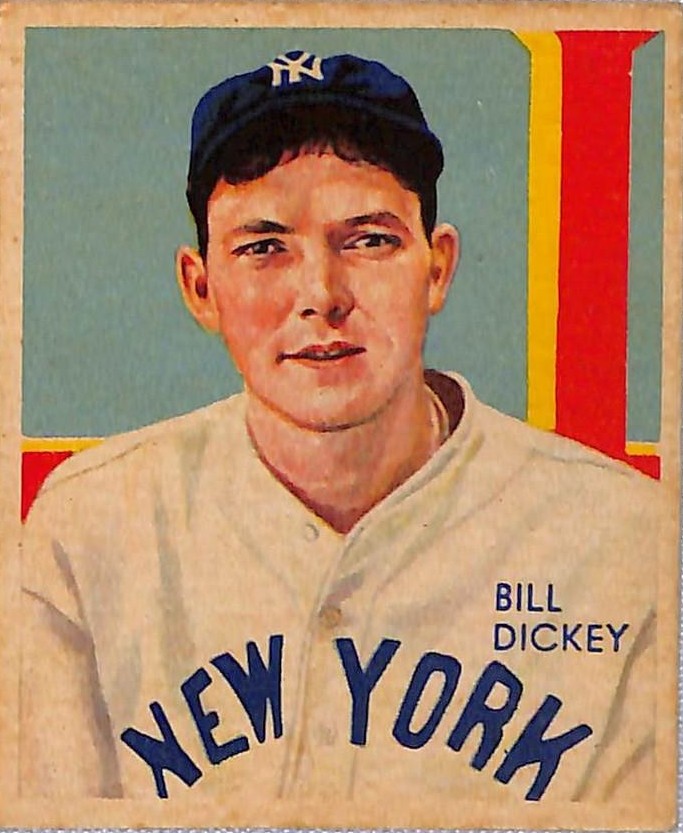
This 2014 panini auto was one of the only cards I could find with his number 3 displayed where he was on the Tampa Bay Rays. I found a couple on Arizona, but I really wanted his Rays jersey as he was a hero in Tampa. Though I’m not a fan of Panini baseball cards overall, this is a nice card with his signature, and I like that it’s a relic card. In 2014, Longo played in all 162 games, which is quite an accomplishment in today’s game. He had 22 home runs and 91 RBIs for the Rays.

Longoria is a three-time All-Star and a three-time Gold Glove award winner. He was AL Rookie of the Year in 2008 and won a Silver Slugger in 2009. He has been to two World Series (2008 and 2023) and although his team lost both, his fifteen years between the two are the longest gap for any player in MLB history (there’s a trivia question for you). He has hit a home run against all 30 current MLB teams (a bonus trivia question).

He owns several Tampa Bay records, and in 2025 Longoria signed a contract with the Rays to retire with the team that started it all. He would complete his career with a .264 batting average, 1930 hits, 431 doubles, 342 home runs and 1159 RBIs.

Final Score:

This is so much fun for me! My lists never go as expected and sometimes I must be flexible and change things around a bit (like adding the Legend spot for Ruth). Which brings me to this next little bonus.

There was a player who had the number 3 for twenty-two seasons from 1980 to 2001. He played DH and outfield for five teams, including the White Sox and Orioles three different times each. His career WAR was 38.8, just missing my criteria of 40. His name is Harold Baines. He was a six-time All-Star, a World Series champ in 2005 and won a Silver Slugger in 1989. His number 3 was retired by the White Sox in 1989, and he was inducted into the National Baseball Hall of Fame in 2019. I didn’t pick Baines, but he deserves a card just for having the number 3 so long. Would you have made him a top seven and in whose place? Here’s a 1983 Topps (another favorite design from the ‘80s) with the awesome White Sox ‘80s uniform and the number 3 on his leg!

Harold Baines, 1983 Topps, #684

Aside from the players I mentioned in the intro, I wanted to shout out a few other players who wore uniform number 3. Bobby Grinch (WAR 71.1) wore it for five years with the Orioles. Johnny Mize (WAR 70.6) and Carlos Beltran (WAR 70) for two seasons. Hall of Famers Bill Terry (WAR 56.6) and Mickey Cochran (WAR 49.8) both wore it for 4 seasons. Controversial players like Rafael Palmeiro (one season) and Gary Sheffield (two seasons) also wore it.

Another controversial player who met all my selection criteria was Alex Rodriguez. He wore number 3 for ten years (which is quite a long time) and his career WAR was well above 40 coming in at a whopping 117.4. He wasn’t controversial just because he was on my least favorite team, the Yankees, either, but I just do not like him as a player. That’s my personal preference, but I’m sure there are many who feel the same. It’s also not just the PED issues, or the 162-game suspension or the fact he has not been included in the Hall of Fame, though these would all be reasons to leave him off the list. While I have criteria, I also reserve the right to include, leave off or move players based on my own personal thoughts, and truth is, I just liked the players I chose more than him. Although I left him off, I still felt he was worth mentioning and for any Alex Rodriguez fans who are offended, here’s a card just to make amends.

Alex Rodriguez, 1997 Topps, #4

There were many other players I could mention, but these posts would get ridiculous if I just started naming everyone, so I’ll leave it here. I hope you’re enjoying this series and come back for uniform number 4. Like uniform number 3,  I think it’s going to be another tough one that will pose more challenges to my criteria. Like the fact that three players had a career WAR over 100.

PLAYER NAMEYEARS WORNCAREER WARNUMBER RETIREDOTHER ACHIEVEMENTS
Jimmie Foxx1292.9No9x All-Star
3x AL MVP Triple Crown (33)
World Series Champ (29, 30) HOF (51)
Alan Trammell1970.6YES (Detroit Tigers 2018)6 x All-Star
4x Gold Glove
3x Silver Slugger World Series Champ (84)
HOF (18)
Harmen Killebrew1960.4YES (Minnesota Twins 1975)13x All Star
6x AL HR Leader AL MVP (69)
HOF (84)
Willie Davis1560.8No2x All-Star
World Series Champ (63, 65)
3 X Gold Glove
Dale Murphy1846.5YES (Atlanta Braves 1994)7x All-Star
2x NL MVP
5x Gold Glove
4x Silver Slugger
Frankie Frisch672No3x All-Star
NL MVP (31) World Series Champ (21,22, 31,34)
Evan Longoria 11 58.9 No3x All-Star
3x Gold Glove ROY (2008)
Silver Slugger

Sources:

https://www.baseball-almanac.com/

https://www.baseball-reference.com/

https://www.sabr.org

Lehman, 2017 “Kellogg’s baseball card set in 1970 started a 14-year run” Sports Collector’s Digest

Shout out to all the cool cards and creative commons for my pictures! Thanks Topps and Upper Deck and Fleer and Donruss and all the rest!

Baseball by the Numbers: 1

Read about the project

Checklist

1

Welcome back! Now things are starting to get difficult. Uniform number 1 has five hundred options to choose from. Way more than 00 (twenty-one players) and 0 (forty-five players). It was quite a challenge. There were twenty-three players who wore number 1 for ten years or more and another fifty-six who wore it over five years. There were eighteen players who had a career WAR over 40 and eleven Hall of Famers. There were some really cool names too, Rabbit, Snuffy, Granny, Sparky, Kiddo, Bubba and Sibby. There will be a nice group of honorably mentioned players. So, without further ado (I’ve always wanted to say that!), here are my top seven players for uniform number 1.

All seven choices wore uniform number 1 for well over five years, in fact, they all wore it over ten years, and all of them had career WAR over 40.  

Number 1:

Ozzie Smith, 1986 Topps, #730

“The Wizard of Oz”. What an amazing nickname for an amazing player. I always loved the 1986 Topps cards. It’s one of my favorite sets, probably more for nostalgic reasons than aesthetics, but this Ozzie Smith one is sweet. I was so happy to see his uniform number on full display.

Ozzie Smith probably doesn’t need an introduction. He played shortstop for nineteen years in the majors from 1978 to 1996 wearing uniform number 1 the entire time. He was on the Padres until 1981 when he was traded in a six-player deal to the St. Louis Cardinals, with Cardinal’s shortstop Garry Templeton (who also wore number 1) and Sixto Lezcano as the key pieces. Initially hesitant, Smith met with Cardinal’s manager Whitey Herzog and was convinced this was the right team. He would play the rest of career for St. Louis. He was with those Cardinals when I first discovered my love of baseball, and baseball cards, and the Wizard was a key player during the 80s and 90s. He was so much fun to watch, with his crazy backflips and infectious smile. Whenever I found an Ozzie Smith card in a pack, I was delighted. 

Smith was a 15-time All-Star. On the defensive end, he won the Gold Glove 13-times in a row. He also helped the Cardinals win the World Series in 1982. He won a Silver Slugger in 1987 and was honored with the Roberto Clemente Award in 1995. He would finish his career with a 76.9 WAR, accumulating 2460 hits with only 28 home runs. He had a career .337 OBP and a .268 batting average, with 580 stolen bases. Smith was elected to the Cardinals Hall of Fame.  He was elected to the Baseball Hall of Fame in 2002 with a 91.7% vote, his first time on the ballot.

His uniform number 1 was retired by the Cardinals.

Number 2:

Lou Whitaker, 1996 Upper Deck, # 107

“Sweet Lou” Whitaker played second base for the Tigers for nineteen years and wore uniform number 1 for eighteen of those. He played from 1977 to 1995. During the ’80s the Tigers were a great team, with Lou Whitaker, Alan Trammell, Lance Parrish, Kirk Gibson, Chet Lemon and pitcher Jack Morris. They won the World Series in 1984.

Like Ozzie Smith, Lou Whitaker played during my formative baseball years. In fact, when I was a kid, I wouldn’t pick a favorite team. I’m now a diehard Red Sox fan, but you know how kids are. For a period, I remember being a Tigers fan. I think it was more because I thought Tigers were cool than any actual baseball reason, but man those early ’80s Tiger’s players still hold a special place for me. I loved getting their cards. For Whitaker, I found this awesome 1996 Upper Deck with him making a leaping defensive play, the number 1 displayed prominently on his back. So cool!

Whitaker was a five-time All-Star. He won ROY in 1978, was a three-time Gold Glove winner and a four-time Silver Slugger. He has a career WAR of 75.1 with a .276 lifetime BA, 420 doubles, 244 home runs and a .363 OBP. He is not in the Baseball Hall of Fame, but I think he could be. Do you?

His uniform number 1 was retired by the Detroit Tigers.

Number 3:

Pee Wee Reese, 1958 Topps, #375

Next, we are going back a bit into baseball history, to the time before I was born. Pee Wee Reese played shortstop for sixteen years from 1940 to 1958 (he missed the ‘43, ‘44, and ‘45 seasons due to military service). He spent his entire career with the Brooklyn Dodgers (LA for his last season).

This 1958 Topps cards is so beautiful. I love the colors on these cards. This would be Pee Wee’s last season, and the Dodgers were newly moved to LA. I like this card because you can see the uniform number 1 on Reese’s back. He wore that number for his entire career.

Pee Wee’s real name was Harold Peter Henry Reese, but he gained the nickname when he was a young boy playing and winning marble championships (yes that was a thing) in Kentucky. I didn’t know much about Pee Wee until I watched the movie “42” (which is amazing and a must watch for everyone; baseball fan or not). I really respected that he was a player who supported the integration of Jackie Robinson into baseball. He didn’t just support him, he also showed solidarity by putting a comforting arm around Robinson during a rough fan heckling situation. That’s a stand up shortstop and person in my book.

Reese was a ten-time All-Star, winning a World Series ring with the Brooklyn Dodgers in ’55 and then again in ‘59 as a coach. He has a career 69.5 WAR with 2,170 hits, 126 home runs, 232 stolen bases and a career batting average of .269. He was elected to the Baseball Hall of Fame in 1984 via the Veterans Committee.

Reese passed away at 81 years old in 1999.

His number 1 was retired by the Dodgers.

Number 4:

Richie Ashburn, 1956 Topps, #120

Another player with a couple of great nicknames, Richie Ashburn played centerfield for fifteen years from 1948 to 1962, mostly for the Phillies (twelve years) and later in his career, two years with the Cubs and one with the Mets. He was sometimes known as “Putt-Putt” and “the Tilden Flash”, but regardless of what you called him, Ashburn makes uniform number 1 proud. He wore it for all fifteen of his seasons, while becoming a legend in Philadelphia.

I couldn’t find a card with his number displayed, but I’m a huge fan of the 1956 Topps design, so I picked it to highlight Ashburn on my uniform number 1 list. You must admit…it is a sweet looking card.

Ashburn started his Phillies career strong. He led the league in stolen bases and was voted into the All-Star game in 1948, his rookie season, while he finished 3rd in ROY voting, behind Al Dark and Gene Bearden. He would go on to have five more All-Star appearances. He was also the NL batting champ in ’55 and ’58. 

Ashburn had a nice career. His career WAR was 64.3 with a .308 career batting average, 2,574 hits, 1,322 runs, and 234 stolen bases. He also had a nice .396 OBP. He is also 3rd in putouts for centerfield, behind greats Willie Mays and Tris Speaker.

After retirement, Ashburn would become a popular commentator for the Phillies until his death. He is a member of the Philadelphia Phillies Hall of Fame and was voted into the Baseball Hall of Fame in 1995 by the veterans committee behind plenty of fan support.

Ashburn passed away at the age of 70 in 1997 just a couple hours after broadcasting a game.

His uniform number 1 was retired by the Phillies.

Number 5:

Bobby Doerr, 1941 Play Ball, #64

I was very excited to include Bobby Doerr on the list. He spent his entire fourteen-year career as a second baseman for the Boston Red Sox from 1937 to 1951 (missing ’45 for military service). His 1941 Play Ball card is a great example of cards from the ‘40s. I’m not an art connoisseur, so I can’t adequately explain how elegant these cards are, but I’ll try. Beautiful colors, vibrant pictures, a great art-deco style. It’s like looking at a time machine. The perfect card to capture the essence of the era.

Doerr wore uniform number 1 his entire career with the Red Sox. He was a nine-time All-Star while batting over .300 three times and hitting 100 RBIs in 6 seasons. He was a forefather on a team with a storied past, known for some of the best players in Major League history (and I’m not just saying that because I’m a Red Sox fan).

After leaving the game, Doerr would become a coach, helping shape Carl Yastrzemski’s legendary triple crown season. He finished with a career WAR of 54.4 along with 2,042 hits, 381 doubles, 89 triples, 223 home runs, and .288 career batting average. Doerr is a member of the Red Sox Hall of Fame and in 1986 was enshrined in the Baseball Hall of Fame.

Doerr passed away in 2017 at 99 years old.

Like all the players picked before him, his uniform number 1 was retired by the Red Sox.

Number 6:

Buddy Myer, 1934 Diamond Stars, #4

Another example of a beautiful card, the 1934 Diamond Stars Buddy Myer is pure nostalgia. Myers played for seventeen years in the Majors from 1925 through 1941. He mostly played second base (with occasional stints at third and in the outfield), predominantly with the Washington Senators, but he also had two seasons with the Red Sox. He wore uniform number 1 for eleven seasons, all with Washington. He started his career during the time when numbers were rare, so it appears he wore number 1 his entire career.

Myer was a great player whose batting average was .300 or better in nine seasons. He won the batting title in 1935 and was a two-time All-Star. In 1933 he got into a fight was Ben Chapman, a player known not only for his dirty play, but his use of racist remarks (he infamously heckled Jackie Robinson in 1947 when Chapman managed the Phillies). Myer, who was not himself Jewish, but had Jewish heritage, was spiked by Chapman, who then berated Myer with anti semitic remarks, causing one of the craziest fights in baseball history; one that spread to the dugout and the fans.

Myer ended his career with a 48.4 WAR and a .303 batting average. He had career .389 OBP and struck out only 428 times in over 7000 at bats. That’s like 6%! He also had 965 walks, double the amount of career strikeouts.

Myer passed away in 1974 at the age of 70.

Number 7:

Tony Fernandez, 1993 Fleer Ultra, # 426

Another player I grew up watching, Tony Fernandez played for seventeen seasons from 1983 to 2001 (He missed the 1996 season due to injury). Fernandez played for the Blue Jays from ‘83-‘90, then was traded to the Padres along with his teammate “The Crime Dog” Fred McGriff for Joe Carter and Roberto Alomar. He would then bounce around a lot, playing for the Mets and Blue Jays in ’93, then the Reds, Yankees, Cleveland (Blue Jays again! ‘98-‘99), then went to Japan and was on the Seibu Lions, came back to play for the Brewers and ended his career with (Bueller, Bueller?), yep, the Blue Jays again. He wore uniform number 1 for fourteen of his seventeen seasons.

Fernandez was a five-time All-Star who was known for his stellar defensive play, winning four Gold Gloves. He was part of the 1993 World Series Champion Blue Jays and holds the record for RBIs in the World Series for a shortstop with nine. He’s also a member of the Canadian Baseball Hall of Fame.

 He ended his career with a WAR of 45.3, a .288 batting average, 2,276 hits, 414 doubles, 92 triples and 246 stolen bases.

Fernandez passed away at the age of 57 in 2020.

Final Score:

Uniform number 1 had a lot of players to choose from. I suspect that will be the case for many of the numbers moving forward. There are a lot of solid players coming up, so many of my lists will be very subjective. There will likely be some Red Sox bias, a lot of players I enjoyed watching in my lifetime, and a lot of snide remarks about the Yankees.   

Out of the seven players above three only played for one team. They also all had their uniform number for a long time. 4 had it 100% of their career, the other three 80%. THis is likely the case for all-stars and Hall of Famers, especially those who stayed with one team, but it seems common to have players wear a uniform number for a few seasons and then switch up (likely when traded or signing elsewhere).

As I mentioned at the start of this post, there were eleven Hall of Famers who wore uniform number 1, and over fifty players also met the five years plus criteria. There were also so many fun nicknames on this list. So, a few honorable mentions. Garry Templeton (3x All-Star) had number 1 for fifteen seasons and was traded for Ozzie Smith. Mookie Wilson (stupid 1986 Mets!) also for fifteen seasons. Hall of Fame pitcher Earle Combs had the number for seven seasons. Hall Of Famer “Rabbit” Maranville also had it for 3 seasons. He also has an awesome nickname and looks very rabbit like in some of his pictures. There were many great choices, but I digress. Maybe when I finish the first set of posts, I’ll do more.   

Make sure to check out the next post where things are sure to heat up with uniform number 2. I already know of one player that I’m not looking forward to putting on the list, but he deserves to be there. Can you guess who it is? Thanks for joining me!

PLAYER NAMENUMBER of YEARS WORNCAREER WARALL-STAR APPEARENCESOTHER ACHIEVEMENTS
Ozzie Smith1976.91513 Gold Gloves World Series Champ (82) HOF (02)
Lou Whitaker1875.15ROY (78) 3x Gold Glove 4x Silver Slugger World Series champ (84)
Pee Wee Reese1668.510World Series Champ (55) HOF (84)
Richi Ashburn1564.36HOF (95)
Bobby Doerr1351.49HOF (96)
Buddy Myer1148.42 
Tony Fernandez1445.354 x Gold Glove World Series Champ (93)

Sources:

https://www.baseball-almanac.com/

https://www.baseball-reference.com/

https://www.sabr.org

Shout out to all the cool cards and creative commons for my pictures! Thanks Topps and Upper Deck and Fleer and Donruss!

Smoky in a Pinch

posted May 6th, 2025 by jake

Smoky Burgess,1963 Fleer #55

I believe that everyone has an interesting story, and I love reading about people. People in history, music, Hollywood, writers, inventors, but I also love the randomness of finding someone I have never heard of before and learning their stories. In baseball, for every Mickey Mantle, there is a Don Demeter. Which is an awesome name if I’m honest. Aside from interesting stories, I also get pulled in by names, especially when I’m researching players for…yep you guessed it, my Immaculate Grids! So, imagine the level of my interest meter when I saw the name Smoky Burgess. Then I saw this picture and I was hooked. He did not look like a prototypical baseball All Star.

Smoky Burgess, 1967 Topps #506

Like many of the players with cool names, Smoky was not his given name. Forrest “Smoky” Burgess was born in 1927 in North Carolina. His father was a semi-professional player, and Smoky followed in his father’s footsteps. Smoky was a solid left-handed hitting catcher (he threw righty), and played well in high school. He was noticed by scouts and in 1943 the St. Louis Cardinals tried to sign him at the age of 16, but he was considered too young and had to wait until a year later before he was grabbed by the Chicago Cubs.

1944 was a great year for Smoky. After signing with the Cubs, he bought himself a shiny new Mercury and would meet the woman of his dreams, Margaret, who would eventually become his wife.

At 17, he had a great season for the Lockport Cubs, hitting .325 in 1944. He would only play 12 games in 1945 before joining the Army. He would remain enlisted through the rest of the 1945 season and almost all of 1946. Smoky would return with a bit of extra weight and a serious injury to his throwing arm, the result of a jeep accident while in the Army in Germany.

Upon his return, Smoky would continue his hard-hitting ways, though he had to be moved from catcher to outfield due to the injury. He would win the batting title in 1947 for the Fayetteville Cubs, batting .387 with a 1.008 OPS including 11 home runs and 28 doubles. In 1948 it was more of the same for the Nashville Volunteers as he would once again win the batting title, this time hitting .386 was an OPS of 1.082 and 22 home runs, 102 RBIs and 38 doubles. He was promptly promoted. He was also moved back to catcher as his arm began to improve.

Smoky was 22 years old when he made his major league debut on April 19, 1949, for the Chicago Cubs. He would only play in 46 games and didn’t play well. He was sent back to the minors where he would stay for all of 1950. After hitting .325 for the Springfield Cubs he found himself back in Wrigley for the 1951 season.

It wasn’t a great start for Smoky as he hit only .251 in 94 games with 2 home runs and .632 OPS. After the season, he was traded to Cincinnati, where he played exactly 0 games before being traded again, this time to the Philadelphia Phillies.

With the Phillies, Smoky started to blossom. His aggressive approach at the plate lead to his first (1954) of 9 All Star selections and he routinely hit for average. His All Star season was his best to date. He hit .368 with 127 hits and only 11 strikeouts with an OBP of .432. Unfortunately, he only had 392 plate appearances, disqualifying him for the 1954 batting title.

In 1955 after only 7 games, he was traded to the Cincinnati Redlegs (as they were called from ’53 to ‘58). He was once again an All Star, hitting .306 in 421 at bats, with 20 home runs. On July 29th he went 4-6 with 3 home runs and 9 RBI’s helping the Redlegs beat the Pirates. His best game in the majors! In 1956, he was the catcher for a 10-inning no-hitter against the Milwaukee Braves. Three pitchers combined to hold the Braves hitless through 10 innings, but the Redlegs lost in the 11th inning.

He was a good teammate in the locker room and had a solid reputation off the field as well. He was known to be a good family man, attended church regularly and avoided vices like tobacco and alcohol. If there was one weakness, it was probably his defense.

He struggled defensively since his Army injury. His defensive contribution was rated -96 by Total Baseball, he was an easy catcher to steal against and “he routinely ranked among the league leaders in passed balls, stolen bases allowed, and errors by a catcher.” Sturgill, Andy. “Sweet ’60: The 1960 Pittsburgh Pirates” (SABR, 2013. pg 45)

Still, he was known to be a real pain to batters at the plate. According to Bill James, “Some catchers like to chatter at the hitters to see if they can mess them up while they’re trying to hit. Smoky was the world’s champion. He used to drive Richie Ashburn nuts. He’d say, ‘Get ready, Rich; it’s a fastball.’ Ashburn would pop up or something, so Burgess would say ‘You didn’t do too well on the fastball, Richie; let’s try a curve.’ Of course, Ashburn never could believe him and couldn’t ignore him. One time he asked the umpire, ‘Isn’t there some rule that will make that guy shut up?'” (The New Bill James Historical Baseball Abstract. Free Press Publishing. 13 June 2003. Pg 392)

He would remain with the Redlegs through the 1958 season before being traded to the Pirates where he would become an All Star in his first three seasons with Pittsburgh. In ’59 he hit .297 and once again found himself on the receiving end of a no hitter.

On May 26th 1959, pitcher Harvey Haddox, who happened to be traded with Smoky from the Redlegs earlier in the year, pitched a perfect game through 13 innings against the Milwaukee Braves. The same team as the last no-hitter Burgess was a part of in 1956. Like that game, this one also ended in a loss. After 13 perfect innings, in which Haddox would retire 36 straight batters, a throwing error by the Pirate’s third baseman landed a player on first. The Braves Eddie Mathews would then hit a sacrifice, moving the runner to second. With his perfect game tanked, Haddix still had a no hitter going, so when “Hammerin’ Hank” Aaron came up to bat the obvious move was an intentional walk to face Joe Adcock, who was sitting at 0-4 for the day. Adcock would nail the ball to deep right center for a game winning double. This made Burgess the catcher for two no hitters that both ended in losses in extra innings to the Milwaukee Braves. That’s crazy right!?

1960 was an awesome year for the Pirates and for Smoky. He played solid defense, posting the top fielding percentage among NL catchers. He also hit well, with a .294 average in 337 at-bats, and he was a key contributor to the Pirates World Series run making the All Star game for the 2nd year in a row.

For Smoky, it was his first time in the playoffs, and he went 6-18 for a .333 average and had a key hit in the seventh game of the World Series against the Yankees. The Pirates would eventually win the title on a ninth inning home run in game seven by Bill Mazeroski. This was the only time a World Series was won on a game winning home run in the 9th inning of game seven and is one of the most iconic World Series wins in history. It was the Pirates first title in 35 years and their third overall. It was also the one and only World Series ring for Smoky Burgess.

Smoky would remain with the Pirates through most of the 1964 season. During ’64, he would play 68 games, but only fielded in 44, the rest of the time pinch hitting. In September of ’64 he was released and picked up on waivers by the Chicago White Sox. He would spend the rest of his career with Chicago and would become one of the premier pinch hitters in baseball. This was prior to the DH position which may have been great for Burgess. Smoky currently ranks fourth all time with 145 pinch hits with 16 pinch home runs.

Smoky would retire at the age of 40 on October 1st, 1967.

For his career, he was selected to the All-Star game nine times and was the first catcher in baseball history to be selected from three different teams (the Phillies 1954, Redlegs 1955, Pirates in 1959, 1960, 1961, and 1964). Later joined by two other outstanding catchers; Lance Parrish (a personal favorite of mine) and Paul La Duca.  He also won that World Series ring in 1960. He had a career batting average of .295 (nice for a catcher/pinch hitter), 126 home runs, 673 RBI’s and a .362 OBP along with 230 doubles.

He would go on to run a car dealership in North Carolina and spend time with his family. Smoky eventually became a scout and minor league batting coach with the Braves, helping players like Dale Murphy hone their skills.

Smoky Burgess passed away at the age of 64 in 1991.

“Everything went well, I have no regrets. I don’t know a thing I would have changed. If I hadn’t played baseball, I would have probably had to work in the cotton mills. That’s real hard work. I’m certainly glad I had baseball.”-Smoky Burgess (Sturgill, Andy pg 50)

Smoky Burgess, 1953, Public Domain

Sources

https://www.baseball-almanac.com

https://www.baseball-reference.com

Grosshandler, Stanley, “Unsung Heroes: No-Hit Catchers”, 1979 Baseball Research Journal

Hurte, Bob “Sweet ’60: The 1960 Pittsburgh Pirates” (SABR, 2013), e-book pg 340-352

James, Bill. “The New Bill James Historical Baseball Abstract “Free Press Publishing. 13 June 2003. E-book Page 392

https://sabr.org

Schatz, Michael ballparksavvy.com February 2025

Sturgill, Andy “Sweet ’60: The 1960 Pittsburgh Pirates” (SABR, 2013), e-book pg 41-50

https://en.wikipedia.org/wiki/Smoky_Burgess

“Moyer” Age is Just a Number

Posted April 26th, 2025 by Jake

Jamie Moyer pitching for the Colorado Rockies during a game against the Atlanta Braves on May 5, 2012.
By MrMcPhoto – Own work, CC BY-SA 3.0

This is my second entry in the Age is Just a Number series featuring a pitcher who defied the critics and his own struggles to break a number of records and have a pretty awesome career.

Jamie Moyer played Major League baseball for 25 years, on eight different teams, including a stint with my Red Sox in 1996. I remember opening packs of cards, looking for players like Griffey Jr, Frank Thomas, of course Cal Ripken, who I just loved, and always Red Sox players. In fact, that might be the only time I would have given Moyer a second look. Sure, I remember his cards, in fact I probably have a bunch in my common’s boxes from my junk wax openings. He’s got plenty of cards out there, hell he played in four decades!

Moyer was no superstar. He was the opposite of Nolan Ryan, throwing an assortment of pitches, relying on control and mixing things up, rather than speed. Moyer was never the first name that came to mind when thinking of the greatest pitchers in baseball. He was an All Star only once in 2003 with the Seattle Mariners and, in 2018, he failed to meet the 5% threshold to remain on the Hall of Fame ballot, receiving only 10 votes. Still, there’s something to be said for longevity, especially for a pitcher, and that Moyer had in spades. He was also an honorable family man and cared deeply for his community.

Moyer was born in 1962. He was a natural sports star, playing baseball, basketball and golf in High school, where he pitched 3 consecutive no-hitters, going 10-0 in his junior year. He was a record breaker in college for the Saint Joseph’s Hawks. He holds the season records for most wins (16) for ERA (1.99) and for strikeouts (90). He is a member of his Alma Mata’s Hall of Fame and had his number retired at Saint Joseph’s in 2018.

He started his Major League career with the Cubs in 1986 and won his first game against Steve Carlton and the Phillies, which was of huge significance because Moyer grew up in Pennsylvania as a Phillies fan and Carlton was a boyhood hero. He didn’t have a great rookie season though, with a horrible 5.05 ERA and a 7-4 record.

Moyer didn’t fare much better in his sophomore season finishing with a 5.10 ERA and a losing record of 12-15 in 33 starts. He pitched 201 innings with 147 strikeouts and led the league in earned runs with 114.

By 1988, Moyer started to put things together…a little. Although his record would be 9-15, he had a much-improved ERA at 3.48. Still, he had done little to gain the Cubs confidence and in December he was traded along with Rafael Palmeiro and Drew Hall to the Texas Rangers for 6 players.

In 1989 Moyer had only 15 starts due to a lat strain and was a terrible 4-9 with a 4.70 ERA. In 1990 he mostly played out of the bull pen and again had a pretty poor performance at 2-6 with a 4.66 ERA and a measly 58 strikeouts in 102 innings. After the season he was unceremoniously released by Texas and this was the start of a few poor showings for Moyer who joined the Cardinals in 1991 for one season, but was sent to the minors after a poor start to the season and subsequently released. He was picked back up by the Cubs in 1992, now 29 years old, but didn’t make the team out of spring training. He was released again and played in Detroit’s minor league system.

By 1993, Moyer had been released by four teams and was 30 years old when the Baltimore Orioles signed him. According to The Sporting News, “Jamie Moyer, 30, has had significant major league experience with the Cubs, Rangers, and Cardinals, but he is fighting to keep his career alive.” He did just that, finishing the season for Baltimore with a winning record (12-9) and a 3.43 ERA in 25 games. He also pitched three complete games, including his first shutout in three years.

1994 was shortened by the strike and Moyer had a 5-7 record and 4.77 ERA in 23 starts. By 1995 he was back in the bullpen and working to earn another role in the starting rotation. He would go 8-6 with a 5.21 ERA and was again released. Now over 30, Moyer was struggling to find a home after 9 tumultuous seasons in the Majors.

1996 would see Moyer join the Boston Red Sox, but they struggled to find a place for him, shifting the embattled pitcher between the bullpen and rotation. He was not happy in Boston, and they traded him to the Seattle Mariners. He started 11 games and went 6–2 with a 3.31 ERA. Moyer’s record of 13–3 between Boston and Seattle led the majors in winning percentage at .813. It seemed that Moyer was finally figuring things out, and he would continue to have his best years with Seattle, where he played for the next 11 seasons.

From 1996 to 2006, he would be one of the better pitchers in the league. Over his 11 seasons with the Mariners, he would compile a franchise leading 2,093 innings pitched, 323 starts, and 188 quality starts, and his 1,239 strikeouts are the third most for the Seattle franchise. He would have 145 wins, second most in Seattle history. Moyer was the Mariners Opening Day starting pitcher in 2000, 2004-2006. He also got his one and only All-Star selection in 2003 when he went 21-7 with a 3.27 ERA. By 2006 he was the oldest active Major League player at 43 years old.

During the 2006 season, Moyer was on the decline and considered retirement, but Seattle offered to trade Moyer to his childhood team, the Phillies, and he was off to the City of Brotherly Love. He would become the oldest pitcher in Philadelphia franchise history to win a game and would finish 5–2 with a 4.03 ERA. This earned him a 2-year contract at 44 years old.

In August of 2007 Moyer struck out his 2,000th batter. He had a winning record that year at 14-12 but had a 5.01 ERA. He is said to have had the slowest fastball of all NL starters, averaging 81.1 miles per hour. The Phillies were good in 2007, they won the division, but failed to win a playoff game.

2008 was a great year for Moyer, who at 45, was the oldest active player in the MLB. He also set a couple of other oldest player records. He would get a hit in a game against the Padres in April, becoming the oldest Phillie ever to get a hit. After beating the Rockies in May, he secured his 235th career win, and for his career, a win against every Major League team. 2008 continued to provide Moyer was some amazing moments.

He earned his 16th win of the year and became the second-oldest pitcher to win 16. Moyer also became the second-oldest pitcher to ever start a postseason game at the age of 45 years 321 days. Jack Quinn started for the Philadelphia Athletics in 1929 at 46 years 103 days.

Moyer became the oldest pitcher at 45 years 329 days to pitch in a National League Championship Series game, starting in Game 3. With all he had accomplished, I think most importantly for Moyer was winning his first World Series ring when the Phillies defeated the Rays. After 23 Major League seasons, he finally had a ring, and the best part; it was with his childhood team. The last time the Phillies had won the World Series was 1980 when Moyer was still in High School.  It was only the second time Philly had won, and Moyer was overjoyed.

Aside from the World Series win and all the oldest pitcher records, Moyer had a decent season. He would finish 16-7 with a 3.71 ERA. Good enough for Philly to give him another 2-year contract.

In 2009 Moyer struggled out of the gate, and the Phillies sent him to the bull pen. Manager Charlie Manuel said, “Jamie was a total professional and team player when we let him know of the decision to move him to the bullpen. He has been, and will continue to be, a very important part of this team.” (Miller, 2009). This showed just how important Moyer was to the team and the type of player and person he was. By the end of 2009, Moyer pulled three muscles, the wear and tear becoming apparent, and would miss the rest of the season and playoffs. He would finish 2009 with a 12-10 record and a 4.94 ERA.

Moyer was entering his age 47 season in 2010, and he would again break the age barrier, becoming the sixth-oldest pitcher to appear in a game and the eighth major league pitcher to start a game in four different decades. He was also, along with Omar Vizquel, the only other player left who played in the 1980’s. Moyer became the oldest player in Major League Baseball history (47 years, 170 days) to pitch a shutout on May 7, 2010, against the Braves. This was a momentous moment for Moyer as he was the only MLB pitcher to throw a shutout in four different decades (1980s, 1990s, 2000s, and 2010s). Sadly, his season was cut short due to a sprain in his ulnar collateral ligament, ending his season.

At the end of 2010 Moyer had Tommy John Surgery, causing him to miss all of 2011. His contract with Philly would end, and there was speculation that he would retire. He was, after all, 48 years old and coming off major surgery and an entire missed season. Still, in 2012 at 49 years old, the Rockies would give the old veteran a chance.

In 2012, Moyer would become the oldest pitcher to record a win as well as the oldest player to record RBI (remember there was a time when pitchers still hit). By 2012, Moyer had pitched in 50 Major League stadiums, the most of any pitcher since 1900. Unfortunately, he was released in June after going 2-5 with a 5.70 ERA.

He would sign a couple of minor league contracts with the Orioles and then the Blue Jays but was released by both.

In 2013 Jamie Moyer would retire from Major League Baseball at the age of 50.

Moyer didn’t have a Hall of Fame career, but he was a determined pitcher who never gave up on his dreams. His longevity earned him several interesting records and a World Series ring with his childhood team. He would finish his career with a 49.8 WAR, 269 wins to 209 losses, 2,441 strikeouts in 4,074 innings and a 4.25 ERA.

He was a great member of his communities, wherever he played. Moyer won both the Branch Rickey and Roberto Clemente awards for community service and is also an advocate for children, starting The Moyer Foundation to help children deal with their grief over the loss of a loved one. Moyer was always considered a strong teammate and a resilient person who loves baseball and his community. He’s also an inspiration to those who agree that age is just a number.

Sources:

Baseball-Reference.com

Bush, Federick SABR.org

Miller, Doug (August 11, 2009).”Pedro to make ’09 debut Wednesday”. Major League Baseball. Retrieved April 23rd, 2025.

Peebles, Laura “April 17, 2012: Jamie Moyer sets record as oldest winning pitcher as Rockies beat Padres, 5-3.” SABR.org

“Moyer proves that some things get better with age,” The Sporting News, October 1, 2001, vol :58.

Wikipedia Page

Age is Just a Number

Posted April 17th, 2025 by jake

Minnie Miñoso 1953 Bowman

I was playing pickleball the other day, and this older man came over to be my partner. He explained that he was probably going to need a bit of help as he was not too quick on his feet. He was 85, and while he struggled a little to get to some balls, his reaction time at the kitchen was insane, he had a great serve and could dink with the best of them. We didn’t win, but man he was funny, and we had a blast. His friend who brought him was very grateful that I played with him, and I said “anytime”. I’m no pro, I’m out there to have fun, and he made it fun. He was full of energy and humor. I realized, this is someone I would like to emulate as I get older. I hope I’m able to get out, meet new people and play a sport when I’m that age. This got me to research some of the oldest to players in the Major Leagues and it was quite the list of interesting feats.

From Satchel Paige striking out a batter at nearly 60 for the Kansas City As in 1965 to Julio Franco smacking a home run for the New York Mets at almost 49 years old in 2006, there are many age defying stories to be told. In life age is just a number, and one player who proved this in seven different decades was Minnie Miñoso.

Minnie Miñoso was inducted into the Baseball Hall of Fame in 2022. Minoso passed away in 2015 at the age of 90-92 years old depending on the birthday you use. I want to add a disclaimer here. I’ve noticed some discrepancies with Miñoso’s age and date-of-birth in a few different articles. It would seem there was some confusion as to his actual age and birth year. I’ve been going on November 29th, 1923, a date that you find almost everywhere. So, if sometimes his age seems off, you may be right.

At the induction, his family were on hand to receive the honors and his wife, Sharon Rice- Miñoso, spoke on his behalf. He was elected through the Golden Days Era Committee along with Jim Kaat, Tony Oliva and Gil Hodges. It was a beautiful summer day. I remember it well. I was there, along with my uncle and cousins. As lifelong Red Sox fans, we made the trip to Cooperstown for David Ortiz, and it was an all-around awesome experience.

One of the facts that struck me about Miñoso was that he played in seven different decades, though some of the at-bats were for promotional purposes, I still thought it was pretty cool. He made plate appearances in the 1940’s in his home country of Cuba and eventually for the New York Cubans of the Negro National League, winning a World Series with them in 1947 and becoming a two-time Negro League’s All Star.

The next year, 1948, he signed on with the Cleveland Indians. He would only play in 9 games before being sent to the minors in San Diego for additional conditioning. He played well in San Diego, hitting for a .297 average with 22 homers, 19 doubles and 13 stolen bases in 137 games in 1949, then in 167 games in 1950, he had 203 hits and batted .339 with 130 runs, 40 doubles, 10 triples, 20 home runs and 115 RBIs, plus he also stole 30 bases. Miñoso showed all the skills of a future All Star and in 1951 he was promoted to the Majors.

 Unfortunately, he would only play in 8 games for Cleveland. This had nothing to do with his skill or potential, but was due to a lack of open spots in which to play him. I said unfortunately, but not for Miñoso…for Cleveland. They would trade him to the Chicago White Sox where he would play for the next 6 seasons, becoming an instant All Star.   

Miñoso was the first black player for the White Sox and the fans loved him, even giving the rookie his own day and the nickname “Mr. White Sox”. He would play 138 games for Chicago in 1951, batting an outstanding .324 with 32 doubles, 14 triples (most in the MLB), 10 home runs and 31 stolen bases. He was known to crowd the plate, and he was plunked a league-leading 16 times, frustrating opposing pitchers. He would make the first of his 7 All Star team appearances (as one of the first Latin Americans to be named All Star) and he would finish 2nd in AL Rookie of the Year voting and 4th for MVP.

Miñoso was just getting started. After his spectacular rookie season “Mr. White Sox” would continue to wow the Comiskey Park fans. He was an All Star again in 1952, 1953 and 1954. Having had arguably his best season with the White Sox in 1954 batting .320 with 182 hits, 29 doubles, a league leading 18 triples and 19 home runs with 116 RBI’s, he also stole 18 bases.

Miñoso was a character both off and on the field. Driving around Chicago in his green Cadillac, flashy cloths and jewelry, and big hats, he continued to live up to his nickname, “Mr. White Sox”.

In 1957, Miñoso had another All-Star season. He ended up with 21 home runs (the most he had hit up until that point) and led the league in doubles with 36 while also hitting .310. But the White Sox were desperate to win, having continuously been bested by the Yankees, and were offered a trade that they just couldn’t pass up. In the off season, Cleveland offered up Al Smith, who was a quality player with youth on his side, and pitcher Early Wynn, who would go on to have a Hall of Fame career, for Miñoso, and “Mr. White Sox” left the windy city.

Miñoso was back with Cleveland in 1958, and had a solid season with 168 hits, 94 runs, and 14 stolen bases (though he was also caught stealing 14 times). He also hit the most home runs of his career with 24, to go along with 80 RBIs, 25 doubles and a .302 batting average. I mentioned earlier researching those who defied the age barrier, well by 1958 Miñoso was 34 years old, and he had the most home runs of his career!

In 1959, he was once again an All Star, hammering 21 home runs and finishing the season with a .302 batting average. Cleveland finished five games back behind Miñoso’s former White Sox, who made a trade in the off season to bring Miñoso back to Chicago.

In 1960, he entered his 3rd decade playing ball. He was now 36 years old and started the decade off with a bang. Once again with the White Sox, he played in 154 games and made the All-Star team again. He led the league in hits with 184, and had 34 doubles, 20 home runs and 105 RBIs to go along with a .311 batting average. “Mr. White Sox” was back, and the fans were ecstatic!

In 1961, the White Sox struggled to a fourth-place finish. Miñoso had another productive season. He played in 152 games and had a .280 batting average with 151 hits, 28 doubles and 14 home runs. Unfortunately, it would be his last productive season in the Majors.  He was traded to the Cardinals but only played 39 games in 1962 due to injuries. He was then sent off to the Washington Senators in 1963 and played 109 games as the fourth outfielder. In 1964, he found his way back to the White Sox but only played 30 games.

Though he was slowing down, at 40 he decided to play in Mexico, and had a resurgence. He batted .360 and led the league with 106 runs and 35 doubles for Charros de Jalisco in 1965. He would continue to play baseball for 8 more years in Mexico, bringing him into his fourth decade. He would finally leave the game in 1973 at 49 years old…or so it seemed.

He would become a coach for the White Sox in 1976 and appeared as a DH in 3 games with Chicago. In 8 at bats, he would only get one hit, but was still a favorite of the White Sox fans. He continued to coach through 1978.

In 1980, he would amazingly get two more at bats with the White Sox. He was around 56 by this point, depending on which date of birth you use, and became one of only two players to have played a game in five decades! The other being Nick Altrock, who remains the oldest player ever to hit a triple at age 48 in 1924. Altrock played his last game in 1933 at 57 years old, but Miñoso would top that.

Miñoso didn’t suit up again for 13 years. In 1993, at 69 (I know this is getting ridiculous now!), he signed with the Saint Paul Saints. This would seem to be more of a promotional stunt, but according to Michael Clair of MLB.com, “Mike Veeck, the owner of Saint Paul, made it clear that this wasn’t just a promotion to get fans into the gates and that a baseball player, especially one like Miñoso, would not do anything to embarrass himself. “I don’t think of it as a promotion, I think that’s an appearance of talent,” Veeck told MLB.com. “That’s how I view it — it’s an opportunity for these younger fans, and for fans who enjoy them to see this remarkable human who all these years later could still swing the bat, who still hustled out to first base.” (Clair, Micheal, MLB.com, 2021)

Miñoso got one live at bat, and made contact, grounding out. This would be his sixth decade, and the bat and ball are now enshrined at Cooperstown. Six decades, and he made contact with the ball, at 70! I wish.

His seventh decade was also with the Saints. This time in 2003 at the young age of 79. He signed a one-day contract and walked in his only at-bat. This made him the only player to have played in seven decades.

Miñoso had a career WAR of 53.2 with 2113 hits, 195 home runs, 365 doubles, 95 triples, 1089 RBIs, 216 stolen bases and a career .299 batting average. He was a 9x All Star and was inducted into the Hall of Fame in 2022, 7 years after his death in 2015 at 90 something depending on the date of birth. I’m going with 91. His number 9 was retired by the White Sox in 1983.

“Once you get (baseball) in your blood, you can never quit,” “I love the game.” Minnie Miñoso, via the Daily Sentinel, 1976

by John Rice is licensed under CC BY 2.0

Sources:

https://www.baseball-reference.com/players/m/minosmi01.shtml retrived April 2025

Clair, Michael. “Miñoso’s amazing seven-decade career.” MLB.com, February 2021

Livacari, Gary. “Minnie Minoso’s “Grand” Return to the White Sox, 1960!,” baseballhistorycomesalive.com, February 2022

Muder, Craig. “Miñoso defies time as White Sox’s DH,” baseballhall.org, retrieved April 2025

Stewart, Mark. “Minnie Miñoso,” SABR bio, December 2021

https://en.wikipedia.org/wiki/Minnie_Mi%C3%B1oso retrieved April 2025