
10
Welcome back to Baseball by the Numbers. Today we are looking at uniform number 10. I found that around 689 players in history wore the number 10 at some point in their career. Out of that group, one player had a career WAR of over 100. This player is a pitcher, which is important because so far I’ve posted uniform number 00 to uniform number 9 and have featured a total of 89 players with only 4 being pitchers (two in 00 post and 2 in the 0 post). This is mainly due to the way in which numbers have had been distributed historically, with the numbers being assigned based on batting order.
Twenty-six additional players who wore number 10 had a career WAR of 40+ and 109 players wore the number for 5 years or more. There was one player who is on this list who was already featured for wearing a different number at one point in his career, but deserves to make both lists. I’m sure this will happen on occasion in the future too. So let’s get to it!
The Legend:
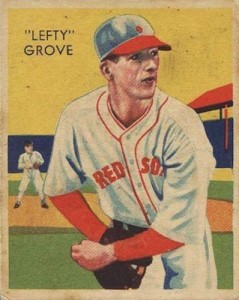
Robert Moses Grove, better known as Lefty, was a left-handed (bet that was hard to guess) pitcher who played for 17 seasons from 1925 to 1941. He was a member of the Philadelphia Athletics until 1933 and then played on the Boston Red Sox from 1934 to 1941. Grove wore uniform number 10 for eleven years and had a career WAR of 106.8 good for 26th all-time. This is only the 5th time out of all these post that features a pitcher.
I had to use this 1934 Diamond Stars card because Lefty is in his Red Sox uniform, and I love Diamond Stars. Luckily, he did wear number 10 while on the Sox, so it works. 1934 was his first year in Boston and due to an injury, he only pitched 109 innings. He usually averaged over 250 innings a season. He went 8-8 with 43 strikeouts.
Grove was a 6-time All-Star. Lefty won his first Triple Crown in 1930 when he had 28 wins with a 2.54 ERA and 209 strikeouts in 291 innings. He also led the league in WAR (10.4), W-L % (.848), games (50), Whip (1.14) and saves with 9. He was the American League MVP in 1931 when he won his second pitching Triple Crown with 31 wins, a 2.06 ERA and 175 strikeouts. Although he only had 200 strikeouts once, he led the league in strikeouts on seven occasions. He also led the league in ERA a record 9-times and wins 4-times.
Grove was a member of the 1929 and 1930 Philadelphia Athletics World Series Champions. Managed by Connie Mack, the teams featured Mickey Cochrane, Eddie Collins, Jimmie Foxx and Al Simmons.
Grove retired in 1941. He had a career record of 300-141 for a .680 w/l % (13th all-time). His 300 wins are good for 23rd all-time. Grove pitched in 3,940.2 innings, the 44th most in history. He had a career ERA of 3.06 with an ERA+ of 148 (9th all-time), 2,266 strikeouts (SO/9 of 5.2) and a 1.278 WHIP. He also saved 54 games.
Grove is a member of the Athletics and the Boston Red Sox Hall of Fame and was voted into the MLB All-Century Team.
He was inducted into the National Baseball Hall of Fame in 1947.
Lefty Grove passed away in 1975 at the age of 75.
Number 1:
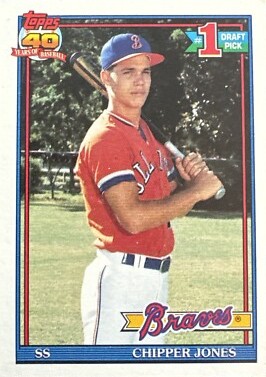
From 1993 to 2012, Chipper Jones played third base and left field with the Atlanta Braves for his entire nineteen-year career. He wore uniform number 16 in 1993, then wore uniform number 10 for the rest of his career, eighteen seasons. He had a career WAR of 85.3.
Jones was the first overall pick in the 1990 draft. The Braves originally wanted a pitcher and intended to draft Todd Van Poppel, a coveted prospect at the time. Van Poppel was not interested in playing in Atlanta and made it known early on. This turned out to be the best possible turn of events as the Braves opted for Jones, and the rest is history. Rogers, Phil (June 4, 1990).
This 1991 Topps card represents Jones being the first pick in the draft. I love this card! It brings back so many memories. When I was a kid, the 1991 Chipper Jones Topps card was always on our wish lists. I remember also wanting Todd Van Poppel cards, but he turned out to be a dud, while Chipper was a stud. Chipper didn’t make it to the Majors until 1993 when he had only 3 at-bats, then missed all of 1994 with an injury. By 1995, he would start to show the world why he was the number 1 draft pick, placing second in ROY voting that season. He lost to Hideo Nomo (One of my favorites!).
Jones was an 8-time All-Star. He won the National League MVP in 1999 when he batted .319 with 181 hits, 41 doubles, 45 home runs, 110 RBIs and 25 stolen bases, while walking 126 times with .441 OBP, .633 SLG and 1.074 OPS. Oddly enough, Jones was not an All-Star selection in 1999. I had to look this up, and found that the MVP has not made the All-Star game at least twelve other times. This article by Jason Foster at MLB.com, highlights those instances.
Jones won two Silver Slugger awards. He batted over .300 in 10 different seasons with 30 or more home runs in 6 seasons, 100 or more RBIs in nine and an OBP of over .400 in ten seasons. He was a member of the 1995 World Series Champion Braves, a team managed by Bobby Cox, and featuring pitching greats Greg Maddux, John Smoltz and Tom Glavine, and the “Crime Dog”, first baseman Fred McGriff.
Chipper would retire in 2012 finishing in the top 50 all-time in many offensive categories. He had a career batting average of .303 with 2,726 hits, 549 doubles (32nd), 468 home runs (35th), 1,623 RBIs (35th), and 1,619 runs (46th). He added 150 stolen bases and 1,512 walks (16th all-time) to go with a .401 OBP, .529 SLG and a .930 OPS (41st all-time).
Jones is a member of the Braves Hall of Fame, and his uniform number 10 was retired by Atlanta in 2013.
He was inducted into the National Baseball Hall of Fame in 2018. He is one of only four number one draft picks in the Hall, the others being Ken Griffey Jr., Joe Mauer and Harold Baines.
Chipper has since been a coach and consultant for the Braves and has done some work in the broadcast booth.
Number 2:

Known as “Big Jawn”, Johnny Mize played for fifteen seasons in the MLB from 1936 to 1953 (he missed 1943-1945 for military service). Mize played first base for the St. Louis Cardinals, New York Giants and New York Yankees. He wore uniform number 10 for six seasons while with the Cardinals, and had a career WAR of 70.6.
This is the 1936 R312 baseball card. I chose it due to Mize being on the Cardinals at the time this card was released, which was when he wore the number 10. These cards were produced by National Chicle, a gum company. I found some interesting information about these cards at oldcardboard.com.
Johnny Mize was a ten-time All-Star. He batted over .300 in nine seasons, leading the league in 1939 with a .349 average. He also led the league in home runs 4 times smashing 51 in 1947. In eight seasons he drove in over 100 RBIs, leading the league in that category on 3 occasions.
From 1949 to 1953, Mize was a member of the New York Yankees that won the World Series Championship a record five straight years. Members of that team included, Manager Casey Stengel and Hall of Famers Yogi Berra, Phil Rizzuto, Joe DiMaggio, Whitey Ford and Mickey Mantle.
Mize retired in 1953. He had a career batting average of .312 with 2,011 hits, 359 home runs, 1,337 RBIs with a .397 OBP, and is ranked 19th all-time in SLG (.562) and 20th in OPS (.959).
Mize is a member of the St. Louis Cardinals Hall of Fame and was inducted into the National Baseball Hall of Fame in 1981.
Johnny Mize passed away at the age of 80 in 1993.
Number 3:
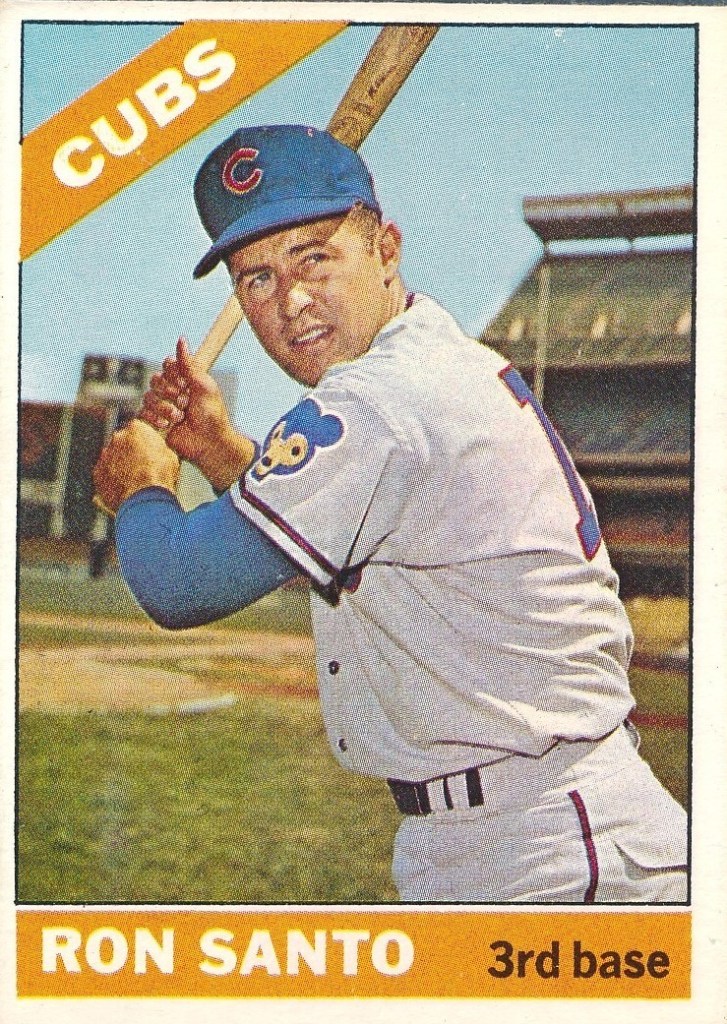
Ron Santo spent fifteen seasons in the Majors, all of them in the Windy City from 1960 to 1974. Santo was the third baseman for the Chicago Cubs until 1973 and spent his final season on the South Side with the White Sox in 1974. Santo wore uniform number 10 his entire career, save for a few games in 1960, and had a career WAR of 70.5.
I haven’t used too many 1966 Topps cards. I like this one, you can see Santo’s number just a little on his back, the design is nice, and the old 1966 Cubs uniform is sweet, especially the logo on the sleeve.
Santo was a 9-time All-Star who batted over .300 four times. He led the league in season WAR once, walks four times and on base percentage twice. He also hit over 30 home runs in four seasons and is the only third baseman to have over 90 RBIs in eight straight seasons.
Santo was an excellent defender. He had 5 straight Gold Glove winning seasons while leading the league’s third basemen in assists and putouts seven times and double plays six times.
Santo retired in 1974 after being traded to the White Sox and having an awful season. He would finish his career with a .277 career batting average, 2,254 hits, 1,138 runs, 365 doubles, 342 home runs and 1,331 RBIs.
He is a member of the Chicago Cubs Hall of Fame, and his uniform number 10 was retired by the Cubs in 2003.
He was inducted into the National Baseball Hall of Fame in 2012.
He went on to become a broadcaster for the Cubs. Santo suffered from Type 1 Diabetes his entire life and had both of his lower legs amputated in 2001 and 2002, he would eventually pass away from complications of the disease in 2010 at the age of 70.
Number 4:
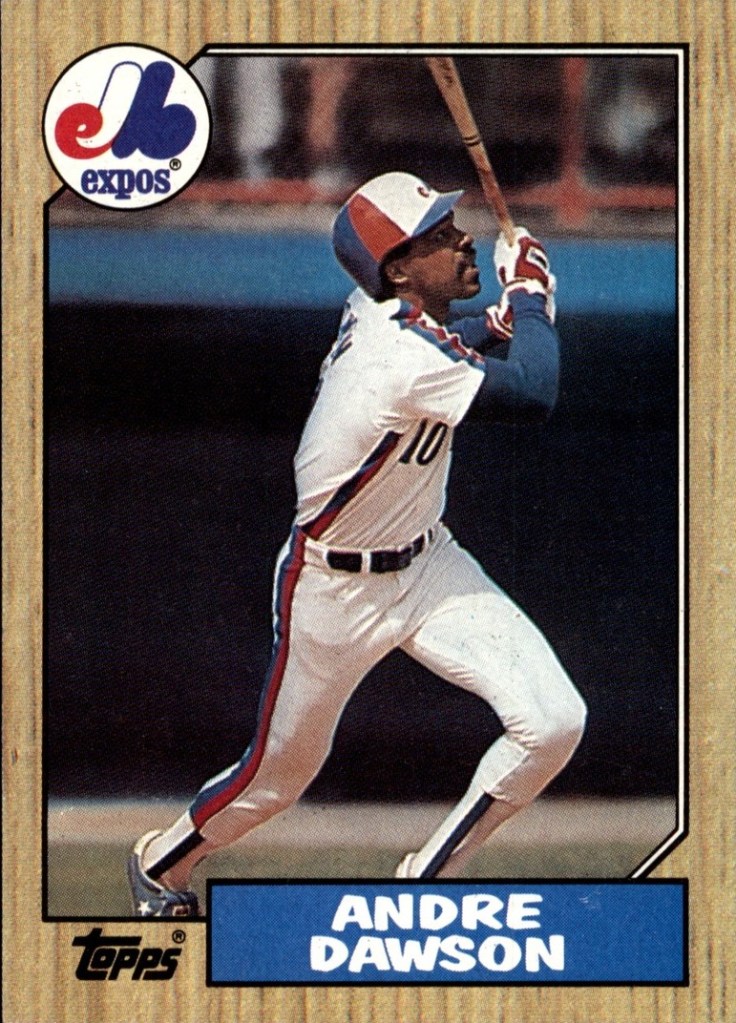
“the Hawk” is another player whose cards I have a lot of. He played for twenty-one seasons from 1976 to 1996 as an outfielder. Andre Dawson started his career with the Montreal Expos where he played for eleven seasons. In 1987, he joined the Cubs where he stayed until 1992. He finished his career with two-year stints on the Boston Red Sox and the Florida Marlins. He wore uniform number 10 for twelve seasons (with the Expos and Red Sox) and had a career WAR of 64.8.
Dawson is the first player that I have featured twice. He wore uniform number 8 while with the Chicago Cubs for 8 seasons.
1987 Topps, oh how I love thee. While not the most aesthetically pleasing set of Topps, 1987 holds a special place in my heart. It is the first set that I received as a kid from my grandmother for Christmas. She would go on to buy me the full Topps sets for the next five years. I always looked forward to getting those sets. This Dawson card is cool because he’s with the Expos, whose cards I always liked, and his number is front and center. He was the MVP in 1987, when he led the league in home runs (49), RBIs (137) and Total Bases (353).
Dawson was an eight-time All-Star. He was the National League ROY in 1977 and as mentioned earlier, was the MVP in 1987. He was a great defender, having won eight Gold Glove Awards in his career. He was a four-time Silver Slugger who batted over .300 on five occasions. He was also fast on the bases and stole 25 or more bases in six seasons. By 1994, injuries began to reduce his playing time and he played less than 80 games in each of his last few seasons before retiring in 1996.
Dawson finished his career with a .279 career batting average. He had 2,774 hits with 503 doubles. His 438 home runs are 47th all-time and his 1,591 RBIs are 40th. He also had 314 stolen bases and is 31st in Total Bases with 4,787.
Dawson is a member of the Montreal Expos and Chicago Cubs Hall of Fame.
He was inducted into the National Baseball Hall of Fame in 2010.
Number 5:
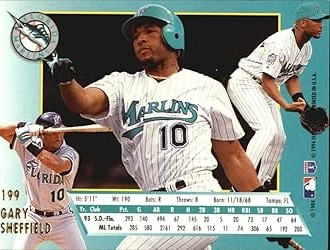
I feel like Sheffield is a controversial pick due to his implication in the PED scandals, but I’ve decided to let that go and just highlight the players, no place for negativity in these posts. So you will see other controversial players as we move along. These posts are for the nostalgia and Sheffield was a fun player to watch when I was a kid.
Gary Sheffield played outfield and third for twenty-two seasons from 1988 to 2009 on eight different teams. He started on the Brewers (we all wanted those Sheffield Future Stars cards), and went on to play for the San Diego Padres, Florida Marlins, Los Angeles Dodgers, Atlanta Braves, New York Yankees, Detroit Tigers and finally the New York Mets. He wore uniform number 10 for eleven seasons with the Padres, Marlins (6 years) and the Mets. He had a career WAR of 60.5.
The Marlins are the primary team that I remember Sheffield playing for, and the team in which he wore uniform number 10 the longest, so I chose this 1994 Fleer Ultra. I loved the Ultra; they were glossy and colorful and had these great card backs. This one is awesome and shows his uniform number twice! It’s only the second time I’ve used the photo from the back of a card, the first being Jeff Bagwell.
Sheffield was a 9-time All-Star. He batted .290 or more fourteen times, while winning 5 Silver Slugger awards. He was a member of the 1997 World Series Champion Marlins team, the first in franchise history. The team was managed by Jim Leyland and included slugger Bobby Bonilla, speedster Édgar Rentería, the clutch Moisés Alou, pitchers Kevin Brown and Alex Fernandez and closer Robb Nenn.
Sheffield never played after 2009. He finished his career with a .292 batting average, 2,689 hits and 467 doubles and 253 stolen bases. He is 27th in home runs with 509, 39th in runs scored (1,636), 30th in RBIs (1,676), 21st in walks (1,475), and 35th in Total Bases (4,737). Sheffield holds the record for most MLB ballparks played in (51) and he and Fred McGriff, who was mentioned earlier in the Chipper section, are the only players to have 30 or more home runs in one season for 5 different teams.
Sheffield was eligible for the Hall of Fame in 2015, but due to his implications with steroids, fell off the ballot in 2024, having never received enough votes to be inducted.
His uncle is New York Mets legend Dwight “Doc” Gooden.
Number 6:

Ron Cey played for seventeen seasons from 1971 to 1987. He was a third baseman who played for the Los Angeles Dodgers, Chicago Cubs and spent one season on the Oakland Athletics. Cey wore uniform number 10 for the twelve seasons he was with the Dodgers. He had a career WAR of 53.7. He was also one of Batman’s biggest enemies. I jest, but with his nickname, “the Penguin” , what was I supposed to think? The nickname was based on his unusual running style.
I wasn’t collecting when this 1981 Fleer came out, but I somehow had a lot of early 80s cards in my collection once I got going. The 1981 Fleer I remember well. The design is cool, and I’m a fan of the color borders and the little baseballs on the front with the team’s name is a nice touch. This Ron Cey also shows his uniform number, which works for my posts.
Cey was a 6-time All-Star. He was never much of a power hitter, having only hit 30 home runs once, but he did have 20 or more in ten seasons. He also never batted .300. He was consistent at driving in runs, having over 100 RBIs twice and over 90 five times. “the Penguin” wasn’t fast and only stole 24 bases in his entire career. He was, however, a hustler, who played hard and came in clutch when needed.
He was a member of the 1981 Dodgers World Series winning team, managed by Tommy Lasorda and featuring Pedro Guerrero and Steve Yeager. Cey, along with those two, were the co-MVPs of the 1981 Series.
He retired from baseball in 1987 with a .261 batting average, 1,868 hits, 316 home runs, 1,139 RBIs and a .961 fielding percentage.
Cey tried his hand at acting when he appeared in an episode of Columbo in 1990. He continues to work in an administrative role with the Los Angeles Dodgers.
Number 7:

Tommy Bridges pitched for sixteen seasons from 1930 to 1946 exclusively with the Detroit Tigers. He was a right-handed pitcher known for his curveball. Bridges wore uniform number 10 for thirteen seasons, wearing number 16 his first three. He had a career WAR of 50.4.
Any chance I get to feature a Diamond Stars card, I’m taking it, and in this post I got two. This Tommy Bridges 1934 Diamond Stars features another wonderful art-deco style photo. I love the colors and style of these pre-World War 2 cards.
Bridges was a 6-time All-Star who led the American League in wins once and strikeouts twice. He had 20+ wins three seasons in a row from 1934-1936.
Bridges was a member of Detroit’s World Series Championship teams in 1935 and ten years later in 1945. In 1935, he was on a Tigers team that also featured Hank Greenberg, Mickey Cochrane, Charlie Gehringer and Goose Goslin. The 1945 team featured Greenberg again and fellow pitcher Hal Newhouser.
Bridges didn’t play in 1944 due to military service and only played 13 games between 1945 and 1946, when he would retire. He had a final record of 194-136 with a career ERA of 3.57. He had 1,674 strikeouts in 2,826.1 innings (5.3 SO/9). His career WHIP was 1.368 and his ERA+ was 126. He also had 10 career saves.
Tommy Bridges passed away in 1968 at the age of 61.
Final Score:
There were a few players who wore uniform number 10 for one season and whose career WAR was over 40. These include, Carl Hubbell (68.5, New York Giants, 1932), Al Simmons (68.5, Red Sox, 1943), Wes Ferrell (60.1, Washington Nationals, 1938), and Dave Stieb (56.4, Chicago White Sox, 1993). Evan Longoria who was already featured in the uniform number 3 post, wore it for 5 seasons with the San Francisco Giants.
Three others I’d like to mention here are 6-time All-Star Rusty Staub (WAR 45.8) who wore uniform number 10 for nineteen seasons, Yankees Hall of Famer Phil Rizzuto (WAR 42.1) wore it his entire thirteen season career, and Rangers great Jim Sundberg wore it for twelve seasons with Texas (1974 to 1983, and in 1988-89).
Thank you for joining me. If you’re enjoying these posts, feel free to share, follow, like and comment, and of course check out the next post as well explore uniform number 11!
Sources:
https://www.baseball-almanac.com/
https://www.baseball-reference.com/
Bolton, Barry (March 24, 2010). “Ron Cey sets record straight on ‘The Penguin'”. Coug Fan.
Foster, Jason (July 2025). MVP Award Winners Who Did Not Make the All-Star Team. mlb.com
Rogers, Phil (June 4, 1990). “The Class of ’90: TO EARN OR TO LEARN”. Sports Illustrated. Archived from the original on September 24, 2015.
https://baseballhall.org/discover/yankees-five-year-title-stretch-still-unmatched
Shout out to all the cool cards and creative commons for my pictures! Thanks Topps and Fleer and Donruss and Upper Deck and all the rest.
 Weekly Windup