
Checklist
14
Welcome back to Baseball by the Numbers. Today we are looking at uniform number 14. 755 players have worn number 14 at some point in their career. Two all-time greats wore this number for one season each. The amazing Willie Mays, who is 5th all-time for career WAR (156.2), had uniform number 14 his rookie season with the New York Giants in 1951. It was the only season he didn’t wear number 24. One of my all-time favorite players, the GOAT Rickey Henderson had uniform number 14 in 1993 while with the Toronto Blue Jays. Rickey is 19th all-time in career WAR at 111.2 and wore 6 different numbers throughout his career. Aside from those two legends, an additional thirty-two players who wore number 14 also had a career WAR of 40 or better and eighty-two players wore the number 14 for five years or more. Since Mays and Henderson only had this number 1 season each, there will be no “official” legend in this post, though the number 1 player is still a legend in my book.
Number 1:
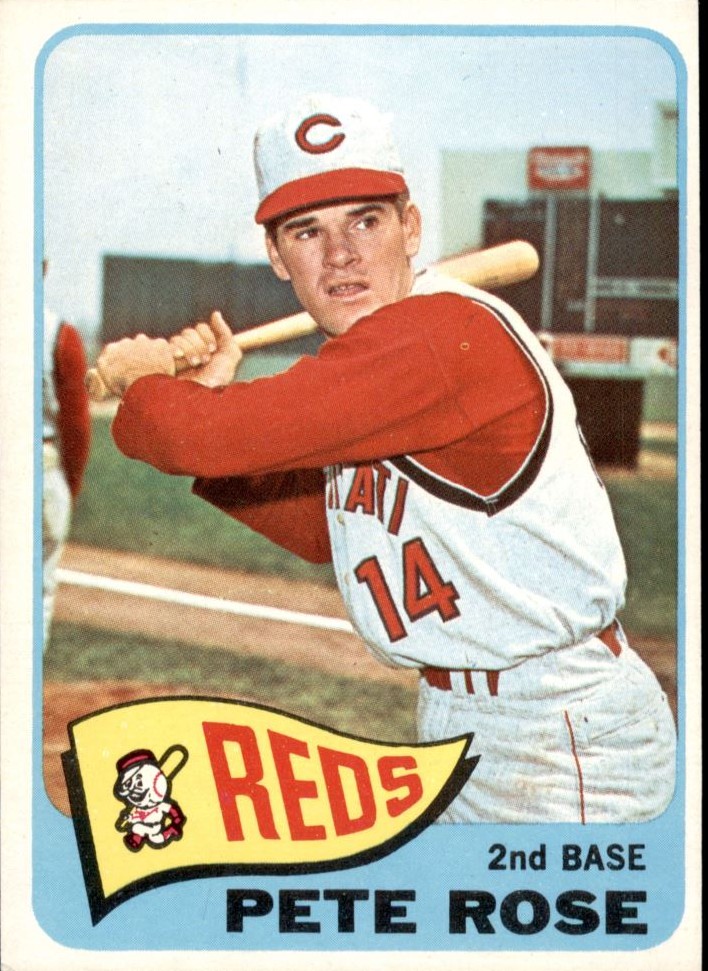
Mostly known as one of the best hitters in baseball history, Pete Rose was also a great defender. He is the only player with over 500 games played at five different positions (first base, second base, third base, right field and left field) and has also played games in center as well. There’s a helpful fact for your Immaculate Grid.
From 1963 to 1986, “Charlie Hustle” spent twenty-four seasons wowing fans with his defensive prowess and hitting and base running skills. Rose played for the Cincinnati Reds (1963-1978, 1984-1986), Philadelphia Phillies (1979-1983), and the Montreal Expos (1984). He wore uniform number 14 his entire career and had a career WAR of 79.6.
I love this 1965 Topps card of Pete Rose. It’s a great photo of him with the Reds, and his number is visible on the front of the uniform. I really like the design of 1965 Topps, especially the banner at the bottom with the team’s name and logo displayed. Love that old school Reds logo!
Rose has the 9th most All-Star appearances in history with seventeen. He is the only player to have had All-Star appearances at five different positions. Rose was the National League Rookie of the Year in 1963 and was the NL MVP in 1973. He has two Gold Glove awards, a Silver Slugger, and won the Roberto Clemente award in 1976. He hit .300 or better in fifteen seasons, leading the league three times. He led the league in hits seven times and had 200 or more hits in ten seasons, tied for the most with Ichiro Suzuki. He also led the league in doubles five times, runs four times and OBP twice.
Rose was a member of three World Series Championship teams. He won two (1975 and 1976) with the “Big Red Machine” Cincinnati Reds team which also featured manager Sparky Anderson, and Johnny Bench, Joe Morgan and Tony Perez. Rose was the MVP in the 1975 Series when he batted .370 with 10 hits, 3 runs, a double, a triple and 5 walks. He was won a ring as a member of the 1980 Phillies along with pitcher Steve Carlton and third baseman Mike Schmidt.
Rose played 95 games for the Expos in 1984 when he was traded back to the Reds. He would play his last few seasons with the Reds as a player/manager. He would retire as a player in 1986 but stay on as Reds manager through 1989.
Rose holds several MLB records. He is first in games played, at-bats, plate appearances and singles. His 4,256 hits is 1st all-time, and he had 100 or more hits in a record 23 straight seasons. He is also tied for first with ten seasons of 200 hits or more. He has a .303 career batting average and is 2nd all-time in doubles with 746 and 6th all-time in runs with 2,165. He has 135 triples, 160 home runs, 1,314 RBIs and 198 stolen bases. He ranks 14th in all-time walks (1,566) and 9th in Total Bases (5,752).
Rose is a member of the Cincinnati Reds Hall of Fame, and his uniform number 14 was retired by the Reds in 2016.
Despite all his achievements, Rose was banned from the National Baseball Hall of Fame in 1991 due to his inclusion on the permanently ineligible list in the aftermath of a gambling investigation in 1989.
Pete Rose passed away at the age of 83 in 2024.
In May of 2025, Rose became eligible for the Hall of Fame due to a change regarding permanent ineligibility after death. He will be eligible for Veterans Committee selection in 2027 and I hope he gets in.
Number 2:
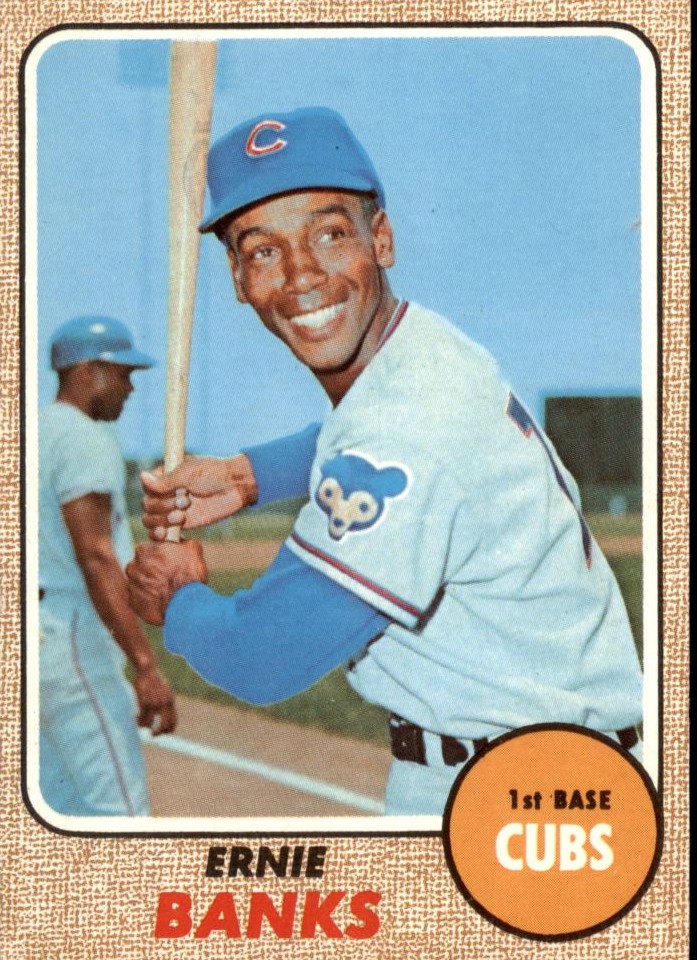
Known as “Mr. Cub” for playing his entire nineteen-year career with the Chicago Cubs, Ernie Banks was a shortstop and first baseman from 1953 to 1971. Banks started his career in the Negro Leagues in 1950 and in 1953, became the first black player for the Chicago Cubs franchise. Banks wore uniform number 14 his entire career and had a career WAR of 67.8.
Look at that smile. This 1968 Topps card of Ernie Banks showcases his other nickname “Mr. Sunshine” given to him for his infectious smile and ever-present optimism and love of baseball. Aside from that smile, I really love the old Cubs uniforms and logo, and the design of these 1968 Topps is classic.
Banks was a phenomenal player. He placed 2nd in ROY voting in 1954 losing to Wally Moon. He was an All-Star fourteen times and won a Gold Glove in 1960. He was the National League MVP in 1958 and 1959. In 1958, he led the league in home runs (47), RBIs (129), SLG (.614) and TB (379) and in 1959 he had a league leading season WAR of 10.2 with 45 home runs and again led the league in RBIs with 143. Banks had over 40 home runs in five seasons and over 100 RBIs in eight. Banks was also a strong defensive player, and he led the National League in putouts five times and in fielding percentage four times.
Banks won the Lou Gehrig Memorial Award in 1968 and retired in 1971. He was named to the MLB All-Century Team. He finished his career with a .274 batting average, 2,583 hits, 407 doubles, 512 home runs (23rd all-time), and 1,636 RBIs (33rd).
“Mr. Cub” is a member of the Chicago Cubs Hall of Fame and the Cubs retired his uniform number 14 in 1982.
Banks was inducted into the National Baseball Hall of Fame in 1977.
Ernie Banks passed away in 2015 at the age of 83.
Number 3:
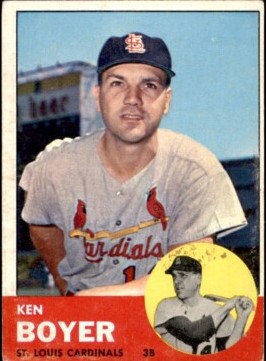
Ken Boyer spent fifteen years in the Majors from 1955 to 1969. He was a third baseman whose best years were with the St. Louis Cardinals (1955-1965). He was traded to the Mets in 1965 and stayed with them until mid 1967 when he was traded to the Chicago White Sox for Sandy Alomar. He would eventually be released and spent the rest of his career with the Los Angeles Dodgers, playing his last game in August of 1969. Boyer had a career WAR of 62.8 and wore uniform number 14 for fourteen seasons, wearing 45 only with the Dodgers.
I like the 1963 Topps design with the little photo in the corner. I chose this card of Boyer because he is with the team he spent most of his career with and you can just about make out the uniform number 14 on the front of his jersey…just use your imagination and squint.
Boyer was a strong defensive third baseman. He earned 5 Gold Glove Awards and led the league in fielding percentage once and double-plays five times. He was an eleven-time All-Star who batted over .300 in five seasons and, in 1964, was voted National League MVP after hitting .295 with 185 hits, 30 doubles, 24 home runs and a league leading 119 RBIs. Playing alongside Lou Brock and pitcher Bob Gibson, Boyer’s MVP play in 1964 propelled the Cardinals to a World Series win.
Boyer ended his career with a .287 batting average, 2,143 hits, 318 doubles, 68 triples, 282 home runs and 1,141 RBIs. Defensively at third base he is ranked 32nd in putouts, 21st in assists and 14th in double plays turned all-time.
Boyer is a member of the St. Louis Cardinals Hall of Fame, and his uniform number 14 was retired by the Cardinals in 1984.
He was only 51 when he passed away from cancer in 1982.
Number 4:
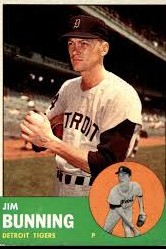
There have been over 238,000 games played in baseball over the course of roughly 154 years…and only 24 times has a pitcher pitched a perfect game. Jim Bunning accomplished that feat on June 21st, 1964.
Jim Bunning was a pitcher in the Majors for seventeen years from 1955 to 1971. He played for the Detroit Tigers (1955-1963), Philadelphia Phillies (1964-1967), Pittsburgh Pirates (1968-1969), Los Angeles Dodgers (1969) and finished back with the Phillies (1970-1971). He had a career WAR of 59.4 and wore uniform number 14 for sixteen seasons.
Like Boyer above, I used another 1963 Topps for Bunning since I had trouble finding a card with his number visible. In this card he is with the Tigers where he played for nine seasons.
Bunning was a nine-time All-Star. He had over 200 strikeouts in six seasons, leading the league three times and pitched over 200 innings in twelve (300+ twice). He led the league in season WAR twice, wins once and shutouts twice. Aside from his perfect game in 1964, mentioned above, he pitched a no-hitter on July 20th, 1958. He is one of only seven pitchers in history (along with Sandy Koufax, Addie Joss, Cy Young, Randy Johnson, Roy Halladay and Mark Buehrle) to pitch both a no-hitter and a perfect game in their career.
Bunning retired in 1971 with a career winning % of .549 with a 224-187 record. He has a career ERA of 3.27, WHIP 1.179 and ERA+ of 115. In 3,760.1 innings he is ranked 22nd in strikeouts with 2,855. He also has 151 complete games with 40 shutouts (44th all-time tied with 6 others) and he has 16 saves.
He is on the Phillies Wall of Fame, and his uniform number 14 was retired by Philly in 2001.
Bunning was elected to the National Baseball Hall of Fame in 1996.
After retirement Bunning was a politician and is the only baseball player in history to be elected to both the United States Senate and the National Baseball Hall of Fame.
Jim Bunning passed away in 2017 at the age of 85.
Number 5:

Eleven weeks after Jackie Robinson broke the color barrier in Major League Baseball, centerfielder Larry Doby made his debut on July 5th, 1947. He was the first black player in the American League. Doby started with the Newark Eagles of the Negro Leagues and played four and a half years before joining the Majors. He played thirteen seasons in the Majors from 1947 to 1959 with Cleveland (1947-1955, 1958), Chicago White Sox (1956-1957, 1959) and the Detroit Tigers (1959). He had a career WAR of 56.7 and wore uniform number 14 for eleven seasons.
Doby was a Negro Leagues All-Star in 1946 and won the World Series with teammates Leon Day and Monte Irvin of the Newark Eagles that same year. In the Majors, Doby was a seven time All-Star. He led the league in runs once, home runs twice and RBIs once. He had over 100 RBIs in four seasons and hit over 20 home runs eight times. Doby was a part of the 1948 World Series Champion Cleveland Indians, a team that featured feature Hall of Famers Lou Boudreau, Bob Feller, Joe Gordon, Bob Lemon and Satchel Paige. “In Game 4 of the World Series against the Boston Braves, Doby became the first African-American player to homer in a World Series.” (Monagan, 2017)
Doby suffered from bone deterioration in his ankle and retired in 1959. He finished his career with a .283 batting average, 1,515 hits, 253 home runs and 970 RBIs.
Doby is a member of the Cleveland Guardians Hall of Fame. His uniform number 14 was retired by Cleveland in 1994, and he was elected to the National Baseball Hall of Fame in 1998.
Larry Doby passed away at age 79 in 2003.
Number 6:
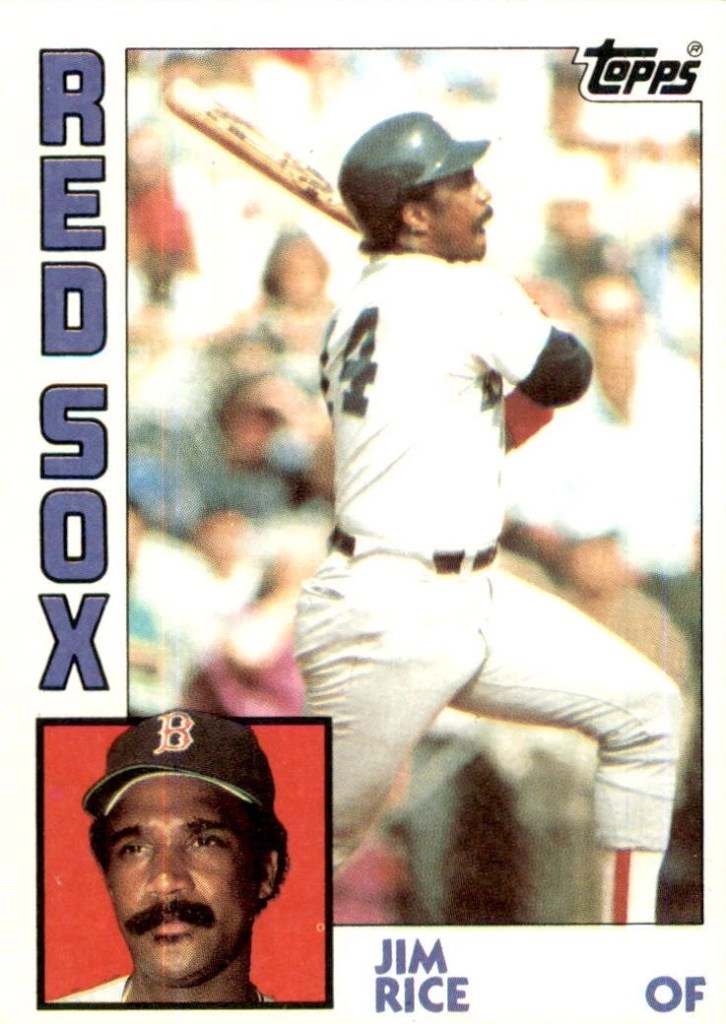
I’m always excited when I get to write about a Boston player, and Jim Rice is the quintessential Red Sox hero. Rice played from 1974 to 1989 and spent his entire sixteen-year career as a left fielder and later designated hitter for the Boston Red Sox. He wore uniform number 14 his entire career and had a career 47.7 WAR.
I’ve always been partial to the 1984 Topps design. I really like this card of Jim Rice. It’s a great example of the set, with the team’s name along the side and the portrait of Rice (and his great mustache) in the corner box. The main photo also works great for this post as you can see Rice’s number 14 on the back of his jersey as he completes his swing.
In 1975, Rice was second in Rookie of the Year voting, losing to teammate Fred Lynn. He won the American League MVP award in 1978 when he led the league in 14 categories including WAR (7.6), hits (213), triples (15), home runs (46) RBIs (139) and OPS (970). Rice is the only player in history to lead the league in home runs, RBIs, and triples in the same year. Blevins, David (2012)
He batted over .300 seven times with four 200+ hit seasons, hit over 30 home runs four-times and had over 100 RBIs eight times. He was an eight-time All-Star and won two Silver Sluggers. He was a member of two Red Sox World Series appearances (1975 and 1986). The Sox lost both 4 games to 3. (ugg!)
Rice played his last game in August of 1989. He finished his career with a .298 batting average, 2,452 hits, 373 doubles, 79 triples, 382 home runs, 1,451 RBIs, 1,249 runs scored and 4,129 total bases.
Rice is a member of the Boston Red Sox Hall of Fame, and his uniform number 14 was retired by Boston in 2009.
He was inducted into the National Baseball Hall of Fame in 2009.
Rice is 72 years old and works as an analyst during Boston Red Sox pre and post-game shows for NESN (New England Sports Network).
Number 7:
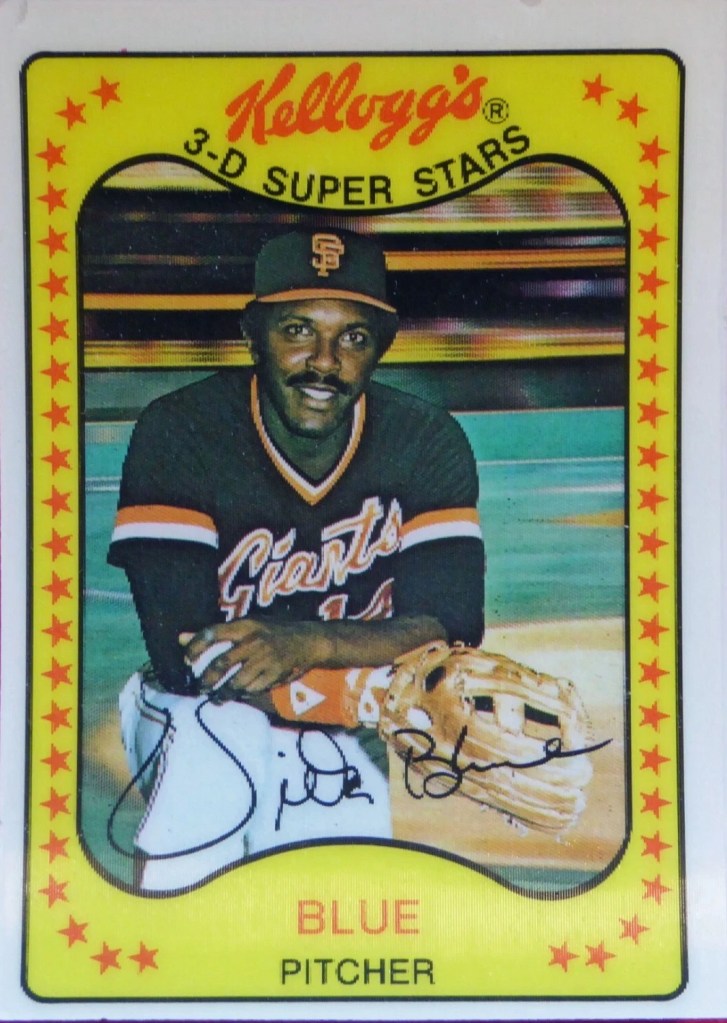
A left-handed fireballer, Vida Blue played for seventeen seasons from 1969 to 1986. Blue pitched for the Oakland Athletics (1969-1977), San Francisco Giants (1978-1981, 1985-1986) and Kansas City Royals (1982-1983). Originally wearing four different numbers while with the A’s (21,28,17,35), he switched to uniform number 14 in 1973 and wore it for most of the next twelve seasons (he also wore 33 while with Kansas City). Blue had a career WAR of 45.1.
I really wanted to pick a card with Vida Blue on the Oakland A’s, but the only cards I could find that had the number visible showed uniform number 35. Then I saw this beauty. I love Kellogg’s Brand 3-D baseball cards. This is from 1981 and you can see Blue’s number 14 right on the front of his Giants uniform.
Vida Blue won the Cy Young Award and was the American League MVP in 1971. In 39 starts, he went 24-8 with 24 complete games and led the league with 8 shutouts. He had 301 strikeouts in 312 innings for a league leading 8.7 SO9. He also led the league with a 1.82 ERA. He was also an All-Star, one of 6 seasons as an All-Star.
In his seventeen seasons, Blue had 20 or more wins three times and pitched for an under 3 ERA seven times. On September 21st, 1970, he pitched a no-hitter. Blue was a member of the Athletics three consecutive World Series Championships from 1972-1974 along with fellow pitchers Catfish Hunter and Rollie Fingers, and “Mr. October” Reggie Jackson.
Blue played his last game in 1986. He would finish his career with a .565 W-L % on a 209-161 career record. He had a 3.27 ERA, 1.233 WHIP and an ERA+ of 108. In 3,343.1 innings he had 2,175 strikeouts with a SO9 of 5.9. He pitched 143 complete games and 37 shutouts.
He is a member of the Oakland Athletics Hall of Fame and the San Francisco Giants Wall of Fame.
Vida Blue passed away at the age of 73 in 2023.
Final Score:
It seemed that a lot of players like to keep number 14, so I wanted to highlight a few players who missed the cut but wore uniform number 14 for a long time. Hall of Famer Gil Hodges wore it for seventeen seasons, 3-time All-Star Julio Franco for 16 years, 6-time All-Star Paul Konerko wore it sixteen years while with he White Sox, the “Big Cat” Andrés Galarraga wore 14 for fifteen seasons, Minnesota Twins Legend Kent Hrbek wore it thirteen seasons, and 8-time All-Star Bill “Moose” Skowron wore uniform number 14 for twelve seasons. There are so many more, but they will have to wait for the next go through.
Thank you so much for reading. I hope you enjoy these posts. Please subscribe and share, like and comment, I’d love to hear from you! And stay tuned because uniform number 15 will be coming up soon!
Sources:
https://www.baseball-almanac.com/
https://www.baseball-reference.com/
Blevins, David (2012). The Sports Hall of Fame Encyclopedia: Baseball, Basketball, Football, Hockey, Soccer. Lanham, Maryland: The Scarecrow Press. p. 800.
Coffey, Michael (2004). 27 Men Out: Baseball’s Perfect Games. New York: Atria Books. pp. 79–95
Monagan, Matt (2017). Nearly 70 years ago, Larry Doby became the first African-American player to hit a World Series HR, mlb.com
Shout out to all the cool cards and creative commons for my pictures! Thanks Topps and Fleer and Donruss and Upper Deck and all the rest.
 Weekly Windup