Flick Finds Fame

Posted March 27, 2025 by jake
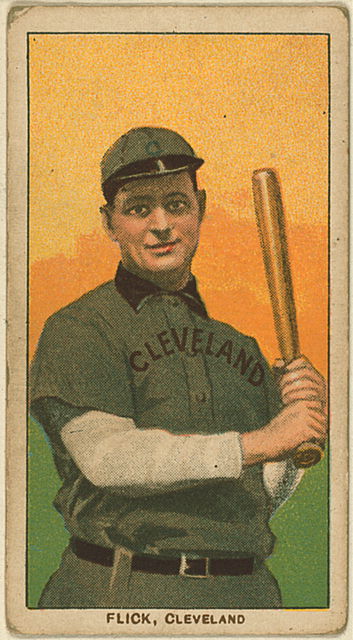
Elmer Flick, outfielder with the Cleveland Bronchos/Naps, image from the 1910 American Tobacco Company baseball card.

When I saw the name Elmer Flick the other day, I had to learn more, especially when I found out he was a Hall of Famer (Class of 1963). I personally could not remember hearing the name Flick in the past, but I quickly discovered an underrated and often forgotten old school star.

Flick was born in Bedford, Ohio in 1876, the son of a farmer and Civil War Veteran. In true 1800’s style, he joined a semi-pro team when he was 15 years old because the team was short a player and Flick happened to be hanging around the train station when they were leaving for a game. He played catcher in high school and was waving the local team on when they realized they needed the help. For a youngster, he did well, and not long after, Flick began to play minor league ball with the Youngstown Puddlers in 1896.

Using a baseball bat that he handmade (that is old school baseball gold), Flick hit over .400 but struggled in the outfield. Flick had always played catcher, so his .826 fielding percentage was no surprise; there would be an adjustment to the outfield. Luckily, he was a quick study, and his defense improved.

His hitting skills were never a question, and with the improved defense, he found himself playing left-field for the Dayton Old Soldiers. (I Love these team names!!) His fielding percentage increased to .921, and his offense was legendary. Flick batted .386 with 183 hits. This included 42 doubles, 10 home runs, an impressive 135 runs and even 25 stolen bases. He also led the league in triples with 20 and total bases with 295.

In 1898 he was signed to the Philadelphia Phillies as a reserve outfielder, but due to injuries, he quickly became a starter. It was a great rookie season for the young slugger as he finished with a .302 average including 16 doubles, 13 triples, 8 homeruns, and 81 RBI’s. He also stole 23 bases and only struck out 36 times in 453 at bats.

In 1900, still with the Phillies, he had an amazing season. In 545 at-bats, he had only 30 strikeouts, batting .367 (a career high) which included additional career highs in hits (200) home runs (11), slugging (.545), OPS (.986) and a league leading 110 RBIs. He also had 32 doubles, 16 triples and 35 stolen bases. His high batting average put him in a tense race for the batting title against super star Honus Wagner, who would end up winning the title at the end of the season. Wagner spoke of the race, “I’ve had a lot of thrills, but don’t think I was ever happier than in 1900 when I won after battling Elmer Flick to the last day of the season for the title.”  Lieb, Fred (January 27, 1971)

 Not only was he great at the plate, but he was becoming a solid outfielder with a .914 fielding percentage and 232 put-outs’ and 23 assists, often throwing out hitters at first. He was also a feisty player, one time getting into a fist fight with teammate and future Hall of Famer, Nap Lajoie, over a bat! Lajoie would end up breaking his thumb in the altercation, missing 5 weeks.

Apparently Flick and Lajoie buried the hatchet, and both left the Phillies in 1902 joining the American League Philadelphia Athletics. They only played 11 games with the Athletics before moving to the Cleveland Bronchos. This was due to a legal injunction obtained by the Philadelphia Phillies which prevented players under contract with their team from moving to other teams. This injunction was found to only be valid in Pennsylvania and couldn’t be enforced in Ohio. To avoid legal ramifications, Flick and Lajoie would travel together, ensuring never to step foot in Pennsylvania until 1903 when the two leagues made peace.

Born and raised in Ohio, Flick would stay with Cleveland, now called the Naps, for the remainder of his Major League career. He would continue to play well for Cleveland, leading the league in batting average (.308) , triples(18),  SLG (.432) and OPS (.845)  in 1905, leading in games (157), plate appearances (707) at bats (624), runs (98), triples (22) and stolen bases (39) in 1906 and again in triples (18) in 1907, his last full season.

By 1907, Flick had second thoughts about his baseball career. He was stressed from the constant playing and felt physically run down. He considered retiring but stayed on for the season. Flick was so highly regarded by the Naps that in spring training of 1907 they turned down a trade from the Detroit Tigers, who offered a straight up deal, Flick for future AL MVP and Hall of Famer Ty Cobb! Based on the rest of these two players’ careers, I’d guess that the Naps regretted turning that deal down.  

Although Flick had another productive year in 1907, even leading the league in triples again with 18, by 1908 his health had severely deteriorated. He was plagued with an unexplained gastrointestinal illness which caused him to miss almost the whole season, playing in only 9 games. He continued with the Naps in 1909 and 1910, but played in only 66 and 24 games respectively. He was replaced by a pre–Black Sox Scandal Shoeless Joe Jackson, and eventually sold to the Kansas City Blues, however the deal was canceled when Flick refused to go to Kansas City and, without a team, he would return to the minor leagues.

He played two more seasons for the Minor League Toledo Mud Hens in 1911 and 1912 before being released and retiring from baseball.

He would move back to his hometown of Bedford, Ohio and take up raising horses and real estate. He got married and had five children. He also did some scouting for Cleveland as well.

Flick seemed to live in relative obscurity until 1961 when Ty Cobb passed away. A few stories about Cobb mentioned the failed trade of Cobb for Flick in the 1907 season, and with some influence from Branch Rickey, Flick was inducted into the Hall of Fame by the Veteran’s Committee. Flick was 87 years old, and didn’t believe that he had been elected. He had to be convinced that it was real. Flick was the oldest living inductee, and at the ceremony he said, “This is a bigger day than I’ve ever had before. I’m not going to find the words to explain how I feel.” Corcoran, Dennis (2010)

Flick passed away at the age of 94 in 1971, one of only 4 19th century players who were still alive. Flick played 13 years in the Majors accumulating a 52.7 WAR with 1752 hits, 48 home runs, 756 rbis, 950 runs, 268 doubles, 164 triples and 330 stolen bases. His career batting average was .313 with a .389 career OBP.

Flick’s Hall of Fame induction was met with much criticism, but  anyone who can hit .400 with a homemade bat, get in a fist fight during a season and still almost beat Honus Wagner for the batting title, have his team refuse to trade him for Ty “freaking” Cobb, and then live to be 94 years old, is one tough ball player, and I, for one, am glad he was inducted and got to be around to not believe it. I’m glad Flick found fame.

Elmer Flick, outfielder with the Cleveland Naps (AL), before a game, circa 1910


Sources:

https://www.baseball-reference.com/players/f/flickel01.shtml

Corcoran, Dennis (2010). Induction Day at Cooperstown: A History of the Baseball Hall of Fame Ceremony. McFarland. pp. 78–80.

Lieb, Fred (January 27, 1971). “Rickey, Honus Remembered Flick”. St. Petersburg Times. Retrieved March 26, 2025.

Louisa, Angelo “Elmer Flick” via https://sabr.org/ Retrieved on March 26th, 2027

https://en.wikipedia.org/wiki/Elmer_Flick

Photos:

1: This media file is in the public domain in the United States.

2: This work is from the George Grantham Bain collection at the Library of Congress. According to the library, there are no known copyright restrictions on the use of this work.
A “Pitch” Hitter

March 14, 2025 by jake

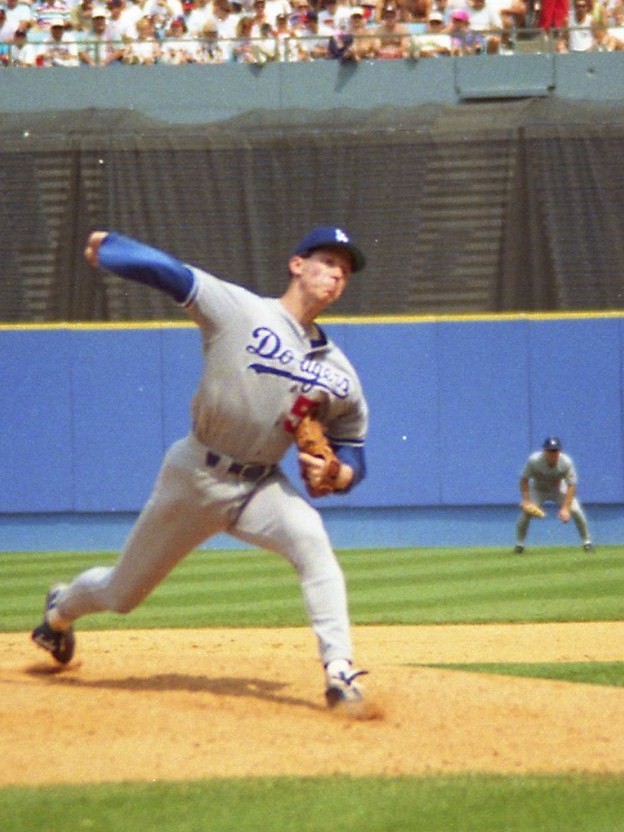
“Orel Hershiser 1993” by jimmyack205 is licensed under CC BY 2.0.

The designated hitter has been a staple of the American League since 1973. Pitchers in the National League were still required to bat, and usually in the ninth spot, until 2022. Since 1986, the World Series has followed the rules of the designated home team’s league. It’s no surprise the designated hitter rule had finally become the standard. Most pitchers were easy outs. Sure, there were occasional big hit moments, but by and large, the pitcher coming up to bat was a joke. In 1993 one pitcher defied the standard.

Orel Leonard Hershiser IV was born September 16, 1958 and played 18 seasons in the Major Leagues from 1983 to 2000. He is currently 66 years old. He was a 3 time All Star, a World Series winner (1988), a NL Cy Young winner (1988), a 2 time LCS MVP (1988, 1995), a World Series MVP (1988), he won the Gold Glove in 1988 and even won the Silver Slugger in 1993.

Of his 18 seasons, 1988 was Hershiser’s best season by far. He started 34 games, completing 15 of them, 8 of which were shutouts. In his 267 innings pitched, Hershiser had 178 strikeouts and an ERA of 2.26.

While not a flamethrower, Hershiser was a strategic pitcher, which gained him 23 wins that season. This style of pitching also led to Hershiser obtaining the record for consecutive scoreless innings pitched with 59. He also won the Gold Glove. The Dodgers made the playoffs, and Hershiser won his first NL Championship MVP Award (the second was 1995) after pitching starting in three games against the New York Mets, shutting them out in Game 7. Oh, and for good measure, he got a save in Game 4.

The Dodgers won the World Series ring 1988 after beating the Athletics 4 games to 1. Most people remember that timeless pinch-hit walk-off homerun by a hobbled Kirk Gibson in Game One of that series, but it was World Series MVP Oral Hershiser who really secured the ring. In Game two he allowed only three singles, all by Dave Parker, shutting out the A’s. He also was the first pitcher to get three hits in a World Series game since 1924, and the first pitcher to record a World Series RBI since 1983. So, the dude could hit!

He capped off the World Series in Game Five, by pitching a complete game, allowing only four hits, two runs, and striking out nine.

1988 was a great year for Hershiser and led to him becoming the only player to receive the Cy Young Award, the Championship Series MVP Award, and the World Series MVP Award in the same season.

Enough about his great 1988 season, I’m here to talk about 1993, and not because of his pitching. In fact, 1993 was a mediocre year for Hershiser. He started 33 games, completed 5 of those with one shutout. He pitched 215 innings with 141 strikeouts and a pretty pedestrian 3.59 ERA. He went 12-14. But what really caught my attention was his hitting stats. Remember I mentioned that 3 hit game in the 1988 World Series? It was important because in 1993 he won a Silver Slugger Award. In 73 AB he had 26 hits for a .356 avg. He had 11 runs, 4 doubles and 6 RBI’s. He really had a great hitting season for someone who only appeared in 34 games. Sure, he was no Shohei, no one is, but in a time when the 9th batter was almost always a pitcher, and the likelihood of an out, or possibly a bunt was very high, Hershiser defined the odds-at least in 1993. For his career his batting average is .201.

Hershiser retired in 2000 but continued to be involved in baseball in many ways. He’s been a consultant, a special assistant, a pitching coach, and executive and a television analyst. He finished his career with a 204-150 win-loss record, 3.48 career ERA and 2,014 career strikeouts.

“Go after the hitter, I said. Quit being so careful. Get ahead of the count. Even the good hitters are going to fail 70 percent of the time. You got what it takes to get anybody out. What I saw in Orel over the next twelve years was a baseball player with a tenacious will to learn, to grow, and to improve. I saw an outstanding young man who was a hard worker – aggressive, even daring, on the mound. Not only did I get what I asked for, I got more. Without a doubt, Orel Hershiser is one of the smartest baseball players I’ve ever managed.”- Hall of Fame Manager Tommy Lasorda in Between the Lines: Nine Things Baseball Taught Me About Life (Orel Hershiser, Faithwords, 07/01/2002, Foreword)

A Series of Firsts

March 13th, 2025 by Jake

Wheeler “Doc” Johnston

Welcome to another post directly inspired by the most recent Immaculate Grid. Today’s research was for players who played for both Cleveland and Cincinnati. This player only played 3 games with the Reds in 1909, but I love players with the name Doc, which reminds me of the Old West, sort of like baseball in the late 1800’s and early 1900’s, only with balls and gloves instead of pistols, though I’m sure I’ll find a story about some pistol carrying pitcher at some point. I digress, let’s get to the player, and why, even though he only has a career 3.2 WAR, I still felt there was a cool story to tell.

Doc Johnston was born September 9th, 1887, in Cleveland…Tennessee! (See already a twist!) His first name wasn’t really Doc. (Did you really think it would be?) But rather, his full name was Wheeler Roger Johnston. Doc to his teammates.

Doc started his career as a first baseman on the Reds in 1909, but played in only 3 games. He then spent most of his career with the Cleveland Naps (1912,1913,1914) and Cleveland Indians (1918,1919,1920). In the middle he was with the Pittsburgh Pirates (1915 and 16), where he had possibly his best season in 1915, with a 2.1 WAR. That season, he committed only 13 errors at first base in 1,514 chances for a fielding percentage of .991. He also hit 5 HR, had 12 triples, 19 Doubles and 26 Stolen Bases, though he was also caught stealing 17 times! But what I really want to look at is 1920, a historic season for Cleveland, ending with an interesting trip to the World Series for Doc.

The 1920 Cleveland Indians had a 98-56 record which brought them to the World Series and, ultimately, their first World Series Title after beating the Brooklyn Robins 5 games to 2. The fifth game of this series was historical in many ways. First, it featured an unassisted triple play by Second Baseman Bill Wambsganss, who leapt to catch a line drive, landed on second forcing the out there, then tagged the runner coming from first. Game 5 also featured the first ever grand slam in World Series history, a smoking shot in the first inning by Elmer Smith, giving the Indians a quick 4-0 lead. Finally, Jim Bagby, Cleveland’s starting pitcher and the winner of the game, helped himself with a 3-run home run in the fourth inning, the first by a pitcher in World Series history. Winning the World Series was bittersweet for the 1920 Cleveland Indians who had lost a teammate and a friend in Short Stop Ray Champman, who, on August 17, was hit by a pitch, becoming the only Major League player to die on the field.

Though not the best player on the team, Doc Johnston had a great season in 1920. His stellar defensive play was on display again as he committed only 12 errors in 1530 chances with a .992 fielding percentage. He batted .292 in 535 AB, with 2 HR, 71 RBI, 24 doubles, 10 Triples and 13 Stolen Bases, though he didn’t do much during the World Series with only 3 singles in 11 AB.

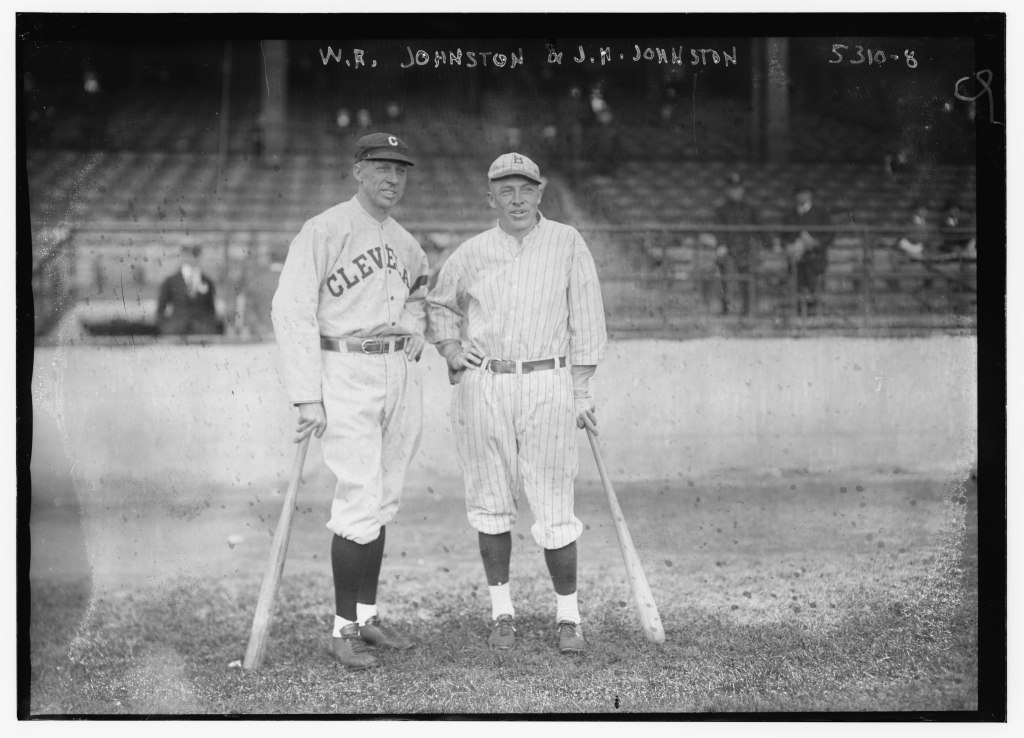
Still, the 1920 World Series was a notable one for Doc Johnston. Aside from getting a ring, there was a familiar face on the Brooklyn Robins, his younger brother Jimmy Johnston, who played third base. This was another first for the World Series; the first time two brothers would face each other in the big game. Jimmy was in the World Series twice, both with Brooklyn (1916 and 1920), and both losses, while older brother Doc got his ring.

Doc Johnston would go on to play two more seasons. In 1921, he would remain in Cleveland and play 118 games. In 1922, he would move on to the Philadelphia Athletics where he would play 71 more games before leaving the Majors. He finished his career with a 3.2 WAR hitting .263 in 3774 AB with 992 hits, 14 home runs, and 381 RBI’s. He was considered a terrific defensive player and would end his career with a .989 fielding percentage at first base. After leaving the Major Leagues, he would go on to manage a few years in the minors.

On February 17th, 1961, Wheeler “Doc” Johnston would pass away at the age of 73.

Below are brothers Wheeler “Doc” Roger Johnston and James “Jimmy” Harle Johnston 1920 World Series.

Photos:

1st: Library of Congress, Prints and Photographs Division, Washington, D.C. 20540 USA, hdl.loc.gov/loc.pnp/pp.print Public Domain

2nd: Bain News Service, publisher – Library of Congress Catalog: https://lccn.loc.gov/2014711589 Public Domain