Baseball by the Numbers: 7

Read about the project

Checklist

7

Welcome back to Baseball by the Numbers. Today we are looking at uniform number 7. Uniform number 7 had 752 players who wore it during their career. There was one Legend (career WAR over 100) and thirty-two players with a career WAR over 40. 107 players wore uniform number 7 for five years or more. That is a lot to choose from!

Overall, the uniform number 7 list was much easier than I anticipated. The Legend was obvious and the other seven players all matched the criteria (5 yrs + worn and career 40+ WAR). There were two very good players who wore number 7 but only for a shorter duration.

Barry Bonds, who had a career WAR of 162.8, good for 4th all-time, wore number 7 during his rookie season with the Pirates. Eddie Mathews (career WAR of 96) also wore number 7, but only for two seasons with the Tigers at the end of his career. Both will make it onto later posts.

I wanted to add a little factoid about number 7. The reason I chose to feature seven players as part of my criteria was due to my love of number 7. 7 or 77 has always been the number of my players in games like MLB The Show and Madden, and I use it as part of my username in many computer games. I have always liked the number and felt it to be lucky. Most people have lucky numbers, and 7 or 17 or 77 is the one for me. I will literally go out of my way to park in a spot with a 7 or use a locker with a 7! I don’t know how this came to be, but it has always been like this since as long as I can remember. With that said, none of the players who wore uniform number 7 were exactly my favorite. In fact, two of my absolute favorite baseball players wore uniform number 8, so I’m really looking forward to that post. Still, there were quite a few on this list who played during my initial card collecting years, which is always great, and of course there is this Legend.

The Legend:

Mickey Mantle, 1952 Topps, #311

If ever a player fits the legend spot, “the Mick” is it, especially to the New York Yankees fans. Mickey Mantle played mainly outfield for eighteen seasons from 1951 to 1968. He played his entire career under the big city lights of New York City. He was a legend of the Big Apple. He wore uniform number 7 his entire eighteen-year career (he wore 6 for a few months as a rookie), and his career WAR of 110.3 ranks 21st in MLB history.

Iconic. That is the word that best describes this Mantle 1952 Topps card. It wouldn’t be a stretch to say that the 1952 Topps are the most popular cards in existence. And the Mantle is the Holy Grail. In 2022, a grade 9.5 of this card sold for a record 12.6 million dollars. 1952 Topps was the foundation on which modern trading cards was built. It’s a beautiful set, filled with stars and nostalgia. In 1952, Mantle was already becoming a superstar in only his sophomore season. He batted .311, led the league in OPS (.924), hit 23 home runs and had 87 RBIs and made his first All-Star game while placing 3rd in MVP voting.

Mantle would be an All-Star twenty times (this includes twice from 59-62). He was the American League MVP on three separate occasions, including 1956 when he led the league in season WAR (11.3), runs (132), batting average (.353), home runs (52) and RBIs (130) winning the elusive Triple Crown. (Spoiler! Another player in this very post is also a Triple Crown recipient!) He also led the league in SLG, OPS and Total Bases.

Mantle led the league in season WAR during six seasons, led in runs five seasons, home runs four times, walks five times and triples, batting average and RBIs one season each. He also had the highest OBP on three occasions, the highest SLG four times and the highest OPS six different times. He also won a Gold Glove in 1962.

Mantle was a member of 7 World Series Championships (51-53,56,58,61 and 62) with the Yankees, playing alongside other Yankees legends like Yogi Berra, Joe DiMaggio, Whitey Ford, Johnny Mize, Enos Slaughter and manager Casey Stengel. He holds World Series records in home runs (18), runs (42), and RBIs (40).

Mantle retired in 1969 with a career .298 batting average including 2415 hits and 344 doubles. He is 18th all-time with 536 home runs and has 1509 RBIs, he’s 8th all-time in walks with 1733, 19th in OBP (.420), 22nd in SLG (.557) and 14th in OPS (.977).

Mantle was inducted into the National Baseball Hall of Fame in 1974.

His number 7 was retired by the Yankees in 1969.

Mantle passed away at the age of 63 in 1995.

Number 1:
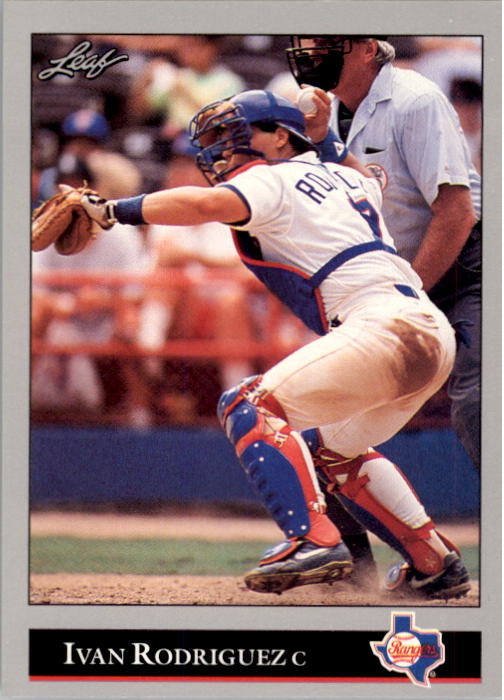
Ivan Rodriguez, 1992 Leaf, #194

Iván Rodríguez was a catcher for twenty-one seasons from 1991 to 2011. He played for the Texas Rangers until 2002 (and again in 2009), then moved around the league, playing for the Florida Marlins, Detroit Tigers, New York Yankees, Houston Astros and the Washington Nationals. He wore uniform number 7 for nineteen years and had a career WAR of 68.7.

1992 Leaf is a set that I remember well. When I was collecting cards, Leaf packs weren’t readily available, but if you went to a show or a card shop you could usually get a pack or two. I liked these cards, and I chose this Rodríguez card because I wanted to showcase him in his full catchers’ gear, showing off that defensive prowess that made him so great. Plus, if you look closely, you can see his uniform number on the back. In ’92 “Pudge” got his first All-Star nod and his first Gold Glove starting his career off strong, a precursor the great catcher he would become.

“Pudge” was a fourteen-time All-Star. He was the American League MVP in 1999 when he batted .332 with 199 hits, 35 home runs, 113 RBIs and 25 stolen bases, while winning a Gold Glove. Rodríguez won thirteen Gold Gloves during his career and seven Silver Slugger Awards. He hit .300 or better ten times.

In 2003 he won a World Series Championship with the Florida Marlins and was the MVP of the NLCS when he batted .321 with 2 home runs and 10 RBI.

He would retire in 2012 signing a one-day contract with the Texas Rangers.

He is first in history with 2427 defensive games played at catcher and had a 46% caught stealing percentage and .991 fielding percentage.

On the offensive end, he has a career batting average of .296 while leading all catchers in hits (2,844), runs (1,354), and doubles (572) to go along with 311 career home runs, 1,332 RBIs and 127 stolen bases. There are only six players in history to have a career .290 or batter batting average, with 2,500 or more hits, over 550 doubles, over 300 home runs and over 1,300 RBI’s, Babe Ruth, Hank Aaron, Stan Musial,  Barry Bonds, George Brett, and Iván “Pudge” Rodríguez.

He is a member of the Texas Rangers Hall of Fame, and his uniform number 7 was retired by the Rangers in 2017.

He was inducted into Cooperstown in 2017.

Number 2:
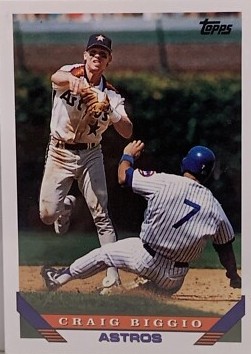
Craig Biggio, 1993 Topps, #680

From 1988 to 2007, Craig Biggio played catcher, second base and outfield for twenty seasons exclusively with the Houston Astros. Aside from his first season and half, he wore uniform number 7 for the rest of his career, nineteen seasons. He had a career WAR of 65.5

Along with his teammates Jeff Bagwell, Lance Berkman and Roy Oswalt, I loved collecting Biggio cards and have a bunch. Highlighting these late ‘80s and early ‘90s players is such a joy for me!

1993 was a down season in the middle of some of Biggio’s most productive years, but I had to use this card. Not only is it a great action shot of Biggio fielding the ball, but it also features another player, Joe Girardi, sliding into second as Biggio tags the base and throws to first. Girardi, a fellow catcher, wore uniform number 7 for seven seasons, and it is shown on this card. While Girardi didn’t make the list (his career WAR was only 5.6) it was evidence that a lot of catchers wore the number (like Rodríguez above, and Biggio). I also thought it was cool to have a photo of two players with the same uniform number interacting, and wonder if this photo was taken on purpose or is it just a crazy synchronicity. Anyone know?

Biggio was a seven-time All-Star with five Silver Slugger awards. He was also a great defender and won the Gold Glove Award four times. Along with Jeff Bagwell and Lance Berkman, he was a member of the Astros “Killer Bees” from 1994 to 2003 when the Astros made it to six postseasons. In 2007, he joined the 3000 hits club, becoming the first player in Astros’ history to do so. He would retire at the end of that season.

Biggio is the only player in the history of baseball with 3,000 hits, 600 doubles, 400 stolen bases, and 250 home runs. He finished his career with a .281 batting average, 3,060 hits (26th all-time), 668 doubles (6th all-time), 291 home runs, 1,175 RBIs and 414 stolen bases.

His uniform number 7 was retired by the Astros in 2008, and he is a member of the Astros Hall of Fame.

He was elected to the National Baseball Hall of Fame in 2015 alongside three great pitchers, John Smoltz, Randy Johnson and one of my favorite all-time players, Pedro Martinez.

Number 3:

Joe Medwick, 1935 Diamond Stars, #66

Joe Medwick played left field for twenty years from 1932 to 1948 with four teams. He started off with the St. Louis Cardinals for his first eight and a half seasons but was traded to the Brooklyn Dodgers in 1940. He played for the Dodgers 4 seasons, then played for the New York Giants, Boston Braves, back to Brooklyn, and finished his final two seasons back with St. Louis.

I got to use another Diamond Stars card! This 1935 Medwick card has his nickname “Ducky” on the front. He was also sometimes called “Muscles”. I love it! This is another beautiful Diamond Stars card. The vibrant colors look great and the photo of Medwick swinging the bat in his Cardinals uniform is perfect. I love the background with the players behind him. Medwick was an All-Star in 1935, he led the league in Total Bases with 365, and batted .353 with 224 hits, 46 doubles, 23 home runs, 126 RBIs and was 5th in MVP voting. And this wasn’t even his best season.

Medwick was a ten-time All-Star who had over 200 hits four times and had 190 and 198 hits in two more seasons. He also hit over .300 fourteen times. He led the league in WAR once, runs once, hits twice, doubles three times, triples once, home runs once and RBIs three times.

In 1937 he won the Triple Crown and was the National League MVP when he batted .374 with 31 home runs and 154 RBIs, while also leading the league with an 8.5 season WAR, 237 hits, 56 doubles and in SLG (.641), OPS (1.056) and Total Bases (406).

He was a member of the 1934 World Series Champion St. Louis Cardinals, the team known as the “Gashouse Gang”,  who were managed by Hall of Famer, Frankie Frisch (who also played), and featured Dizzy Dean, Dazzy Vance, Leo Durocher, and Jessie Haines. 

He retired after the 1948 seasons with a career batting average of .324 (50th all-time), 2,473 hits, 540 doubles, 113 triples, 205 home runs and 1,383 RBIs. He also hit .326 in his 12 World Series games.

He is in the St. Louis Cardinals Hall of Fame.

Medwick was elected to the National Baseball Hall of Fame in 1968.

Joe Medwick passed away at the age of 63 in 1975.

Number 4:

Kenny Lofton, 2008 Topps, #93

Kenny Lofton was an outfielder for seventeen seasons and played on eleven teams, including the Cleveland Indians who he played for on three different occasions. He played from 1991 to 2007, right in the middle of some of my biggest collecting years. I remember him being a fun player to watch. He wore uniform number 7 thirteen seasons and had a career WAR of 68.4.

This 2008 Topps would be Lofton’s final Topps during his career. He left baseball in 2007 after one final season with Cleveland. I chose this card for two reasons: it shows his number and he’s with Cleveland. While switching teams often, he spent ten years at different points with Cleveland, most of his career. In 2008 he was no longer playing after becoming a free agent after the 2007 season.

Loften was an All-Star six times and won four Gold Gloves. He led the AL in stolen bases five years in a row from ’92 to ’96. He was fast, having over 30 stolen bases in nine seasons with six of those seasons over 50 stolen bases. Known to provide a spark for playoff bound teams, Lofton played in 95 postseason games.

He has a career .299 batting average with 2,428 hits, 383 doubles, 116 triples and 130 home runs. His 622 stolen bases is 15th in history. He’s tied for 5th for most postseason triples and is first in postseason stolen bases with 34.

He is a member of the Cleveland Guardians Hall of Fame.

Number 5:
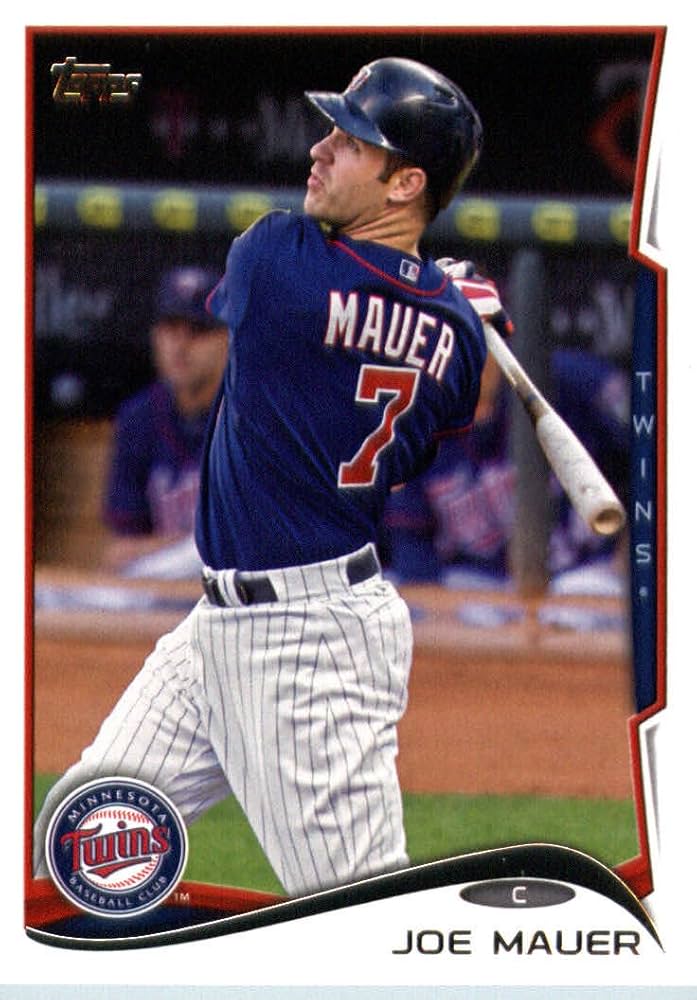
Joe Mauer, 2014 Topps, #125

For fifteen seasons Joe Mauer was behind the plate in Minnesota. He played exclusively for the Twins from 2004 to 2018. He wore uniform number 7 his entire career and had a career WAR of 55.6.

This 2014 Topps Joe Mauer not only showcases his beautiful swing but has the uniform number in the photo. 2014 Topps is not my favorite set, but it’s a nice-looking card overall. I do like the team logo on the front and the black trim, which is nice, and I really like the photo. Mauer didn’t have a great season in 2014, but this card makes up for it.

The first overall draft pick in 2001, Mauer was a six-time All-Star who earned 3 Gold Glove Awards and 5 Silver Slugger awards. He was the American League MVP in 2009 when he batted .365 and led the league in OBP (.444), SLG (.587), OPS (1.031), and had 191 hits, 30 doubles, 28 home runs and won a Gold Glove. He led the league in batting two other seasons (2006 and 2008). His three league leading batting titles are a record for catchers, and his 2009 .365 average and .444 OBP are the highest for any catcher in history in a single season. He batted over .300 in eight different seasons.

Mauer left baseball in 2018 with a career .306 batting average, 2,123 hits, 428 doubles and 143 home runs. He had a career .995 fielding percentage at catcher.

He’s a member of the Twins Hall of Fame and his number 7 was retired in 2019.

He was elected to the Baseball Hall of Fame in the class of 2024. Only three other players who were picked first in the draft are in the Hall of Fame, Ken Griffey Jr., Chipper Jones and Harold Baines.

Number 6:
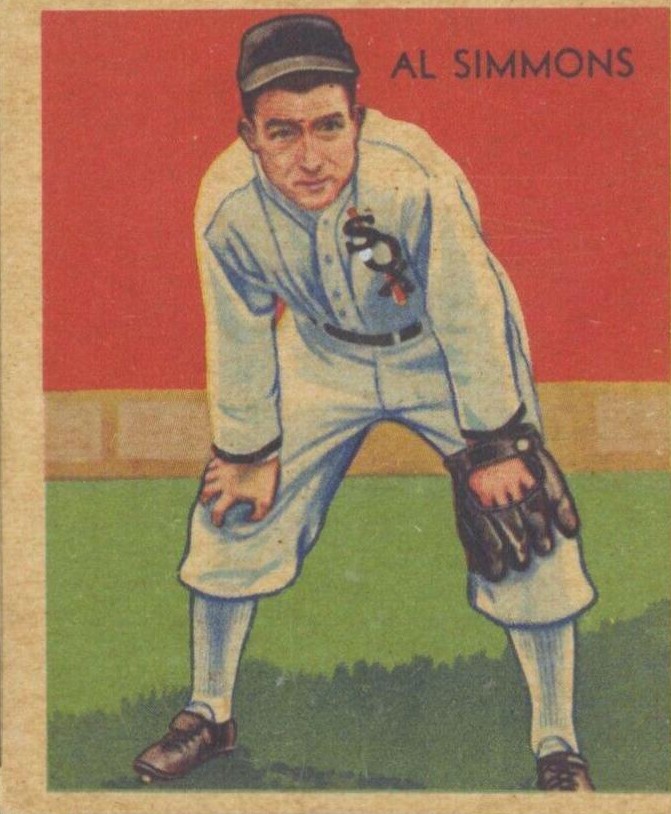
Al Simmons, 1934 Diamond Stars, #2

Al Simmons played twenty seasons in the Majors as an outfielder from 1924 to 1944 for nine separate teams. “Bucketfoot Al” played his first nine seasons with the Philadelphia Athletics, he then played for the Chicago White Sox, Detroit Tigers, Washington Senators, Boston Bees, Cincinnati Reds, Philly again, the Boston Red Sox and finished with Philly for one more season. Playing a half dozen seasons before uniform numbers were widely used, he wore uniform number 7 for five seasons with the Athletics (2 seasons), White Sox (2 Seasons) and the Senators (one season). His career WAR is 68.5. His nickname, “Bucketfoot” is an old baseball term for a flawed batting stance, one that Simmons used to great success.

As you have all figured out by now, I love to use these old Diamond Stars cards. This 1934 Al Simmons is great. The card is another nice-looking vintage photo, and Simmons is on the White Sox, where he wore the number 7 for two of his five seasons worn. 1934 was an All-Star season for Simmons. He batted .344 with a .403 OBP and .530 slugging. He had 102 runs, 192 hits, 36 doubles, 18 home runs, and 104 RBIs.

Simmons started his career prior to the All-Star game and from 1924 to 1932 he was in the top 5 for MVP voting 6 times. Once the All-Star game started, he made it to the roster 3 times. He batted over .300 fourteen times, leading the league twice in 1930 and 1931 when he batted .381 and .390. He also had 200 or more hits six times, leading the league with 253 in 1925. He drove in 100 or more RBIs in twelve seasons, including the 157 in 1929.

Simmons was a member of two World Series Championship teams with the Connie Mack led Philadelphia Athletics in 1929 and 1930.  Both teams won over 100 games each season and featured Hall of Famers Mickey Cochrane, Jimmie Foxx, Lefty Grove and Eddie Collins.

He would finish his career with The Athletics in 1944 with a career batting average of .334 (27th all time), 2,927 hits, 539 doubles, 149 triples, 307 home runs and 1,828 RBIs (21st all-time). He was also spectacular in the World Series having batted .329 with 6 home runs, 17 RBIs and a .658 SLG in 19 games.

Simmons is a member of the Athletics Hall of Fame.

He was elected to Cooperstown in 1953.

He would pass away a few years later at the young age of 54 in 1956.

Number 7:

Reggie Smith, 1975 Topps, #490

From 1966 to 1982 Reggie Smith played seventeen seasons in the Majors, primarily in the outfield. He was a switch-hitter, who played on 4 different teams throughout his career. Starting with the Boston Red Sox where he played for eight seasons, he would move to the St. Louis Cardinals for two and a half, the Los Angeles Dodgers for five and a half and finish with the San Francisco Giants for one last season. He wore uniform number 7 for ten seasons and had a career WAR of 64.6.

I love when I get to feature players from the Boston Red Sox, it’s always nice to learn about my favorite team. Smith played before I was into baseball and collecting, but this 1975 Topps card is awesome. Although I would have liked to showcase a card when Smith was with Boston, this one had his uniform number in the photo.  I do like the 1975 Topps design, with the cool color blending border. In 1975 Smith was an All-Star. He batted .302 with 144 hits, 19 home runs and 76 RBIs.

Smith was a seven-time All-Star who hit .300 or better seven times and over 20 home runs eight times. He won a Gold Glove Award in 1968 and was a member of the World Series Champion 1981 Dodgers who were managed by the great Tommy Lasorda.

He left the Majors in 1982 and went on to play in Japan for the Yomiuri Giants in 1982 and 1983.

He ended his career with .287 batting average, 2,020 hits, 363 doubles, 314 home runs, 1,092 RBIs and a career .978 fielding percentage.

He would later go on to coach for the Dodgers and Team USA.

Smith is a member of the Boston Red Sox Hall of Fame.

Final Score:

There were a few players left off who deserve a mention for uniform number 7. Hall of Famers Hank Greenberg, Gabby Hartnet, Tony Lazzeri, Heinie Manush and Red Schoendienst all wore uniform number 7 one season. 8x Gold Glove winner Mark Belanger wore it for sixteen seasons, Mets legend Jose Reyes wore it for his entire sixteen-year career, and All-Star J.D. Drew wore it for thirteen years.

This was a fun number, with a lot of interesting players to choose from, but I’m really looking forward to the next post. Even though the number 7 is my favorite number, when it comes to baseball uniform numbers 8 was worn by two of my all-time favorite players. One while collecting and growing up, the other is a family legend. I hope you will check out the next post!

Box Score:

Legend Mickey Mantle: 18 yrs worn | Career WAR 110.3 | Number retired by Yankees (69) | 20x All-Star | 3x AL MVP | Triple Crown (56) | Gold Glove | World Series Champ (51-53, 56, 58, 61 and 62) | HOF (74)

 Iván Rodríguez: 19 yrs worn |Career WAR 68.7 | Number Retired Rangers (2017) | 14x All-Star | AL MVP (99) | 7x Silver Slugger | 13x Gold Glove | World Series Champ (2003) | HOF (2017)

Craig Biggio: 19 yrs worn | Career WAR 65.5 |Number Retired Astros (2008) | 7x All-Star | 4x Gold Glove | 5x Silver Slugger | HOF (2015)

Joe Medwick: 9 yrs worn | Career WAR 54.4 | 10x All-Star | NL MVP (37) | Triple Crown (37) | World Series Champion (34) | HOF (68)

Kenny Lofton: 13 yrs worn | Career WAR 68.4 | 6x All-Star | 4x Gold Glove | 5x AL stolen base leader

Joe Mauer: 15 yrs worn | Career WAR 55.6 | Number Retired Twins (2019) | 6x All-Star | 3x Gold Glove | 5x Silver Slugger | AL MVP (2009) | HOF (2024)

Al Simmons: 5 yrs worn | Career WAR 68.5 | 3x All-Star | World Series Champion (29, 30) | HOF (53)

Reggie Smith: 10 yrs worn | Career WAR 64.6 | 7x All-Star | 1x Gold Glove | World Series Champion (81)

Sources:

https://www.baseball-almanac.com/

https://www.baseball-reference.com/

https://www.sabr.org

Shout out to all the cool cards and creative commons for my pictures! Thanks Topps and Upper Deck and Fleer and Donruss and all the rest!

Baseball by the Numbers: 6

Read about the project

Checklist

6

Welcome back to Baseball by the Numbers. Today we are looking at uniform number 6. Uniform number 6 had almost 700 players who wore it in their career. There was one Legend (career WAR over 100). There were thirty-nine players who wore uniform number 6 with a career WAR over 40 and ninety-four players who had the number for five years or more.  

Aside from my one Legend, two other Legends wore number 6, but each only for 1 season. Rogers Hornsby with the Cardinals in 1924, and Mickey Mantle who wore it for his rookie season in 1951. We’ll be seeing Mickey real soon.

Narrowing things down wasn’t too difficult with this number even though nearly a hundred players wore it for over 5 years, the number of players with a career WAR over 40 that overlapped with longevity was quite low. There were quite a few in the thirties for WAR, so I’ll be sure to do some shout outs at the end.

The Legend:

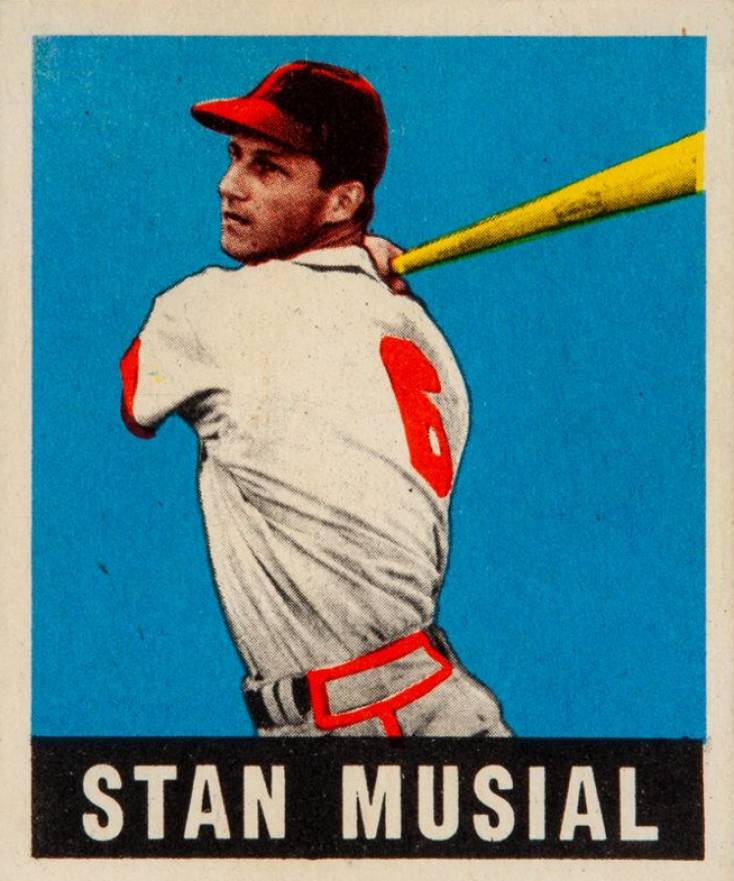
Stan Musial, 1948 Leaf, #4

“Stan the Man” played in the Majors for twenty-two years from 1941 to 1963 with a gap year in ’45 for military service. He wore uniform number 6 for all twenty-two and played outfield and first for the St. Louis Cardinals his entire career. He is eleventh all-time with a career WAR of 128.6.

I love this 1948 Leaf card. Not only is it beautiful in its simplicity, with Musial finishing a powerful swing against a vibrant blue background, but his uniform number is in the photo. That’s something I’ve found unusual for older cards. In 1948 Musial was an All-Star and the National League MVP. He led the league in almost every offensive category; WAR (11.3) runs (134), hits (230), doubles (46) triples (18), RBIs (131), batting average (.376), as well as OBP, SLG, OPS and Total Bases. Leading the league in offensive categories was a regular occurrence for Musial throughout his career.

Although he played for only twenty-two years, he was an All-Star twenty-four times! That’s because of the double All-Star games in the late 50s early 60s he was an All-Star eight times in four years (59, 60, 61, 62). Willie Mays and Hank Aaron are the only other players in history with twenty-four All-Star appearances. 

He was National League MVP three times (43,46,48) and led the league in batting average seven different seasons. Speaking of batting average, he hit .300 or better in seventeen seasons. He also led the league in WAR four times, runs five times, hits six times (getting over 200 in six seasons), he led the league in doubles eight times, triples five times and RBIs twice. Aside from his 3 MVPs, he was the runner up in MVP voting four additional seasons.

He was a part of three World Series Championships with the Cardinals, in 1942 when they defeated the Joe DiMaggio led Yankees, in 1944 when they beat the St. Louis Browns in a cross-town rivalry and in 1946 when they beat Bobby Doerr, Ted Williams and the Red Sox.

When he retired after the 1963 season, he had 3,630 hits which is 4th all-time in Major League history. One crazy fact, he had exactly 1,815 hits at home and 1,815 hits on the road! In his career he had 5 hits in eight different games and 4 hits in fifty-nine games.

He is 3rd all-time in doubles (725), 19th in triples (177), 8th in RBIs (1,951), 10th in runs (1,949) and 3rd in total bases. He also had 475 career home runs (32nd) and a career .331 batting average (34th).  

He is a member of the St. Louis Cardinals Hall of Fame and was voted onto the MLB All-Century team.

He was inducted into the National Baseball Hall of Fame in 1969.

His number 6 was retired by the Cardinals in 1963.

Musial passed away at the age of 92 in 2013.

Number 1

Al Kaline, 1969 Topps, #410

Al Kaline played for twenty-two years in the majors from 1953 to 1974 as a right fielder and first baseman exclusively with the Detroit Tigers. This longevity with Detroit earned him the nickname “Mr. Tiger”.  He wore uniform number 6 every season aside from his first. His career WAR was a wonderful 92.8.

This 1969 Topps card is a wonderful addition to my posts. Not only is the 69 Topps a cool looking card, but it has Kaline’s number showing right out front. I really like it when the uniform numbers are on the front of the uniforms. In 1969, Kaline had an average season. He only played 131 games, batted .272 with 21 home runs and 69 RBIs.

Al Kaline was an eighteen-time All-Star including twice each in ‘59, ‘60, and ’61. He was the batting champ in 1955 when he had a .340 average on 200 hits. Kaline had over 100 RBIs in three seasons, he hit over .300 in nine seasons and came in second in MVP voting twice. Aside from his great hitting, he was a fantastic fielder, winning ten Gold Gloves.

Along with Eddie Mathews, Kaline was a member of the 1968 World Series Champion Tigers who beat the Red Schoendienst managed St. Louis Cardinals, 4 games to 3.

He would retire at the end of the 1974 season after reaching the 3,000-hit milestone. He would end his career with a .297 batting average, 3,007 hits, 498 doubles, 399 home runs and 1,582 RBIs. He also had a career fielding percentage of .987.

Kaline would go on to be a color commentator for the Tigers from 1975 to 2002.

He was elected to the Baseball Hall of Fame in 1980 and was the first to have his number retired by the Tigers in 1980.

Kaline passed away at age 85 in 2020.

Number 2

Sal Bando, 1972 Topps “In Action”, #34

Sal Bando played third base for sixteen years in the Major Leagues from 1966 to 1981 for two teams. He played for the Athletics while the team was still in Kansas City (66 and 67) then stayed with them as they moved to Oakland. In 1977 he went to the Milwaukee Brewers where he remained for the rest of his career. He wore uniform number 6 his entire career. He had a career WAR of 61.5.

In 1972, Bando, a member of the “Swingin’ A’s”, batted .236 with 15 homes runs, 77 RBIs and was an All-Star. This ’72 Topps “In Action” card is a perfect fit for the post. I really like these special Topps cards, so much so that I will be using another one later in the post. I love that this photo captures his swing, with his number and name visible. The card design is super ‘70s retro too.

From 1971-1975 the A’s won five straight division titles. During this time, Bando was a 3x All-Star, with one additional All-Star season in 1969. He was 2nd in MVP voting in 1971 when he batted .271 with 23 doubles, 24 home runs and 94 RBIs. He lost the MVP to his teammate Vida Blue who also won the Cy Young award. In 1973, Bando had his best season with a 6.5 season WAR, he played all 162 games and batted .287 with 29 home runs and 98 RBIs and led the league in doubles with 32 and total bases with 295.

He was a World Series Champ three times with the A’s in 1972, ’73 and ’74. A team that featured Vida Blue, Reggie Jackson, Catfish Hunter, Gene Tenace and Rollie Fingers.

Bando retired in 1981. He is a member of the Oakland Athletics Hall of Fame and the Milwaukee Brewers Wall of Honor.

Bando passed away at age 78 in 2023.

Number 3

Willie Wilson, 1986 Fleer, #25

At one point I was looking through a bunch of my old baseball cards and was surprised at how many Willie Wilson cards I had collected. I remember liking him but never realized I had so many of his cards. It’s always fun to look through your old cards and find these gems.

Willie Wilson played outfield for nineteen seasons from 1976 to 1994. He played for the Kansas City Royals until 1990 when he left for Oakland where he played two seasons before finishing his career with the Chicago Cubs. He wore uniform number 6 for sixteen seasons and had a career WAR of 46.1.

Most of Wilson’s playing career was during my formative baseball card collecting years. This 1985 Fleer is awesome. I must have really liked it because I have still have a few copies. It’s a great photo of Wilson with his number 6 front and center. I love the design of these Fleer cards, with the team logo on the front and the nice border, and those Royals uniforms are perfect. In 1985 Wilson batted .278. He led the league in triples with 21 and had 43 stolen bases.

Wilson was a two-time All-Star. A speedy player, he led the league in stolen bases only once (with 83 in 1979) but had over 30 stolen bases in eleven seasons. He also led the league in triples five times. He was the batting champ in 1982 with a .332 average. He won two Silver Sluggers, one in 1982 and one in 1980. He also won his only Gold Glove in 1980. 1980 was his best year, along with the Gold Glove and Silver Slugger, he led the league in runs (133), hits (230), triples (15) and had an 8.5 season WAR.

He was a member of the World Series winning Kansas City Royals team of 1985 that also featured George Brett. Wilson helped the team win the Series by batting .367.

He played only 17 games in 1994 before being released by the Cubs and leaving baseball.

He is 12th all-time with 668 stolen bases in his career. He had a career batting average of .285 with 2,207 hits, 281 doubles, and 147 triples.  

He is a member of the Kansas City Royals Hall of Fame.

Number 4

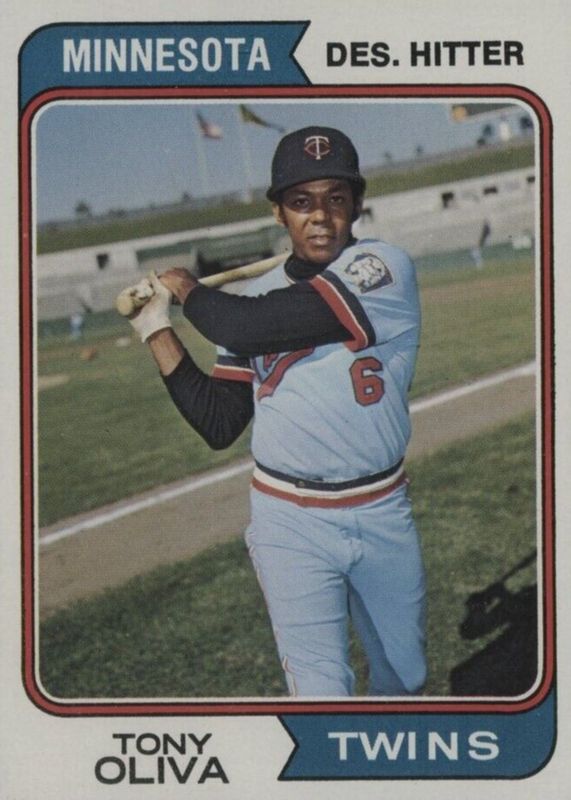
Tony Oliva, 1974 Topps, #190

Tony Oliva was a Cuban born baseball player who played in the Majors for fifteen years from 1962 to 1976. He was a right fielder who played exclusively with the Minnesota Twins. He wore uniform number 6 for thirteen seasons and finished his career with a 43.1 WAR.

I love this 1974 Topps card. Even though it was toward the end of his career, this card is a fantastic companion to the post. The design of these cards is beautiful, with the white borders, the city and team names in the banners along the inner border and the wonderful photo in the center. I’m starting to think I can find something wonderful in every set of old Topps. This photo is great, I really like these old Twin’s uniform colors and, as I’ve mentioned plenty, the uniform number on the front makes this card the whole package. 1974 was close to the end of Oliva’s career, but he played well, batting .285 with 131 hits, 16 doubles, 13 home runs and only struck out 31 times in 459 at bats.

Olivia broke into baseball with a bang. His first eligible season, 1964, he played in 161 games and won the Rookie of the Year with an All-Star season. He led the league in batting average (.323), runs (109), hits (217), doubles (43) and total bases (374). His season WAR of 6.8 would be the best of his career.

He was an eight-time All-Star who led the league in hits five times (with two over 200 hit seasons), doubles four times and batting average three times. He hit over .300 seven times. He also won a Gold Glove in 1966.

After he retired as a player, he became a Twins coach and was also a part of all three World Series appearances for the Minnesota Twins, as a player in 1965 when they lost to the Dodgers 4 games to 3 and as a coach when they won in 1987 and 1991.

He is a member of the Twins Hall of Fame, and his number 6 was retired by the Twins in 1991.

In 2022 he was inducted into the National Baseball Hall of Fame through the Golden Days Era Committee. Also inducted was former Twins teammate Jim Kaat. Fun Fact: I was at that induction ceremony. I had taken a trip to Cooperstown to meet up with my uncle and cousins to support “Big Papi”. It was a great experience!

Number 5

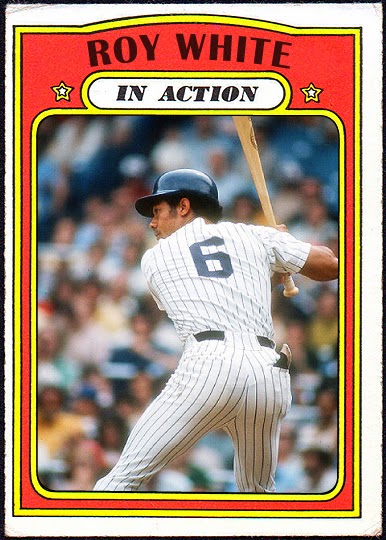
Roy White, 1972 Topps “In Action”, #30

Roy White played fifteen seasons in the Majors from 1965 to 1979 as a leftfielder. He played his entire career with the New York Yankees and wore uniform number 6 for eleven of them. He had a career WAR of 46.8.

Like Sal Bando above, this 1972 Topps “In Action” card was the perfect compliment to this post. Not only is the card design awesome, but the photo is perfect and includes his uniform number. White had a good year in 1972. He led the league in walks with 99 and had a season WAR of 5.4. He batted .270 and only struck out 59 times (40 less than he walked). He had 150 hits, 10 home runs and 23 steals with an OBP of .384.

White was a two-time All-Star. He is 4th all time for single season sacrifice flies with 17, set in 1971 and led the majors in sacrifice flies in both ’71 and ’69. He was a member of the Yankees World Series winning teams in 1977 and 1978 along with Catfish Hunter and Reggie Jackson.

He ended his career with a .271 batting average, 1,803 hits, 300 doubles, and more walks (934) than strikeouts (708). He also had 233 stolen bases.

After retirement he would go on to coach in the Major and Minor Leagues. He started a foundation to help low-income children and young adults attend college.

Number 6

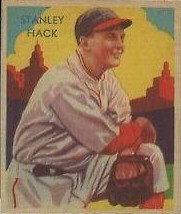
Stan Hack, 1935 Diamond Stars, #34

Another player who stayed with one team for his entire career, Stan Hack played sixteen seasons with the Chicago Cubs from 1932 to 1947, as a third baseman. He wore uniform number 6 for nine seasons, having worn six additional numbers throughout his career. He had a career WAR of 55.2.

This 1934 Diamond Stars had to be used, because as you all know I love me some Diamond Stars cards. This one is perfect with its art deco background colors and Hack with his signature smile on his face. Hack was known as “Smiling Sam” and a bit of research shows many pictures of Hack with a big grin. 1934 was his first full season. He batted .289 with 116 hits, 16 doubles, a home run and 11 stolen bases. He would become an All-Star just a few years later.

Hack was an All-Star five times. He led the league in hits and stolen bases two times each. He batted lefty but threw righty and was a stanch defender at third. He led the National League in putouts five times, in double plays three times and in assists and fielding percentage twice each.

In 1935, the Cubs held a promotion in which they gave the fans mirrors with Hack’s smiling face on the reverse side. The promotion was called “Smile with Stan” with the goal of having the fans smiling into the mirrors. Hack was a popular player, and this was sort of like the 30’s version of bobblehead day. Unfortunately, things did not go as planned. The fans found the mirrors to be a perfect way to screw up the opposing team by reflecting the bright sun into their eyes. The umpires had to threaten a forfeit if the fans didn’t stop and banned mirrors in future promotions. I always wondered why we didn’t get mirrors at baseball games.

Hack retired from baseball in 1947 and went on to manage and coach in both the Majors and the Minors.

He had a career batting average of .301, with 2,193 hits, 361 doubles, 57 home runs to go along with a career OBP of .394 having 1,092 walks to only 466 strikeouts.

He is a member of the Chicago Cubs Hall of Fame.

Hack passed away in 1979 at the age of 70.

Number 7

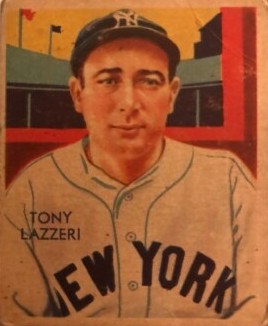
Tony Lazzeri, 1935 Diamond Stars, #74

Part of the Yankees famous “Murderers Row” lineup in the 1920s, Tony Lazzeri played for fourteen years from 1926 to 1939. He was a second baseman and played for the Yankees from ’26 to’37. He would then play for the Chicago Cubs, Brooklyn Dodgers and New York Giants. He wore uniform number 6 for his first five seasons and had a career WAR of 47.6.

I may have picked both Hack and Lazzeri just to use these 1935 Diamond Stars cards. Lazzeri’s card is another great product, again with the art deco colors and graphic in the background and the nice portrait with New York written on his jersey. It’s another great looking old card. 1935 was an average year for the second baseman. He batted .273 with 130 hits, 18 doubles, 13 home runs and 83 RBIs. He also added 11 stolen bases.

Lazzeri was an All-Star in one season. Keeping in mind he played his best years prior to the All-Star game’s inception. He hit .300 or better in five seasons. He hit over 100 RBI in seven seasons. In 1927 he batted .309 with 18 home runs and 102 RBI. His 18 home runs were third in the American League behind his teammates Babe Ruth and Lou Gehrig. He holds the American League record for most RBIs in a game with 11 and was the first player in history to hit two grand slams in one game. He is also the only player in major league baseball to hit for the cycle with the final home run being a grand slam.

Lazzeri was a member of five World Series Championships all with the New York Yankees.

He was voted into the National Baseball Hall of Fame by the Veterans Committee in 1991.

Lazzeri passed away at the young age of 42 in 1946 after a fall due to a suspected epileptic seizure.

Final Score

There are a few players that I want to shout out for uniform number 6. Rogers Hornsby, Brooks Robinson, Jim Thome, Scott Rolan and Larry Doby all wore it for one season.

Hall of Famer and 9x All-Star Joe Gordon of the Yankees wore it for seven seasons. He had a career WAR of 55.6 and almost made the list, but I already featured a couple of Yankees, so he didn’t make the cut.

Current All-Star Sterling Marte has worn number 6 for fourteen seasons. Former Red Sox great Rico Petrocelli had the number for eleven seasons.

There are always several players left off who I would have liked to use, but I’m sticking to my seven and already pushing it by adding the Legends spot.

I do hope that you are enjoying Baseball by the Numbers and will check out the uniform number 7. It’s my favorite number just in general. As a uniform number it should be a fun one with one Legend and some cool players. As always: Thanks for the support!!

PLAYER NAMEYEARS WORNCAREER WARNUMBER RETIREDOTHER ACHIEVEMENTS
Al Kaline2192.8Yes (Detroit Tigers 1980)18x All-Star
10x Gold Glove World Series Champ (68)
HOF (80)
Sal Bando1661.5No4x All-Star
3x World Series Champ (72-74)
Willie Wilson1646.1No 2x All-Star
Gold Glove (80)
2x Silver Slugger
World Series Champ (85)
Tony Oliva1343.1Yes (Minnesota Twins 1991)8x All-Star
1 Gold Glove
ROY (64)
3x Batting Champ World Series Champ (c87, c91) HOF (2022)
Roy White1146.8no2x All-Star
World Series Champ (77, 78)
Stan Hack955.2no5x All-Star
Tony Lazzeri547.6no1x All-Star
World Series Champ (27, 28, 32,36,37)

Sources:

https://www.baseball-almanac.com/

https://www.baseball-reference.com/

https://www.sabr.org

Shout out to all the cool cards and creative commons for my pictures! Thanks Topps and Upper Deck and Fleer and Donruss and all the rest!

Baseball by the Numbers: 5

Read about the project

Checklist

5

Welcome back to Baseball by the Numbers. Today we are looking at uniform number 5. Uniform number 5 had over 600 players wear it at some point. Using my criteria (here), I was able to narrow things down. There were eighty-five players who wore uniform number 5 for five years or more and thirty-seven with a career WAR over 40. Between those two criteria, only seventeen players overlap. There was also a Legend player (career WAR over 100), so I had sixteen players to choose from.

Two players wore number 5 for only one season each and also had a career WAR over 100. Mel Ott, who wore it in 1932 with the New York Giants, and was already featured in a prior post for number 4. and Hank Aaron, who wore it during his rookie season in 1954 with the Milwaukee Braves, and will be featured much later.

As I looked through the list, I realized this post was going to be a challenge, with so many great players who fit the criteria, and several personal favorites. Choosing seven was not easy, but I managed to do it, so here you go!

The Legend:

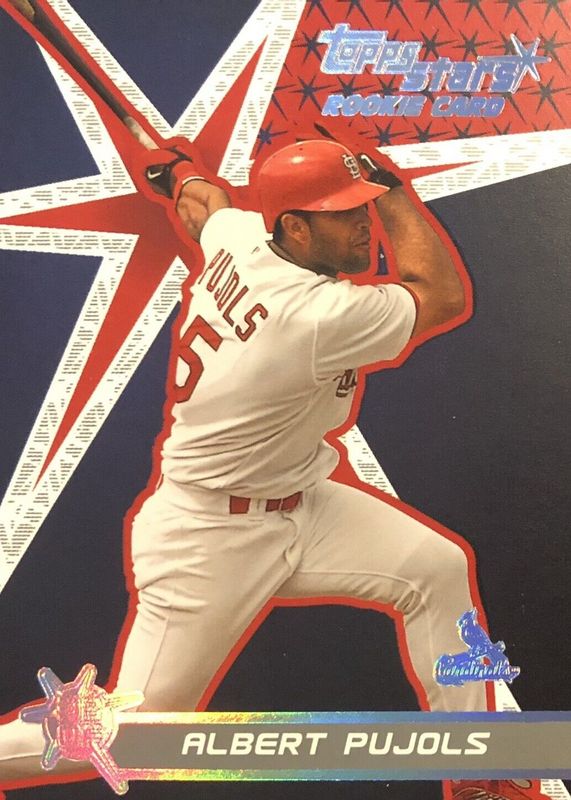
Albert Pujols, 2001 Topps Stars, #198

Pujols played for twenty-two seasons in the MLB, and wore uniform number 5 for all twenty-two, though he had a brief 85 game stint with the Dodgers at the end of his career with the number 55. His career WAR was 29th all-time at 101.2.

Pujols played first base and DH from 2001 to 2022 with the St. Louis Cardinals, Los Angeles Angels, the previously mentioned Dodgers, and then finished with the Cardinals again.  

The card I picked is the 2001 Topps Stars card. It’s his first season and he was already shaping up to be a future star. The card is awesome, with flashy colors and the cool star design. He’s finishing his swing, and his number is easy to see on the card. In fact, when looking for a card I found the Pujols uniform number was visible on so many different options it was hard to choose, so I went with his rookie season.

In 2001, Pujols had an All-Star campaign hitting .329 with 37 home runs, 130 RBIs (an NL rookie record), 47 doubles, 194 hits, and a 1.013 OPS. He was the easy favorite for NL Rookie of the Year and won a Silver Slugger. He joined Wally Berger (1930), Ted Williams (1939), Walt Dropo (1950) and Mike Piazza (1993) as the fifth MLB rookie to hit .300 with 30 home runs, 100 runs, and 100 RBIs. Jose Abreu would add his name to the group in 2014. It was the start of an amazing career for Pujols.

“La Máquina” “the Machine” was an eleven-time All-Star. He was Rookie of the Year in 2001 and won the National League MVP award three times in 2005, 2008, and 2009. He led the league in WAR six different seasons, in home runs twice, runs five times, hits, batting average, doubles and RBIs once, and SLG and OPS three times each. He was a six-time Silver Slugger and hit over .300 in ten straight seasons.

In 2004, Pujols helped the Cardinals get to their first World Series since 1987 and he was named the NLCS MVP after batting .500 with 4 home runs and 9 RBI. Pujols was a part of two World Series winning teams with the St. Louis Cardinals in 2006 and 2011.

He won the Hank Aaron award twice in 2005 and 2009, and the Clemente award in 2008. He was the comeback player of the year in 2022 (his last season) when he rejoined the Cardinals and was an All-Star batting .270 with 24 home runs. He retired after the season.

He ended his career in tenth place all-time with 3,384 hits, fourth in home runs (703), fifth in doubles (686), and second in RBIs (2,218). He has a career .296 batting average, .387 OBP, .544 SLG and .918 OPS. He joined Hank Aaron as the only players in history with 3,000 hits, 700 home runs, and 2,200 RBIs. He never struck out more than 100 times in a season which is incredible, especially in today’s baseball.

Pujols is eligible for the Hall of Fame in 2028 and should be a guaranteed inductee. I’ve been lucky to have been able to watch Pujols his entire career.

Number 1:

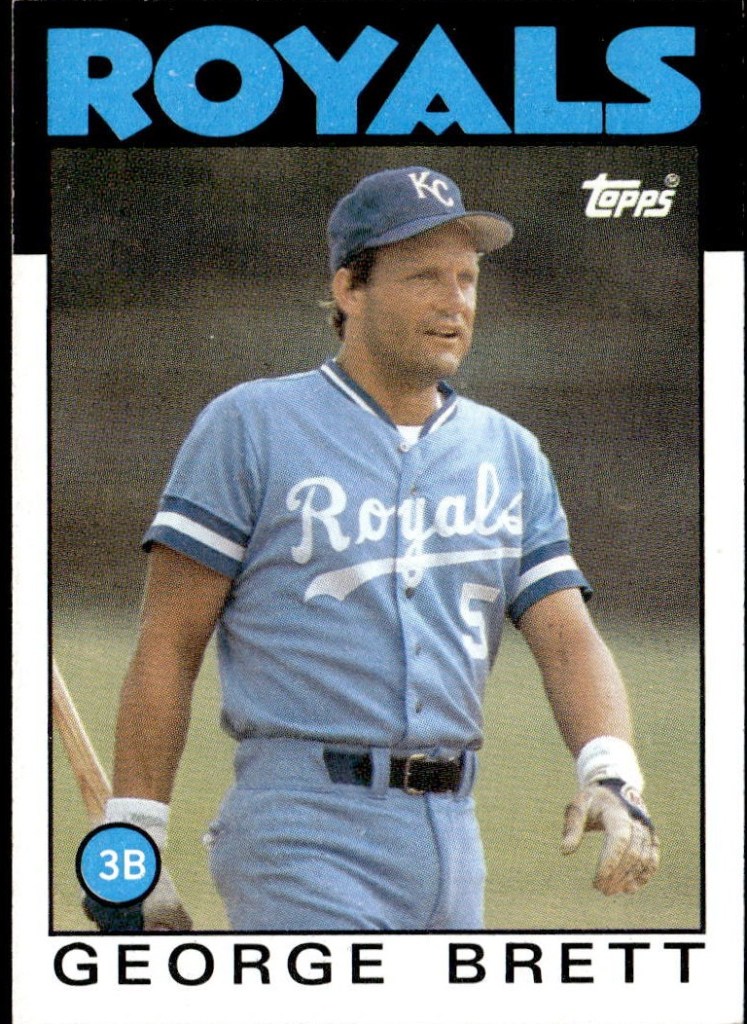
George Brett, 1986 Topps, #300

George Brett was one of my absolute favorite players growing up. I loved collecting his cards and watching him play whenever possible on TV or on the highlights of This Week in Baseball. He was such a great player.

Brett played twenty-one seasons in the MLB from 1973 to 1993 as a third and first baseman. He spent his entire career with the Kansas City Royals. He wore uniform number 5 for nineteen seasons, having worn 25 his first two. He has a career WAR of 88.6.

Yes, another 1986 Topps! I’ve said it before, I like this set, and this card is a personal favorite. I think I have a half dozen of them, none of which would grade above a six (lol). The card is gorgeous. The Royals team name in blue against that black background looks so nice with the photo. Brett walking along carrying his bat, the number 5 so nicely displayed on the front of that Royal blue uniform. Perfect! In 1986, Brett was an All-Star. He had a .290 batting average with 16 home runs and 73 RBIs.

Throughout his career, Brett was a thirteen-time All-Star (nine times in the 80s). He was the American League MVP in 1980 when he batted .390, and led the league not only in batting average, but in OBP, SLG, OPS, OPS+ and WAR. He won a Gold Glove in ’85, was a three-time Silver Slugger and a three-time batting champ.

In 1985 he helped the Royals win their first World Series in history after a wonderful season which saw him bat .335 with 30 home runs and 112 RBIs while leading the league in SLG and OPS. He would win the ALCS MVP award batting .348 with 8 hits, 3 home runs, and 5 RBIs in the seven games against Toronto. He also batted .370 in the World Series win against St. Louis. He was clutch in the postseason and batted .337 with 10 home runs and 23 RBIs in 43 career postseason games.

Brett would finish his career in 1993. He is 18th all-time in hits with 3,154. He has a .305 career batting average, 317 home runs, 665 doubles (7th all-time), 1,583 runs, 1,596 RBIs and 201 stolen bases. He joined Stan Musial, Willie Mays and Hank Aaron as the only players with 3,000 hits, 300 home runs, and a career .300 batting average (Miggy Cabrera would also join this group).

Brett is a member of the Royals Hall of Fame.

His uniform number 5 was retired by the Royals in 1994.

He was inducted into the National Baseball Hall of Fame in 1999.

Number 2:

Brooks Robinson, 1959 Topps, #439

Brooks Robinson was considered by many to be the greatest defensive third baseman in major league history. Because of his defensive prowess, he earned two very cool nicknames, “Mr. Hoover” and “the Human Vacuum Cleaner”.

Robinson played for twenty-three years in the MLB from 1955 to 1977, all of them at third base and all of them with the Baltimore Orioles. This earned him the fan nickname of “Mr. Oriole”.  He wore uniform number 5 for twenty-one seasons. His career WAR was 78.3.

I was excited to see that this 1959 Topps card showcased Robinson’s uniform number. It’s a nice card. I like the ’59 Topps design, the photo in the circle, with the yellow border, the old school Orioles logo in the bottom corner and Robinson’s signature across the front. In ’59 he only played 88 games, in part due to an injury that could have been career ending. He was in the minors working on his hitting and fell into the dugout while catching a ball. His arm was impaled on a hook that severed several tendons but luckily missed any nerves. Once he was back, he hit .284 for the season. He would become an All-Star the next year (twice!).

Robinson was an eighteen-time All-Star. He would be an All-Star in fifteen straight seasons (there were two All-Star games in the ’60, ‘61’ and ’62 seasons). He would also win sixteen straight Gold Gloves, living up to his vacuum cleaner nicknames.

He was the American League MVP in 1964 when he hit .317 with 28 home runs, 118 RBIs (led the league), 35 doubles and 194 hits. He also led the league in putouts, assists, double plays and fielding percentage.

He was part of two World Series Championships with the Orioles (1966 and 1970) and was the MVP of the 1970 World Series batting .429 with 2 home runs, 6 RBIs, and 9 hits. He also played phenomenal defense against the hard-hitting Cincinnati Reds.

He retired after the 1977 season with several defensive records at third, including most putouts (2,697), assists (6,205) and double plays (618). He had a career .267 batting average with 2,848 hits, 482 doubles, 268 home runs, 1,357 RBIs and only 990 strikeouts in 10,654 at bats.

His twenty-three seasons with the Orioles is tied for longest tenure exclusively with one team with Carl Yastrzemski of the Boston Red Sox. Go Yaz! You’ll be seeing him soon.

Robinson is a member of the Orioles Hall of Fame, and his number 5 was retired in 1978.

He was inducted into the National Baseball Hall of Fame in 1983.

Brooks Robinson passed away in 2023 at 86 years old.

Number 3:

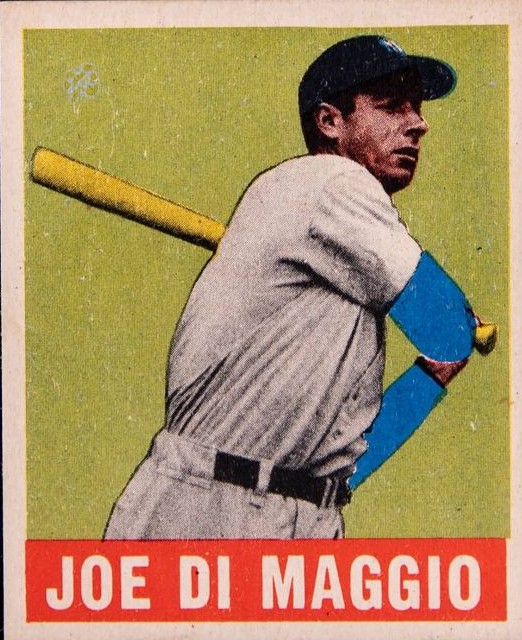
Joe DiMaggio, 1948 Leaf, #1

Joe DiMaggio was so good he had three nicknames. Most of us know “Joltin Joe” and “the Yankee Clipper”, but he also went by simply “Joe D.”. From 1936 to 1951 he was a baseball icon and after baseball, he was a social icon with his high-profile relationships and marriage to the actress Marilyn Monroe. During his career he played centerfield for thirteen seasons (he missed ’43-’45 for military service), exclusively with the New York Yankees. He wore uniform number 5 twelve seasons (he wore 19 his rookie year) and had a career WAR of 79.1.

As is often the case with these older cards, it was difficult to find a card photo with the uniform number showing. I choose this 1948 Leaf because it has such an iconic look, perfect for an iconic figure like DiMaggio. It seems to encapsulate his larger-than-life persona so well. In 1948 DiMaggio was an All-Star (he was an All-Star every season he played). That season, he batted .320 and led the league in home runs (39) and RBIs (155) and was second in MVP voting to another player who also wore uniform number 5 and will be featured soon, Lou Boudreau.

DiMaggio was an All-Star thirteen times, every season in which he played. He is the only player to have accomplished this feat. He was a three-time AL MVP (1939, 1941, 1947). He led the league twice in batting average, home runs and RBIs, three times in season WAR, once in triples and once in runs. He hit over .300 in all but two of his seasons, and in 1941 he would get a hit in 56 straight games, a record that seems unbreakable. In modern times only two players, Pete Rose in 1984 (44) and Paul Molitor in 1987 (39) have even come within fifteen games.

From 1936 to 1951, he was a member of the nearly unbeatable “Bronx Bombers” a Yankees team that consisted of Bill Dickey, Lou Gehrig, and Joe Gordon and later Yogi Berra. With the Yankees he won nine World Series rings, second in history only to Yogi.

He would retire after the 1951 season at 37 years old citing aches and pains after a variety of injuries had plagued his season.

He would finish his career with a .325 batting average (forty-eighth all-time), 2,214 hits, 361 home runs, 1,390 runs, 389 doubles and 1,537 RBIs.

His uniform number 5 was retired by the New York Yankees in 1952.

He was inducted into the National Baseball Hall of Fame in 1955.

DiMaggio passed away in 1999 at the age of 84.

“Where have you gone, Joe DiMaggio?
Our nation turns its lonely eyes to you
Woo, woo, woo
What’s that you say, Mrs. Robinson?
Joltin’ Joe has left and gone away”

Mrs. Robinson: Paul Simon (Simon and Garfunkel) 1968.

Number 4:

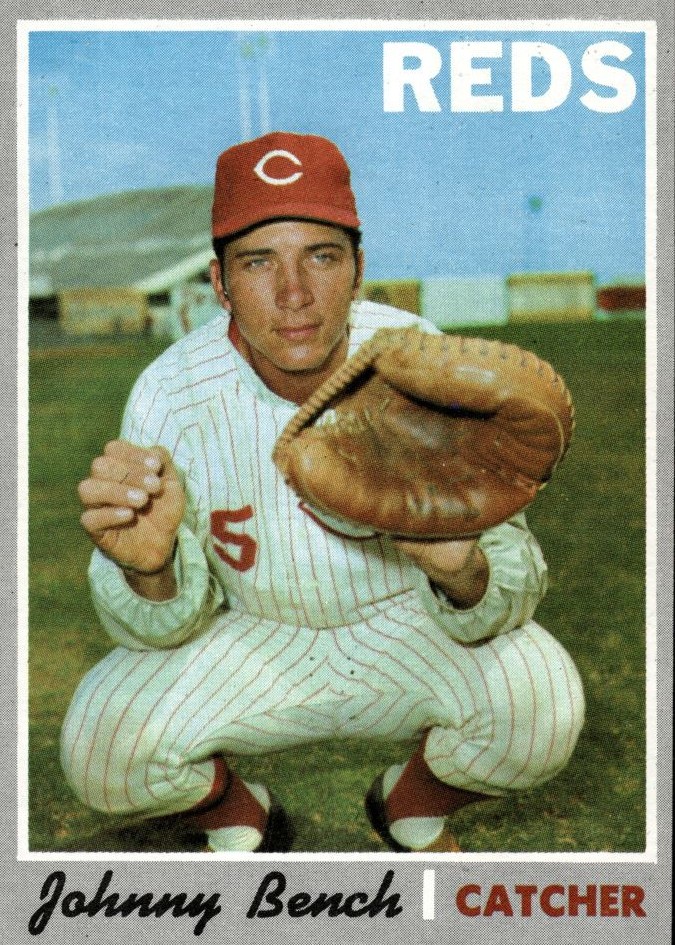
Johnny Bench, 1970 Topps, #660

Johnny Bench played seventeen years from 1967 to 1983 in the MLB, primarily as a catcher, though he did short stints at first, third and all the outfield positions. He played all seventeen years with the Cincinnati Reds and wore number 5 the entire time. His career WAR was 75.1.

This 1970 Topps card was perfect for this post! Literally perfect! It is a beautiful card, that shows Bench in his catching position (Is it just me or does it look like his glove could catch cantaloupes?), with his number 5 just popping. Seriously, this card was made for my post. He looks so suave, but then Bench always does. Not only is the photo perfect, but it was one of his best seasons. He was an All-Star and the NL MVP after leading the league in season WAR (7.4), home runs (45) and RBIs (148) while hitting .293.

Bench was the Rookie of the Year in 1968. He was a fourteen-time All-Star and was the NL MVP in 1970 and 1972. He was an excellent defensive catcher winning ten straight Gold Gloves, a record at the position.

He won two World Series Championships with the Reds “Big Red Machine” in 1975 and 1976. From 1970 to 1979, Bench led a dominant Reds team that averaged 95 wins a season and featured players like Pete Rose, Joe Morgan, Tony Perez, George Foster, Ken Griffey Sr. pitchers Don Gullett and Gary Nolan and was managed by the great Sparky Anderson.

In the 1976 World Series, Bench hit an amazing .533 with 2 home runs and 6 RBIs winning the World Series MVP award.

Bench retired at the end of the 1983 season at age 35 with a career batting average of .267, 2,048 hits, 381 doubles, 389 home runs and 1,376 RBIs and a .990 fielding percentage at catcher.

He is a member of Baseball’s All-Century team and All-Time team.

He is a member of the Reds Hall of Fame, and his uniform number 5 was retired by the Reds in 1984.

He was inducted in the National Baseball Hall of Fame in 1989.

Number 5:

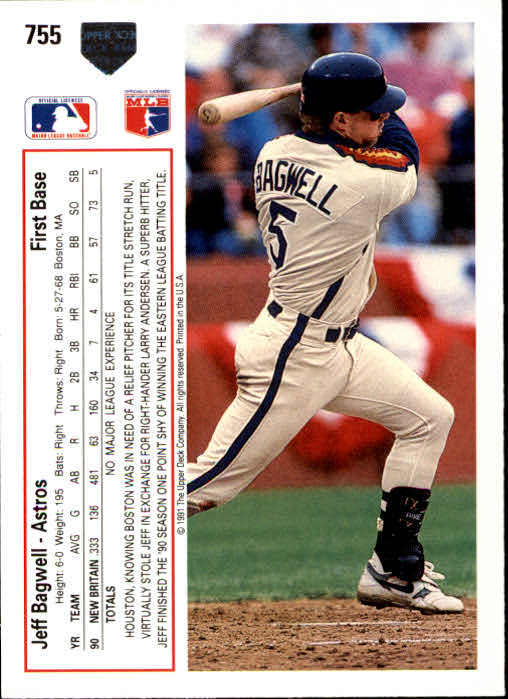
Jeff Bagwell, 1991 Upper Deck, #755 Back

I remember watching Jeff Bagwell dominate the Majors with both awe and a sense of disappointment. As a Red Sox fan, it was always difficult to move past the fact that Bagwell could have been a Sox legend. He was drafted by the Red Sox and was traded to the Astros in 1990 for pitcher Larry Anderson. It was the Curse of the Bambino all over again! I’m being dramatic, but it was one of the worst trades in MLB history. I guess hindsight is 20-20, right? Right?!

Jeff Bagwell played first base for fifteen years from 1991 to 2005 exclusively with the Houston Astros. He wore uniform number 5 his entire career and finished with a WAR of 79.9.

This is the first time I used the back of a baseball card for these posts. This is Bagwell’s 1991 Upper Deck, his rookie season. Upper Deck was all the rage in the early 90s, and I remember this card well. In fact, I think I have a few in my closet. It was during the junk wax era, but collecting as a kid we were unaware that the bubble was about to burst. I’m sure this card went for a pretty penny when it first came out. Either way, this is a great photo, showcasing Bagwell’s uniform number after a powerful swing.

After being traded from the Red Sox (I will not get over it!), Bagwell was the NL ROY in 1991. He hit .294 with 15 home runs and 82 RBIs.

Jeff Bagwell was a four-time All-Star. He was the National League MVP in 1994 when he led the league in WAR (8.2), runs (104), RBIs (116), SLG (.750) and OPS (1.201) and got his only Gold Glove award. Bagwell also won three Silver Slugger awards. He displayed uncommon speed for a first baseman, and he and Barry Bonds are the only two players in history with two 40-30 seasons. In 1997 Bagwell had 43 home runs and 31 steals and in 1999, 42 and 30.

Bagwell was a part of the Astros’ “Killer Bs” along with teammates Craig Biggio and Lance Berkman. (I think there was even a cool 90s poster of the three-I loved those posters!) They never won a World Series, but the Astros were a force between 1994 and 2005, making the playoffs on six occasions and losing to the White Sox in their lone World Series appearance of 2005.

Aside from losing the World Series, Bagwell had a tough season in 2005. He was plagued with arthritis in his shoulder and would miss several games. He eventually had surgery and tried to continue to play but never made it through spring training of 2006 before opting to retire.

He would finish his career with a .297 batting average, having hit over .300 in six seasons. He is forty-second in home runs with 449 for his career (tied with Vladimir Guerrero). He has 2,314 career hits, 488 career doubles and 1,529 career RBIs. His .948 OPS is twenty-sixth all-time. He also has 202 career stolen bases making him the only the first baseman to reach 400 home runs and 200 stolen bases together.

Bagwell is a member of the Astros Hall of Fame, and his uniform number 5 was retired by the Astros in 2007.

He was inducted into the National Baseball Hall of Fame in 2017.

Number 6:

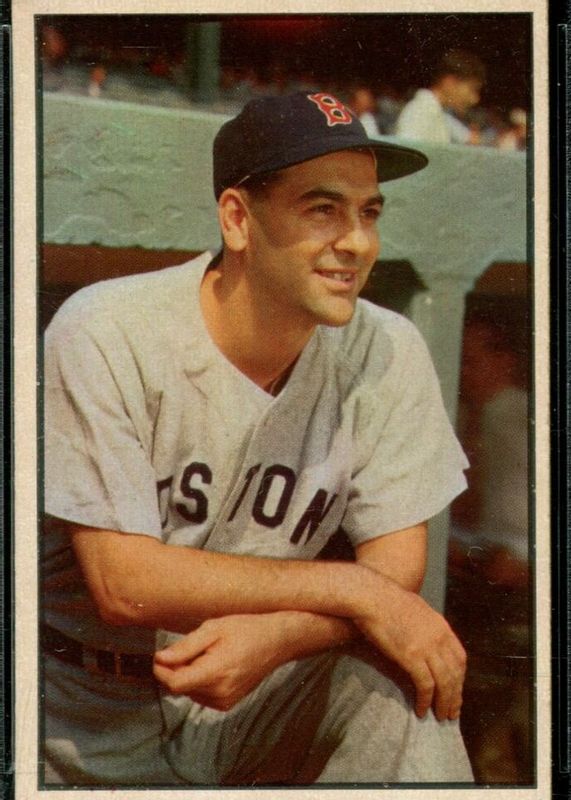
Lou Boudreau, 1953 Bowman, #57

Lou Boudreau played for fifteen seasons in the MLB from 1938 to 1952. He played for Cleveland until 1950, then did a two-year stint with the Boston Red Sox. He had three distinct nicknames, “the Good Kid”, “Handsome Lou” and “Old Shufflefoot”. The last one is likely due to the way he moved at shortstop, the position he played for most of his career. Lou was also a player/manager for many years. He wore uniform number 5 for twelve seasons and had a career WAR of 63.1.

Even though he only played for the Red Sox in 1951 and 1952, I had to go with this card. It’s old school 1953 Bowman and the photo is great, and of course it’s the Red Sox. It’s a nice card! ‘52 was Boudreau’s last as a player, and he only had two at-bats, so this might be a manager card. I never looked at the back, but he is in the managerial posture. The’53 Red Sox were 4th in the AL going 84-69.

Boudreau was an eight-time All-Star. He was the batting champ in 1944 with a .327 average.

1948 was a great year for Boudreau, he was the American League MVP with a league leading 10.4 season WAR, he batted .355 with 199 hits, 34 doubles, 18 home runs and 106 RBIs. He only struck out 9 times in 560 at bats! He was also a part of the 1948 Cleveland Indians World Series winning team. A team that included Larry Doby, Bob Feller, Bob Lemon and Satchel Paige, and was the first World Series to be widely televised.

Boudreau would retire as a player after the 1952 season eventually moving into broadcasting for the Chicago Cubs where he would remain until 1987.

He finished his career with 1,779 hits, 385 doubles and a .295 career batting average.

He is a member of the Chicago Cubs Hall of Fame as a broadcaster.

He is a member of the Cleveland Guardians Hall of Fame, and his uniform number 5 was retired by Cleveland in 1970.

He was inducted into the National Baseball Hall of Fame in 1970.

Boudreau passed away at age 84 in 2001.

Number 7:

Hank Greenberg, 1934 Goudey, #62

Hank Greenberg played thirteen seasons in the MLB from 1930 to 1947. He only had one at bat in 1930 and did not play in 1931 or 1932. He was out for 47 months of military service from ’42 to ’44, the longest of any Major League player. He played most of his career with the Detroit Tigers as a first baseman and center fielder, but played his last season with the Pittsburgh Pirates. He wore number 5 eleven seasons and had a career WAR of 55.5.

Any chance I get to showcase a Goudey card, I’m taking it. This 1934 Hank Greenberg is perfect. I love the photo on the front in his Detroit uniform, the light blue background with the baseball diamond outline. Man, I wish I had some of these cards! In 1934, Greenberg was an All-Star, batting .317 with 33 home runs and 113 RBIs.

Greenberg was an All-Star five times, he led the league in home runs four different seasons, RBI’s four seasons and hit over .300 in eight seasons. He was the American League MVP twice in 1935 and 1940. He was a member of two World Series Championship teams both with the Tigers, once in 1935 with Charlie Gehringer , and ten years later in 1945.

He played his final season, 1947, with the Pirates and although he was productive, he decided to retire. He would finish his career with a .313 career batting average, 1,628 hits, 379 doubles, 331 homeruns, 1,274 RBI’s. He’s tenth all-time with a career OPS of 1.017 and tenth in career SLG with .605. One can only wonder what he would have accomplished had he not missed three seasons in the prime of his career.

Like fellow uniform number 5 player Joe DiMaggio, Greenberg also married a famous actress, Linda Douglas, in 1966.

Greenberg was inducted into the National Baseball Hall of Fame in 1956. His uniform number 5 was retired by the Detroit Tigers in 1983.

Greenberg passed away in 1986 at the age of 75.

Final Score:

Uniform number 5 was a very difficult number to narrow down. There were several personal favorite players that I left off. First a couple of Boston Red Sox shout outs; Vern Stephens who played for Boston from ’48 to ‘52 wore it for eleven years and had a career WAR of 46.4 and Nomar!! Man leaving Nomar Garciaparra off was tough, he wore number 5 for fourteen years and was a member of the Red Sox for eight and a half seasons, his career WAR was 44.3.

Freddie Freeman currently has a career WAR of 64.1 and has worn uniform number 5 his entire sixteen year career so far. He is currently still playing well and is a future Hall of Famer, but I left him off this list, mainly because he still plays. I’m sure he’ll make my list at some point.

A few other players I wanted to mention who wore uniform number 5 for fourteen years each; Brian Downing (51.5 WAR) played with the Angels for thirteen years and was a player whose cards I would often get in packs in the ‘80s, David Wright (49.1 WAR) was a seven-time All-Star who played exclusively with the Mets and had two Gold Gloves and two Silver Sluggers, Ron Gant (34.1 WAR) was a two-time All-Star and had a rookie card that was all the rage when I was collecting and Ray Durham (33.8 WAR) who was a two-time All-Star and wore the number 5 his entire career.

Doing these shout outs makes it clear that once I finish this series, I may need to revisit and start another list. If you’re enjoying these posts, please subscribe and stay tuned for uniform number 6!

PLAYER NAMEYEARS WORNCAREER WARNUMBER RETIREDOTHER ACHIEVEMENTS
George Brett1988.6Yes (1994 Kansas City Royals)13 x All-Star
AL MVP (80)
Gold Glove (85)
3x Silver Slugger 3x Batting Champ World Series Champ (85)
HOF (99)
Brooks Robinson2178.3Yes (1978 Baltimore Orioles)18 x All-Star 16x Gold Glove AL MVP (64) World Series Champ (66, 70) HOF (83)
Joe DiMaggio1279.1Yes (1952 New York Yankees)13x All Star
3x AL MVP (39,41,47)
9 x World Series Champ (36-39, 41,47,49-51)
56 Game Hitting Streak
HOF (55)
Johnny Bench1775.1Yes (1984 Cincinnati Reds)14x All Star
10x Gold Glove
2x NL MVP (70,72) NL ROY (68)
HOF (89)  
Jeff Bagwell1579.9Yes (2007 Houston Astros)4x All-Star
NL ROY (91)
NL MVP (94)
3 x Silver Slugger 1x Gold Glove HOF (17)
Lou Boudreau1263.1Yes (1970 Cleveland Guardians)8x All-Star
World Series Champ (48)
AL MVP (48)
HOF (70)
Hank Greenberg1155.5Yes (1983 Detroit Tigers)5x All-Star
2x AL MVP (35,40) 4x AL HR Leader 4x AL RBI leader 2x World Series Champ (35, 45) HOF (56)

Sources:

https://www.baseball-almanac.com/

https://www.baseball-reference.com/

https://www.sabr.org

Shout out to all the cool cards and creative commons for my pictures! Thanks Topps and Upper Deck and Fleer and Donruss and all the rest!

Baseball by the Numbers: 4

Read about the project

Checklist

4

Welcome back to Baseball by the Numbers. Today we are looking at uniform number 4. Uniform number 4 had over 550 players listed at the number. Just like number 3, there were a lot of great names on the list. Using my criteria, I was able to narrow things down. There were seventy-three players to wear the number 4 for five years or more and thirty-eight had a career WAR of 40 plus.

Last post I made a special spot for Babe Ruth, highest career WAR in history, and after I did that, I decided it would be cool to just have anyone with a career WAR over 100 listed as a Legend, that is of course depending on a few factors (see A-Rod). In all of history there are only thirty-two players with a 100 or more career WAR and three have some significant controversies, asterisks if you will (Bonds, Clemens, A-Rod). I think nine played prior to uniform numbers (Ty Cobb, Tris Speaker, Cy Young, Walter Johnson, Honus Wagner, Kid Nichols, Grover Alexander, Nap Lajoie, and Christy Mathewson). I may have to do a post at some point of pre-uniform numbered players (spoiler: those nine will probably be the list). I also already used two (Ruth and A-Rod). So, I’m down to eighteen possible Legends. I figured, “what the hell, let’s do it.” and turned my attention to uniform number 4. Well, to my surprise, three of the Legends wore this number! Crazy! In this post there will be three Legends and my top seven after that. Enjoy!

The Legends:

By Unknown author – The Sporting News via, Public Domain

With a 127.3 career WAR “the Rajah” is ranked twelfth all-time. Rogers Hornsby played for twenty-three years in the MLB. He was one of the greatest hitters of all time. He played from 1915 to 1937 for the St. Louis Cardinals, New York Giants, Boston Braves, Chicago Cubs, the Cardinals again, and finally the St. Louis Browns. He wore uniform number 4 for four years.

Hornsby won his only World Series ring in 1926 with the Cardinals. He was a two-time National League MVP. He won the Triple Crown in 1922 when he hit .401 with 42 home runs and 152 RBIs. That season he also led the league in WAR (10.1), runs (141), hits (250), doubles (46), OBP (.459), OPS (1.181) and SLG (.722). He then won the Triple Crown for a second time in 1925. Over his career, he led the league in batting average seven times, hitting .400 or better in three of those seasons. He had 200 or more hits in seven seasons.

Not only could he get on base, but he had a lot of power, leading the league in home runs twice, RBIs four times, and doubles four times.

Later in his career Hornsby continued with baseball as a player/manager and as a manager and coach. He managed the St. Louis Cardinals (’25-’26), New York Giants (’27), Boston Braves (’28), Chicago Cubs (’30-’32), St. Louis Browns (’33-’37 and ’52), and Cincinnati Reds (’52-’53).

Like three players who I have already written about, Bobo Newsom (00 post) and Frankie Frisch and Babe Ruth in the uniform number 3 post, he is mentioned in Ogden Nash’s 1949 poem “Line-Up for Yesterday” . Spoiler alert, this poem will be mentioned at least two more times later in this post as well.

Hornsby would finish his career with a 127.3 WAR (12th all-time). He is third all-time in batting average (.358), tenth in OBP (.434), fifteenth in SLG (.577) and eleventh in OPS (1.010). He also had 2,930 career hits, 541 doubles, 169 triples, 301 home runs and 1,584 RBIs.

Hornsby is a member of the Chicago Cubs and St. Louis Cardinals Hall of Fame; he was voted onto both the All-Century Team and the All-Time Team and was elected to the National Baseball Hall of Fame in 1942.

Hornsby passed away in 1933 at age 66.

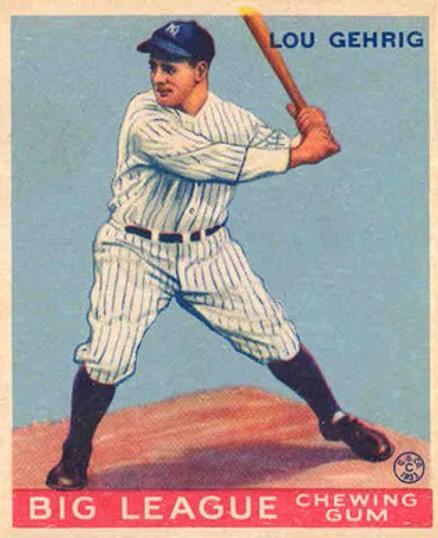
Lou Gehrig, 1933 Goudey, #92

“The Iron Horse” played for seventeen years in the majors, all of them with the New York Yankees. He is not only a legend in New York, but a legend to all baseball fans (see? even as a Red Sox fan, I can admit that). He played from 1923 to 1939, and wore uniform number 4 for eleven seasons, starting in 1929 when the Yankees started using uniform numbers. His career WAR of 113.7 is 18th all-time.

That 1933 Goudey card is legendary. Anyone who collects cards should recognize it. I say this all the time, but I love the art-deco style of these old ‘30s cards. Gehrig’s signature left-handed batting stance backdropped in blue is just so beautiful and full of baseball nostalgia. In 1933 Gehrig was an All-Star. He led the league with 138 runs. He had a .334 batting average, with 198 hits, 41 doubles, 32 home runs and 140 RBIs. 

On April 30th, 1939, after struggling to start the season, Gehrig sat out for the first time in 2,130 consecutive games. A record that remained unbroken until Cal Ripken Jr. broke it on September 6th, 1995. Sadly, Gehrig’s career was cut short in 1939 when he was diagnosed with ALS.

Gehrig was a seven-time All-Star who was part of six World Series Championships with the Yankees. His World Series production is incredible. He played 34 total World Series games across his six World Series wins and batted .361 with 8 doubles, 3 triples, 10 home runs, 35 RBIs, a .483 on-base percentage, .731 slugging percentage, and 1.214 OBP.

He was a two-time AL MVP in 1927 and 1936. He won the triple crown in 1934 with 49 home runs, 160 RBIs and a .363 batting average. He led the league in batting average once (1934), home runs three times (’31,’34,’36) and RBIs five times (’27,’28,’30,’31,’34). Like Hornsby, he was a part of the MLB All-Century team and All-Time Team. He was elected to the Baseball Hall of Fame in a special election in 1939.

Like Bobo Newsom in the 00 post ,Frankie Frisch and Babe Ruth in the uniform number 3 post, and Rogers Hornsby above, he is mentioned in Ogden Nash’s 1949 poem “Line-Up for Yesterday” .

In 1941, at the young age of 37, Lou Gehrig died from complications of ALS only two years after his diagnosis.

His number 4 was retired by the Yankees in 1939.

Mel Ott, 1935 Diamond Stars, #50

Mel Ott’s career WAR of 111 is 20th all-time. Ott played for twenty-two years from 1926 to 1947 with the New York Giants. He spent his entire career as a right fielder and third baseman with New York and wore uniform number 4 for fifteen seasons. Like Hornsby and Gehrig, Ott was also a part of Ogden Nash’s 1949 poem “Line-Up for Yesterday”.

His 1935 Diamond Stars shows a great depiction of his intense stare. What MLB pitcher wouldn’t be intimidated facing him? The card is another beautiful example of the art-deco style of ’30 baseball cards. I love this card’s picture, especially the red flag flying in the background.

Ott was a twelve-time All Star who led the National League in home runs six different seasons and RBIs once. He was a member of the 1933 World Series winning New York Giants team, in which he hit .389, with 2 home runs, 4 RBIs and 4 runs. Ott was another player manager from 1942 to 1946, but in ’46 a serious knee injury forced him to miss most of the season. He still got four at bats in 1947, before officially leaving as a player, but continued to manage for two more seasons.

Ott finished his career with a .304 batting average, including 2,876 hits. He is 9th all-time in walks with 1,708. His 511 career home runs are tied at 25th with Miggy Cabrera. He’s 14th all-time in RBIs with 1,860. He has 488 career doubles, .414 OBP, .533 SLG and .947 OPS.

Ott was elected to the Baseball Hall of Fame in 1957.

His uniform number 4 was retired by the Giants in 1949.

After managing, he would eventually enter the broadcast booth from 1956 until 1958 when he would pass away at the age of 49 from complications due to an auto accident.

Now that the Legends are covered, we can get to my seven selections. I don’t think any other number will have three heroes, but there are still fifteen players left with over 100 career WAR, so I guess we’ll find out together.

Number 1:

Luke Appling, 1936 Diamond Stars, #95

Luke Appling played shortstop for twenty seasons in the MLB, from 1930 to 1950. He did miss one season (1944) due to his military service. He played his entire career with the Chicago White Sox and wore uniform number 4 for seventeen seasons. His career WAR was 77.2.

Another awesome card, his 1936 Diamond Stars is one of my favorites so far. I know I’m getting repetitive, but these cards are so fun! This one has the coolest colors, and I love the two players in the background. I’m not sure, but based on the picture in the foreground, it’s possible the background fielder also depicts Appling, only showing off his fielding skills. In 1936 Appling was an All-Star. He had a 7.1 season WAR and led the league in batting average (.388).

Appling was a seven-time All-Star, who led the American League in batting average twice (1936 and 1943). He hit over .300 in sixteen of his twenty seasons.  He is 5th all-time in double plays turned by a shortstop with 1,424.

He had a funny nickname, “Old Aches and Pains”, as he was said to constantly have minor complaints about such things as a sore back or sprained finger. It didn’t stop him from playing hard though.

Appling had a career .310 batting average with 2,749 hits (4th all-time at shortstop), 440 doubles and a .399 OBP. Appling was great at getting on base, having had over 100 walks a season on three separate occasions and an over .400 OBP eight times. He wasn’t a huge power hitter and in fact only 27% of his hits went for extra bases.

Appling was inducted into the Baseball Hall of Fame in 1967. His uniform number 4 was retired by the White Sox in 1975.

In 1991 Appling passed away at the age of 83.

Number 2:

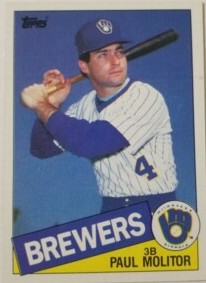
Paul Molitor, 1985 Topps, #522

Paul Molitor is a player that I grew up watching and collecting. He played twenty-one years in the majors from 1978 to 1998. Primarily a third and second baseman, Molitor played with the Milwaukee Brewers for fifteen seasons. He then played with the Toronto Blue Jays and the Minnesota Twins. He wore uniform number 4 for eighteen seasons, with only his three seasons in Toronto the exception (#19). His career WAR is 75.7.

Known as “the Ignitor” due to his ability to make things happen on the diamond. He could hit and steal with the best of them and is one of only five players in history with a career batting average of .300 or more, over 500 stolen bases and over 3,000 hits. The others being Ty Cobb, Honus Wagner, Eddie Collins, and Ichiro Suzuki. 

This 1985 Topps is just a thing of beauty. I love the 1985 Topps cards. I didn’t start really collecting in earnest until 1986, but I remember I started getting packs of cards in the early ‘80s and just loving every single design. This one is wonderful, with Molitor’s batting stance backed by the blue sky, his Brewers uniform crisp and clean, the number 4 perfectly visible on the front, it’s such a great card. In 1985 Molitor would be an All-Star for the 2nd time with a .297 batting average, 21 stolen bases, 28 doubles and 174 hits.

Molitor was a seven-time All-Star. He was 2nd in ROY voting in 1978 losing to sweet Lou Whitaker who was already featured under the uniform number 1 post.

He was a World Series champion with the 1993 Blue Jays and was the MVP of the series hitting .500 with 2 doubles, 2 triples, 2 home runs, 4 RBIs, 1 stolen base and 4 runs.

He is a four-time Silver Slugger, and in 2017 was the American League Manager of the Year with the Minnesota Twins.

His career 3,319 hits ranks 11th all-time, and he is 15th all-time in doubles (605). Molitor has a career batting average of .306 with 234 home runs, 1,782 runs, 114 triples and 504 stolen bases.

Molitor was elected to the Baseball Hall of Fame in 2004, and his uniform number 4 had been retired by the Milwaukee Brewers in 1999.

Number 3:

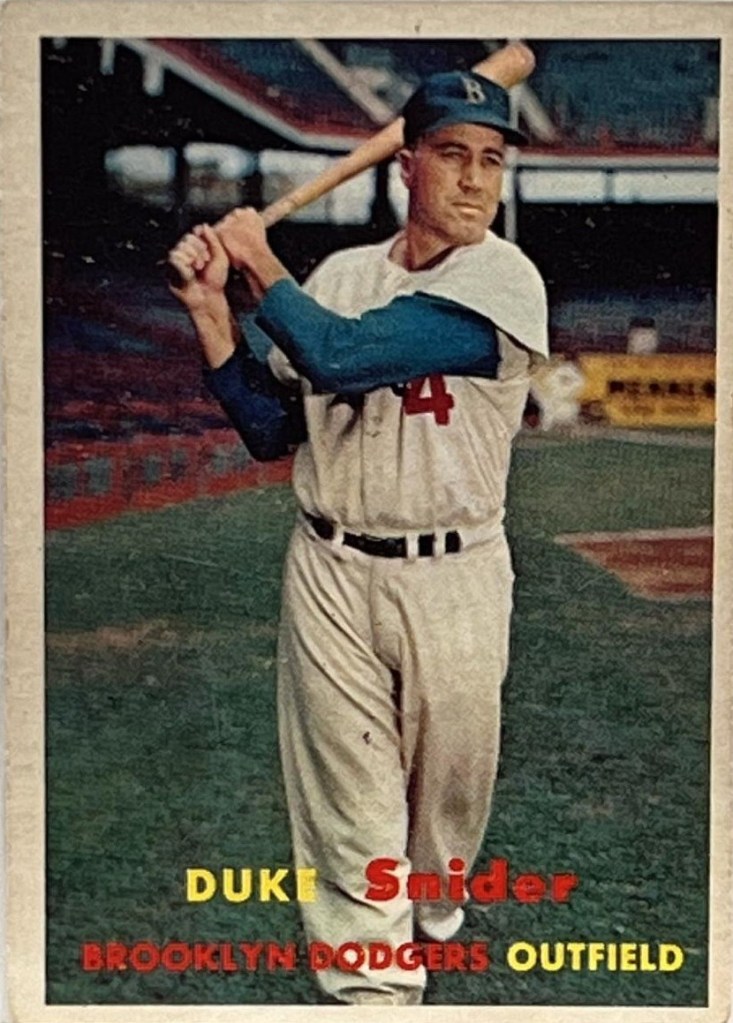
Duke Snider, 1957 Topps, #170

Known as “the Duke of Flatbush”, Snider played eighteen years in the MLB, sixteen with the Brooklyn/Los Angeles Dodgers and a season each with the New York Mets and the San Francisco Giants. He was an outfielder who wore uniform number 4 seventeen seasons. He also wore it for half a season with the Mets and while on the Giants, number 4 was already retired due to the previously mentioned Mel Ott.  His career WAR was 66.

This 1957 Topps card was a perfect fit for my post. The photo of Snider is wonderful, with his uniform number front and center. I like most Topps cards, but I’ll be honest, I’m not a huge fan of this design. The photo is nice, but the player and team name colors are off putting, and the card is just basic. Still, I got that uniform number on there, so I’m happy with that. In 1957, Snider batted .274, he had 40 home runs (it was his fifth straight season with 40+ home runs) and 92 RBIs.

Snider was a eight-time All-Star who led the National League in home runs in 1956 with 43 and RBIs in 1955 with 136. He won two World Series rings with the Dodgers in 1955 and 1959 on teams that included Pee Wee Reese , Jackie Robinson, Sandy Koufax, Roy Campanella and Don Drysdale. He was a great fielder too, leading the league in center field fielding average 3 different seasons.

Snider led the league in WAR twice, runs three times and had over 190 hits in three different seasons. He ended his career with a .295 batting average, 407 home runs, 2,116 hits and 1,333 RBIs.

He was voted to the Hall of Fame in 1980.

His uniform number 4 was retired by the Dodgers in 1980.

Duke passed away at the age of 84.

Number 4:

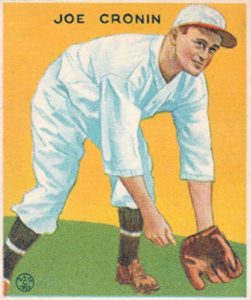
Joe Cronin, 1933 Goudey, #109

Joe Cronin was involved with the MLB for almost fifty years as a player, manager, GM and as president of the American League for fifteen years from 1959 to 1973.

As a player, Cronin was a shortstop for twenty years from 1926 to 1945. He played two seasons with the Pittsburgh Pirates, then seven with the Washington Senators, and finally eleven seasons with my Boston Red Sox. He wore uniform number 4 for fourteen seasons with Washington and the Sox and had a career WAR of 64.8.

Joe Cronin’s 1933 Goudey card is one of the more basic cards of the set, but it’s still cool. The shortstop is bent down, glove at the ready overlapping a bright yellow background. In ’33 Cronin was selected to his first All-Star appearance. He led the league in doubles with 45 and had a .309 batting average. He had 118 RBIs with 5 home runs! Is it just me or does that seem a little crazy sounding?

Cronin would go to seven more All-Star games. He was the MVP in 1930, and hit over .300 eight times, and had over 100 RBIs eight times.

In 1933 as a player/manager, his Senators lost the World Series to the New York Giants. While playing he managed the Senators in the ’33 and ’34 seasons, and he managed the Red Sox all eleven seasons plus two more after retiring as a player. In 1946 he was again managing a World Series team, but the Red Sox lost to the Cardinals. He finished his managing career with an over .500 winning percentage.

He had a career .301 batting average with 2,285 hits, 515 doubles and 1,424 RBIs, and a career .390 OBP.

After his stint as the Red Sox manager, he would go on to become their General Manager for eleven years from 1947 to 1959 before becoming the president of the American League.

Cronin is a member of the Boston Red Sox Hall of Fame, and he was inducted into the National Baseball Hall of Fame in 1956.

His number 4 was retired by the Red Sox in 1984.

Cronin passed away in 1984 at 77 years old.

Number 5:

Ralph Kiner, 1952 Bowman, #11

Ralph Kiner only played for 10 seasons from 1946 to 1955. He was an outfielder and played on the Pittsburgh Pirates, the Chicago Cubs and the Cleveland Indians. He had a career WAR of 48.1 and wore uniform number 4 for eight seasons.

This 1952 Bowman shows Kiner in his Pirates uniform who he played with for seven seasons. He wore number 4 with the Pirates, although I couldn’t find a card with the number showing. In 1952 he was an All-Star for the 5th time and led the league in home runs for the 7th year in a row with 37. He also led the league in walks with 110.

Kiner was a six-time All-Star, who led the league in home runs seven straight years from 1946 to 1952. He also led the league in RBIs in 1949. He had two seasons with over 50 home runs and five with over 40. He also had over 100 RBIs in six seasons. Unfortunately he was forced to retire after a serious back injury at only 32 years old.

He finished his career with 369 home runs, 1,015 RBIs and a .279 batting average. Imagine if he had played just a couple more seasons.

He went on to become a popular broadcaster with the New York Mets, staying behind the mic for fifty-three seasons. He was honored with the New York Mets “microphone” in 2014 and is a member of the Mets Hall of Fame.

As a player he is a member of the Pirates Hall of Fame and was inducted into the National Baseball Hall of Fame in 1975.

His number 4 was retired by the Pirates in 1987.

Kiner passed away at the age of 91 in 2014.

Number 6:

Bobby Grich, 1986 Donruss, #207

It’s Bobby Grich not Grinch, which for some reason I just keep typing, even though he looks like a happy dude in most pictures. Still, I’d be a grinch if I played as well as Bobby and wasn’t in the Hall of Fame!

Grich played second base for seventeen seasons from 1970 to 1986 with the Baltimore Orioles and the California Angels. He wore uniform number 4 for ten seasons and had a career WAR of 71.1.

1986 was his last season, but I found Grich’s ’86 Donruss to be a nice looking card. His uniform number is easy to see, which is part of my criteria for these posts, and the card design is perfect ‘80s style. Grich didn’t have a great season in ’86 as he was starting to slow down, getting only 313 at bats for the season. When the Angels lost the ’86 ALCS to the Boston Red Sox after being up three games to one, Grich announced his retirement.

During his career, Grich was a six-time All-Star. He won four Gold Gloves and a Silver Slugger Award in 1981 while leading the American League in home runs with 22. He is a member of both the Angels and Orioles Hall of Fame.

Number 7:

Carney Lansford, 1986 Topps, #134

I was very happy to include Carney Lansford on this list. There were a few players I could have put ahead of him, but growing up, he was a player I really liked, so he got the nod.

Lansford played for fifteen years in the MLB from 1978 to 1992. He was primarily a third baseman but also played a little first as well. He played for the California Angels until 1980 when he was traded to the Boston Red Sox. He played with Boston in 1981 and 1982, but with Wade Boggs emerging as a future Hall of Famer, Lansford was traded to the Oakland Athletics where he would remain the rest of his career. Lansford had a Career WAR of 40.4 and wore uniform number 4 for twelve seasons.

I really love the 1986 Topps. I know there are many who don’t, and I understand why. I would say it’s probably the worst design of the ‘80s Topps cards, but it is a set that I have a lot of memories of. This Lansford card was a perfect choice because his number is so prominently displayed. I also love the way his photo and the A’s name at the top match so well. In 1986, Lansford batted .284 with 19 home runs, 72 RBIs and 16 stolen bases.

Lansford was an All-Star once in 1988. He won a Silver Slugger and was the American League batting champion in 1981 with the Red Sox. He batted over .300 five different seasons.  He also won a World Series ring in 1989 with an Oakland team that included Dennis Eckersley, the great Rickey Henderson, Dave Parker and the Bash Brothers (Jose Canseco and Mark McGwire). There was a major earthquake during this World Series, giving it the name, “The Earthquake Series”. I remember it well.

Lansford was great during the postseason. In 33 postseason games he hit .305 with 2 home runs and 18 RBIs. After retiring, he would go on to coach with multiple franchises.

He is a member of the Athletics Hall of Fame.

Final Score:

I found it crazy that out of the thirty-two players in all of MLB history with a career WAR over 100, three of them wore number 4. The great part about that was it let me write about three extra players. (Carney Lansford would have never made it on the post without the Legend category)

There are some players I’d like to mention who wore number 4 that I didn’t include. Jimmie Foxx wore it one season (old giant arms was in my last post here). Hall of Famers Craig Biggio (2 seasons) Billy Herman (5 Seasons) and Bill Terry (1 season) all wore it. Kansas City Royals All-Star and defensive player extraordinaire, Alex Gordon, had it for thirteen seasons. Lenny Dykstra had it for twelve. There are also a couple of currently active players who have number 4 and could make this list someday (George Springer and Ketel Marte). There is one player who I really could have included if I had eight spots, so why not stick him in here.

Yadier Molina played catcher for the St. Louis Cardinals for nineteen years from 2004 to 2022 and had uniform number 4 for seventeen of those. He got edged out by Lansford, but only because I liked Lansford growing up. Molina was a 10x All-Star, 9x Gold Glove winner, a 4x Platinum Glove winner and won two World Series rings with the Cardinals (06,11). Let’s end this post with a card!

Yadier Molina, 2021 Topps, #41

I hope you come back for uniform number 5! Thanks for reading and please leave some comments or likes or shares.

PLAYER NAMEYEARS WORNCAREER WARNUMBER RETIREDOTHER ACHIEVEMENTS
Luke Appling1777.2Yes (White Sox 1975)7 x All-Star
2x AL Batting Champ
HOF (64)
Paul Molitor1875.7Yes (Brewers 1999)7 x All-Star
World Series Champ (93)
4 x Silver Slugger AL Manager of the Year (17)
HOF (04)
Duke Snider1766Yes (Dodgers 1980)8 x All-Star
World Series Champ (55,59)
NL Home Run Leader (56)
NL RBI leader (55)
Joe Cronin1464.8Yes (Boston Red Sox 19847x All-Star
HOF (56)
Ralph Kiner848.1Yes (Pirates 1981)6x All-Star
7x NL Home Run Leader
New York Mets “microphone” HOF (75)
Bobby Grich1071.1no6x All-Star
4 X Gold Glove Silver Slugger (81) AL home run leader (81)
Carney Lansford1240.4no1 x All-Star
World Series Champ (89)
Silver Slugger (81) AL Batting Champ (81)

Sources:

https://www.baseball-almanac.com/

https://www.baseball-reference.com/

https://www.sabr.org

Shout out to all the cool cards and creative commons for my pictures! Thanks Topps and Upper Deck and Fleer and Donruss and all the rest!

Baseball by the Numbers: 0

Read about the project

Checklist

0

Double zero (00) was not a very popular number, with only twenty-one players ever having worn it, and none for five years. It’s also not a number I really like. I’m also not a fan of the single zero uniform number (0). Only forty-five players wore 0 and only seven of those wore it for five years or more, so I’ll be taking some liberties with this post as well. What I found interesting about the big 0 were the years in which it was worn. 85% of the players who have worn 0 played after Y2K. One player wore it from the 70s to the 90s. Another player wore it once in ’79 and 3 wore it in the 80s and 2 others in the 90s. This was mostly due to tradition; in the early days of uniform numbers, players were often assigned numbers based on their place in the batting order, so zero wasn’t really an option.

Number 1:

Al Oliver, 1983 Topps, #420

Al Oliver played outfield and first base for 18 seasons in the Major Leagues from 1968 to 1985. He played for six teams. He started his career with the Pirates until 1978 when he was sent to the Rangers. He then played with the Expos, San Francisco Giants, the Phillies, the Dodgers and the Blue Jays.

Oliver hit all the right buttons to easily take the number one spot on this list. Aside from the highest career WAR of all zero wearing players (43.7), he has an awesome nickname (Scoop), he wore the number 0 for eight years, and he was the first player in the Majors to select zero as his number. He did that in 1978, after his first ten years with the Pirates. He was traded to the Texas Rangers and chose the number to represent the new start.

Oliver was a seven-time All-Star. He was a part of the amazing Pirates team of the early 70s that featured players like Roberto Clemente, Bill Mazeroski, Willie Stargell and Dock Ellis. He was part of what is believed to be the first all-black lineup in the history of the MLB on September 1st, 1971. He got his one and only World Series ring with that 1971 Pirates team.

Oliver was also a 3x Silver Slugger, he won the batting title in 1982 as well as leading the National League in RBIs. He was 2nd in ROY voting in 1968. Oliver is a member of the Pirates Hall of Fame.

He would finish his career with 2,743 hits and a .303 career batting average. He has 219 career home runs, 1326 RBI’s and 84 stolen bases. Such a solid player!

Number 2:

Adam Ottavino, 2024 Topps, USC 138 Purple Lava

Ottavino has played fifteen seasons in the Majors. Ottavino is a pitcher, who has been used in a variety of relief roles, including stints as both a set-up man and a closer. He made his debut in 2010. He has played for the Rockies, Yankees, Red Sox and Mets. He is currently a free agent having been waived by the Yankees earlier in the year.

Ottavino is second on this list due to the distinct honor of wearing the number 0 for twelve years. Four more than any other player. He has never been an All-Star but does hold a silver medal for playing in the 2023 World Baseball Classic.

Ottavino’s current career WAR is 15, he has a 41-43 record with a 3.48 career ERA with 862 strikeouts in 744.2 innings. He has been a serviceable journeyman relief pitcher throughout his career with his only red mark being a former Yankee. Hey, it’s my blog so I’m allowed to diss on the Evil Empire!

Number 3:

Marcus Stroman, 2022 Topps, #184

Ugh! You can tell that this number is bare when I’m forced to put two recent Yankees on my list. Back-to-Back! Like Ottovino, Stroman, a pitcher, started the season as a Yankee but was recently released after posting a 3-2 record in 9 starts with an unsightly 6.23 ERA. He has held the number 0 for five years since 2021. Stroman has played for eleven years with the Blue Jays, Mets, Cubs and Yankees, and is currently still a free agent.

Stroman is listed at 5 feet 7 inches tall. A very short height for a modern era pitcher. In fact, in the 21st century there have been only six pitchers (including Stroman) under 5 feet 10 inches to start in the MLB

Stroman was a two-time All-Star who also won a Gold Glove. He has a gold medal from the 2017 World Baseball Classic where he was also named the MVP of the tournament.

Stroman currently has a career 21.9 WAR, 90-87 career record and a 3.79 ERA. He has 1230 strikeouts in 1497.1 innings.

Number 4:

Andrès Giménez, 2024 Topps Finest

Andrès Giménez is currently the starting second baseman for the Toronto Blue Jays. He has been in the Majors for six seasons, starting his career with the Mets. He was only in New York for one season before being traded to Cleveland. With the Guardians he was named to the All-Star team in 2022 and won 3 Gold Gloves. At the end of 2024 he was traded to Toronto.

Giménez has worn the number 0 for five seasons so far. At only 26, I’m sure he’ll have the opportunity to at least catch up to Al Oliver’s eight.

At this point in his young career, Gimènez has a 19.3 WAR, with that one All-Star season. He’s a stellar defender and although he is not having a great offensive year this season (hitting just .214), there’s a lot of potential.

Number 5:

Oddibe McDowell, 1986 Kay Bee, #20

A standout college athlete for Arizona State, Oddibe McDowell played only seven seasons in the Majors as an outfielder from 1985 to 1994 (He didn’t play from ’91 to ’93). He was drafted in the first round by the Rangers and played with them until ’88, then did a short stint with Cleveland, Atlanta, and in ’94 was back with the Rangers for his final season. He wore uniform number 0 for four seasons. He also wore it in college with ASU and the college retired his number in ’91. I thought that was cool and almost moved him up a notch on my list.

McDowell was never an All-Star and has a career WAR of 10.6. His best season was ’86 when he hit .266 with 18 home runs and 33 stolen bases. In 1985 he hit for the cycle becoming the first ever Rangers player to do so.

He is a member of the National College Baseball Hall of Fame and won a gold medal in the 1981 World Games and a silver in the 1984 Olympics. Although he was never a superstar and didn’t play many seasons, I have a lot of memories of Oddibe from collecting cards as a kid.

Number 6:

Billy Hamilton, 2021 Topps Chrome Update Sapphire, #US18

Billy Hamilton was fast, like a cheetah. He had four seasons in which he stole over 50 bases from 2014 to 2017. Unfortunately, getting on base was a problem and after that stretch, Hamilton sort of faded off. He played outfield for eleven seasons on nine different teams from 2013 to 2023. He wore uniform number 0 for three of those seasons.

After the four-year stretch, Hamilton had one season of 34 stolen bases and never stole more than that again. He finished his MLB career with 326, accumulating 70% of his total in that one four-year stretch. He has a career WAR of 9.8. Hamilton still holds the Minor League single season stolen base record with 155. He is currently still playing baseball in Mexico for the Charros de Jalisco.

Number 7:

Sam Haggerty, July 29th, 2022 Screen Grab

I had to pick someone, so I chose Haggerty, who has worn number 0 for five seasons. He has played seven seasons so far from 2019 to present. He started with the Mets, played most of his career with the Mariners, and is currently on the Texas Rangers. There is not much more to say about the youngster, except congratulations for wearing such an obscure number for 5 seasons and wishing you many more.

Final Score:

I was very happy to have found a picture for every player with their 0 uniform number prominently displayed. Haggerty needed a screen grab from a couple year old game, but the rest were all cards.

There were almost double the number of players who wore uniform number 0 than 00, but still not an elite grouping by any means. There are a couple who wore it for one season that I can shout out. George Scott in 1979 with the Royals, he’s a 3x All-Star and 8x Gold Glover who also won the AL home run title in 1975 and is a member of the Red Sox Hall of Fame. Woot Woot! Two other Red Sox Players wore uniform number 0 for one season each, Brandon Phillips in 2018 and Walker Buehler this season. I’ll also give a shout out to Oscar Gamble who wore it with the White Sox in 1985.

Make sure to check out the next post when things are sure to heat up with uniform number 1. There were 500 players with number 1 so I’m sure my seven will lead to much controversy! Thanks for joining me.

PLAYER NAMENUMBER of YEARS WORNCAREER WARALL-STAR APPEARENCESOTHER ACHIEVEMENTS
Al Oliver843.77 x3 x Silver Slugger, Batting Champ and RBI leader (1982), World Series ring (71) Pirates HOF
Adam Ottavino12150Current FA
Silver Medal in WBC (23)
Marcus Stroman521.92 xGold Glove Current FA
Gold Medal in WBC (17)
Andrés Giménez519.41 x3 x Gold Glove Current Player (Blue Jays)
Oddibe McDowell410.6 0Olympic Silver (1984) and Gold (1981)
Billy Hamilton39.8 0 230 stolen bases in a 4 year period
Sam Haggerty52.9 0Current Player (Rangers)

Sources:

https://www.baseball-almanac.com/

https://www.baseball-reference.com/

https://www.sabr.org

Shout out to all the cool cards and creative commons for my pictures! Thanks Topps and Upper Deck and Fleer and Donruss!

Baseball by the Numbers: 00

Read about the project

Checklist

00

I was surprised to find out that over twenty players have worn the crazy number 00. The number 00 is one of my least favorite numbers. Out of the twenty-one players who wore it (see it was technically over twenty), half of them only wore it for one season or less, and NONE had it for 5 years. This was definitely going to put a damper on my criteria for choosing players, but you gotta start somewhere. So, I decided to start with the player who had it the longest, because anyone who could wear 00 for 4 years had to be cool, right?

NUMBER 1:

Jeffrey Leonard, 1990 Donruss, #93

Jeffrey Leonard played leftfield in the Majors for 14 seasons from 1977 to 1990. He’s first on this list due to his having worn 00 for four of those seasons (1987, 88, 89 and 90). The most of any player. He wore it on three different teams. The Mariners (as seen above) the Giants of San Fran and the Brew Crew.

He was a 2 x All-Star, twice while wearing 00 (87 and 89). Leonard was a beast during the 1987 NLCS with San Francisco, when he hit .417 with a .917 slugging. He had 10 hits, 4 home runs and 5 RBIs and was presented with the ’87 NLCS MVP, even though his team lost. He’s the last player to receive an NLCS MVP while with the losing team.

While not a Hall of Fame caliber player, Leonard had a solid career that included being the runner up for NL ROY in 79 losing to the awesome Rick Sutcliff.

Number 2:

“Buck Newsom, Los Angeles Angels” by Los Angeles Times is licensed under CC BY 4.0.

Bobo Newsom went by many names. He was born Louis Norman Newsom. He was known as “Bobo” to most, even himself apparently, as he would often refer to himself in the third person, and for some reason, he was also known as “Buck” on occasion.

Bobo played for twenty seasons from 1929 to 1953 as a right-handed pitcher. He played for nine different teams but wore the number 00 for three seasons while with the Washington Senators in ’43 and again in ’46 and ’47. Bobo was an All-Star four times and got his ring in 1947 with the New York Yankees. He had a 211-222 record with 3.98 ERA and 2,082 strikeouts in 600 games. He had a 47.8 career WAR. He and pitcher Jack Powell are the only pitchers to have 200 wins and still have sub .500 winning percentages. He is mentioned in Ogden Nash’s 1949 poem “Line-Up for Yesterday” and is the only player in the poem not in the Hall of Fame.

Bobo passed away at the young age of 55 in 1962.

Number 3:

Don Baylor, 1988 Topps Big, #162

Wow, my first controversy. Don Baylor. I wanted to put him in here because I liked him when I was collecting cards and I found him listed as wearing 00 in 1988, his last season of baseball. Baylor played nineteen seasons as a first baseman, left fielder and DH from 1970 to 1988. Baylor played with the Athletics in 1988, and I could not find a single picture of him wearing 00. In fact, I found this interesting reddit thread about this very subject. Who actually wore 00

It seems that Baylor may have worn 00 in 1988, his last season in the Majors, but only part of the season, or it could be an error in reporting, either way, a little about my number three pick.

Baylor was an All-Star in 1979 as well as the AL MVP. He hit .296 that year, with a league leading 120 runs, 36 home runs, 136 RBI’s (leading the league) and 22 stolen bases. He has three Silver Sluggers and was on the World Series winning Twins in 1987. After his playing career ended, he became a well-regarded manager, winning the NL Manager of the Year award in 1995 with the Colorado Rockies.

Baylor passed away in 2017 at 68 years old. We may never know if he wore 00 in 1988, but if any readers out there have the inside scoop, please drop me a comment.

Number 4:

Bobby Bonds, 1981 Fleer, #548

Right fielder Bobby Bonds played for eight teams in his fourteen year career between 1968 to 1981. He only wore 00 in 1980 while with the St. Louis Cardinals. This was very close to the end of his career. It seems 00 is a choice number for retiring players.

During the 70’s Bonds was a 3-time All-Star and 3-time Gold Glove winner. He was fast as lightning, stealing over 30 bases in 11 of his 14 seasons. If only he could have struck out less (he led the league 3 times in strikeouts). He also has five 30-30 seasons, tied for the most career 30-30 seasons with one other player…his son! Barry Bonds. Like father, like son.

For his career he has a 57.9 WAR (the highest on this list), 332 Home Runs, 1,024 RBI’s, 461 Stolen Bases, a .268 batting average with 1886 Hits.

For me, Bonds is a personal favorite player, who is very underrated. I never really saw him play and didn’t start collecting cards until he was well into retirement, but I love watching his highlights. He sadly passed away due to cancer at the age of 57 in 2003.

Number 5:

Jack Clark, 1991 Upper Deck, #735

Jack “The Ripper” Clark played for Boston at the end of his career in the early 90’s, so he holds a special place on my list. He was a right fielder and first baseman for eighteen seasons, playing with the San Francisco Giants, St. Louis Cardinals, New York Yankees(Ugg), San Diego Padres, and the previously mentioned Boston Red Sox. He only wore 00 for one season, 1990 with the Padres, but I did find a card so that’s cool.

He was a four time All-Star and two time Silver Slugger. He has the second highest career WAR for 00 players with 53.1. He led the league in walks 3 times (’87,’89,’90) and is ranked 54th in history for walks. For his career, Clark had 1826 hits, a .267 batting average, 340 home runs, 1180 RBIs, and his 54th ranked 1262 walks.

After retirement Clark has done some coaching and radio hosting and currently hitting the autograph circuit.

Number 6:

John Mayberry, 1971 Topps, #148

John Mayberry makes his way to number six even though he only wore 00 for one season. It was 1968 and he was a rookie on the Houston Astros playing only four games, but he wore it, and he has the 5th highest WAR of all 00’s, so I’m using him.

Mayberry played fifteen seasons in the Majors at first base, and aside from the Houston Astros he also played for the Royals, Blue Jays and Damn Yankees! He was an All-Star twice in ’73 and ’74, with the Royals and that’s likely why he is in the Kansas City Hall of Fame. In ’75 he was 2nd in AL MVP voting having hit .291 with 34 home runs, 106 RBIs, and leading the league in walks with 119 and in OPS+ with 168. 1975’s All-Star team was stacked, and he was not selected despite having his best overall season with a 7.2 WAR for the year.

Mayberry went on to coach for a bit and work in community affairs for the Royals. His son also played in the Majors for 2009 to 2015.

Number 7:

Omar Olivares, Topps Stadium Club, #425

Omar Olivares should make the list just because he has that awesome card with his 00 prominently displayed for all the world to see. He wore the 00 two seasons in 1993 and 1995.

Olivares was a right-handed pitcher who played twelve seasons from 1990 to 2001 in the Majors with eight different teams! That’s a lot of cities. He is also the only other pitcher on this list. His 00 was on display while with the Cardinals and the Phillies. He also played for the Rockies, Tigers, Mariners, Angels, Athletics and Pirates.

He was never an All-Star and finished his career with 13.2 WAR, a losing record of 77-86, and unsightly 4.67 ERA, and 853 strikeouts in 1592 innings, a 4.8 SO/9. Aside from being the only other pitcher on this list, he played for the Colorado Rockies in 1995, the same year that Don Baylor was the manager and won Manager of the Year. Maybe Baylor really did have 00 at some point, and the energy of the numbers blessed him.

Final Score:

Well, there you have it. Seven players who wore 00 (maybe). This number was a shit of a start. Not only was it limited by players, but no one had the number very long and there was no player left off that I would be giving honorable mentions. They choices weren’t all that tough, and I’m not even sure Baylor actually had the number. Here’s a little summary to cap things off. At least this time, if you like it let me know, if not let me know and if no one is reading this (which is the most likely scenario), then I’ll just do whatever I want. Thank you for reading and stay tuned for the big ZERO! Coming soon to Weekly Windup.

PLAYER NAMENUMBER of YEARS WORNCAREER WARALL STAR APPEARANCESOTHER ACHIEVEMENTS
Jeffrey Leonard49.92xcool card and #1 on this list
Bobo Newsom347.84x1947 World Series Ring
Don Baylor½ maybe?28.51x3 x Silver Slugger, 1987 World Series Ring, AL MVP (1979), NL MOY (1995)
Bobby Bonds157.93x3x Gold Glove and
5x 30-30 club
Jack Clark153.14x2x Silver Slugger Cool Nickname
John Mayberry1252x Royals HOF
Omar Olivares215.50Cool Card and Played on ’95 Rockies

Sources:

https://www.baseball-almanac.com/

https://www.baseball-reference.com/

https://sabr.org

Shout out to all the cool cards and creative commons for my pictures! Thanks Topps and Upper Deck and Fleer and Donruss!